China’s booming open-source AI injects strong momentum into the global AI revolution.The shared and collaborative nature of open-source AI allows countries and industries to more easily access resources and participate in the innovative development of AI. In this process, robot systems, as an important application area of AI technology, benefit from the development of open-source AI.Numerous algorithms and models developed based on open-source AI frameworks provide possibilities for the intelligent upgrade of robot systems.
NVIDIA Omniverse’s digital twin simulation technology plays a key role in the development of robot systems. China has already implemented hundreds of projects using this platform for the design and optimization of factories and warehouses, laying the foundation for the application of robot systems in real industrial scenarios. In the Omniverse virtual world, robots can undergo simulated training. By constructing virtual environments that closely resemble reality, robots can repeatedly practice various tasks such as material handling and assembly operations. This virtual training not only significantly shortens the development cycle of robots and reduces development costs, but also allows robots to accumulate rich experience before entering the physical world, enhancing their safety and adaptability in real environments.
The reasoning ability of robot systems is an important manifestation of their intelligence. It is based on advanced AI algorithms and extensive data learning, enabling them to analyze and understand their surrounding environment and task requirements. Taking visual reasoning as an example, the images and data collected by the cameras and sensors equipped on robots, after being processed by deep learning algorithms, allow robots to recognize features such as shape, color, and position of objects and make inferences based on this information. For instance, on an industrial production line, robots need to determine whether the quality of a product is acceptable. They achieve this through visual inspection of the product’s appearance, combined with pre-trained models, to infer whether defects exist. This reasoning ability is not merely simple pattern recognition, but rather a deep analysis based on logic and knowledge.
In the next decade, factories will be driven by software and AI, and robot systems will collaborate with humans to complete production tasks. This human-robot collaboration model fundamentally differs from traditional industrial production models. In the traditional model, humans primarily operate machinery, while robots take on more repetitive and hazardous tasks. In the future human-robot collaboration model, robots and humans will allocate tasks based on their respective strengths. Humans, leveraging their creativity, judgment, and complex problem-solving abilities, will be responsible for higher-level decision-making and management tasks, such as product design and production planning. Robots will utilize their precise operational capabilities, high endurance, and rapid data processing abilities to undertake specific execution tasks on the production line, such as part processing and product assembly.
Robot systems, as the next wave of AI, are leading profound changes in industrial production models. From their gradual development within the AI ecosystem today to the comprehensive reshaping of factory production models in the future, robot systems demonstrate tremendous potential.Robot systems are expected to become an important force driving economic development and social progress in the next decade, ushering in a new era of intelligent industry.
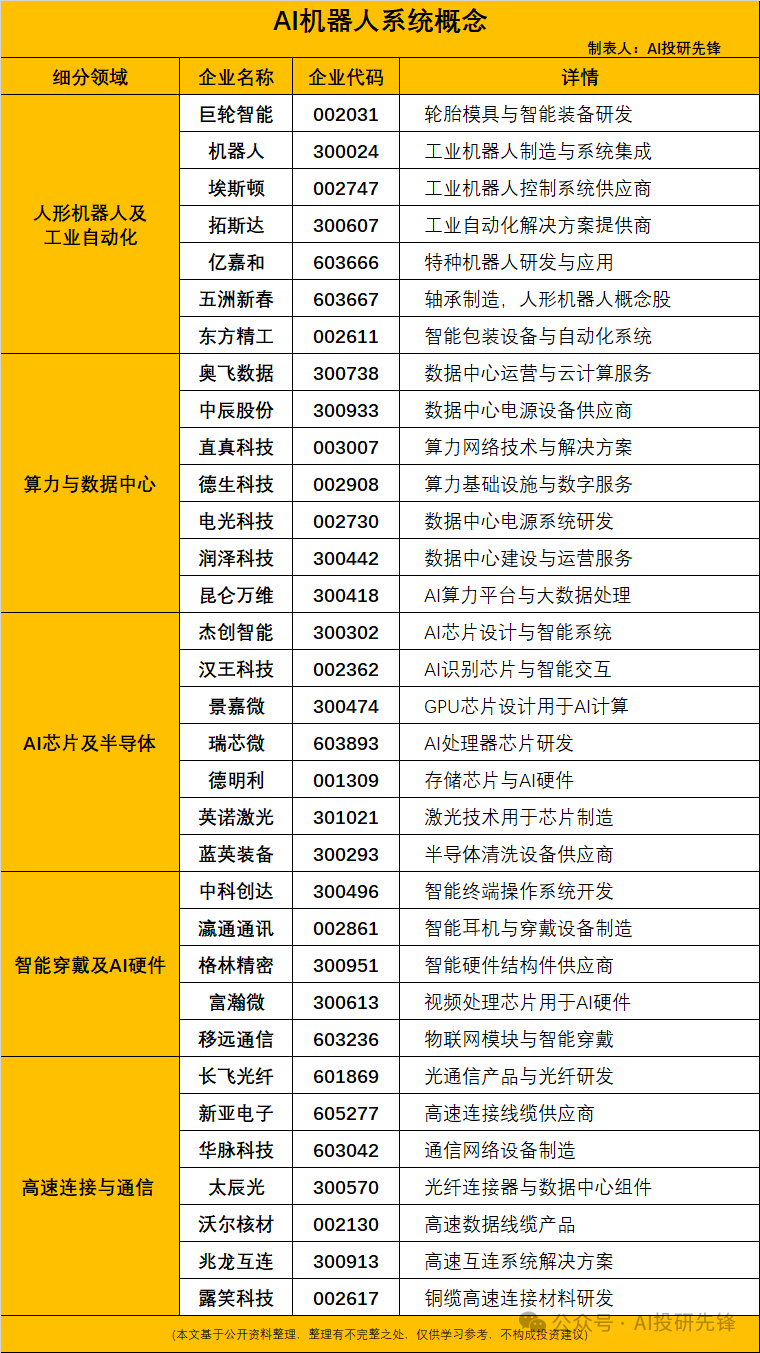
Core Targets of AI Robot Systems
Estun (002747)
Estun is a leader in industrial robot control systems, focusing on high-precision motion control algorithms, leading the market share in the automotive and electronics manufacturing sectors. Data shows that its products support Omniverse virtual training, shortening development cycles by over 30%, benefiting from the increased penetration of industrial robots. Future growth points lie in human-robot collaboration system integration, with a projected compound annual growth rate of over 20% as factories become more intelligent.
Robot (300024)
As a manufacturer of industrial robot bodies, the company provides comprehensive automation solutions, with technology covering high-precision scenarios such as assembly and welding. Data emphasizes its collaboration with NVIDIA on digital twin technology, enhancing virtual training efficiency and reducing real machine failure rates. Driven by AI, robot systems are expected to reshape production lines, and the company’s valuation benefits from the dividends of Industry 4.0 policies.
Topstar (300607)
Topstar focuses on comprehensive services for intelligent manufacturing, integrating industrial robots with AI vision systems to serve the consumer electronics and new energy industries. Multiple sources list it as a “Huawei robot partner,” optimizing algorithms through open-source frameworks to achieve a quality inspection accuracy of 99.9%. Its expansion potential lies in the implementation of 3D vision technology, driving a productivity increase of over 35% per capita.
Yijiahe (603666)
Yijiahe focuses on the research and development of special robots, such as power inspection and security robots, with strong environmental adaptability. Data indicates that its products are used in high-risk scenario virtual training, enhancing safety through AI reasoning algorithms. With the upgrade of smart cities and power grids, the company’s order volume is increasing by 30% annually, making it a benchmark for the intersection of “robots + AI” applications.
Julong Intelligent (002031)
The company specializes in tire molds and intelligent equipment, entering the humanoid robot reducer field to promote domestic alternatives. Data frequently refers to it as a “genuine robot concept stock,” with technological breakthroughs breaking foreign monopolies. In the future, it will benefit from the industrialization of humanoid robots, with cost advantages driving market share expansion.
Jingjia Micro (300474)
Jingjia Micro is a leader in domestic GPU chips, with products used for machine vision inference acceleration, supporting real-time processing of deep learning algorithms. Data emphasizes that its AI chips replace imports in industrial quality inspection, achieving an accuracy of 99.9%. Under the trend of computing power autonomy, the company’s growth relies on the expansion of the AI ecosystem, with chip iteration cycles shortened by 40%.
Rockchip (603893)
Rockchip develops AI processor chips, empowering edge computing devices such as industrial cameras and wearable hardware to achieve low-power visual analysis. Data lists it as a “core target for AI vision,” with algorithm optimization reducing development costs by 90%. Expansion potential lies in vehicle-mounted vision and robot collaboration, with chip demand exploding as smart manufacturing upgrades.
Aofei Data (300738)
Aofei Data provides data center services, supporting AI computing power networks, with business covering cloud computing and big data processing. Data shows that its computing power platform reduces AI model training costs, promoting the scaling of robot virtual training. As the AI revolution deepens, the company benefits from a surge in data traffic, with data center utilization exceeding 80%.
Friends, please give a thumbs up in the lower right corner【Like】【Looking】 to support, click on the business card below to follow and set it as a star⭐️, so you can receive notifications first and not miss important content!
Special statement: The above content does not constitute any investment advice, guidance, or commitment, and is for academic discussion only. The market has risks, and investment decisions should be based on rational independent thinking.
#AI #Robots #Robot Systems