I am Lao Wen, an embedded engineer who loves learning.Follow me to become even better together!In previous articles, we briefly introduced the basic information of the ATK-DLMP257B development board. You can click the link below to review the content of the last article.Why is the performance of STM32, familiar to embedded engineers, becoming increasingly powerful?For experienced embedded engineers, when they get a chip or a development board, they usually first gather information about the chip or board from various sources and then download the materials in a frenzy.The information for the ATK-DLMP257B development board has been fully presented in the original link, interested engineers can take it freely~However, for some engineers who are not very experienced, they often encounter a situation: after buying the development board and downloading the materials, they start to feel lost and confused, not knowing where to begin learning!To avoid this confusion, there is a document titled “Material Mind Map and Learning Path” in the root directory of the supporting materials for this development board. I believe this document is very important as it can inform engineers about the organizational framework of the materials and guide them on how to use the materials and read the documents.(Providing a learning path for the corresponding development board is a significant improvement in the realm of development board materials!)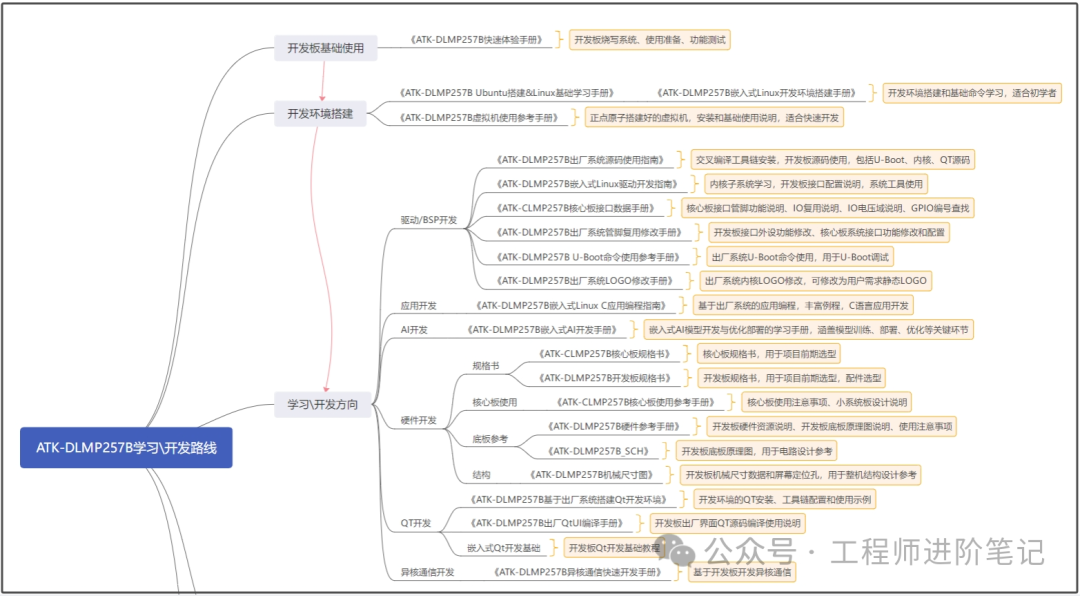 Development Board Learning Path (Part of it)According to the guidance of this learning path, every engineer who receives the development board can gradually master the board. Although the entire development learning process involves a lot of content, it is much better than aimlessly browsing through materials.No matter what type of development board (microcontroller, Linux, embedded AI), when we get specific hardware, we all want to power it on quickly and check whether the various functional interfaces of the development board are intact.When I received the ATK-DLMP257B development board, I did not immediately set up the environment and software programming, but first carefully read the “01 [Zhengdian Atom] ATK-DLMP257B Quick Experience Manual V1.1”, to understand the software and hardware situation of the development board and test various peripheral resources.
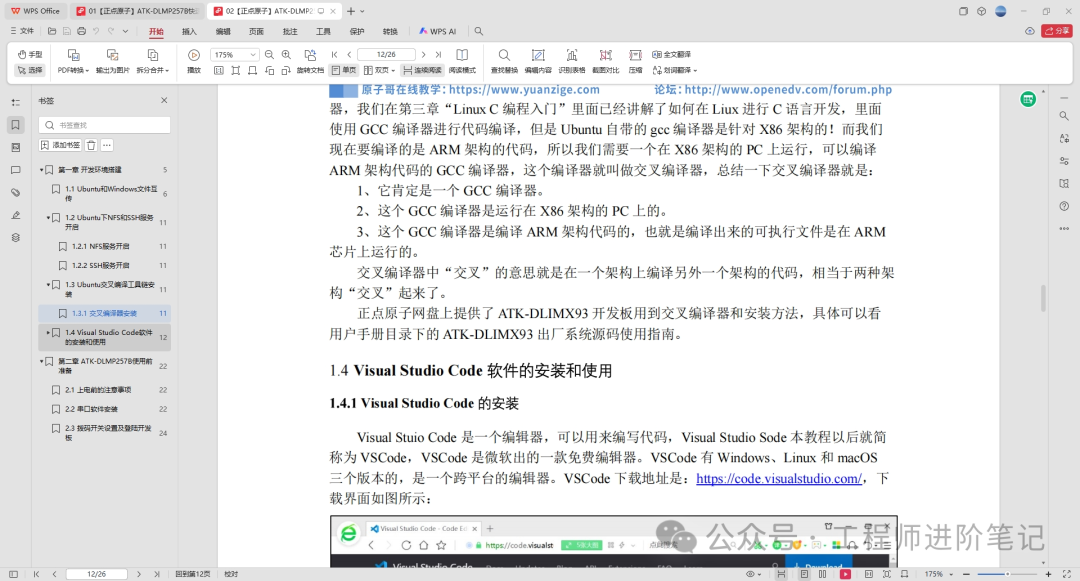
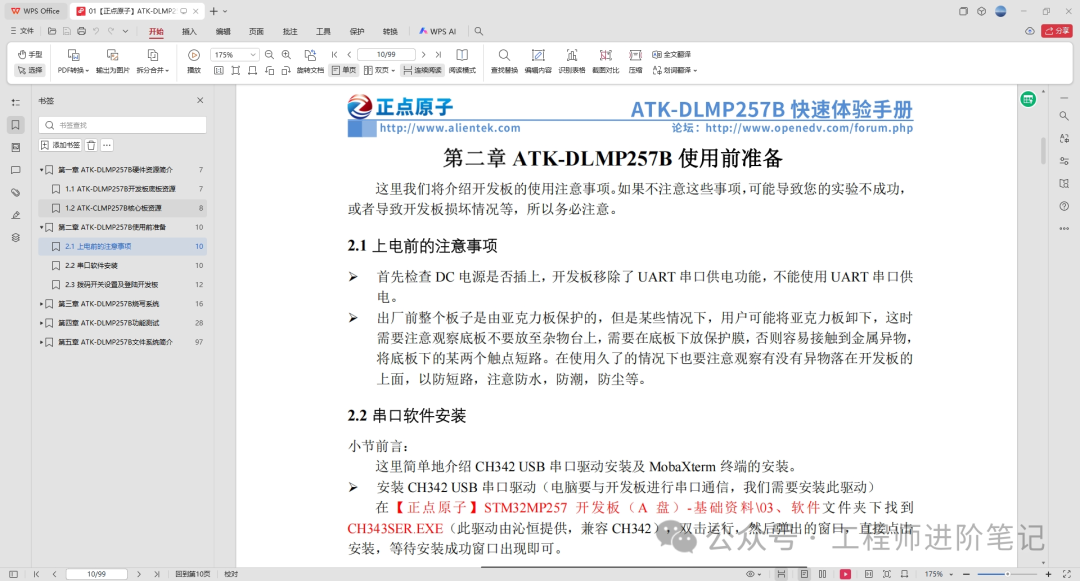 (Quick Experience Manual)After quickly experiencing the development board, the next step is to set up the development environment for the development board on the computer, as setting up the development environment is the primary task for both embedded Linux driver development and application development. You can directly refer to the following two documents, which contain very detailed steps.“01 [Zhengdian Atom] ATK-DLMP257B Ubuntu Setup & Linux Basic Learning Manual V1.0.pdf”“02 [Zhengdian Atom] ATK-DLMP257B Embedded Linux Development Environment Setup Manual V1.0.pdf”
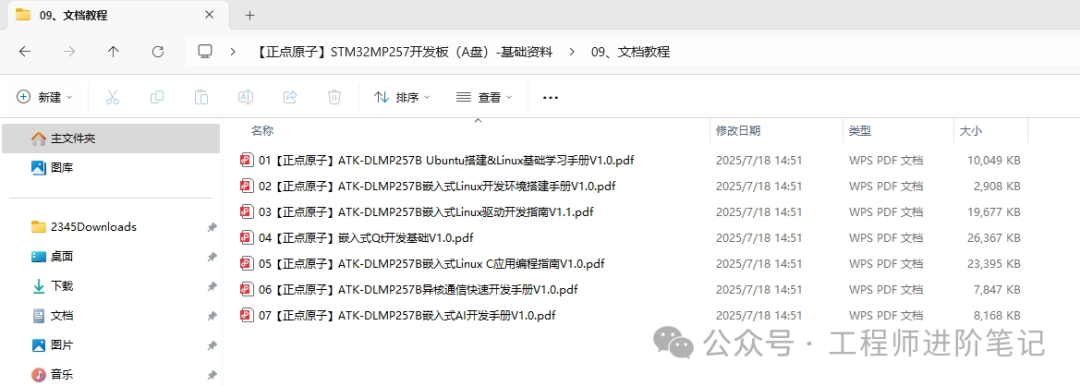
 In the “09, Document Tutorials” folder, there are tutorial manuals for Linux drivers, Qt applications, C application programming, heterogeneous core communication, and embedded AI. Developers can start learning whichever section they are interested in, or as the saying goes, kids make choices, adults want it all, so let’s learn everything!
 In the “10, User Manual” folder, there are mainly some documents from the development process. These documents are notes made by the Zhengdian Atom team during the development of the STM32MP257. Based on these documents, setting up the development environment is definitely not a problem!
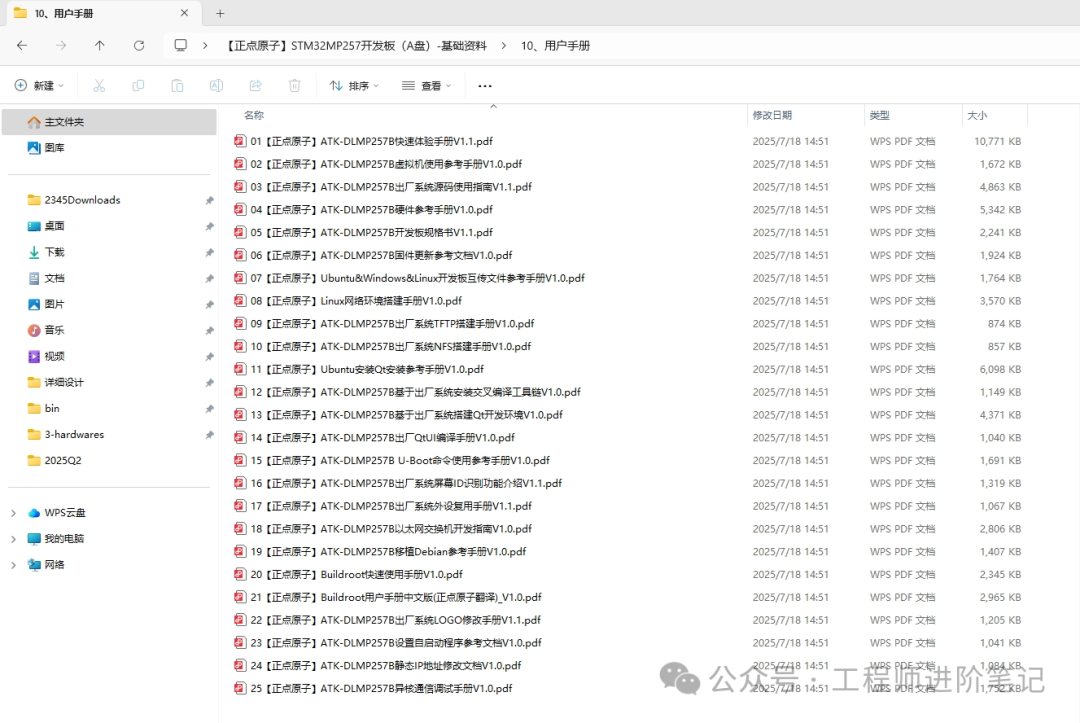 As many chips now support heterogeneous multi-core, I believe that for the high-performance MPU STM32MP257, both heterogeneous core communication and embedded AI can be studied in detail to understand how heterogeneous communication and artificial intelligence work within the ST ecosystem~
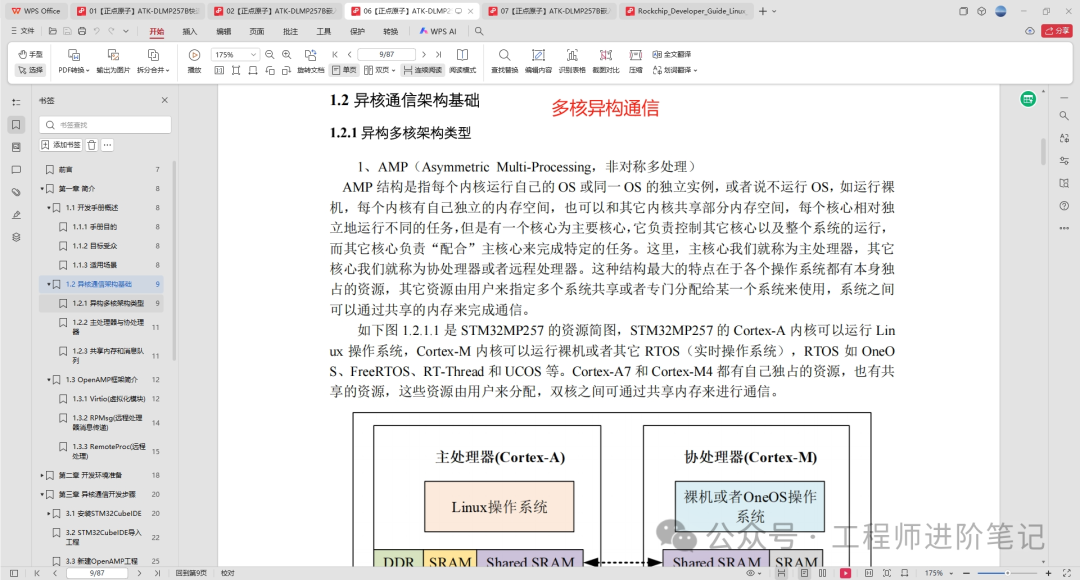 (Heterogeneous Core Communication Tutorial)The role of heterogeneous core communication is significant, as each processor core can run its own operating system and handle real-time or non-real-time tasks through shared memory or shared peripherals. Heterogeneous core communication has several key application scenarios:
(1) Multimedia Processing: In audio and video applications, the co-processor Cortex-M33 processes real-time signals and sends the results back to the main processor Cortex-A35 for subsequent operations.
(2) Industrial Automation: In automation systems, the main processor Cortex-A35 is responsible for high-level control and user interaction, while the co-processor Cortex-M33 executes real-time tasks such as sensor data collection and signal control.
(3) Edge Computing: In edge devices, the main processor Cortex-A35 handles high-level tasks, while the co-processor Cortex-M33 performs local machine learning inference or data filtering to reduce data transmission volume.
(4) IoT Applications: In IoT systems, heterogeneous core communication is used to achieve efficient data exchange and management between devices, enhancing overall system performance.
For embedded AI, most embedded engineers learn how to convert trained models into the model format specified by the chip and deploy them for inference on embedded devices.
(To be frank, model design, training parameter tuning, and algorithm design require a high level of education and hardware/software resources, making it relatively difficult for ordinary embedded engineers to access~)
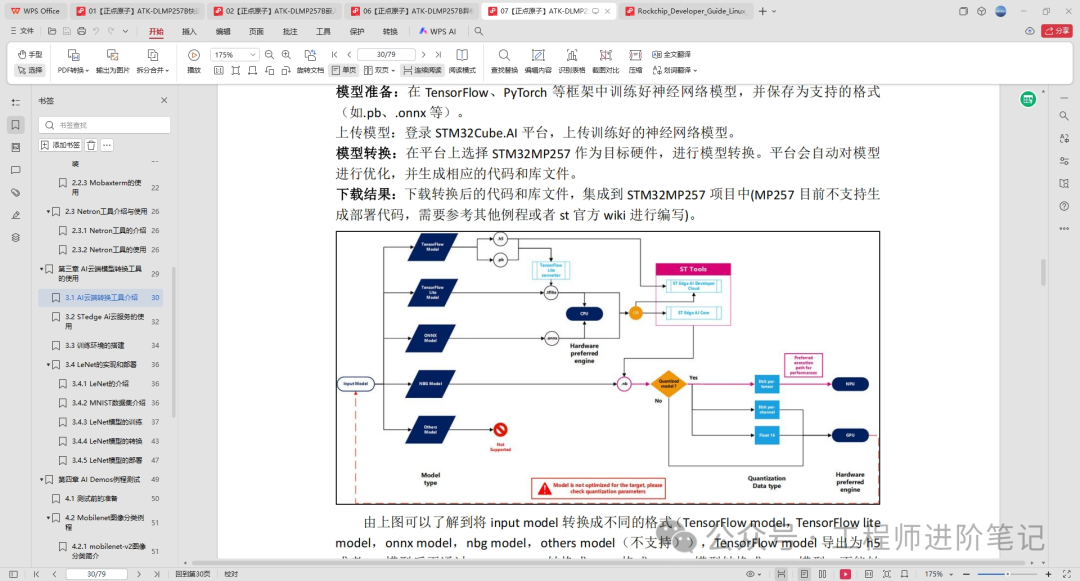 (Embedded AI Tutorial)
I have previously studied tutorials related to domestic embedded AI chips, and I feel that the overall development routine is quite similar. Basically, it involves setting up a Conda development environment, using the model conversion tools provided by the manufacturer for model conversion, model deployment, and programming development using APIs.
Embedded devices combined with AI technology are widely used in many business scenarios, such as:
In the field of industrial automation, AI devices can predict and maintain faults in industrial machines; in the field of smart healthcare, AI devices can analyze patients’ medical imaging data and physiological data. In the field of robotics, embedded AI enables robots to have good perception and decision-making capabilities, and so on.
The embedded AI tutorials that come with the development board provide several AI demos, including: Mobilenet image classification example, ssd-mobilenet object detection example, yolov8-pose human keypoint example, yolov8-person human detection example, yolov5 model object detection example, and deeplab image segmentation example.
These AI demos can serve as references for engineers who want to get started with embedded AI development. However, to deeply understand the implementation principles behind these AI models and optimize their parameters, it is certainly not something that can be described clearly in a day or two. Interested engineers can also expand their learning independently.
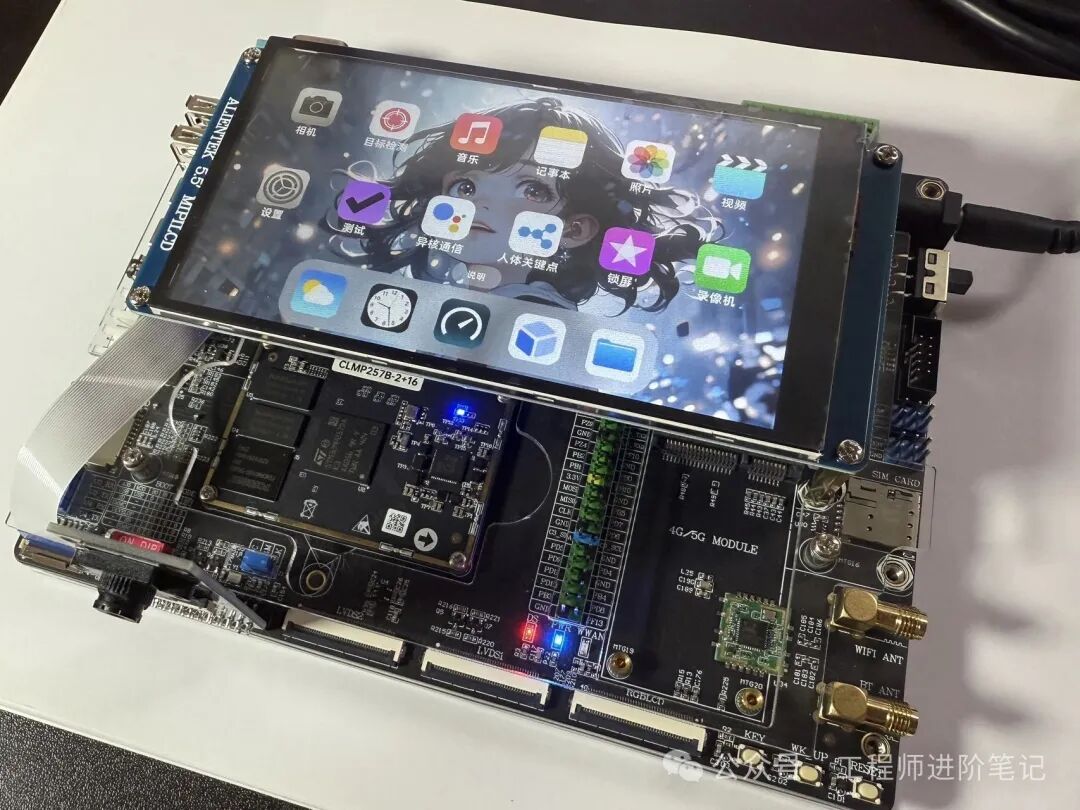
In summary, after analyzing the complete supporting materials, the ATK-DLMP257B development board has been designed with a lot of time and effort by the Zhengdian Atom team in terms of packaging accessories, appearance design, interface design, and supporting materials. I believe that during the learning process, the Q&A team will also provide strong support.
All materials for the development board have been fully opened, and interested embedded engineers can download them freely. Happy learning to everyone!
http://www.openedv.com/docs/boards/arm-linux/mp257.html
(Copy to the browser to open, or click [Read the original])
-END-
Previous Recommendations: Click the image to jump to read
Data communication and storage for embedded devices, some commonly used simple verification algorithms.
What methods can make embedded code run efficiently?
I deeply resonate! Most embedded development projects are dragged down by these factors!
I am Lao Wen, an embedded engineer who loves learning.Follow me to become even better together!