Multicore Real-Time Operating System RTEMS (14) – BSP Initialization

Technical experience sharing, welcome to follow and provide guidance. Before performing the boot_card initialization, the BSP hook is set up in advance. This article analyzes the code of bsp_start_hook_1. A. AArch64 Start Set Vector Base This writes the vector table to the exception vector table VBAR_EL1, with the variable bsp_start_vector_table_begin defined as follows: bsp_start_vector_table_begin: .balign … Read more


Automatic Hardware Behavior Triggered by Interrupts in ARMv8-A AArch64

Automatic Hardware Behavior Triggered by Interrupts in ARMv8-A AArch64

1. Automatic Hardware Behavior Triggered by Interrupts in ARMv8-A AArch64 1. Save PSTATE to SPSR_ELx; 2. Save return address to ELR_ELx; 3. Set PSTATE.{D,A,I,F} to 14; if it is a synchronous exception or SError, update the ESR_ELx exception characteristics register; 5. Jump to the exception vector table; 6. Select the target exception level's sp_elx

Master ARM Architecture from Beginner to Expert

Master ARM Architecture from Beginner to Expert

Purchase ARM Phase 3 today and receive: 999 RMB for ARM live broadcast replay 199 RMB for AArch64 Assembly Basics 99 RMB for ARM Architecture Basics – SoC Architecture Literacy 99 RMB for Feishu – ARM Column 1 Instructor Introduction Zhou Hehe Baron, with 12 years of experience in mobile security, automotive security, and chip … Read more

How ARMV8-AARCH64 Exceptions Jump to the Vector Table

How ARMV8-AARCH64 Exceptions Jump to the Vector Table

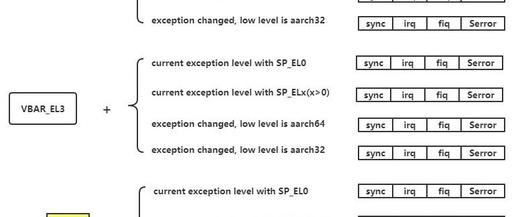
Click the blue "Arm Selected" in the upper left corner and choose "Set as Favorite" First, let’s look at a block diagram. After an interrupt occurs, the PC will jump to VBAR + interrupt offset. For example, the blue part in the diagram There are three base addresses: VBAR_EL1, VBAR_EL3, and VBAR_EL1 (secure). Which one … Read more

Introduction to SIMD/FP Instructions in ARMv8-Aarch64

Introduction to SIMD/FP Instructions in ARMv8-Aarch64

1. Hardware Floating-Point and Software Floating-Point In ARMv8, hardware floating-point is part of the architecture.AArch32 state supports software floating-point, but AArch64 state does not support software floating-point. ARM systems may have: A VFP coprocessor, which supports hardware floating-point. No floating-point hardware, meaning does not support hardware floating-point. If you compile for a system with a … Read more

Understanding the ARMv8-A Architecture

Understanding the ARMv8-A Architecture

Click the card below to follow Arm Technology Academy This article is selected from the Extreme Technology column “IC Design”, authorized to be reprinted from the WeChat public account Old Qin Talks Chips. This article will briefly study the Cortex-A series of the Armv8 architecture. In previous articles, Armv8-A has often been mentioned. So what … Read more

Understanding ARMv8-A Architecture

Understanding ARMv8-A Architecture

In previous articles, we often mentioned Armv8-A. So what exactly is Armv8-A? This question can be simple or complex. Today, let’s take some time to briefly study it. As we all know, ARM is a company that designs and licenses processors and corresponding IPs (such as interconnect buses, interrupt controllers, image processors, etc.). Currently, its … Read more

Quick Start Guide to Arm NEON Programming

Quick Start Guide to Arm NEON Programming

This article is reprinted from the Jishu Community Jishu Column: Open Source Software on Arm Infrastructure Author:yang 1 Introduction This article aims to introduce Arm NEON technology, hoping that NEON beginners can quickly get started with NEON programming after reading this article. This article will also provide readers with a document index containing more detailed … Read more

In-Depth Analysis of TiFlash: Compiler-Based Automatic Vectorization Acceleration

In-Depth Analysis of TiFlash: Compiler-Based Automatic Vectorization Acceleration

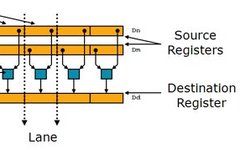
SIMD (Single Instruction Multiple Data) is a technology that uses a single controller to manage multiple processors, executing the same operation on each element of a set of data (also known as a “data vector”), thereby achieving spatial parallelism. It is an important means of program acceleration. This article will briefly introduce some basic knowledge … Read more