Vapor-Phase Living Assembly of π-Conjugated Organic Semiconductors
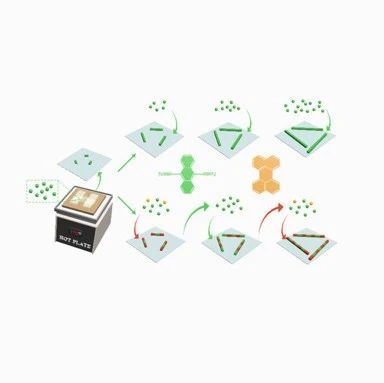
Vapor-Phase Living Assembly of π-Conjugated Organic Semiconductors

The superior light/electronic transport capabilities of organic micro-nano crystals show great application prospects in optoelectronic fields such as optical waveguides, optical logic gates, and p-n heterojunctions. However, there is still a lack of in-depth understanding and control over the complex dynamic assembly characteristics of organic molecules. In particular, achieving controlled preparation of π-conjugated molecular micro-nano … Read more
Harnessing Cross-Strand π−π Interlocking for Enhanced Immune Checkpoint Blocking and Ferroptosis

Harnessing Cross-Strand π−π Interlocking for Enhanced Immune Checkpoint Blocking and Ferroptosis

The dynamic characteristics of non-covalent bonds in peptide self-assembly can selectively accommodate guest molecules. However, how to utilize co-assembly to enhance the application defects of host peptides while improving guest molecules remains unclear. In this regard, Professors Wang Weizhi and Niu Guangle from Beijing Institute of Technology aim to realize the supramolecular synergy between the … Read more

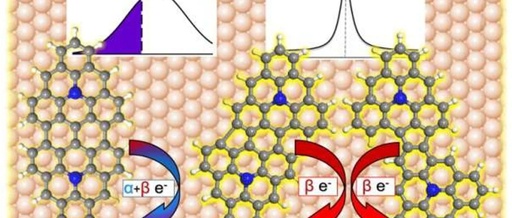
Emergence of π-Magnetism in Fused Aza-Triangulenes: Symmetry and Charge Transfer Effects

Emergence of π-Magnetism in Fused Aza-Triangulenes: Symmetry and Charge Transfer Effects

First Author:Jan Patrick Calupitan, Alejandro Berdonces-Layunta (Donostia International Physics Center, Spain) Corresponding Authors: Jan Patrick Calupitan, Dimas G. de Oteyza, Wang Tao (Donostia International Physics Center, Spain) Keywords: Nitrogen-doped triangulenes, molecular symmetry, Coulomb repulsion, π-magnetism, charge transfer, surface synthesis Original Link: https://pubs.acs.org/doi/epdf/10.1021/acs.nanolett.3c02586 Background Introduction Charge transfer between molecules and substrates is one of the core … Read more

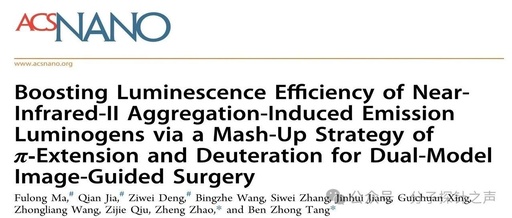
Enhancing Near-Infrared II Emission Efficiency Using π-Extension and Deuteration Strategies for Surgical Navigation

Enhancing Near-Infrared II Emission Efficiency Using π-Extension and Deuteration Strategies for Surgical Navigation

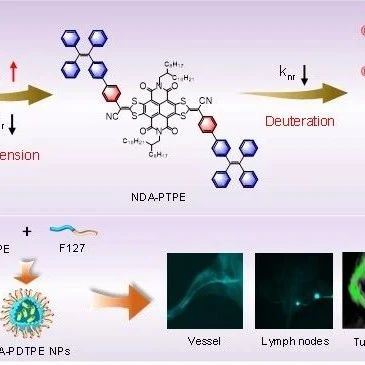
Abstract Simultaneous acceleration of radiative and restricted non-radiative decay is crucial for constructing fluorescent materials with high luminous efficiency in the near-infrared second window (NIR-II). This paper proposes a dual strategy of π-extension and deuteration to effectively address this challenging issue. By extending the π-conjugation of aromatic groups and introducing isotopic effects in the AIEgen, … Read more

Enhancing Fluorescence Efficiency and Reactive Oxygen Species Generation through Anion-π+ Interaction and Crowded Conformation

Enhancing Fluorescence Efficiency and Reactive Oxygen Species Generation through Anion-π+ Interaction and Crowded Conformation

Cancer is a terrifying public health threat with low survival rates and a global prevalence. Therefore, exploring effective diagnostic and therapeutic methods is crucial. Traditional cancer treatments, including surgery, radiotherapy, and chemotherapy, often prove to be limited in efficacy and significant in side effects. Fortunately, fluorescence imaging-guided photodynamic therapy (FLI-guided PDT) offers a non-invasive strategy … Read more

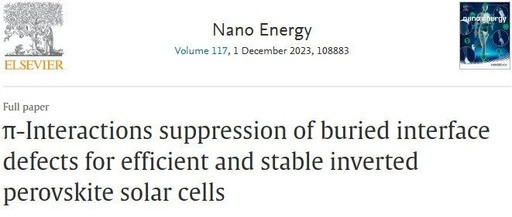
Suppressing Buried Interface Defects for Efficient and Stable Inverted Perovskite Solar Cells

Suppressing Buried Interface Defects for Efficient and Stable Inverted Perovskite Solar Cells

Poly(triarylamine) (PTAA) is typically used as a hole transport layer due to its suitable energy band alignment with the perovskite layer, but its poor permeability to perovskite precursors can easily lead to buried interface defects. In light of this, Professor Li Xuanhua from Northwestern Polytechnical University and colleagues published a paper in Nano Energy, titled … Read more

Enhancing NIR-II AIEgens for Efficient Dual-Modal Surgical Navigation

Enhancing NIR-II AIEgens for Efficient Dual-Modal Surgical Navigation

First Author:Dr. Ma Fulong, Dr. Jia Xi, Dr. Deng Ziwei Corresponding Authors:Professor Tang Banzhong; Professor Zhao Zheng Affiliation:The Chinese University of Hong Kong (Shenzhen), School of Science and Engineering Full Text Link:https://doi.org/10.1021/acsnano.3c11078 Keywords NIR-II; Aggregation-Induced Emission; Molecular Motion; Radiative and Non-Radiative Transitions; Surgical Navigation Research Background As an emerging diagnostic technology, fluorescence imaging offers advantages … Read more

Bright Near-Infrared π-Conjugated Oligomer Nanoparticles for Deep-Brain Three-Photon Microscopy Excited at the 1700 nm Window in Vivo

Bright Near-Infrared π-Conjugated Oligomer Nanoparticles for Deep-Brain Three-Photon Microscopy Excited at the 1700 nm Window in Vivo

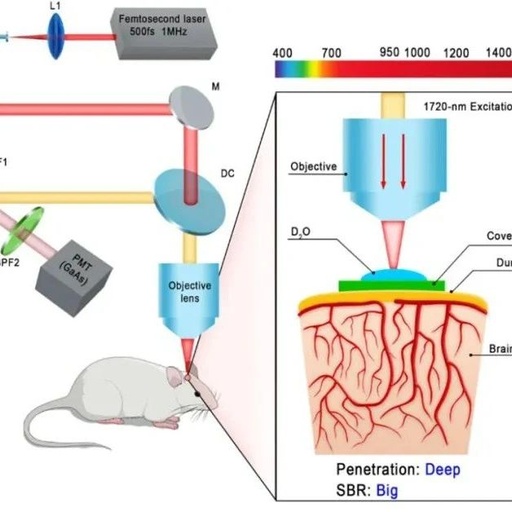
Developing a 1700 nm excited three-photon fluorescent group is significant for achieving in vivo imaging of deep brain tissues. Professor Li Shengliang from Soochow University, Professor Wang Ke from Shenzhen University, and Chun-Sing Lee from City University of Hong Kong designed and synthesized a fluorescent molecule (OFET) and used it for three-photon microscopy imaging of … Read more

Enhancing Luminescence Efficiency of NIR-II AIEgens for Dual-Model Image-Guided Surgery

Enhancing Luminescence Efficiency of NIR-II AIEgens for Dual-Model Image-Guided Surgery

Click the blue text to follow us As an emerging diagnostic technology, fluorescence imaging has attracted significant research interest due to its advantages such as high speed, high sensitivity, high spatiotemporal resolution, and no radiation. Compared to visible light (VIS) and near-infrared region I (NIR-I) imaging, near-infrared region II (NIR-II, 900-1700 nm) fluorescence imaging exhibits … Read more

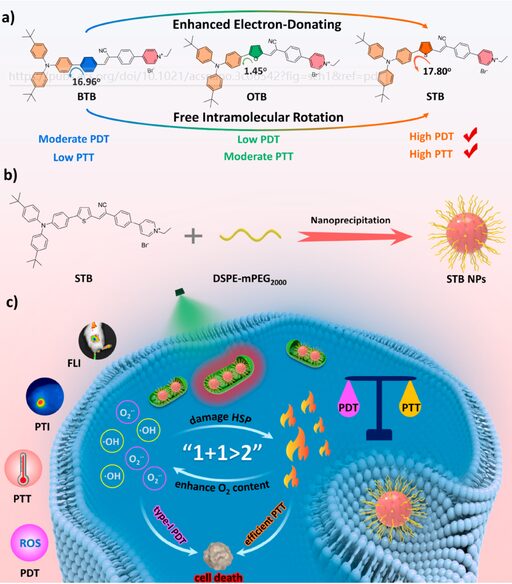
Enhanced Dual Modality Phototherapy for Tumor Mitochondria Targeting via π-Bridge Engineering

Enhanced Dual Modality Phototherapy for Tumor Mitochondria Targeting via π-Bridge Engineering

Click the blue text to follow us Phototherapeutic agents exhibit excellent performance in both Type I photodynamic therapy (PDT) and photothermal therapy (PTT); however, designing mitochondria-targeted phototherapeutic agents (PTAs) remains challenging. Feng Shouhua from Jilin University and Ma Pingan’s team from the Changchun Institute of Applied Chemistry, Chinese Academy of Sciences, proposed the development of … Read more