We know that typical IC components usually have only two power pins, one is Vcc or Vdd, and the other is Gnd or Vss. However, modern MCUs often have multiple power pins; what is the reason for this?
Taking a 100-pin MCU as an example, we can see that it has 5 sets of VDD/VSS, and it requires each set of VDD/VSS to be connected. In fact, these multiple VDD pins are internally connected together. If that is the case, why don’t chip manufacturers just leave one set? Or, if multiple sets are provided, can we connect only one set externally? If this is possible, it would save pins and reduce external wiring.
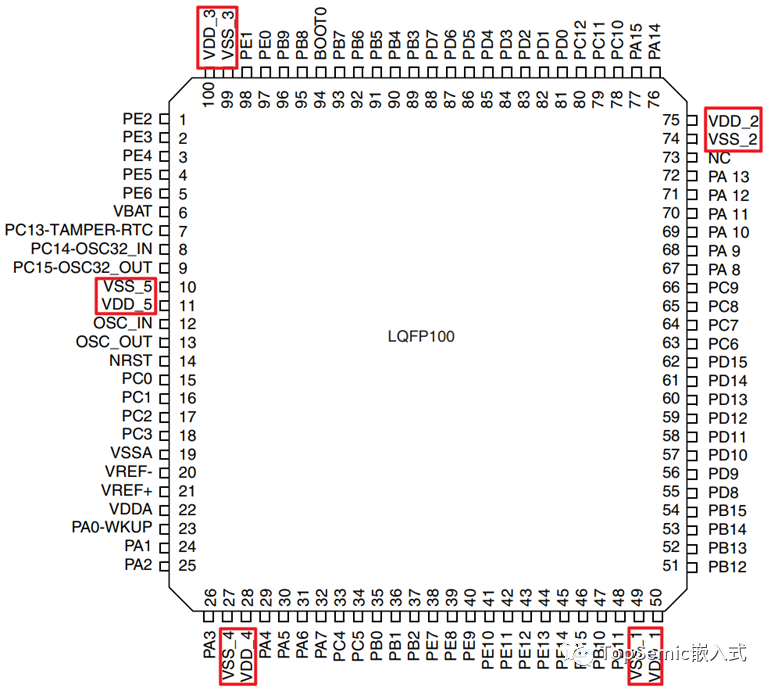
If only one set of VDD is connected externally, the current path inside the chip will be relatively long, as shown by the red lines in the diagram below.
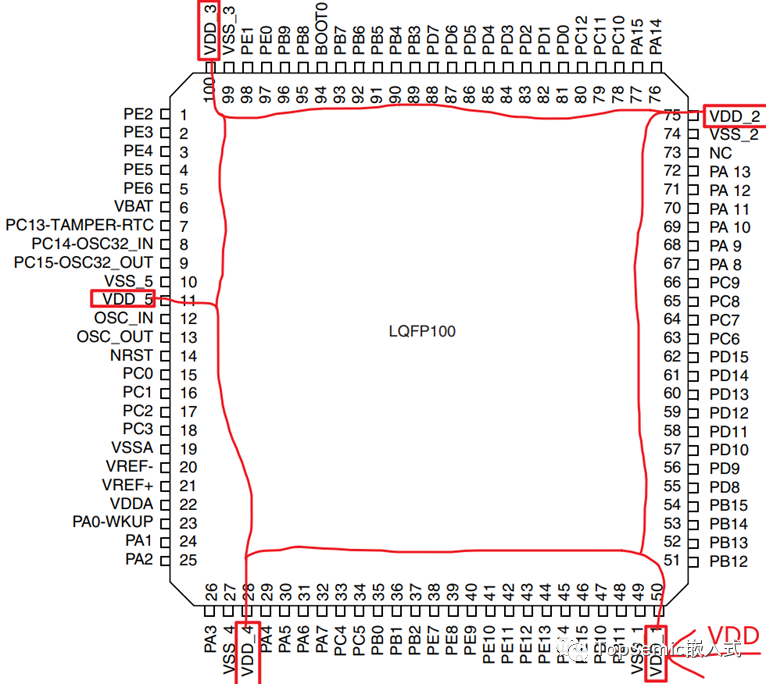
For high-frequency circuits, the VDD current will experience high-frequency transients (as the frequency increases, the required current also increases). At this time, the inductive reactance generated along the path will hinder the change in current; the longer the path, the greater the inductive reactance, thus the obstruction to current will be more pronounced, leading to voltage variations in the chip network, which can affect the normal operation of the MCU system. For low-frequency or DC circuits, the long path has little impact. Therefore, early low-frequency MCUs only had one VDD. Multiple VDD pins can reduce inductive effects (the total inductance decreases when inductors are connected in parallel, and shorter paths also reduce inductance).
We can imagine the power supply process of the above chip as the process of irrigating a field; having only one water inlet is certainly not as effective as having multiple inlets.
In addition, here are a few more points:
1) The analog peripherals of the MCU, such as ADCs, usually have a separate power supply, VDDA. This is because ADCs require as clean a power supply as possible to ensure the accuracy of conversion results, and a separate line can avoid interference from noise on other power supplies.
2) Multiple voltage requirements. Sometimes, different parts of the chip operate at different voltages. A typical example is a low-voltage core and high-voltage I/O. The core uses a lower voltage to reduce power consumption, while the I/O operates at a higher voltage to better connect with external circuits. In this case, multiple power supplies are also needed, commonly seen in complex SOC chips.
3) Compared to a single VDD, having multiple VDD pins reduces the current passing through each VDD pin, so the pins do not have to bear excessive current, enhancing reliability.
Scan the QR code below to join the MCU knowledge group.