In today’s thriving Internet of Things (IoT) landscape, various wireless communication technologies are flourishing. From the convenient short-range connections of Bluetooth to the high-speed network coverage of WiFi, and the remote communication capabilities of cellular networks, each technology plays a vital role in its respective domain. Behind the scenes of these technologies, there is a quietly working “invisible weaver”—ZigBee, which, with its unique charm, weaves a solid and efficient network for the development of the IoT. Today, let us step into the world of ZigBee and unveil its mysterious veil.
1. Origin of the Name
The name ZigBee is filled with inspiration from nature. When bees discover a patch of flowers, they communicate the location of the new food source to their companions through a special body language—the Z-shaped dance. The ZigBee Alliance adopted this as the name for this new generation of wireless communication technology, symbolizing its ability to transmit data efficiently between devices, just like bees convey information.
2. What is ZigBee?
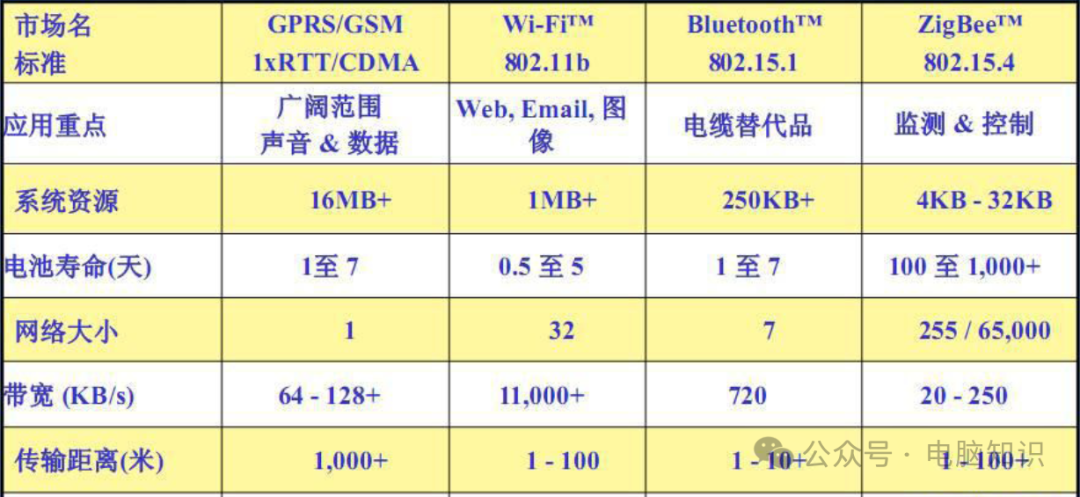
ZigBee is a bidirectional wireless communication technology developed based on the IEEE802.15.4 wireless standard, characterized by short-range, low power consumption, low data transmission rates, low complexity, and low cost. It acts like a “mini communication expert” designed specifically for the IoT, operating in three frequency bands: 2.4GHz (popular globally), 868MHz (popular in Europe), and 915MHz (popular in the USA). It is mainly used for data transmission between various electronic devices that require short distances, low power consumption, and moderate transmission rates, making it particularly suitable for applications with periodic, intermittent, and low response time data transmission. In simple terms, ZigBee is a wireless data transmission network platform composed of up to 65,535 wireless data transmission modules, where each ZigBee network module can communicate with one another, and the distance between network nodes can be extended infinitely from the standard 75m.
3. Features of ZigBee
1. Low Power Consumption: This is one of ZigBee’s most prominent features. Due to its low transmission rate and a transmission power of only 1mW, along with its sleep mode, ZigBee devices are very energy-efficient. It is estimated that ZigBee devices can operate for 6 months to 2 years on just two AA batteries, which is a significant advantage for devices that need to run for long periods without frequent battery replacements, such as sensors and door locks.
2. Low Cost: The initial cost of ZigBee modules is around $6, and with technological advancements, the cost is continuously decreasing, expected to soon drop to $1.5-$2.5. Additionally, the ZigBee protocol is royalty-free, significantly reducing its usage costs. The low cost makes ZigBee highly competitive for large-scale applications, positively promoting the proliferation of the IoT.
3. Short Latency: ZigBee performs exceptionally well in terms of both communication latency and wake-up latency from sleep mode. The typical device search latency is 30ms, wake-up latency is 15ms, and active device channel access latency is also 15ms. This extremely short latency makes ZigBee technology suitable for wireless control applications that require stringent latency requirements, such as industrial control scenarios.
4. Large Network Capacity: A star-structured ZigBee network can accommodate up to 254 slave devices and one master device, with a maximum of 100 ZigBee networks existing simultaneously in one area, and the network composition is very flexible. Moreover, through a mesh topology, ZigBee can theoretically support large-scale networking with up to 65,000 nodes, providing the possibility for constructing large-scale IoT systems.
5. Reliability: ZigBee employs a collision avoidance strategy and reserves dedicated time slots for communication services that require fixed bandwidth, avoiding competition and conflicts in data transmission. The MAC layer uses a fully acknowledged data transmission mode, where each sent data packet must wait for acknowledgment from the receiver. If issues arise during transmission, retransmission can occur, ensuring the reliability of data transmission.
6. Security: In terms of security, ZigBee provides a data packet integrity check function based on cyclic redundancy check (CRC), supports authentication and authorization, and employs AES-128 encryption. Each application can flexibly determine its security attributes based on its needs, effectively ensuring the secure transmission of data.
4. Composition of the ZigBee Protocol Stack
The complete ZigBee protocol stack consists of the application layer, application support layer, network layer, data link layer, and physical layer from top to bottom.
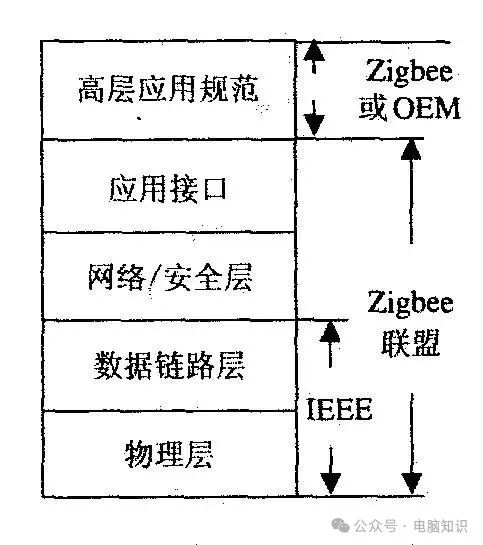
1. Physical Layer: As the lowest layer of the ZigBee protocol structure, it provides data interface services to the upper MAC layer and serves as a bridge for interaction with the physical world, responsible for handling the transmission and reception of radio frequency signals and other basic tasks.
2. MAC Layer: This layer is mainly responsible for establishing, maintaining, and terminating wireless data links between different devices, while also ensuring reliable data transmission at the link layer through acknowledgment of data sent and received.
3. Network/Security Layer: This layer ensures the transmission and integrity of data within the network and can encrypt data to prevent theft or tampering, ensuring the security of network communication.
4. Application/Support Layer: This layer enables effective communication between multiple devices based on design purposes and requirements, achieving various specific application functions.
5. Application Examples
ZigBee technology, with its unique advantages, has a wide range of applications across various fields.
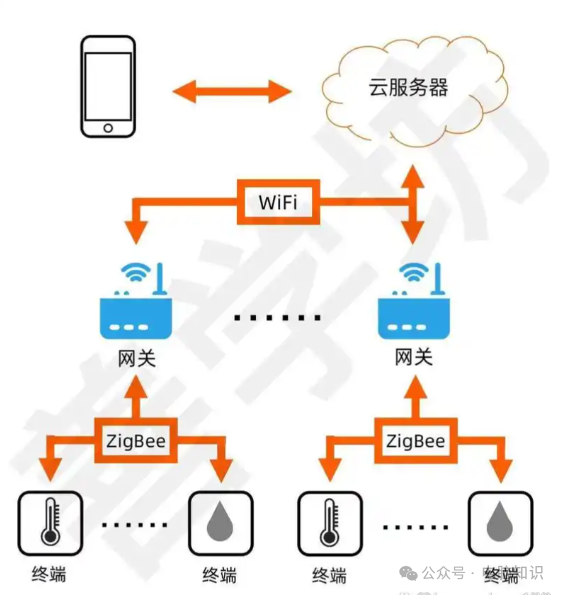
1. Smart Home: In the smart home sector, ZigBee shines. It enables interconnectivity between home devices, such as smart lighting, temperature control devices, and security systems, all connected through ZigBee technology. Users can easily control home appliances remotely and set automation through terminal devices like smartphones or smart speakers, greatly enhancing convenience and comfort in daily life. For example, on your way home from work, you can use your phone to turn on the air conditioning in advance and adjust it to a comfortable temperature; you can also remotely control smart locks to allow delivery personnel to safely place packages inside your home. In smart communities, ZigBee also plays a crucial role, connecting devices like smart locks and smart trash bins through the ZigBee protocol for more intelligent community management.
2. Industrial Automation: ZigBee technology also holds an indispensable position in industrial automation. It is widely used in sensor networks, wireless monitoring, warehouse management, automation control, and robotics. By utilizing ZigBee technology, factories can achieve efficient communication and automation control between devices, improving production efficiency, reducing operational costs, and enhancing product quality. For instance, in a large warehouse, ZigBee networks can monitor the storage location and quantity of goods in real-time, achieving intelligent warehouse management; on production lines, ZigBee sensors can collect operational data in real-time, providing a basis for equipment maintenance and optimization.
3. Agricultural IoT: In the agricultural sector, ZigBee technology provides strong support for modern agricultural management. By using ZigBee technology, environmental data such as soil moisture, temperature, and light intensity can be collected and transmitted in real-time to a control center, enabling remote automated operations for irrigation, fertilization, and temperature and humidity maintenance. This helps establish a modern agricultural management system, improving crop yield and quality. For example, in greenhouse cultivation, ZigBee sensors can monitor environmental data in real-time, automatically controlling ventilation and irrigation equipment to create the best growing environment for crops.
4. Medical Monitoring: In the medical field, ZigBee technology also plays a significant role. Through wireless devices, ZigBee can obtain real-time health status data from patients, such as heart rate, blood pressure, and body temperature, and send it to doctors or relatives, helping to detect health issues early and provide timely treatment. For example, some wearable medical devices use ZigBee technology to transmit patients’ health data in real-time to hospital monitoring systems, allowing doctors to stay updated on changes in patients’ conditions and provide timely medical services.
5. Environmental Monitoring: ZigBee technology can also be used in environmental monitoring to track indicators such as air quality, water quality, and soil conditions. By uploading collected data to servers via ZigBee networks, real-time monitoring and early warning of environmental conditions can be achieved. For instance, multiple ZigBee air quality monitoring nodes can be deployed in urban areas to monitor pollutant concentrations in the air, providing accurate data support for environmental protection departments to take timely measures to improve air quality.
6. Smart Cities: In the construction of smart cities, ZigBee technology is also a crucial component. In urban traffic systems, logistics management, and automated smart homes, ZigBee technology can enable various functions such as public sector coordination, resource integration, environmental monitoring, and travel services, thereby enhancing the quality of life and competitiveness of cities. For example, in urban traffic, ZigBee technology can achieve coordinated control of smart traffic lights, optimizing traffic flow and reducing congestion; in logistics management, ZigBee technology can be used to track the transportation status of goods in real-time, improving logistics efficiency.
7. Warehouse Logistics: The security, reliability, and multi-path routing features of ZigBee technology make it particularly suitable for warehouse and logistics systems. It can be used for on-site vehicle scheduling, constructing network structures for warehouse logistics, and optimizing information transmission paths. For instance, in large warehouses, ZigBee networks can achieve real-time scheduling of transport equipment like forklifts, improving the operational efficiency of warehouse logistics.
8. Other Fields: In addition to the above fields, ZigBee technology can also be applied in automotive, road signage, and safety walking applications. For example, using ZigBee technology in tire pressure monitoring systems can extend the battery life of built-in wireless communication devices and overcome the shielding effects of noisy environments and metal structures on electromagnetic waves.
6. Disadvantages of ZigBee
Although ZigBee technology has many advantages, it is not without its flaws.
1. Limited Bandwidth: Due to ZigBee’s low communication rate, its bandwidth is limited, making it unsuitable for applications requiring high-speed data transmission. For example, in scenarios like video surveillance that involve large data transfers, ZigBee’s rate may not meet the requirements. In high-definition video monitoring, the massive amount of video data can lead to stuttering, delays, or even failure to transmit properly due to ZigBee’s low speed.
2. Poor Signal Penetration: ZigBee technology uses low-power short-range transmission, resulting in relatively poor signal penetration. If there are obstacles or the transmission distance is too far, communication quality may decline or the signal may be interrupted. For instance, within a building, if ZigBee devices are separated by multiple walls, the signal will be significantly affected, potentially leading to communication failures.
3. Susceptibility to Interference: Since ZigBee operates in the 2.4GHz band, it may encounter interference issues with some household appliances. For example, sharing the frequency band with WiFi can lead to interference, necessitating appropriate interference suppression measures. In a home environment, if ZigBee devices and WiFi devices are used simultaneously, mutual interference may occur, affecting the normal operation of the devices.
4. Network Scale Limitations: Although ZigBee network topologies can support hundreds of devices, there are limitations to network scale. As the network size increases, network management and communication load will rise, potentially leading to decreased network performance. When too many devices are connected to a ZigBee network, the network’s response speed may slow down, and data transmission delays may increase.
5. Limited Availability of Devices: Although ZigBee technology has developed widely in the smart home sector, the number of available and selectable devices is relatively limited compared to other wireless communication technologies. This may restrict users’ choices and, to some extent, affect its popularity.
7. Conclusion and Outlook
ZigBee technology occupies an important position in the IoT field due to its significant advantages such as low power consumption, low cost, and self-organizing networks. It acts like a universal key, unlocking the door to intelligent development across various fields. However, we must also recognize its disadvantages. In practical applications, we need to comprehensively consider the pros and cons of ZigBee technology based on specific needs and scenarios, making reasonable choices and applications of this technology.
As IoT technology continues to develop and proliferate, ZigBee technology is also evolving and improving. In the future, we have reason to believe that ZigBee technology will play an even more important role in more fields, bringing greater convenience and innovation to our lives and society. Let us look forward to ZigBee technology shining even brighter on the stage of the IoT!