It’s not difficult at all; a good paper will make you soar. I will use many examples to help you understand it instantly, so don’t be afraid!
Here’s a tip:
You can skip the parts you don’t want to read, take what you need, and finishing reading is more important than understanding everything.
If you want to see future updates, remember to mark this account as a star; otherwise, it might be goodbye.
This paper, “LoRA: Low-Rank Adaptation of Large Language Models,” is one of the most influential papers in the field of large models in recent years, proposing a very efficient fine-tuning method. The core idea of this method is to adapt pre-trained models through low-rank matrix decomposition instead of updating all parameters.
Paper link: https://arxiv.org/abs/2106.09685
I will combine professional interpretations with simple analogies to ensure you can understand both the core ideas and the technical details.
Let’s get started.
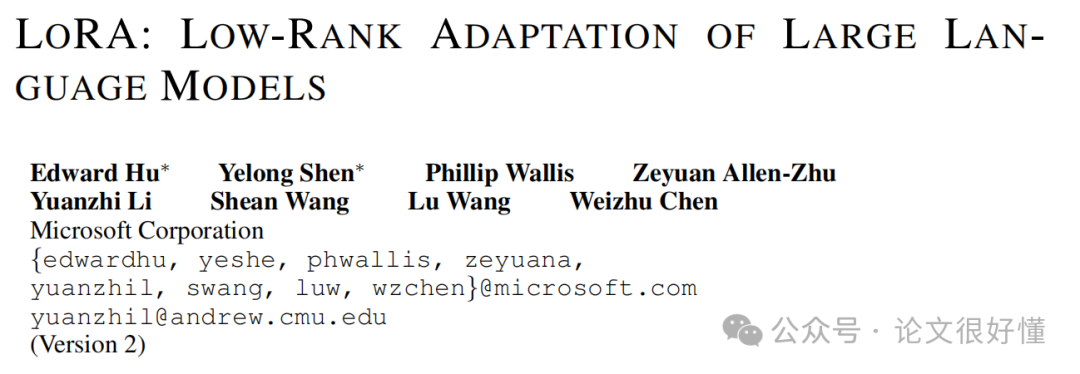
Paper Title and Authors
LORA: LOW-RANK ADAPTATION OF LARGE LANGUAGE MODELS (LoRA: Low-Rank Adaptation of Large Language Models)
- • Author Team: Researchers from Microsoft Corporation and Carnegie Mellon University (CMU).
Interpretation: The title directly points out three core concepts:
- 1. Large Language Models (LLMs): These are our research subjects, such as GPT-3, RoBERTa, etc., which have billions or even hundreds of billions of parameters.
- 2. Adaptation: Refers to making a pre-trained general model “adapt” to a specific downstream task, such as sentiment analysis, article summarization, code generation, etc. This process is usually called “fine-tuning.”
- 3. Low-Rank: This is the core technology proposed in this paper. Don’t worry about this mathematical term; we will explain it with very vivid analogies later. You can temporarily understand it as a method of “highly compressed” or “focusing on the essentials.”
Abstract
An important paradigm of natural language processing consists of large-scale pre-training on general domain data and adaptation to particular tasks or domains. As we pre-train larger models, full fine-tuning, which retrains all model parameters, becomes less feasible.
Professional Interpretation: This describes the current “paradigm” in the NLP field, which is “pre-training + fine-tuning.”
- • Step 1: Pre-training. It’s like teaching a child to read all the books in a library, giving them a comprehensive and foundational understanding of world languages and knowledge. This process is very resource-intensive, resulting in “generalist” models like GPT-3.
- • Step 2: Fine-tuning. If you want this “generalist” model to become a “specialist,” for example, to write poetry, you need to provide it with some poetry data and adjust all its internal parameters (knowledge) to adapt to this new task. This process is called “full fine-tuning.”
Here comes the problem: For a massive model like GPT-3 with 175 billion parameters, adjusting all 175 billion parameters for a new task is too costly.
Simple Analogy: Imagine you have a Michelin three-star chef (the pre-trained large model) who is proficient in all cuisines.
- • Full Fine-tuning: Now you want him to “customize” a Sichuan dish. You would have to adjust all his cooking skills and recipe memories (175 billion parameters) to turn him into a Sichuan cuisine expert. If tomorrow you want him to cook Cantonese cuisine, you would need to clone him again and adjust everything to make him a Cantonese cuisine expert. Keeping a complete, adjusted “chef copy” for each cuisine takes up too much space (storage) and costs too much (training costs).
We propose Low-Rank Adaptation, or LoRA, which freezes the pre-trained model weights and injects trainable rank decomposition matrices into each layer of the Transformer architecture, greatly reducing the number of trainable parameters…
Professional Interpretation: Here comes the core idea of the LoRA method:
- 1. Freezing the pre-trained model weights: We no longer adjust those 175 billion base parameters.
- 2. Injecting trainable low-rank matrices: Next to each layer of the model, we add two small, trainable “bypass” matrices. We only train these small matrices.
Simple Analogy: We no longer modify the entire brain of the Michelin chef (freezing). Instead, we stick a small “sticky note” (LoRA module) on him.
- • This sticky note says: “When making Sichuan dishes, remember: add more chili, less sugar.”
- • We only modify the content on this sticky note (train LoRA parameters), while the chef’s core skills remain unchanged.
- • Want to cook Cantonese cuisine? Just change the sticky note: “When making Cantonese dishes, remember: focus on freshness, control the heat.”
- • These “sticky notes” are very small, and the cost of making and switching them is extremely low.
Compared to GPT-3 175B fine-tuned with Adam, LoRA can reduce the number of trainable parameters by 10,000 times and the GPU memory requirement by 3 times.
Professional Interpretation: Here is a quantitative demonstration of LoRA’s effectiveness:
- • Reduction of trainable parameters by 10,000 times: For example, if you originally needed to train 175 billion parameters, now you might only need to train 17.5 million (or even less), a drastic reduction in scale.
- • Reduction of GPU memory requirements by 3 times: Since most parameters are frozen, we do not need to compute gradients for them or store optimizer states (like momentum and variance for the Adam optimizer), significantly lowering the hardware threshold.
Simple Analogy: Previously, to learn a new dish, the chef needed a huge kitchen and a full set of new kitchenware (high memory). Now, he only needs a small piece of paper and a pen (low memory) to grasp the key points of the new recipe.
LoRA performs on-par or better than fine-tuning… despite having fewer trainable parameters… and, unlike adapters, no additional inference latency.
Professional Interpretation: LoRA is not only efficient but also effective, with additional benefits:
- • Performance comparable or better: In many tasks, its performance is on par with full fine-tuning.
- • No additional inference latency: This is a significant advantage of LoRA over earlier efficient fine-tuning methods (like Adapter). During deployment, LoRA’s small matrices can be “merged” back into the original large matrix, so the model’s structure and computational load remain the same as before fine-tuning, without adding extra computational steps.
Simple Analogy:
- • Adapter method: It’s like adding an extra cooking step for the chef: “Before serving, please check the instructions on this small card.” This “checking” action itself takes extra time.
- • LoRA method: The chef has already internalized the content of the sticky note before officially starting, directly modifying a step in the original recipe (for example, changing “5 grams of sugar” to “15 grams of chili”). So when he actually cooks, he follows the original process without any extra steps, resulting in no delay.
Sections 1-3: Introduction & Problem Statement
These sections elaborate on the background and issues mentioned in the abstract.
The major downside of fine-tuning is that the new model contains as many parameters as in the original model… a critical deployment challenge for GPT-3… with 175 billion trainable parameters.
Interpretation: This reiterates the “storage and deployment” nightmare of full fine-tuning. If you have 100 different tasks, you need to store 100 model files, each several hundred GB in size.
We hypothesize that the change in weights during model adaptation also has a low “intrinsic rank”…
Core Hypothesis: This is the theoretical foundation of LoRA. It posits that the “change amount” (ΔW) of the weights of a pre-trained large model to adapt to a new task is inherently “low-rank.”
Professional Interpretation: The “rank” of a matrix can be understood as the complexity or core dimensions of the “information” it contains. If a matrix is “low-rank,” it means it can be represented with less information, or that there is a lot of linear correlation between its rows/columns. LoRA’s hypothesis is that the parameter changes ΔW during model fine-tuning do not need to be that complex; they can be represented in a simpler form.
Simple Analogy: Again, think of our chef. To go from a “generalist chef” to a “Sichuan cuisine expert,” the “changes” (ΔW) he needs to make are actually very simple and can be summarized in a few core points:
- 1. Increase the use of spiciness.
- 2. Increase the use of numbing flavor.
- 3. Decrease the use of sweetness. … There may only be a few core principles. The “intrinsic rank” of this “change” is very low. We don’t need to teach him how to chop vegetables or stir-fry; we just need to tell him these key “adjustment directions.” LoRA aims to find and only learn these key “adjustment directions.”
Adapter Layers Introduce Inference Latency… large neural networks rely on hardware parallelism to keep the latency low, and adapter layers have to be processed sequentially.
Interpretation: This explains why the Adapter method increases latency. On modern GPUs, large matrix operations can be processed in parallel, which is very fast. However, Adapters are “small modules” inserted between the original layers, disrupting this parallelism and creating a “serial” bottleneck. Even if the computation itself is small, this “wait-process-wait” pattern slows down overall speed, especially in online services where the batch size is 1.
Section 4: Our Method
This is the core technical part of the paper.
It’s a bit challenging; I have a complete set of analogies later, so you can skip this professional interpretation.
For a pre-trained weight matrix W₀ ∈ Rᵈˣᵏ, we constrain its update by representing the latter with a low-rank decomposition W₀ + ΔW = W₀ + BA, where B ∈ Rᵈˣʳ, A ∈ Rʳˣᵏ, and the rank r ≪ min(d, k).
Professional Interpretation: This is where the mathematical magic of LoRA lies.
- • W₀: The original, frozen weight matrix (for example, a large 1000×1000 matrix).
- • ΔW: The “change amount” we want to learn, which is the same size as W₀.
- • LoRA’s approach: We do not directly learn ΔW. Instead, we approximate it using the product of two much smaller matrices B (size d x r) and A (size r x k). Here,
<span>r</span>is the “rank,” a very small number (like 2, 4, 8). - • Parameter Comparison:
- • Directly learning ΔW requires
<span>d * k</span>parameters. - • Learning B and A only requires
<span>d * r + r * k</span>=<span>r * (d + k)</span>parameters. - • Since
<span>r</span>is very small,<span>r * (d + k)</span>is far less than<span>d * k</span>.
During training, W₀ is frozen… while A and B contain trainable parameters… our modified forward pass yields: h = W₀x + ΔWx = W₀x + BAx
Interpretation:
- • During training: The input
<span>x</span>splits into two paths. One goes through the original W₀ path, and the other goes through the new B -> A bypass. Then the two results are added together. Gradients only propagate through B and A; W₀ is completely uninvolved. - • During inference: We can pre-compute
<span>W' = W₀ + BA</span>. Thus,<span>W'</span>becomes a new matrix of the same size as W₀. During inference, we compute<span>h = W'x</span>, just like the original model, so there is no delay.
No Additional Inference Latency. When deployed in production, we can explicitly compute and store W = W₀ + BA and perform inference as usual.
Interpretation: This emphasizes the significant advantage of LoRA’s “train first, merge later, seamless integration”. This is also a key reason why it is more popular than many other efficient fine-tuning methods.
Complete Analogy
Imagine a world-class Michelin three-star chef.
- • Pre-trained model (W₀): This is a thick, comprehensive “Cooking Bible” that the chef has compiled over a lifetime, containing 10,000 core cooking techniques and ingredient pairing principles (this is the model’s weights
<span>W₀</span>). This book is his foundation, sacred and inviolable; we will never modify a single word in this book (<span>W₀</span><code><span> is </span><strong><span>frozen</span></strong><span>).</span> - • Downstream Task: A discerning customer proposes a completely new, unprecedented request: “I want a dish of ‘Deep Sea Bluefin Tuna with Dried Tangerine Peel Flavored Sichuan Sauce.'”
- • Full Fine-tuning: This is equivalent to asking the chef to rewrite the entire “Cooking Bible” for this new dish. He needs to review and modify all 10,000 principles to ensure the new dish’s style integrates into his entire cooking system. This is extremely costly, and for the next new dish, he would have to rewrite it again. This is clearly unrealistic.
LoRA’s Insight: What Changes Are Truly Needed?
After some thought, the chef realizes that to create this new dish, he does not need to overturn his cooking philosophy. He only needs to make some small, directional adjustments. The essence of this “adjustment” (<span>intrinsic rank</span>) is actually very simple.
This “adjustment plan” (<span>ΔW</span>) would be a huge list detailing how to modify 10,000 techniques. But LoRA believes it’s unnecessary to do so. We can break it down into two extremely simple parts:
<span>ΔW = B * A</span>
Let’s thoroughly understand B and A:
1. Matrix B: Defining “New Flavors” (What to change)
Matrix <span>B</span> is a very brief “New Flavor Inspiration Card.” It is very “tall and thin,” defining the core new elements needed for this innovation.
For this new dish, the chef’s inspiration card might only have <span>r=2</span> new flavors:
- 1. Flavor Element #1: “Citrus Aroma of Dried Tangerine Peel”
- 2. Flavor Element #2: “Spicy Layers of Sichuan Sauce”
This card (matrix <span>B</span>) precisely defines the “flavor vectors” of these two flavors in mathematical terms. Here, <span>r=2</span> is the rank, representing that the core dimensions of this innovation are only two.
2. Matrix A: Writing “Usage Instructions” (How to change)
Matrix <span>A</span> is a similarly brief “New and Old Fusion Manual.” It is very “short and stout,” telling the chef how to apply the flavors from the “New Flavor Inspiration Card” to his original 10,000 cooking techniques.
The instructions are as follows:
- • Usage instructions for “Citrus Aroma”:
- • When using the 3rd technique “Fish Meat Aging,” add
<span>0.8</span>portions of citrus aroma. - • When using the 125th technique “Sauce Emulsification,” add
<span>1.2</span>portions of citrus aroma. - • When using the 5000th technique “High-Temperature Grilling,” add
<span>0.1</span>portions of citrus aroma. - • … For other unrelated techniques, add
<span>0</span>portions. - • Usage instructions for “Sichuan Spiciness”:
- • When using the 3rd technique “Fish Meat Aging,” add
<span>0</span>portions. - • When using the 125th technique “Sauce Emulsification,” add
<span>1.5</span>portions of Sichuan spiciness. - • …
Look! We did not directly write the complete modification plan for those 10,000 techniques (<span>ΔW</span>). We only wrote a card containing 2 new flavors (<span>B</span>) and a manual on how to use these 2 flavors (<span>A</span>). Learning these two small pieces of paper is far simpler than rewriting the entire “Cooking Bible.”
LoRA’s Workflow: Training and Serving
a) During Training: The Chef’s Experimental Kitchen (Parallel Computing)
When the chef is developing this dish in the kitchen (training process):
- 1. Main Path: He strictly follows the original method in the “Cooking Bible” (
<span>W₀</span>) to create a basic version of the dish. - 2. Bypass Path: At the same time, he takes out the “Inspiration Card (
<span>B</span>)” and “Manual (<span>A</span>)” to make real-time, additional adjustments. - 3. Fusion: The final product served to the customer is the “basic dish + additional adjustments” (
<span>h = W₀x + BAx</span>).
After the customer tastes it and provides feedback (calculating loss), the chef will only modify the content on the “Inspiration Card (<span>B</span>)” and “Manual (<span>A</span>)”, while the “Cooking Bible” (<span>W₀</span>) remains untouched on the shelf. This greatly reduces his mental effort (computational resources) and the amount of draft paper he needs to record (memory).
b) During Serving: Writing into the Official Menu (Merging and Deployment)
When the dish development is complete, and the flavor is perfect, to add it to the restaurant’s official menu (inference deployment):
- 1. “Internalizing the Secret Recipe”: The chef no longer needs to refer to two documents (Bible + small card) every time. He will spend an afternoon permanently updating the final content from the “Inspiration Card” and “Manual” into his mind’s “Cooking Bible,” forming a new, unified version (
<span>W' = W₀ + BA</span>).
- • For example, he will directly update the “Sauce Emulsification” technique to “Sauce Emulsification (Dried Tangerine Peel Sichuan Version)” in his cooking system.
<span>W'</span>) to prepare it. The entire process flows smoothly, just like making any old dish, with no additional steps for checking or thinking.This is the essence of LoRA’s “no additional inference latency”: during customer service, it is no longer a “patch” but has become an integral part of the system.
Summary:
- • The essence of LoRA: It does not modify the vast original knowledge base (
<span>W₀</span>), but learns a minimal “adjustment plan.” - •
<span>ΔW = BA</span>intuitive understanding: - •
<span>B</span>is “what to change” (What) -> proposing a few core new concepts. - •
<span>A</span>is “how to change” (How) -> explaining how to apply new concepts to the old system. - • LoRA’s dual advantages:
- • Lightweight during training: Only learning B and A is as simple as writing two sticky notes.
- • Seamless during inference: The effects of B and A are “baked” into the original model without leaving any additional computational traces.
Sections 5 & 7: Empirical Experiments & Understanding Low-Rank Updates
This section verifies the effectiveness of LoRA through extensive experimental data and attempts to explain why it succeeds.
Key Experimental Conclusions:
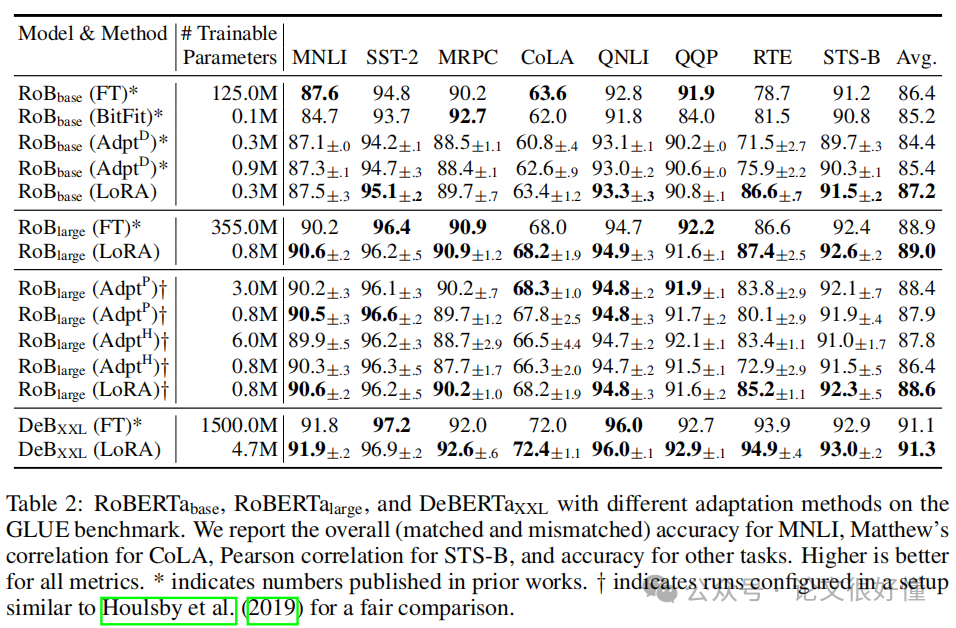
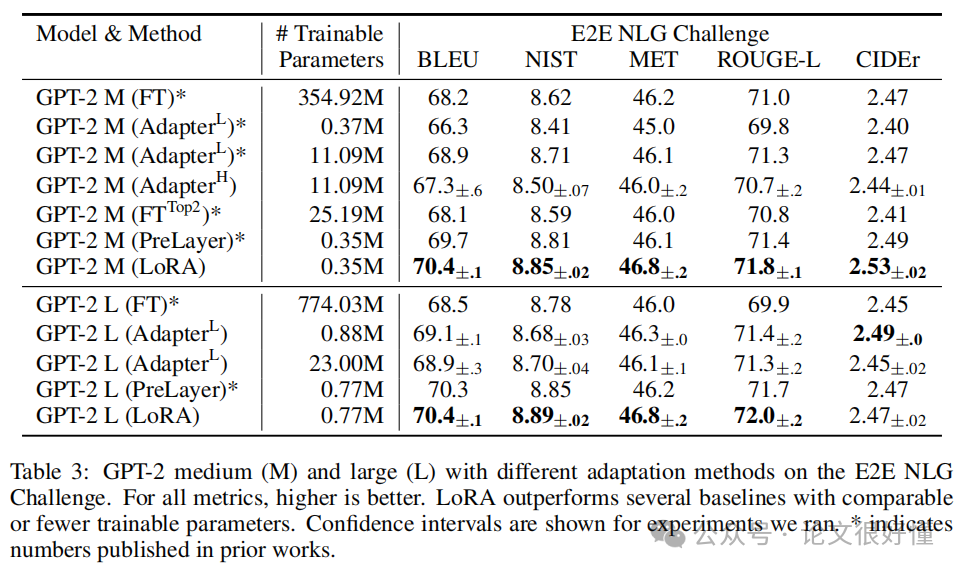
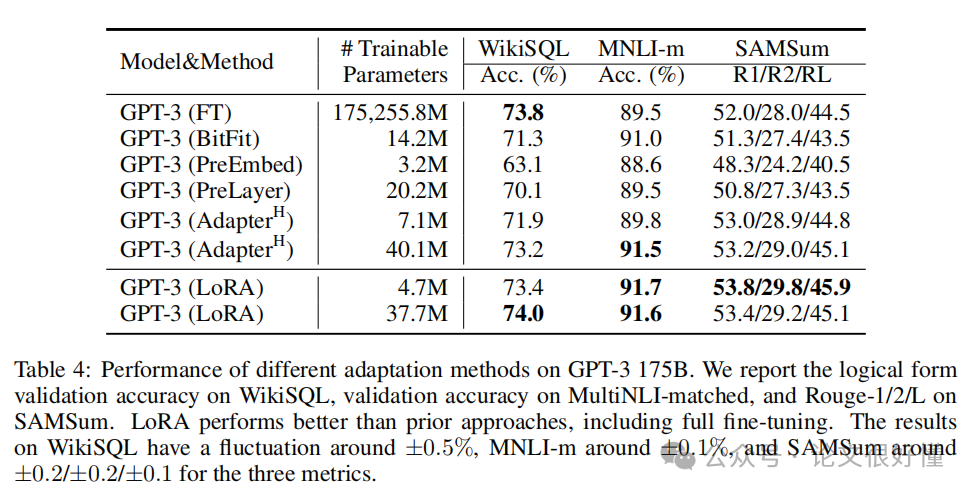
- 1. Performance on par with full fine-tuning: In various models (RoBERTa, DeBERTa, GPT-3) and tasks (NLU, NLG), LoRA (blue) performs almost equally to full fine-tuning (FT, orange), and sometimes even better (see Tables 2, 3, 4 in the paper).
- 2. Very small rank
<span>r</span>is sufficient: Table 6 shows that for GPT-3, setting<span>r</span>to 1 or 2 can achieve very good results on certain tasks. This strongly supports the core hypothesis that “the change amount during model adaptation is low-rank.” 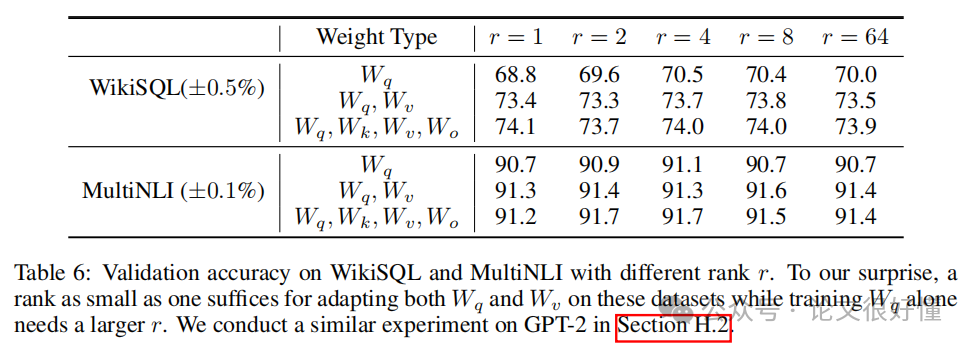
- 3. Where should LoRA be applied? Experiments found (Table 5) that applying LoRA to both the query (Query, Wq) and value (Value, Wv) matrices in the self-attention module of the Transformer yields the best results.
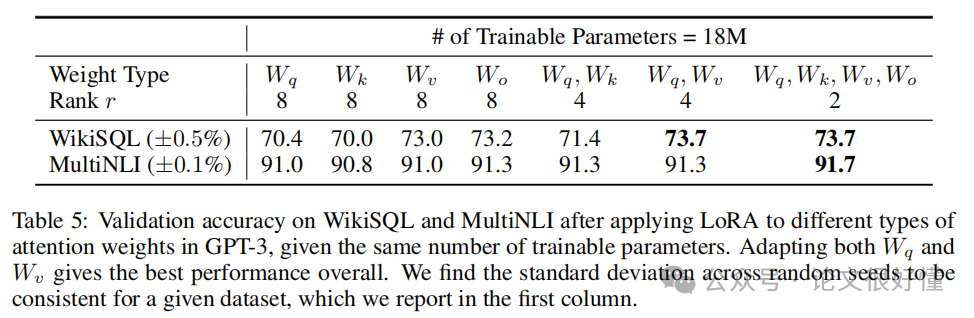
- • Simple Understanding: This is equivalent to adjusting the model’s “what information to focus on (Wq)” and “what information to extract (Wv).” These seem to be the two most critical points when adapting to new tasks.
- • Experiments found that ΔW is not random; it has a strong correlation with W₀.
- • Interestingly, ΔW does not amplify the already strong directions in W₀ but rather amplifies the directions that are present but relatively weak in W₀.
- • Simple Analogy: Our chef (W₀) is already very sensitive to “saltiness” (the direction representing saltiness in W₀ is strong). When teaching him to cook Sichuan cuisine, LoRA (ΔW) does not make him “saltier” but instead makes him pay attention to the flavors of “numbing” and “spiciness” (which are present but weaker in W₀) and greatly amplifies them. This indicates that LoRA is “filling in the gaps” for the model, activating those potentials that are crucial for the new task but have not been fully utilized.
Conclusion
The contributions of the LoRA paper are revolutionary:
- 1. Proposed a core hypothesis: The weight changes during model fine-tuning are low-rank, and this has been fully validated through experiments.
- 2. Provided an elegant solution: By freezing the original model and injecting trainable low-rank matrices (A and B), it achieves highly efficient fine-tuning.
- 3. Addressed practical pain points:
- • Training Costs: Significantly reduced the hardware threshold and time costs for fine-tuning.
- • Deployment Storage: Changed from storing a huge model for each task to only adding many tiny “LoRA plugins” to a general model, reducing storage costs by thousands of times.
- • Inference Performance: The “train first, merge later” feature ensures that it does not introduce any additional computational delays in production environments.
Due to these significant advantages, LoRA and its variants have become the de facto standard for fine-tuning large models in the open-source community today. Many models released by individuals or small teams that perform excellently in specific fields are almost all fine-tuned based on LoRA or similar technologies.
I hope this interpretation helps you thoroughly understand this important paper! If you have any specific questions, feel free to ask.
If you find this article good, remember to follow me, and let’s enjoy classic papers together!
If you find this article good, please give it a thumbs up; thank you for your support!
About “The Paper is Easy to Understand” (I suggest you read it carefully)
Many papers can change the world, can be very enlightening, or can even be quite fun.
I will help you understand obscure papers with simple examples.
If you have a paper you want to understand, please write the download link in the comments, and I will interpret it for you within 1-7 days.
Due to limited energy, I will process according to the following priority principles:
1. Fans first. Users who follow me will have their comments prioritized.
2. Likes first. Papers with a high number of likes in the comments will be prioritized.
3. Time order. Earlier comments will be prioritized.
Writing is not easy; please indicate the source when spreading.If you find this article good, remember to follow me!