Click the blue text | Follow us
In the new wave of industrial revolution, 3D printing technology, as a revolutionary manufacturing technique, has been widely applied in various fields.

In the automotive manufacturing sector, 3D printing technology is breaking through traditional manufacturing paradigms with its unique process advantages, becoming the core driving force for the industry’s transformation towards intelligence, lightweight, and sustainability. This article will systematically explain the transformations brought by 3D printing technology to the manufacturing of automotive components, using sand casting as a starting point.
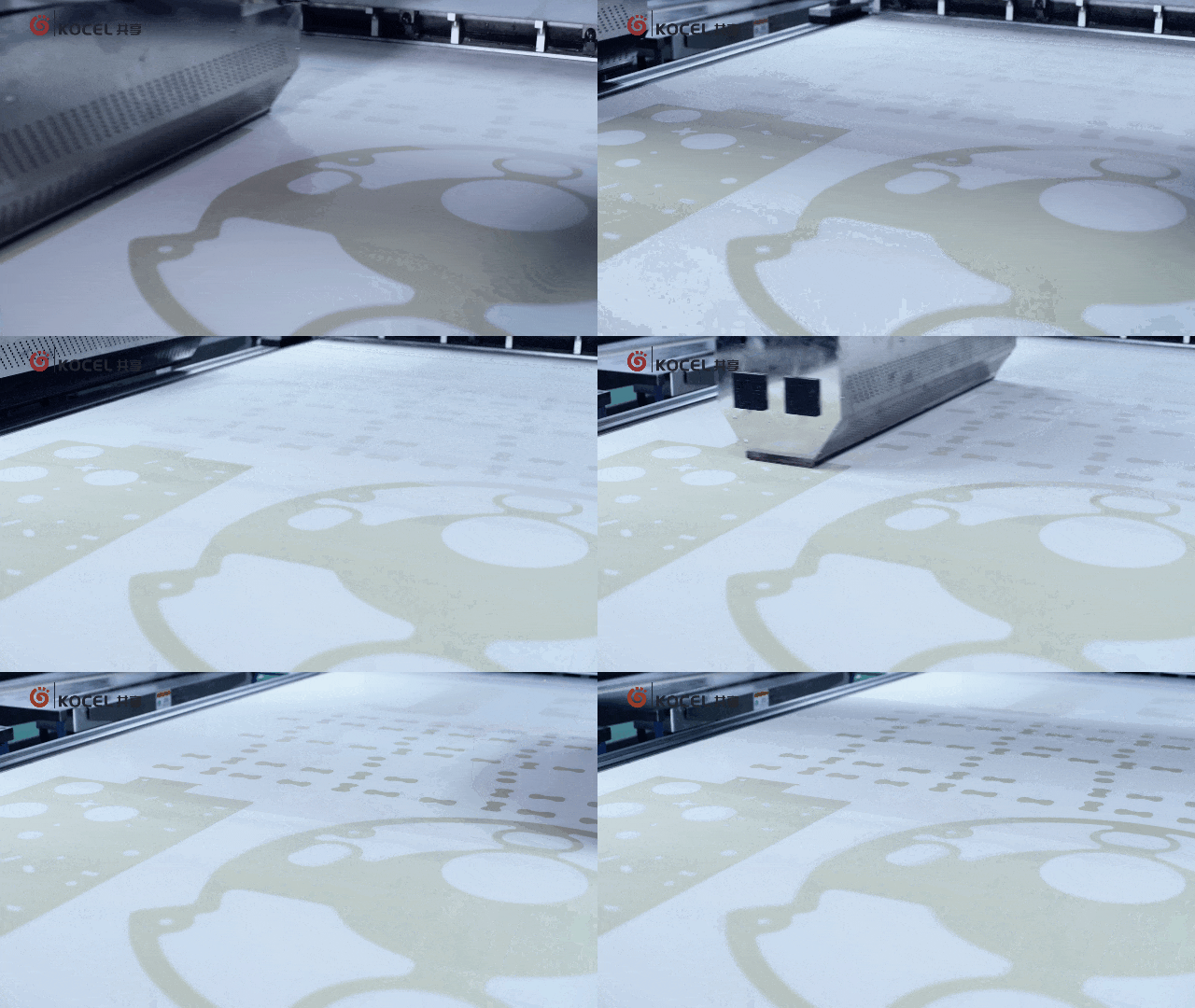
Limitations of Traditional Sand Casting
Traditional sand casting mainly uses wooden molds, metal molds, and other molding processes. Taking the automotive axle housing as an example, it first requires designing and manufacturing molds based on the shape of the casting, then embedding the mold in molding sand, and after hardening, opening the box to remove the mold, resulting in the external contour of the casting, which is a semi-finished product.
Complex structures require the use of core boxes: the sand core features are reverse-engineered according to the casting structure, and molds for the core boxes are made accordingly. Molding sand (usually composed of silica sand, resin, and hardeners) is then filled into the core box molds, compacted, and hardened, and finally, the sand core is removed.
For products with complex internal structures like cylinder blocks and cylinder heads, the design and processing of molds are difficult, time-consuming, and costly. Moreover, since such castings require many internal cores to form the cavity structure, this means an equal number of core box molds (a single product may involve dozens or even hundreds of sand core boxes). Any design change will lead to mold scrapping and remanufacturing, severely restricting the flexibility of product iteration.
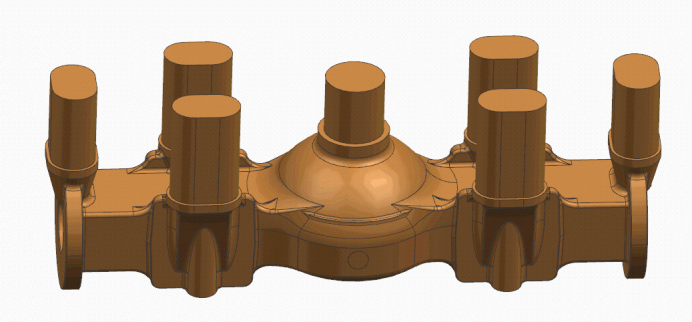
Product Mold
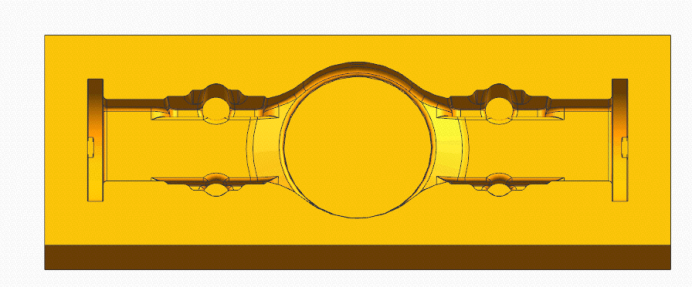
Semi-finished Casting
Traditional sand casting has low precision, with significant dimensional errors and surface roughness in sand cores, which can easily lead to dimensional deviations and sand sticking defects in castings, affecting product quality. Additionally, the production efficiency of traditional sand core manufacturing is low, making it difficult to meet the large-scale and fast-paced production demands of the automotive manufacturing industry.
Transformations Brought by 3D Printing Technology
In the automotive manufacturing sector, 3D printing technology eliminates the need for molds and core boxes, allowing for the rapid production of sand cores directly from three-dimensional digital models, bringing multiple transformations to the manufacturing of automotive components.
1. Enhanced Design Freedom
Traditional sand casting is limited by molds, making it difficult to achieve many complex internal structures and irregular channels. In contrast, 3D printing can easily produce complex sand cores that traditional processes cannot achieve, such as engine cylinder head sand cores with conformal cooling channels and complex intake manifold sand cores. This technological breakthrough not only significantly enhances the functional performance of products but also liberates engineers’ creativity at the design level, shifting the design philosophy from “manufacturability” to “performance optimization,” redefining the boundaries and possibilities of innovation in automotive components.
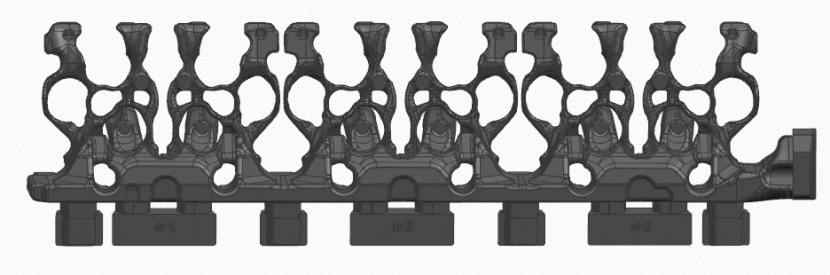
Cylinder Head Internal Core
2. Shortened Production Cycle
Traditional sand casting requires multiple steps, including mold design, manufacturing, testing, and repeated modifications, leading to production cycles generally lasting 4-8 weeks, severely restricting product development efficiency. In contrast, 3D printing technology establishes a simplified manufacturing chain of “digital model – direct printing – finished sand core,” completely avoiding the time loss associated with molds.
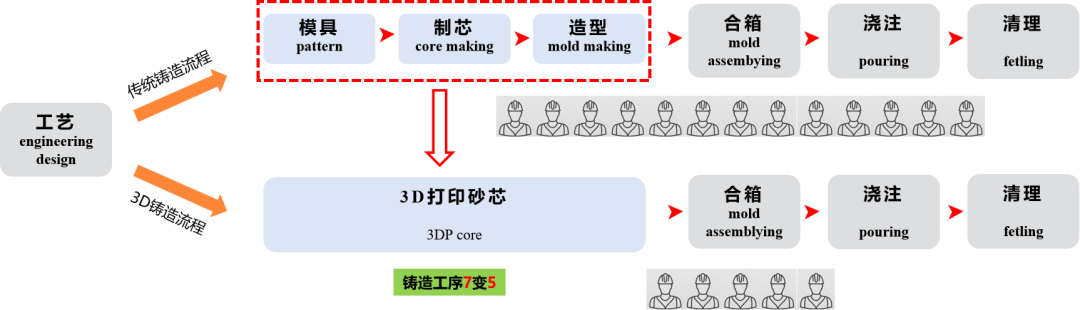
For new product development, 3D printing can quickly complete sand casting and conduct casting trials, significantly shortening the R&D cycle; for small-batch, multi-variety component production, it can quickly respond to diverse market demands, significantly enhancing the market adaptability of enterprises and giving them a competitive edge in a fierce market.
3. Improved Product Quality
3D printing does not require design draft angles, and the assembly precision of sand cores is high, which can reduce processing and correction amounts, achieving precise control of weight deviations. Additionally, the number of sand cores is reduced, leading to fewer casting seams and significantly improved appearance quality of castings.
Comparison of Traditional Casting and 3D Printing Sand Core Technology
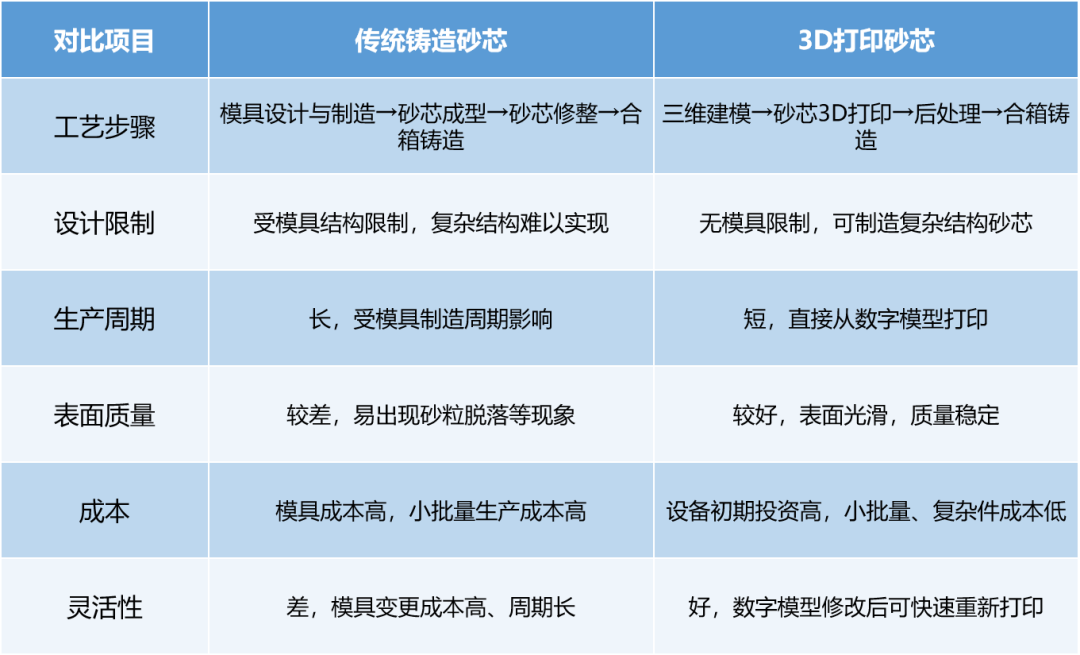
3D printing technology breaks through the mold dependency and structural limitations of traditional casting processes, providing efficient and high-precision solutions for automotive manufacturing. In the future, as the application scenarios of 3D printing in our country continue to expand, promoting the high-quality integration and development of 3D printing technology with the manufacturing industry has become a key engine for cultivating and strengthening new productive forces.Shared intelligent equipment will also continue to deepen the industrial application of 3D printing, setting new benchmarks and injecting new vitality into the high-end, intelligent, and green development of the casting industry.
Scan the QR code | Follow us
Editor | Ma Caixia
Reviewer | Wang Long