According to a report by Electronic Enthusiasts Network (Author: Zhang Ying), in 2025, DeepSeek will launch and open-source the DeepSeek – V3 model, significantly reducing the cost of introducing large models into AIoT, making it possible for large models to be deployed on the edge. The industry is officially entering a pre-explosion phase, and 2025 is widely regarded as the “Year of Edge AI” in the industry.At the recent AIOT conference, Yang Kai, Marketing Director of Canaan Semiconductor (Shanghai) Co., Ltd., shared the latest data on the smart terminal market, stating that the global smart terminal market will exceed $95 billion in 2024 and reach $420 billion by 2030, showing explosive growth.The growth is driven by three main factors: first, the popularization of AI technology; second, the expansion of emerging products; and third, the demand for upgrades in emerging markets.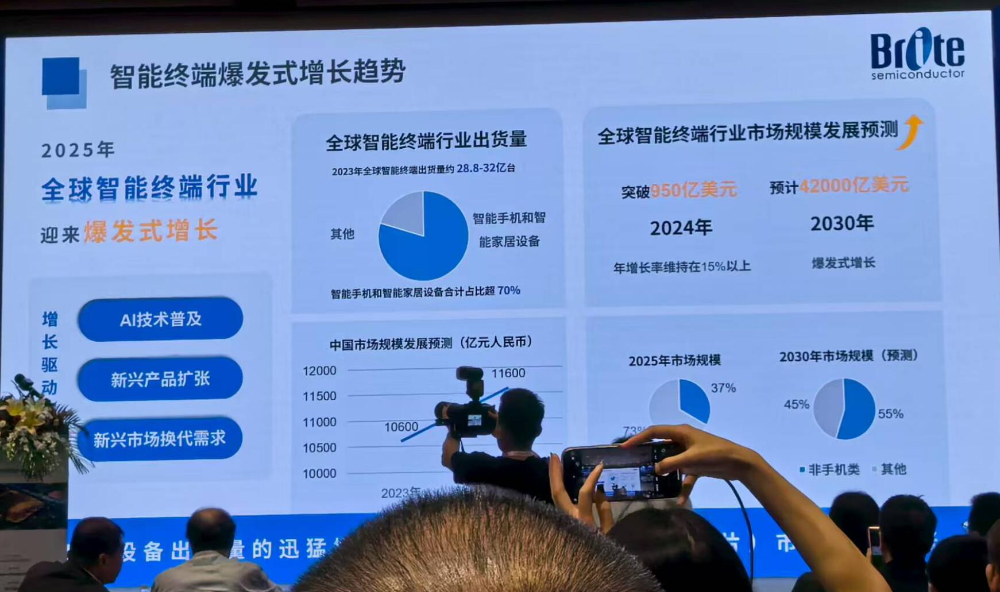 The expansion of markets such as smartphones, smart screens, AI PCs, automobiles, and robotics directly drives the demand for upstream SoC chip markets. For example, one of the leading domestic AIoT SoC chip companies, Rockchip, has released the edge AI large model coprocessor RK1820/RK1828, and the Rockchip RK3588M has already been deployed in smart cockpits, serving multiple models from SAIC and GAC. The 6nm chip BES2800 launched by Hengxuan Technology has been implemented in several smartwatches and flagship headphones.
SoC Chips vs. Traditional Chips: Cost and Performance Advantages Meet Smart Terminal Needs
Yang Kai pointed out that traditional chips can no longer meet the high performance, low power consumption, and high integration requirements of smart terminals, and customized SoC chips have become the key to solving this problem.SoC chips integrate microprocessors, analog IP cores, digital IP cores, and memory on a single chip, making SoC chips a miniature system.He believes that compared to traditional chips, SoC has stronger optimization capabilities in customized scenarios, a more critical balance between performance and power consumption, and can achieve lower power consumption and better performance through advanced processes.The demand from multiple fields drives the continuous growth of the SoC market, with the SoC market size reaching $154.8 billion in 2022, and the global SoC market size expected to exceed $320 billion by 2032. According to SIA statistics, besides China, countries like Vietnam, Thailand, Malaysia, and Singapore also make significant contributions to the dominant position of the Asia-Pacific market. SoC chips can be applied in the fields of IoT, smart home appliances, smart cities, smart industries, and wearable devices.In Yang Kai’s view, customized SoC chips achieve scenario optimization by deeply integrating the modules required for specific applications, such as baseband and AI accelerators. For example, smartphone SoCs are specially optimized for camera ISP and 5G modems, significantly enhancing user experience. In terms of cost structure, although the non-recurring engineering (NRE) costs of customized SoC chips are relatively high initially, they reduce the overall bill of materials (BOM) costs by minimizing peripheral components, making them more economical in mass production devices.Traditional chips, such as CPU and GPU chips, prioritize computing power, including high frequency and multi-core architecture, resulting in high power consumption. However, edge computing or some small models do not require such high-power chips; mobile SoCs focus more on the chip’s energy efficiency ratio. Chip manufacturers design and adjust based on power consumption or the balance between power consumption and performance, maximizing the functionality of SoC chips while meeting basic customer needs. When we design for differentiation, we integrate accelerated modules to handle specific loads, achieving a tenfold or more improvement in energy efficiency when performing AI inference tasks compared to traditional chips.The typical development cycle for CPUs is usually 18 to 24 months, while the design of SoC chips can be shortened to 6 to 12 months with the help of some EDA tools, from design to verification.
Focusing on Customized SoCs, Canaan Provides Rich IP and Platform Solutions
“Canaan Semiconductor has rich IP and platform resources in SoC design, with products including high-speed interfaces, storage DDR, audio codec IP, and more, as well as WiFi, BLE, and SoC solutions, successfully applied in smart home, smart security, and smart logistics scenarios.We have diversified IP support to help customers define and design products.” said Yang Kai, Marketing Director of Canaan Semiconductor (Shanghai) Co., Ltd.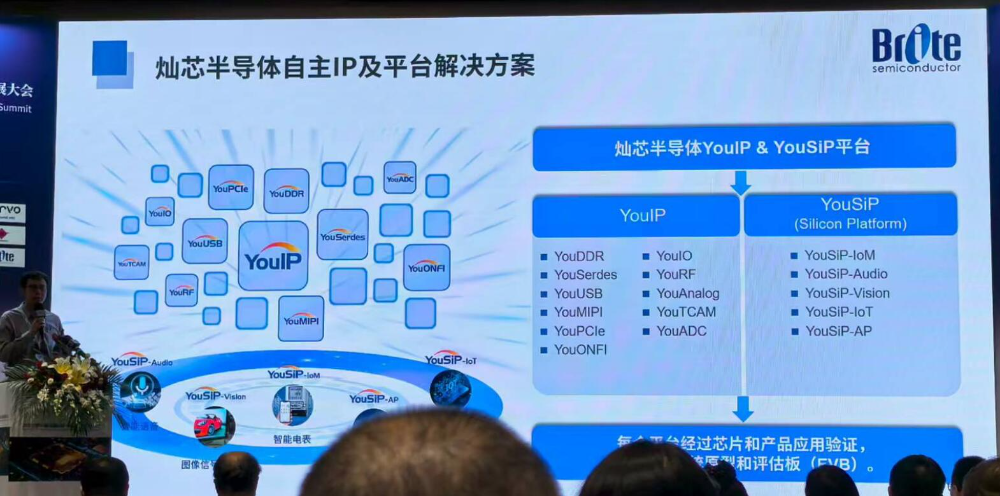 For example, in the field of edge intelligent voice chip solutions, Canaan can provide customers with a complete design from specification definition to mass production, including Tensilica DSP, audio codec, hardware VAD IP, Canaan USB/12S/DMAC IP, and hardware USB, utilizing low-power design (UPF Flow). Additionally, we provide domestically produced, controllable RISC-V CPU designs that also support low-power design.Canaan Semiconductor was established in Zhangjiang, Shanghai in 2008, and on April 11, 2024, the company successfully listed on the Science and Technology Innovation Board of the Shanghai Stock Exchange, with a current total employee count of around 350, handling about 190 to 200 design and tape-out agency projects each year, with approximately 80K tape-outs annually.As a one-stop customized chip and IP supplier, Canaan Semiconductor has accumulated rich experience in the field of customized SoCs, providing one-stop solutions including product definition, architecture & RTL design, IP selection & integration, IC physical layer design, wafer manufacturing, and IC packaging and testing.

Disclaimer: This article is original to Electronic Enthusiasts Network, please indicate the source above when reprinting. For group communication, please add WeChat elecfans999, and for submission of interview requests, please email [email protected].
More Hot Articles to Read
-
Details of Huawei Mate80 and Apple iPhone 17 Pro Leaked? Huawei Phones Again Dominate the Chinese Market in Q2
-
Lei Jun: Xiaomi is at the Forefront of Global Self-Developed SoCs
-
Self-Developed Chips, Aggressively Targeting Enterprise-Level, Domestic Storage “Magnitude Leap”
-
TI/ADI/ST Issue Warnings: The Automotive Chip Market Remains Unoptimistic
-
Intel Plans to Lay Off 21,000 Employees, May Skip 18A Process
Click to Follow and Star Us
Star us to not miss any updates!