
When chip giants from the automotive industry venture into the robotics arena.

During the Spring Festival Gala of 2025, a group of robots dressed in colorful coats, performing “cyber folk dances,” entered the public eye. This night marked the true beginning of humanoid robot development. More and more people are beginning to discuss when robots will truly enter our lives.
Currently, the robotics industry is transitioning from prototype demonstrations to large-scale production. However, due to the lack of a “mass production-level” computing platform that meets high reliability, high integration, and high performance, players in the robotics field have been unable to break through the bottleneck of large-scale production. These are precisely the areas where Black Sesame Intelligence, a leader in automotive computing chips, excels.
Black Sesame Intelligence believes that the current state of the robotics industry is roughly equivalent to that of the smart automotive industry in 2018, but the growth rate of the former will far exceed that of the latter. Driven by smart vehicles, the current chip industry has become very mature, and at the same time, outstanding AI models such as large language models, multimodal large models, and world models have emerged. Therefore, Black Sesame Intelligence predicts that the robotics industry is on the eve of an explosion.
Based on this judgment, Black Sesame Intelligence has entered the robotics field, filling this critical gap.
At the same time, embodied intelligence is at the cusp of commercialization. With its accumulated chip R&D foundation and systematic supply chain capabilities in the automotive industry, Black Sesame Intelligence is undoubtedly a strong promoter of the commercialization of embodied intelligence. It can be said that Black Sesame Intelligence’s entry is timely.

Robots, trapped on the eve of mass production
In 1959, American inventors George Devol and Joseph Engelberger successfully developed the world’s first industrial robot, “Unimate,” which was officially put into use at a General Motors factory in 1961. Since then, the robotics industry has completed its initial exploration and officially transitioned from the laboratory to industrial applications.
After decades of long development, the robotics industry is now entering a new stage driven by diversified demand and full-scene penetration.
First, as robotic technology continues to advance, its downstream application scenarios are becoming increasingly diverse. In addition to traditional industrial fields, such as automotive manufacturing and consumer electronics, where robots are used for handling, spraying, and welding, robots are also widely applied in emerging fields such as new energy vehicles, photovoltaics, and biomedicine. For example, new energy vehicle charging robots can automatically complete the entire process of plugging and unplugging the charging gun.
As application fields become broader, different functional requirements naturally emerge. For instance, industrial humanoid robots need to possess autonomous recognition, planning, and decision-making capabilities to complete complex operational tasks; in the long run, household service robots will focus more on human-machine interaction, environmental perception, and personalized service capabilities, such as following commands to do laundry and cook, or to chat.
Correspondingly, the user groups served by robots have also changed. In the past, the main users of robots were large institutions such as industrial enterprises; today, with the popularization of robotic technology and the reduction of costs, more and more small and medium-sized enterprises, research institutions, and even individual consumers are becoming users of robots. Different user groups have varying needs and expectations for robots, further driving the diversified development of the robotics industry.
In summary, the mainstream demand in the robotics market is shifting from “usable” to “easy to use”: requiring robots to possess high-level capabilities such as autonomous perception, complex decision-making, safe control, and system collaboration. This places higher demands on the chips used in robots. For example, they need to meet higher standards in terms of computing power, integration, and real-time performance.
Among these, computing chips are the multidimensional embodied intelligence engine of robots, and their architecture determines the dimensions of spatial intelligence, serving as the physical foundation for robots to achieve understanding, planning, reasoning, and interaction. The dimensions of perception, planning, decision-making, and control required for robots to complete tasks are much higher than those for intelligent driving, necessitating a more dimensional computing architecture. The use of heterogeneous computing in intelligent driving computing platforms has accumulated experience for multidimensional intelligent computing, and the collaborative computing architecture of multiple forms will play a greater role in robotic applications.
Currently, the chip capabilities in the robotics industry still cannot meet higher expectations. This is also a major reason why the robotics industry is stuck in prototype demonstrations and unable to transition to large-scale production. However, Black Sesame Intelligence’s accumulation in automotive chips can be reused in the robotics field.
These changes are also driving robotic systems to evolve from lightweight solutions primarily based on MCUs and single-core CPUs to intelligent module platforms with AI reasoning, visual fusion, and heterogeneous computing capabilities.
On November 20, Black Sesame Intelligence officially launched its multidimensional embodied intelligence computing platform—SesameX™. This platform includes three major computing platforms: the SesameX Kalos computing platform dedicated to commercial service robots, the SesameX Aura general computing platform for multi-task execution robots, and the SesameX Liora all-purpose computing platform aimed at the “brain” of embodied intelligence.
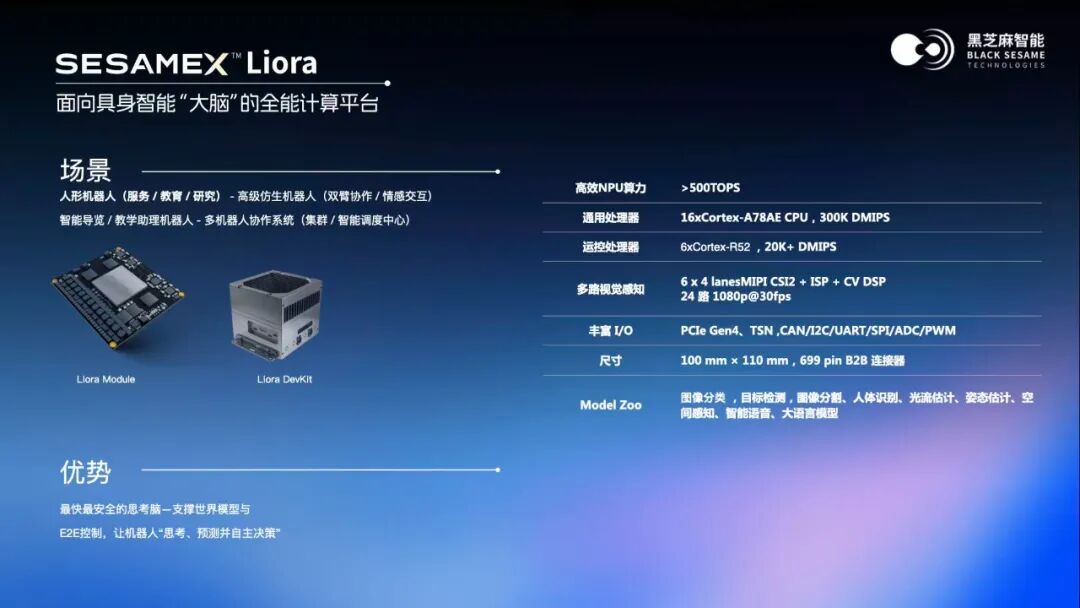
The SesameX robot full-stack computing platform is a complete “systematic computing platform from edge modules to full-brain intelligence,” with hardware, software, toolchains, and model ecosystems all developed in-house by Black Sesame Intelligence. In developing this platform, Black Sesame Intelligence reused its experience and capabilities in designing chips for the automotive market, boasting three major advantages: automotive-grade IP reuse, functional safety certification, and an open technology ecosystem.
A clear trend is that with breakthroughs in technologies across AI cognition, hardware execution, and environmental interaction, combined with explosive market demand and the improvement of industrial ecosystems, the era of full-brain intelligence has arrived in the robotics field. The SesameX robot full-stack computing platform is the industry’s first computing platform for the commercial deployment of robots, integrating perception, control, safety, and intelligence, and supporting the realization of full-brain intelligence, allowing robots to transition from “mechanical executors” to true “embodied intelligent partners.”
Black Sesame Intelligence’s founder and CEO, Shan Jizhang, compares the current robotics industry to “smart cars in 2018” and predicts that its growth rate will far exceed that of the latter: “On one hand, the underlying chip technology is highly mature; on the other hand, the rapid evolution of large language models, multimodal large models, and world models lays a solid foundation for the explosion of robotics.”
Predictions from relevant institutions also confirm Black Sesame Intelligence’s judgment. The global market continues to grow, especially in the fields of service robots and special robots, with the global service robot market expected to exceed $40 billion by 2025, with a compound annual growth rate of over 20%. This inherently contains a huge chip market.
According to GIR research, the global industrial robot chip revenue is approximately $2.322 billion in 2024, expected to reach $4.374 billion by 2031. According to QYResearch statistics and forecasts, the sales of dedicated chips for humanoid robots will reach $686 million in 2024, and are expected to reach $3.271 billion by 2031. In RMB terms, this will be a market scale of 20 billion to 30 billion yuan. This is also one of the reasons for Black Sesame Intelligence’s entry.

Entering the market with capital
When an automotive chip designer decides to participate in robotics chip development, those in the know understand that this is akin to entering the market “with a golden spoon.”
After all, in the surging tide of new energy vehicles, the automotive industry has completed its initial transition from traditional mechanics to intelligence. Advanced urban + high-speed intelligent assisted driving can greatly liberate the hands of drivers, transporting passengers from point A to point B. Meanwhile, intelligent cockpits have also played a significant role in driving comfort and convenience.
Black Sesame Intelligence’s advantage in entering the robotics field lies in the high overlap between the robotics industry chain and the automotive industry chain. The resources accumulated by Black Sesame Intelligence in the automotive field, such as supply chain, quality control, and customer ecosystem, can be seamlessly transferred, forming a strong competitive barrier.
First, let’s look at the technical level. As a complex system integrating multiple sensors, actuators, and AI algorithms, robots are experiencing three major key evolutionary trends. The first is multimodal perception fusion. As robots enter unstructured environments (such as outdoors, commercial areas, parks, and homes), single vision or radar cannot meet task requirements. The technological trend is moving towards the fusion of RGB, depth, IMU, and voice, which places higher demands on data channel bandwidth, image preprocessing, and AI perception computing power. This trend is pushing robotic platforms to transition from traditional ARM + vision chip structures to heterogeneous computing chip platforms that integrate ISP, CV acceleration, and NPU.
The second is the enhancement of edge intelligence and local reasoning capabilities. To reduce cloud dependence and improve response speed and security, robotic systems are gradually moving AI reasoning to local. In typical scenarios such as commercial services, security, and patrolling, mid-to-high intensity reasoning capabilities are required. Therefore, chip modules with (16~100+ TOPS) become a necessity, especially for tasks such as object detection, semantic segmentation, and path planning, where NPU architectures with efficient INT8 reasoning capabilities and low power consumption have become mainstream choices.
The third is the obvious trend of system-level heterogeneous integration. High-level robotic tasks often involve image processing, neural networks, and real-time control requirements. The technological trend requires chip platforms to simultaneously possess high-performance CPU/GPU, dedicated NPU/DSP, automotive-grade safety control units, and support for high-bandwidth interconnections such as PCIe, MIPI CSI, and TSN. This SoC architecture is becoming the core carrier of the “intelligent brain” of robots.
Black Sesame Intelligence’s robotic computing platform can precisely meet the modular solutions for the above three trends of “multimodal, heterogeneous, and edge-based,” gradually approaching international standards in terms of performance, power consumption, interfaces, and ecological compatibility, suitable for various service and special robot deployment scenarios.
A clear trend is that the robotics market is transitioning from “manufacturing tools” to “intelligent partners,” and the foundation supporting this leap is the integrated intelligent computing platform of software and hardware.
Robots are trapped on the eve of mass production, and in addition to the reasons mentioned earlier, cost control and supply chain management difficulties are also constraints. However, Black Sesame Intelligence has significant advantages in supply chain management, cost control, and large-scale production, enabling it to transfer capabilities from the automotive field to the robotics field.

The second growth curve
Black Sesame Intelligence’s entry has opened up another possibility for the robotics industry. Robots are the carriers of “embodied intelligence,” and their core is a powerful “intelligent central” computing platform capable of handling the full chain of tasks related to perception, cognition, decision-making, and control. Therefore, high-performance chips are of critical significance for the future development of the robotics industry.
With Black Sesame Intelligence’s entry, high-performance chips are being integrated into robotic products, accelerating mass production of robots and enabling deployment in more diversified niche fields. This determines whether robots can grow from “automated machines” to “intelligent entities” with strong self-learning capabilities.
The SesameX™ multidimensional embodied intelligence computing platform launched by Black Sesame Intelligence aims to break the boundaries of robotic intelligent perception and operation control, reshape the intelligent central of robots, and push the robotics industry from “specialized equipment” to “general intelligent entities” in a key evolutionary step.
For Black Sesame Intelligence, this represents a new growth engine.
Founded in 2016, Black Sesame Intelligence has focused on the R&D of automotive-grade intelligent automotive computing chips and solutions, being the first in the industry to release the automotive-grade high-performance autonomous driving chip A1000 family, which is currently one of the most mature, mass-produced, and cost-effective single-chip solutions for integrated driving and parking in China. It has also released the Huashan A2000 family of computing chips aimed at the next generation of AI models, with higher performance and efficiency, and the Wudang C1200 family, the first high-performance cross-domain integrated computing platform in China with cabin and driving integration capabilities, achieving a technological breakthrough of four-in-one chips. Currently, Black Sesame Intelligence has entered the leading echelon of China’s intelligent driving chip field.
However, the rapidly evolving automotive demands are forcing automotive chip players to continuously invest substantial funds in R&D. If they can play the robotics card well, not only can they gain more profits, but the two business lines can also enhance brand visibility together, allowing Black Sesame Intelligence to enter a fast lane of dual-engine driving.
With advantages in basic technologies for assisted driving, automotive-grade safety assurance systems, and the construction of an open technology ecosystem, Black Sesame Intelligence has built a full-chain technical capability of “perception-cognition-decision-making-control,” forming a unique competitive barrier for entering the robotics field.
The SesameX platform is also the only robot computing platform in the industry that meets automotive-grade safety standards, capable of rapidly adapting to high-safety robotic scenarios. Its launch marks a substantial step in Black Sesame Intelligence’s layout in the robotics field and will be a key step in seeking new growth points.
In fact, the market has already validated this with real money.
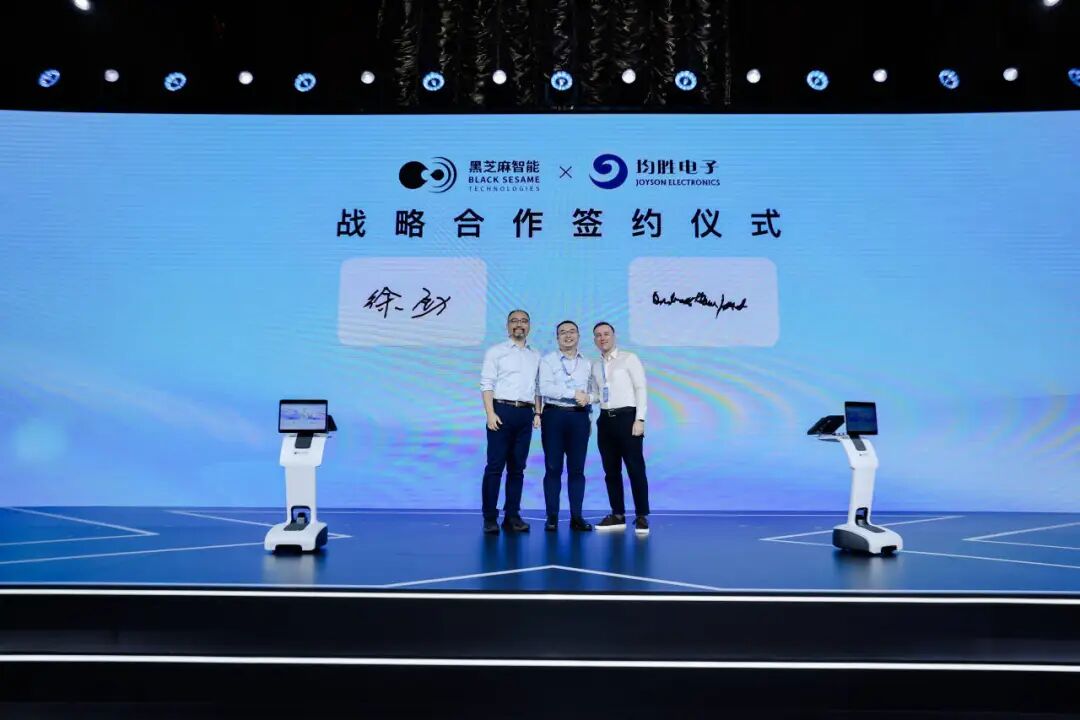
On November 20, at the product launch event for the Black Sesame Intelligence robot platform, both parties signed a strategic cooperation agreement on-site. Joyson Electronics is a leading global provider of intelligent automotive technology solutions, positioned as “automotive + robotics Tier 1,” driving the robotics field with core components and industrial scenarios, supporting global robotic partners in product R&D, and has collaborated with several well-known automotive and robotics companies.
Not only Joyson, but the release of the SesameX platform has also led to cooperation with leading robotics companies in the embodied intelligence industry, marking the first step towards commercialization.
From now on, Black Sesame Intelligence has officially opened a new phase of “car-machine” technology collaboration. This will open a trillion-level new market door for Black Sesame Intelligence.