Abstract:
This article is authorized for publication by New Intelligence Drive, authored by Anqi.
To enrich the electronic functions of vehicles, manufacturers have previously made significant efforts to equip cars with various ECU components. From 1993 to 2010, the number of ECUs used in the Audi A8 model surged from 5 to over 100. In stark contrast, in order to optimize the intelligent experience of vehicles, manufacturers are now working on “reducing the burden” of ECUs, which has caused them considerable headaches, even leading to major organizational restructuring.
The “culprit” behind all this is Tesla.

When the Tesla Model S debuted in 2012, it signified the impending end of the era of installing dozens or even hundreds of ECUs in vehicles, ushering in the age of ECU reduction. Today, the traces of ECUs in the Model 3 have significantly decreased.A reputable Japanese media outlet, after disassembling and examining the internal structure of the Model 3, directly expressed the sentiment that “Tesla is six years ahead of Volkswagen and Toyota.” A Japanese automotive engineer even bluntly stated, “We can’t produce this.” However, reducing the burden of ECUs is not as simple as the physical integration of hardware might suggest. This process requires the gradual separation of hundreds of ECU modules’ hardware and software, followed by injecting the software into a centralized computing unit, ultimately giving rise to a “brain” for the vehicle.How to simplify this complexity has been a headache for many manufacturers. Yet, most of the secrets are actually hidden within a black box known as the domain controller.
1
The Decline of ECUs and the Emergence of the ‘Domain’ Concept
The so-called domain controller is essentially a derivative of manufacturers simplifying ECUs.In the past, ECUs (Electronic Control Units) were widely present in the vehicle’s engine, transmission, and other underlying components, with each function of the vehicle requiring one or more ECU modules for control, thus facilitating the transformation and processing of information throughout the vehicle. Consequently, the architecture composed of these distributed ECUs is referred to as distributed electronic and electrical architecture.The more ECUs there are, the richer the vehicle’s electronic functions. However, this also leads to complex wiring layouts and increased vehicle weight, resulting in higher overall costs; on the other hand, due to the involvement of numerous suppliers, the software development of ECU modules has always been difficult to synchronize, making subsequent updates challenging, let alone the currently hot topic of OTA upgrades.In the era of automotive intelligence, this architecture clearly does not meet the needs of the digital transformation of vehicles, which require the ability to evolve continuously.Thus, spurred by Tesla’s disruptive influence, a transformation towards “centralizing ECU functions” is actively underway: traditional ECU modules are beginning to separate hardware from software, with hardware gradually being eliminated, and software being consolidated to control multiple functions through a single computing platform.The domain controller is the black box that consolidates the discrete ECU software functions into one, and the electronic and electrical architecture based on the “domain” is beginning to emerge.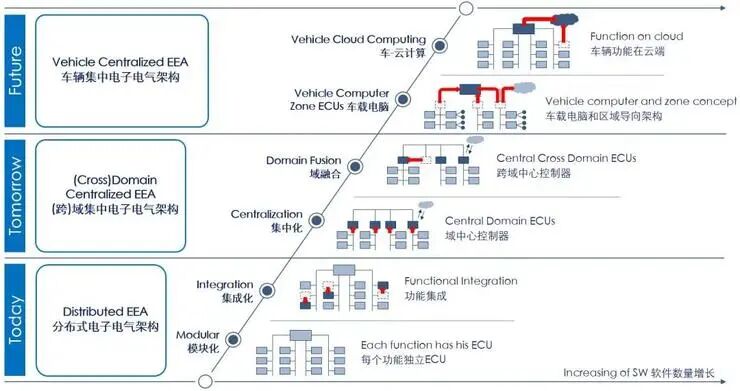 Bosch’s evolution diagram of electronic and electrical architecture
In this transformation, traditional ECU suppliers may be the first to feel the abrupt change of the times.
A widely circulated evolution diagram of electronic and electrical architecture comes from the international parts supplier Bosch. Almost all players’ research and development processes in electronic and electrical architecture can be roughly traced on this diagram, including Tesla.According to Bosch, the progress of the vehicle’s electronic and electrical architecture can be roughly divided into three stages: distributed architecture, cross-domain centralized architecture, and centralized architecture.So, what level have industry players reached in terms of actual progress?Yu Qingzhou, an expert from local autonomous driving product and service provider Fureitech, told New Intelligence Drive: Currently, most manufacturers are still on the path of transitioning from distributed to cross-domain centralized architecture, while cutting-edge players like Tesla and Volkswagen have already delved deeply into the cross-domain centralized architecture field.However, within the cross-domain centralized electronic and electrical architecture, players can be divided into two categories: one led by Tesla, and the other led by Volkswagen, as stated by Duan, the head of electronic and electrical architecture at Xiaopeng Motors.As the pioneer of cross-domain centralized architecture, Tesla’s electronic and electrical architecture has been rapidly evolving.According to New Intelligence Drive, when the Model S was launched in 2012, the initial architecture divided the vehicle into distinct domains such as power domain, chassis domain, and body domain, integrating ECU software by functional attributes.However, by the time the Model 3 was launched in 2017, the division of functional domains had become less distinct, showing signs of cross-domain integration. Its new architecture is divided into three main parts: the Central Computing Module (CCM), the Left Body Control Module (BCM LH), and the Right Body Control Module (BCM RH).Among them, the Central Computing Module integrates the ADAS domain, infotainment system domain, and communication system domain. In other words, the three major modules will “consume” the ECUs adjacent to the position domain, leading to fewer ECU modules in the vehicle and higher integration.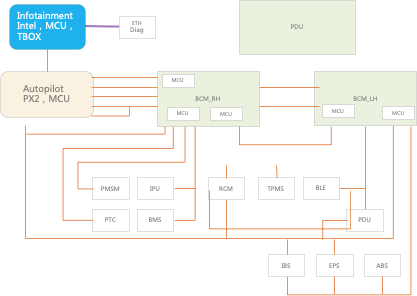 Now, let’s look at Volkswagen.Currently, Volkswagen’s MEB platform has three major controllers, including the Vehicle Control Domain (ICAS1), Intelligent Driving Domain (ICAS2), and Intelligent Cockpit Domain (ICAS3), which is still in the functional domain stage, with a relatively high number of distributed modules. More traditional automakers have a lower integration level in their electronic and electrical architecture, divided into five major domains: autonomous driving domain, power domain, chassis domain, cockpit domain, and body domain.
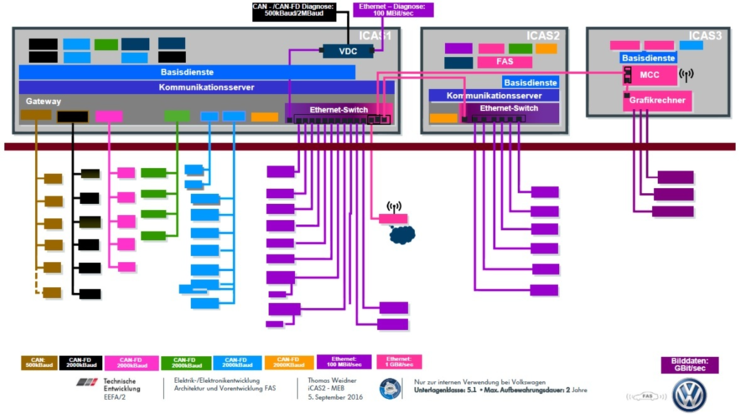 Volkswagen’s electronic and electrical architecture diagramOverall, Tesla has now developed to the “position domain,” while Volkswagen is still in the “functional domain” stage. The latter’s architecture is close to that of the Tesla Model S, hence the statement that “Tesla is six years ahead of Volkswagen and Toyota” is not without merit.However, Duan from Xiaopeng Motors also stated that the two camps of Tesla and Volkswagen essentially follow the same evolutionary path, with Tesla ahead and Volkswagen slightly behind.He believes, “Ultimately, the form of the domain controller may only leave a central domain, controlling all vehicle functions through a central computing unit, just like current computers and smartphones.”This is also a common viewpoint in the industry regarding the evolution of electronic and electrical architecture.After all, if ECU centralization can be gradually achieved, the vehicle communication wiring harness will also be significantly reduced, leading to a clear decrease in overall component costs, making it a win-win situation.In addition to Volkswagen, many players in the industry are also evolving towards cross-domain centralized electronic and electrical architecture: for instance, Audi had previously equipped its A8 model with the zFAS domain controller for autonomous driving; General Motors has also launched its next-generation electronic and electrical architecture, Global B; and domestic new car manufacturers like Xiaopeng Motors have equipped their P7 model with an autonomous driving domain controller based on the NVIDIA Xavier chip; Li Auto has also announced plans to launch an autonomous driving domain controller based on the NVIDIA Orin chip in 2022.Similarly, parts suppliers are actively transforming in this trend: Bosch stated at a media event that it has already secured its first local cockpit domain control project, which will achieve mass production in the fourth quarter of 2021, with the first global cockpit domain controller project set for mass production in the second quarter of 2022.Previously, Huawei’s MDC intelligent driving computing platform is essentially an autonomous driving domain controller.
2
The War in a Nutshell: The Soul of the Domain Controller Lies in Software
However, since Tesla is on a seemingly more advanced path, and other players are striving to catch up, why do other manufacturers seem to be lagging behind their expectations?Several industry insiders who spoke with New Intelligence Drive indicated that the traditional automotive supply chain system is a significant obstacle. With the cancellation of distributed ECU modules, the traditional automotive supplier system will face tremendous disruption.Wu Lihua, Director of the Intelligent Connected Center at BYD, told New Intelligence Drive: Once EUC is integrated into the domain, many quality suppliers may face the risk of being eliminated.“Enticing interests are like enticing souls.” remarked one industry insider.The old supply chain is difficult to shake, which determines that many manufacturers find it challenging to follow Tesla’s path.But this is just one reason.Duan from Xiaopeng Motors also stated that even if some manufacturers are determined to undergo organizational and systemic changes, they will still face a daunting challenge: after “consuming” the distributed modules, with hardware and software separation, is there a dedicated supplier capable of integrating the software?One industry insider also pointed out: “Currently, it seems that there are no mature software suppliers in the existing supplier system. Although everyone talks about software-defined vehicles, is there a mature software business model? In fact, no one has figured it out yet.”Because in the past, suppliers mostly provided integrated hardware and software services, and there were very few dedicated automotive software supply platforms that could adapt to various chip platforms.Therefore, the software capabilities embedded in the domain controller have become the top priority pursued by various players.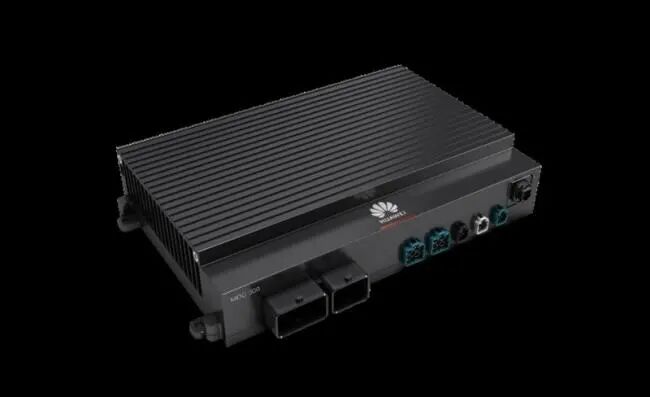 Huawei’s MDC intelligent driving computing platformThis industry insider also clarified: Many people mistakenly believe that the domain controller is merely a box; in reality, software is the soul of the domain controller (provided the chip’s computing power keeps up).Thus, the difficulty of transitioning from distributed architecture to centralized architecture does not lie in the cancellation of physical ECU modules, but in how to integrate the originally distributed software.Taking the intelligent driving domain controller as an example, Yu Qingzhou from Fureitech told New Intelligence Drive that the software algorithms of the domain controller actually consist of three layers: the bottom layer includes algorithms for cameras and other sensors, the second layer consists of basic driving function algorithm software (including L2-level assisted driving functions), and the third layer encompasses advanced intelligent driving functions such as navigation-assisted driving.Very few manufacturers can fully develop these three layers independently, and they must collaborate with suppliers to some extent.“In short, if manufacturers want to adopt domain controllers, they must discard the original setup. However, after discarding, it will place high demands on the manufacturers’ foundational capabilities.” said the aforementioned industry insider.Therefore, against the backdrop of a traditional supply chain that is difficult to pivot and a new software ecosystem that is not yet mature, many traditional manufacturers are struggling to break the old and establish the new.However, for players like Tesla and domestic new car manufacturers, without much historical baggage and systemic burdens, as long as they are willing to invest heavily in self-research, the path to centralized electronic and electrical architecture may be somewhat easier.
3
In the Era of SDV, Will the Relationship Between Manufacturers and Tier 1 Suppliers Be Rebuilt?
Currently, there is a general consensus in the industry: we are in an era of software-defined vehicles. There are many voices advocating self-research within manufacturers, and many manufacturers are aggressively recruiting for software teams.So, will software self-research become the only way out for manufacturers?One industry insider bluntly pointed out: “Tesla is an exceptional outlier, but if all manufacturers follow Tesla’s lead, they will surely fail.” Because most manufacturers do not have Tesla’s genes, it is actually very difficult for them to go all in.Nevertheless, software capabilities are increasingly becoming the “Achilles’ heel” of players in the supply chain. The centralized control of software capabilities by manufacturers may lead to a reconstruction of the supply chain relationships.Wu Lihua from BYD stated that because BYD has accumulated considerable experience in ECU development, it is currently also engaged in the research and development of intelligent cockpit and autonomous driving domain controllers. Therefore, he believes that in the future, manufacturers will gradually take on the role of software contractors.The traditional relationships and structures between manufacturers, Tier 1, and Tier 2 suppliers may undergo some changes. The traditional approach is for Tier 2 to empower Tier 1, which then empowers OEMs. However, after manufacturers centralize domains, they will need to master more software development capabilities and may communicate directly with Tier 2 suppliers.“Tier 1 may become purely hardware suppliers or even contract manufacturers, although there may be some transitional phases where both parties engage in some software development,” Wu Lihua said.It is evident that this presents a transformation full of uncertainties for parts suppliers.However, the aforementioned industry insider stated that from an economic perspective, there are actually some common and mature functions that manufacturers do not need to develop themselves. What manufacturers need to do is to lead the trend in certain functions and differentiate themselves in that regard. But if manufacturers do not possess strong vertical integration capabilities from top to bottom, they may still need to rely on the capabilities of the ecosystem.Therefore, in the era of domain controllers, how the industrial layout between manufacturers and Tier 1 suppliers will be rebuilt remains uncertain.As Duan from Xiaopeng Motors said, there is no right or wrong in the relationship between manufacturers and Tier 1 suppliers, only what is suitable and what is not, ultimately depending on the capabilities of the manufacturers themselves.
4
How Far Are We From the ‘Central Brain’ of Automobiles?
With the emergence of domain controllers, the evolution of automotive intelligence is accelerating. The ideal future state is for vehicles to possess a complete computing platform— a central brain.
However, this poses a significant challenge for everyone; even Tesla is still progressing towards a centralized electronic and electrical architecture.So, what challenges might arise in transitioning from 3-5 domain controllers to a centralized electronic and electrical architecture?This answer involves various aspects, such as whether the computing power of AI chips can support it, whether the vehicle’s operating system can keep up, and whether there are mature software suppliers, etc.Duan from Xiaopeng Motors emphasized: Because the central domain controller may take the form of a computer, the most critical capability will come from the vehicle’s operating system, which needs to connect with both upper-layer software applications and lower-layer hardware resources.This is both a core highlight and a challenge.Because the demands of the various “domains” such as cockpit domain, intelligent driving domain, power domain, and body domain on the operating system are not consistent. For instance, the cockpit system has high requirements for screen color processing and rendering, while intelligent driving functions have particularly high safety requirements.He stated that currently, there is no chip or embedded hardware platform that can provide high computing power to support rich image processing, along with high performance, high storage, and a very rich set of IO interfaces.“If, in the future, the entire vehicle truly reaches this point, I believe whoever first develops this operating system will be able to create a platform that could even monopolize the industry.”In addition to the challenges at the hardware level, the automotive industry’s software supply chain also faces the possibility of reconstruction.“There must be software suppliers in the supply chain; otherwise, this cannot be accomplished,” stated one industry insider. He believes that in the future, the industry may develop a few substantial software suppliers that provide services for the automotive brain through software platforms.The transition of automotive architecture towards centralized may take 3-10 years, according to Huang Li, director of the research institute at Desay SV.
5
Conclusion
At the beginning of any industry transformation, there are always conflicts of interest and the establishment and breaking of rules, and this is also true in the transformation triggered by the decline of ECUs.
In the process of evolving the vehicle’s electronic and electrical architecture towards centralization, the trend of “software-defined vehicles” also conceals numerous possibilities for the rise of various tracks and enterprises.The emergence of domain controllers is merely a mid-game battle.What is certain for the future is that the transformation of the automotive “central brain” and the competition for discourse power in the era of intelligent vehicles will drive various players in the supply chain to move forward.Although Tesla stands at the forefront, there are many determined and resilient players among the latecomers. This transformation is far from complete, and the clashes among players are just beginning.The best is yet to come.
END


Autonomous Vehicle Intelligence Bureau Group Chat

Scan to Join the Group for Discussion