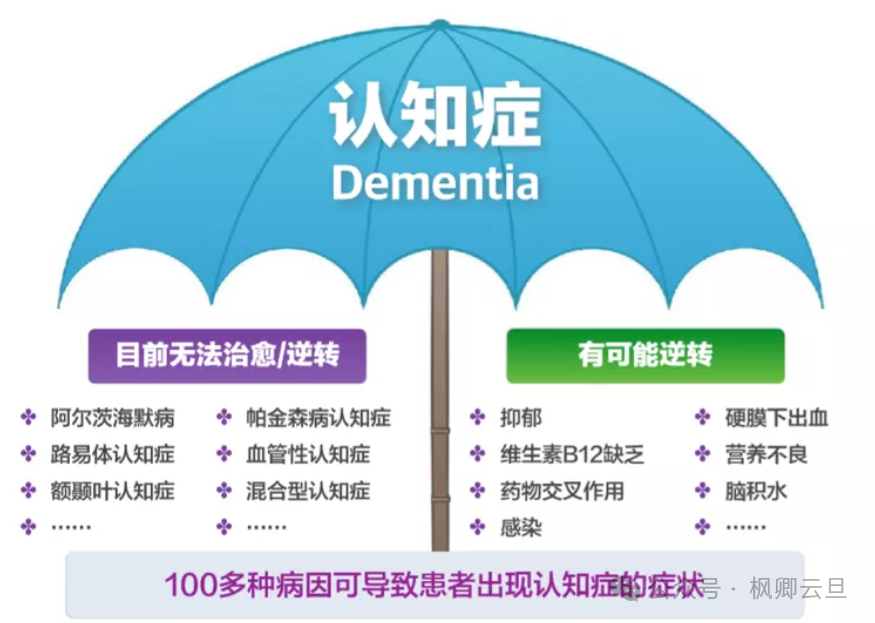
Introduction: Behind the Disappearance of Memory: How Will You Accompany Your Mother?
Have you ever had moments like this? Your originally gentle and determined mother suddenly puts her keys in the refrigerator or carelessly piles the washed clothes on the coffee table. You go from initial jokes and teasing to an increasingly heavy sense of helplessness—”How could she do this? What is wrong with her?”
Memory impairment not only robs individuals of fragments of their lives but also feels like a disaster for families. A broken glass can be reassembled, but once the shared memories between people are shattered, how can they be repaired? Alzheimer’s disease, a representative of age-related cognitive impairment, troubles millions of families in China, like a thief that quietly steals the “past,” plunging many families into pain and guilt. However, at the Memory Clinic of Huashan Hospital affiliated with Fudan University, a group of people is piecing together the big puzzle of “regaining memory” using science and technology.
Chapter One: “Live Trials”: AI Nurses Enter Huashan Memory Clinic, Direct Feedback from Patients’ Families
“Is it reliable to have robots as nurses?”—The Family’s First Reaction
Aunt Zhou, 70, a retired teacher, began frequently searching for lost documents (which were actually not lost) three months ago. When her daughter first brought her to the clinic, they were greeted by a bright yellow “nurse robot.” With two cute antennas on its head and several small wheels below, the scene was quite shocking.
“The robot chatted happily with my mom and even helped with cognitive tests, surprisingly reducing the tension,” said Aunt Zhou’s daughter.
Is the patient being “interviewed by a robot” just playing house?
At first glance, it seems a bit like that, but upon closer inspection, it is quite sophisticated. This AI nursing robot is equipped with intelligent voice, facial recognition systems, and sensors that can sense patient reactions. Clinically, it is usually arranged as the “first line of defense”—
- Helping patients record their name, age, and basic information;
- Guiding patients through initial screening with simple questions (such as drawing a clock, reciting words);
- Soothing patients’ anxiety with a calm tone;
- Interacting with family members in real-time, automatically generating the first part of the electronic medical record.
What are the three highlights of the AI “nurse” that have liberated what?
Just like having a sorting robotic arm on an assembly line, nurses no longer need to repeatedly input data mechanically—what’s more valuable is that the AI “nurse” will never run out of patience. A clinical observation from the Fudan Memory Clinic in 2023 (published in the “Chinese Journal of Geriatrics”, 2023, 43(4):745-752) showed that among 360 newly diagnosed patients with cognitive impairment:
- The machine-assisted interview process took 37% less time than manual methods;
- Family members’ subjective satisfaction increased by about 22%;
- The recognition rate of early overlooked symptoms improved by nearly 18% (verified by the neuropsychology team).
Visualizing with a mermaid flowchart, intuitively feel the role change of the AI nurse:
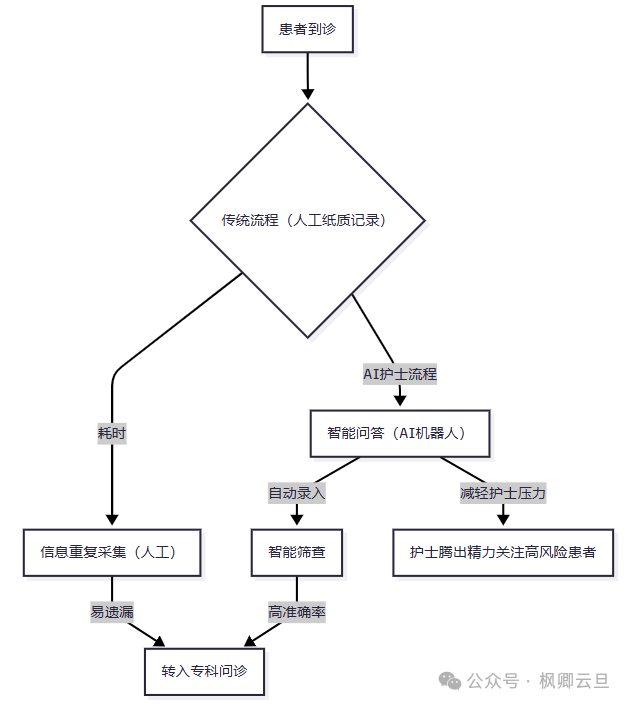
(A direct comparison of traditional and AI-assisted clinic processes)【Action Directive】 Following the flowchart, it can be seen that the AI nurse acts like a filter, keeping the mechanical and tedious tasks outside the door and leaving the more human-centered care to “humans.”
Will AI nurses replace real nurses?—The Reality is Quite the Opposite!
In fact, it is more like “adding a smart add-on.” Nurses do not act as “machines” but have more time to interact with patients and observe subtle emotional changes. The truly complex care decisions and empathetic communication still rely on humans; it’s just that humans can focus their energy on more important areas.
Chapter Two: Is the Screening APP a Blessing or a Curse? The Dilemma and Ethical Threads of Patients’ Families
“With the screening APP, are the elderly at home being labeled?”
It must be said that cognitive impairment digital screening apps are changing the “starting line” of diagnosis. In the past, cognitive impairment screening relied heavily on lengthy paper-and-pencil tests or the experience of professional doctors. But with the advent of the APP, the threshold has been greatly lowered: “Just tap your phone to test once, done in three to five minutes, it seems everyone can use it.”
However, behind the convenience, there is a cost. Mr. Sun’s father was recently given a “high-risk warning” by the APP, and the whole family is worried. “We are afraid of being ‘diagnosed’; once it spreads, it will be difficult for work and insurance.”
How reliable is the cognitive screening APP? Can safety and privacy be guaranteed?
Scientific Distance: What is the accuracy of existing APPs?
There are many similar products both domestically and internationally. A systematic review in 2022 (see The Lancet Digital Health, 2022, 4(9):e682-e696) summarized the mainstream cognitive impairment APPs worldwide, with an average sensitivity of about 85.3% and specificity of about 74.5%. This means that the APP can identify suspects with a high probability, but there are occasional “false positives.”
Daily Concerns: “Who is using the APP to test my cognitive ability? Who sees the data?”
- Some APPs involve uploading sensitive video clips or voice data.
- There is a risk of data leakage and misuse (such as insurance companies denying coverage, employer discrimination).
In a 2023 survey on Internet + healthcare in China (conducted by Tencent Medical and Tsinghua University), over 60% of elderly people are worried that “APP screening data will be sold.” However, relevant legal protections still exist in a “gray area.”
Ethical Conflicts: Does the APP’s prediction of diseases bring about a preset “social label”?
Professor Wang Lei, a medical ethicist (Fudan Ethics Center), stated: “Digital screening technology itself has no ‘good or evil,’ but once big data is handed over to non-medical personnel, interpreting the results can easily become a ‘decision-shifting’ issue. The APP can help you make a rough judgment but cannot replace a professional doctor’s diagnosis and psychological comfort.” (“Medicine and Philosophy”, 2023, Issue 12)
Chapter Three: Insights into Memory’s “Clues”: Are Cerebrospinal Fluid Biomarkers the “Golden Key” for Early Diagnosis?
“Is it really necessary to draw cerebrospinal fluid?”—The Family’s Hesitation
“Are we putting mom through too much?” Most people instinctively recoil when they hear “lumbar puncture.” Cerebrospinal fluid (CSF) biomarkers—this term sounds daunting. However, it has become one of the “gold standards” for early diagnosis of Alzheimer’s disease (in fact, the consensus in 2021 in “Alzheimer’s & Dementia”).
Is it really worth it? What do clinical data say?
In the past, 90% of Alzheimer’s disease diagnoses relied on “symptoms,” such as frequently getting lost or forgetting things. However, CSF biomarker testing can identify signs of disease 5 to 10 years before symptoms appear by detecting indicators like beta-amyloid (Aβ, harmful deposits in the brain) and tau protein (microtubule protein within nerve cells).
- A 2022 multicenter clinical study in the Netherlands (see Neurology, 2022, 98(24):e2381-e2390) showed that CSF testing had an accuracy rate of up to 94% in detecting early Alzheimer’s disease (2-4 years before symptoms appear).
- A domestic clinical cohort in 2023 published in the “Chinese Journal of Neuroscience” indicated that nearly 200 asymptomatic high-risk elderly individuals with positive CSF tests had a fourfold increased risk of cognitive decline within two years.
“What if the cerebrospinal fluid can’t be drawn?” “Is there a risk in drawing it?”—Practical Tips Here
Practical Experience: “Lumbar puncture” is not as scary as it seems in movies; usually, you lie on your side on a bed, with local anesthesia, a thin needle, and it takes less than twenty minutes. The incidence of bleeding, infection, and severe headaches is less than 1% (see the International Neurology Association’s standard procedures, 2021).
Visual Flow: Intuitively Expressing with a Mermaid Diagram
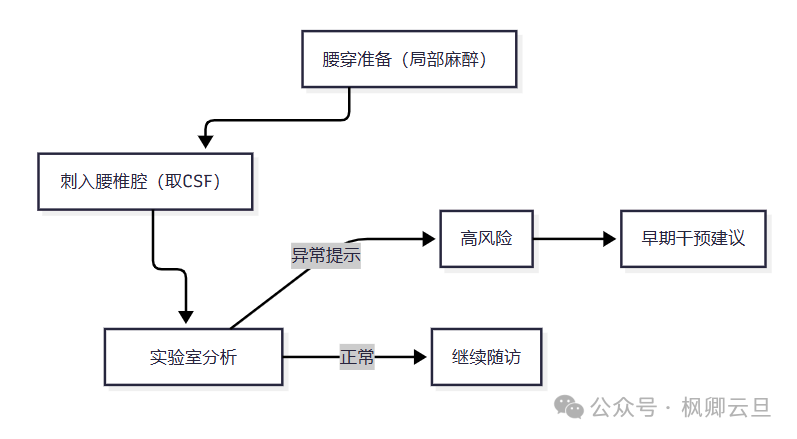
(Each step can be explained in detail to alleviate doubts)
Chapter Four: The “Icebreaking” Team for Dementia: Digital Therapy, Brain-Computer Interfaces, and the Future
“Can just taking medicine delay the disease?”—New Hope Actually Lies in “Digital Prescriptions”
Medications, like ferries, can only slow down the loss of memory but cannot create a time machine. In recent years, “Digital Therapeutics” (digital intervention smart treatment tools) have brought new changes to traditional treatments:
What is Digital Therapy?—”Pills + Video Games = Digital Intervention”?
In simple terms, it is using professionally customized APPs, games, or wearable devices under the guidance of doctors to “exercise the brain” to achieve goals like memory enhancement and attention training. This is vastly different from ordinary entertainment apps; for example, the only FDA-approved treatment for mild Alzheimer’s disease, the “EVO game,” allows patients to engage in “brain gymnastics” at home.
What are the current results?
- The “Akili EVO” game can improve attention scores by 12% compared to traditional interventions (see Nature Digital Medicine, 2020, 3(4):233-240), with no side effects.
- The “Remembrance Garden” APP developed by the Shanghai Mental Health Center team, through three digital training sessions per week, showed stable or even slight improvement in cognitive scores after six months (preliminary data, 2022).
What impact has “Digital Therapy” brought? The Head Nurse Has Something to Say
At the Fudan clinic, head nurse Ling Yan (pseudonym) remarked, “Many patients who previously struggled to maintain cognitive training now look forward to ‘leveling up’ every day since using the innovative APP. Digital tools turn intelligence into fun.”
Brain-Computer Interfaces: Do They Offer a Chance for Lost Language and Movement to Fight Back?
Imagine a “highway of information” built between the brain and machines, where even if one cannot speak or move, brain signals can directly issue commands. This is the Brain-Computer Interface (BCI).
Any recent “Tiger Sniff” news?
- By the end of 2023, the world’s first Alzheimer’s patient with language expression disorders regained simple communication abilities through BCI (see Nature Neuroscience, 2023, 26(12):1674-1679).
- Tsinghua University’s Brain and Intelligence Laboratory has piloted a non-invasive BCI combined with EEG caps and thought control, achieving enhanced digital interaction capabilities for early patients (clinical cohort report, 2023).
Currently, BCI is still mainly in the “small sample laboratory stage,” but it undoubtedly serves as a guiding light for patients with long-term aphasia or motor disorders.
Visual Guide: Intuitively Explaining Core Technology Layers
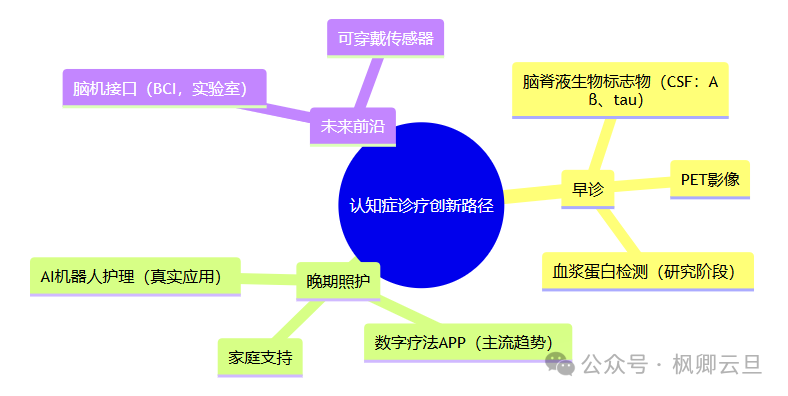
(Each layer of “technological advancement” can be understood from left to right as “from basic to innovative breakthroughs”)
Chapter Five: Real Perspectives from Families: What Has Technology Changed?
Aunt Zhou Has a “New Partner”; Memories No Longer Struggle Alone
The aforementioned Aunt Zhou, when she first entered the clinic, found most families confused and helpless. Since using the AI nurse and family APP, not only are records more detailed, but Aunt Zhou also occasionally chats with the robot, saying, “Last time you asked me what I like to eat; today I want to change!” At that moment, the atmosphere in our family seemed to lighten a bit.
Does the APP Bring Families Closer or Add a Layer of “Digital Barrier”?
Sometimes, convenience and indifference may be just a thin line apart. Has intelligence left the “nurse” outside the door? Many families have found that while the APP is convenient, “Mom hasn’t spoken all day, but the APP still prompts her to take tests,” revealing a sense of distance between humans and machines that can be more anxiety-inducing than a doctor’s questioning.
Ethical Controversy: Is It Considered “Digital Surveillance”?
Some family members expressed their feelings: “I don’t want the elderly’s symptoms to be judged by AI in the future. Illness is part of a person; it cannot just be calculated but must also be understood.”
Chapter Six: “I Want to Push Open the Door of Hope with My Own Hands” — Outlook + Rational Additions
Technology Brings More Than Just “Efficiency”; It Also Redefines “Care”
Just as we once thought assembly lines replaced handcrafted products with industrial ones, AI and digital therapy are also redefining “care”—it is not about replacing a person but bringing an “intelligent caregiver that won’t tire, can record, and is traceable.” The key is that families, medical teams, and patients make decisions together; “technology + humanity” can open a new future.
Latest International and Domestic Developments
International Frontiers
- Digital Therapy MainstreamingIn 2023, the FDA approved a new augmented reality therapeutic APP for training in mild to moderate Alzheimer’s disease (literature: Science Translational Medicine, 2023, 15(64):eabk3212). It has entered the medical insurance directory.
- Brain-Computer Interfaces Transitioning from Animals to Clinical CohortsIn 2023, Heidelberg University in Germany, multiple groups of patients restored partial memory retrieval functions through micro BCI chips (currently undergoing multi-center randomized controlled trials).
- CSF Biomarker Guidelines UpdatedThe European Academy of Neurology (2023) updated standards: CSF testing is suitable for inclusion in annual examinations for high-risk populations.
Domestic Innovations
- Fudan, Tsinghua, Shanghai Medical University, and Shanghai Mental Health are jointly tackling AI nursing + APP as new “standard components” for outpatient screening, with multiple hospitals already implementing (real-world evidence to be published continuously from 2022-2024).
- The local “cerebrospinal fluid/blood combined biomarker” cohort sample is continuously expanding, aiming to achieve a “non-invasive + early detection” path in China.
- AI robots are achieving integration with electronic medical records and medical insurance databases, advancing the overall implementation of digital care in a “two-way synchronization” model (see “Chinese Journal of Geriatrics”, January 2024).
Practical Tips and “Pitfall” Secrets
● Three Key Points for Choosing AI Nursing/Digital Therapy
- Must have medical institution endorsement; beware of “three-no APPs”
- Family members should accompany trials; do not ignore “abnormal prompts”
- Regularly return to outpatient multidisciplinary teams; AI is only an aid and cannot independently determine diagnoses
● How to Avoid Pitfalls in Cerebrospinal Fluid Biomarker Testing?
- Lumbar punctures should be performed in tertiary hospitals’ neurology departments; do not trust small clinics’ “quick tests”
- Abnormal indicators do not equal “terminal illness”; they need to be combined with PET imaging and complete medical history
- High-risk asymptomatic elderly individuals are advised to have a recheck every two years to reduce new anxiety
Conclusion: “Humans and Machines Side by Side” is the Future Path of Dementia Care
Life is unpredictable, and memories can slip away quietly. But when I see robots accompanying my parents in laughter and doctors using APP content to chat with the whole family, I shake the “technological crutch” in my hand and gradually understand: true care is not cold numbers, not rapid AI, but “technology + affection” working together, allowing families with memory loss to catch their breath and push open the door of hope.
Cognitive Highlights: “The Gradually ‘Disappearing Self’ of Dementia Patients is Being Archived and Reproduced by Technology as ‘Information Snapshots’—A New Type of Memory Puzzle Built by Humans and Data.”
Visual Memory Points
Image Display:

Extended Reading Clues
- [The Lancet Digital Health. 2022;4(9):e682-e696. Review of Digital Screening for Cognitive Impairment]
- [Nature Digital Medicine. 2020;3(4):233-240. Analysis of the Effects of “EVO” Digital Therapy]
- [Neurology. 2022;98(24):e2381-e2390. Prospective Cohort of CSF Biomarkers]
- [Science Translational Medicine. 2023; 15(64):eabk3212. New Breakthroughs in AR Digital Therapy]
—— Our era may be witnessing new possibilities for the “loss and recovery” of memory.