 This article is compiled by Semiconductor Industry Insights (ID:ICVIEWS) fromdigitimes
Will the ASIC Market Landscape Change with the Push from Major US CSPs?

As major US cloud service providers (CSPs) prepare to announce their latest earnings, investors are closely monitoring potential changes in their investment strategies and capital expenditures in cloud infrastructure, which are key factors affecting the custom ASIC market.
Despite varying growth rates and restructuring efforts (partly due to competition in the AI sector), leading CSPs remain focused on expanding data center capabilities and developing in-house ASIC solutions. Ensuring the security of AI infrastructure remains a continuous priority to maintain strong demand in this field.
This ongoing momentum intensifies competition among well-known ASIC developers. US semiconductor companies Broadcom and Marvell face fierce competition from Taiwanese companies, including MediaTek and Global Unichip. As the technology gap between US and Asian manufacturers narrows, and communication service providers increasingly emphasize cost-effectiveness, competition for ASIC design contracts has significantly escalated.
 Meta, Google, and AWS at the Center of Vendor Bidding Wars
Against the backdrop of surging global demand for AI chips, competition for orders in the chip industry has become increasingly fierce. According to industry insiders, Broadcom and MediaTek are fiercely competing for Meta’s next-generation AI chip orders, while both companies are also actively vying for Google’s related business. Meanwhile, Marvell and Alchip continue to compete for AWS contracts, leading to a full-scale battle over orders from major corporations.
In the ASIC field, Broadcom currently maintains an undisputed leading position, often seen as the initial frontrunner for several large transactions reported recently. Its accumulated advantages in chip design, manufacturing processes, and market channels enable it to consistently provide high-performance, high-reliability products to customers, giving it a favorable position in competition with other companies.
However, competitors are also ramping up their efforts. Marvell has clearly stated its intention to strengthen its focus on the ASIC field through internal restructuring and cost control. By optimizing internal structures, improving operational efficiency, and reducing production costs, Marvell hopes to enhance its competitiveness in this field and gain more opportunities in the order competition, challenging Broadcom’s leading position.
MediaTek’s development speed has been unexpectedly rapid, and its competitiveness has risen to a level capable of directly challenging major US suppliers. With continuous investment in chip R&D and technological breakthroughs, MediaTek is catching up to and even reaching industry-leading levels in key metrics such as performance and power consumption, demonstrating strong strength in competition with companies like Broadcom.
As AI technology continues to develop and application scenarios expand, the demand for AI chips from major corporations is expected to keep growing, and this order competition may intensify, potentially altering the market landscape for various companies.
 Despite a Fragmented Market, US CSPs Remain Core Revenue Drivers
While the list of major cloud service providers (CSPs) is relatively limited, chip manufacturers emphasize that leading US companies like Google, AWS, and Meta continue to be the core forces driving the largest and most scalable demand for ASICs. At the same time, emerging companies are rapidly rising as important sources of demand for AI chips, including startups like OpenAI and large-scale enterprises like Tesla, diversifying the ASIC demand market.
Among the top customer base, Google and AWS are currently the most proactive in initiating chip designs and placing purchase orders. Google, with its deep layout in the AI field, has a continuous and strong demand for customized ASICs, constantly pushing chip technology towards higher performance and lower power consumption; AWS, relying on its massive cloud computing business, is purchasing ASICs in large quantities to optimize service performance, providing solid business support for chip manufacturers.
Meta remains active in the ASIC market; however, its internal AI strategy is undergoing adjustments, making the short-term demand outlook for ASICs somewhat uncertain, posing challenges for chip manufacturers in collaborating with Meta amidst this uncertainty.
Microsoft’s ASIC business is facing significant challenges, as recently launched products have not met the company’s internal cost-efficiency targets. To keep its ASIC business progressing, Microsoft may need to initiate more projects, but this could pose execution challenges for its chip manufacturing partners, as advancing multiple projects simultaneously requires more efficient coordination and stronger production capacity guarantees.
The performance of these different entities in ASIC demand collectively shapes the current demand landscape of the ASIC market and influences the development pace and technological direction of the ASIC industry to some extent.
 The Long-Term Outlook for ASIC Development Remains Optimistic
Although some cloud service providers have expressed concerns about the resource intensity of developing custom ASICs, most semiconductor manufacturers currently report that core customers remain highly interested in initiating new projects. With the strong support of continuously rising demand for AI workloads, the overall ASIC market is expected to maintain strong growth momentum, a trend expected to continue at least until 2030.
As demand for AI chips from enterprises grows, related revenues for cloud service providers may gradually decrease, but the stable order volume from leading cloud companies still provides key opportunities for engineering innovation and brand upgrades in the ASIC field. These orders not only inject momentum into technological R&D, driving breakthroughs in chip performance and efficiency, but also allow related companies to accumulate technical reputation amidst fierce competition, laying the foundation for expanding broader market space and continuously activating the development vitality of the ASIC industry.
*Disclaimer: This article is the original work of the author. The content reflects their personal views, and our reposting is solely for sharing and discussion purposes, not representing our endorsement or agreement. For any objections, please contact us.

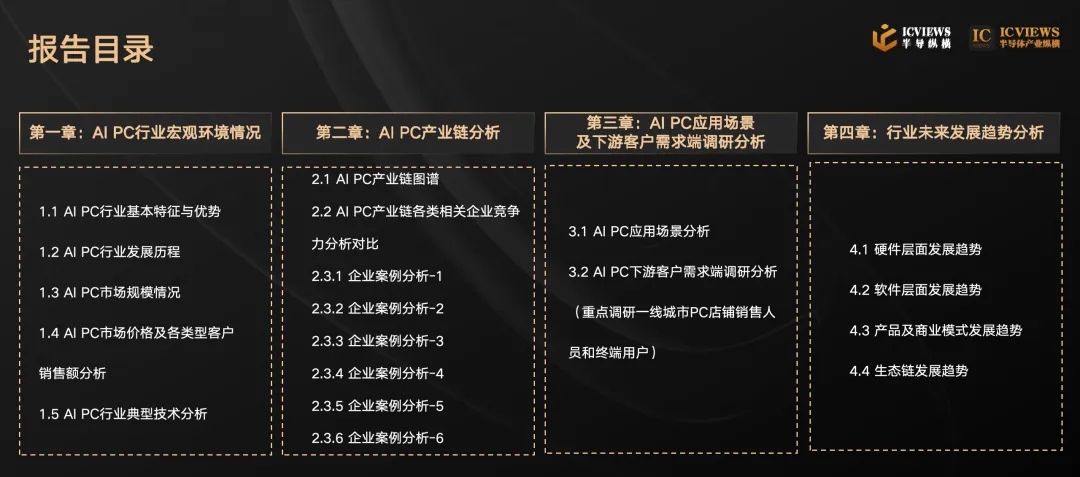
AI PC Industry Research Report
To help players across the hardware, software, model, and terminal layers in the PC field better understand the current development status and future trends of the AI PC industry, Semiconductor Industry Insights is preparing to write the “AI PC Industry Research Report.” We are currently soliciting case studies from various manufacturers in the AI PC industry chain. This report will be published through the Semiconductor Industry Insights multimedia matrix, and participating cases will receive rich promotional support and exposure opportunities. This case solicitation starts now, and the report is expected to be released in July. We welcome relevant companies to actively participate in discussions! Interested parties can contact us:
* WeChat ID 1: icviews2
* WeChat ID 2: Joy8432211