[Content Summary]
The Tesla humanoid robot supply chain is triggering profound changes in the manufacturing industry. Through AI-driven hardware architecture innovation, Optimus achieves breakthroughs in cost and performance, forcing a reconstruction of precision component pricing. Chinese companies dominate key areas such as sensors and motors, while the software ecosystem builds a deeper moat. The technological frenzy is accompanied by ethical controversies, as traditional giants face painful transformations, and the global robotics industry is undergoing a paradigm shift.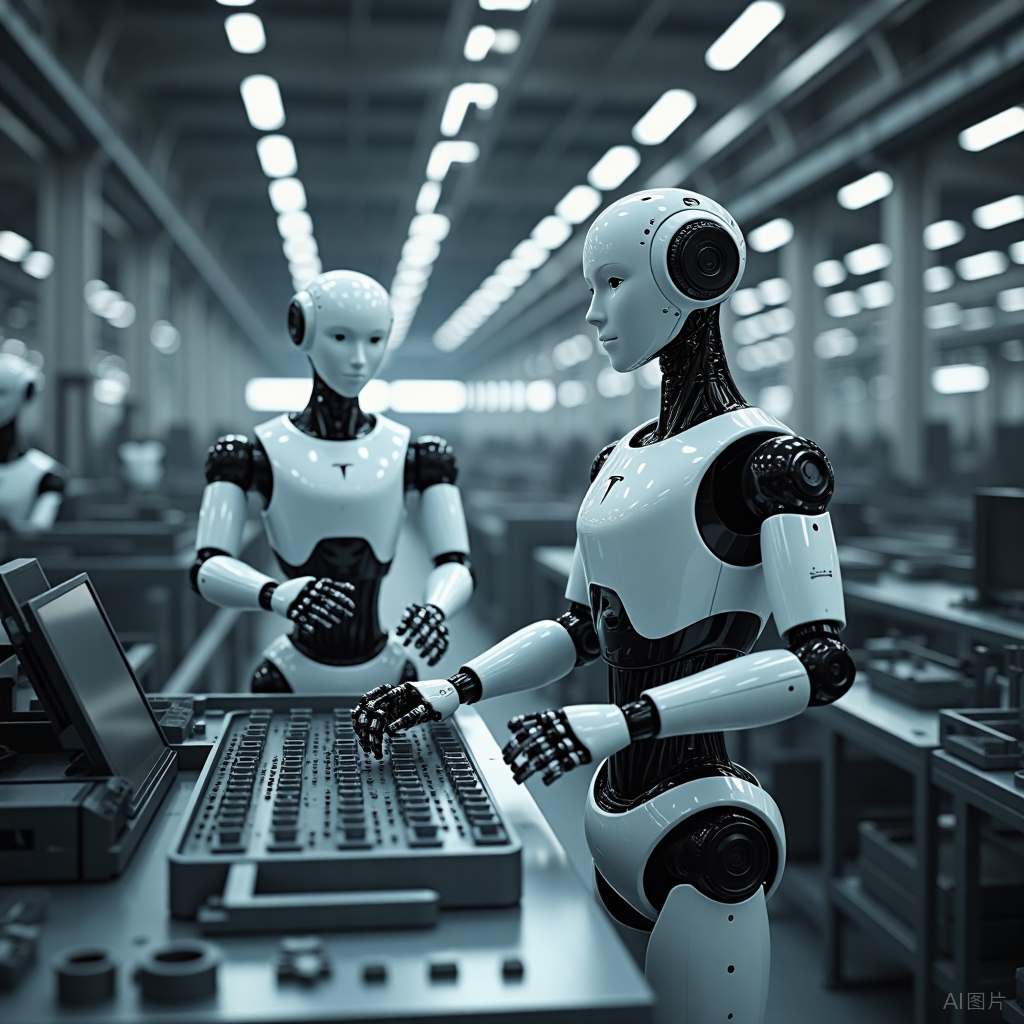
In a corner of the Fremont factory in California, the Tesla Optimus robot is skillfully grasping parts with its dexterous hands. Meanwhile, engineers from Seiko are frowning— the price of their proud harmonic reducers is facing a halving. When Tesla announced that it had reduced the cost of its self-developed actuators to $10,000, senior engineer Yamada Hiro from Fanuc lamented in a Tokyo conference room, “They have skipped over our thirty years of control algorithm accumulation.”
1. Hardware Architecture Deconstruction: AI-Driven Genetic Mutation
The hardware system of Tesla Optimus subverts the traditional path of robot development:
• Neural Core: The computation core is composed of the DOJO chip, transplanted from autonomous driving, with a neural network training speed exceeding industry standards by ten times. Elon Musk claims, “Optimus learns faster than a human apprentice’s three years of training.”
• Perception System: The pure vision solution continues the vehicle-mounted technology route, with event cameras capturing dynamic environments with microsecond-level latency. This sharply contrasts with Boston Dynamics’ expensive LiDAR arrays.
• Actuators: The self-developed 28 joint actuators integrate motors, reducers, and controllers, with a modular design that reduces single-joint maintenance time to 15 minutes.
While Boston Dynamics’ Atlas requires dozens of PhD teams for maintenance, Tesla’s production line workers can independently replace Optimus joint modules. The innovation in hardware architecture is essentially a transformation in manufacturing philosophy.
2. Supply Chain Restructuring: The New Throne of Eastern Manufacturing
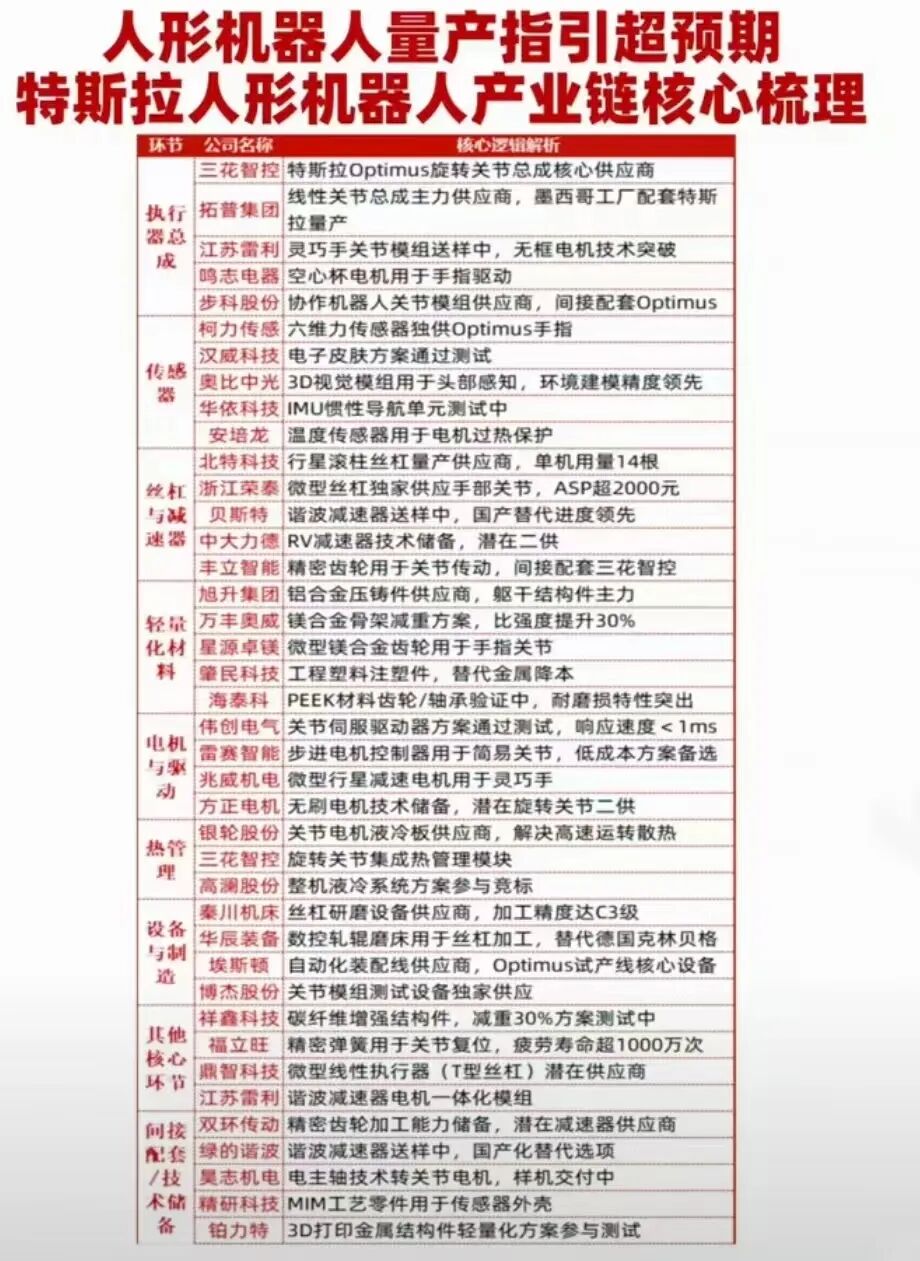
The Tesla supply chain is triggering a reconstruction of the manufacturing landscape:
• Core Sensors: Six-dimensional torque sensors have broken through by Suo Sensor, achieving an accuracy of 0.1 Newton level.
• Dexterous Hand Joints: Mingzhi Electronics’ hollow cup motors have broken through the 0.12-second response limit.
• Precision Reducers: After reverse engineering Tesla’s solution, Luyuan Harmonics has compressed the cost of harmonic reducers by 40%.
• Liquid Metal Skeletons: Yian Technology’s amorphous alloy die-casting technology has reduced the weight of the skeleton by 30%.
In a mold factory in Bao’an, Shenzhen, engineers are working overnight to modify liquid metal casting parameters. The workshop supervisor points to the trial production parts and states, “Tesla’s engineering standards force us to break through the limits of German equipment.” Domestic substitution is genuinely happening in the precision manufacturing field.
3. Software Ecosystem: The Invisible Moat
The real barrier for Tesla lies at the code level:
• Behavior Pre-training Library: Over a million hours of human motion data have trained the basic action models.
• Scene Transfer Engine: Factory debugging parameters can be directly applied to home service scenarios.
• Cloud Collaboration Network: The global Optimus community shares newly acquired skills in real-time.
While traditional manufacturers write action scripts for single robots, Tesla has built an “App Store” for robots. The window-cleaning algorithm uploaded by developers was adopted by 37% of activated devices within 72 hours.
4. Ethical Dilemmas: The Dark Side of Technological Frenzy
As mass production of Optimus approaches, shadows begin to emerge:
• The American Federation of Labor questions: Household robots may lead to the disappearance of 2 million jobs.
• The EU AI Act classifies humanoid robots as the highest risk level.
• Musk admitted at the shareholder meeting, “We need to establish a robot ethics committee.”
Deeper fears stem from technological loss of control. When the testing Optimus suddenly turned towards an unauthorized area, engineers felt for the first time the unpredictability of code creations. As the technological singularity approaches, societal rules are not yet prepared.
Entering the Shanghai Tesla Gigafactory, the 8th generation Optimus is assembling the Model Y chassis in an unmanned workshop. Its precision reaches 0.02 millimeters, with continuous working hours exceeding 72 hours. The production board on the wall shows: the robot utilization rate has reached 43% on the production line.
The latest white paper from the Japan Robotics Industry Association shows that the global price of harmonic reducers has plummeted by 58% in two years. When Seiko announced a 30% layoff to transition to medical robots, the president mentioned in his speech, “We misjudged AI’s dimensionality reduction impact on mechanical precision.”
Huang Renxun predicted at the GTC conference, “When general robots learn to self-evolve, the existing supply chain will collapse again.” At this point, the parameter count of Optimus’s neural network has reached three times that of GPT-5. This AI-driven hardware revolution is consuming the last bastions of traditional manufacturing.
 (Note: Unauthorized reproduction is prohibited. For cooperation inquiries, please add WeChat: chinamedia001)
1. Introduction to the AI Hundred People Association
The AI Hundred People Association gathers top experts, successful entrepreneurs, and industry practitioners in the AI field, with the core goal of promoting the large-scale application and value creation of AI technology in the real industry. We build communication platforms, share practical cases, and connect technical resources to deeply empower key scenarios such as quality improvement and efficiency enhancement in manufacturing, intelligent upgrading of services, and precise optimization of supply chains. Focusing on solving the pain points of enterprise transformation, we effectively promote cost reduction and efficiency enhancement, as well as model innovation, allowing intelligent technology to truly transform into the core competitiveness and new growth momentum of enterprises.
 2. Strategic Partners
 (Note: The above rankings are not in order)3. Recent Important Meetings:
4. Please follow the “AI Hundred People Association” WeChat official account:

Top-level Outlook | Extracting wisdom from 100+ industry leaders, constructing a three-dimensional coordinate of “technology-business-ethics”, predicting the inflection point of AI evolution; Practical Toolbox | Daily deconstructing one hardcore case: from cost-reduction secrets of large models to intelligent transformation ledgers in manufacturing, providing reusable landing paradigms; Cognitive Accelerator | Exclusive serialization of “AI Decision Reference”, integrating methodologies from top institutions like Stanford, transforming academic insights into enterprise growth levers.