
Functional Dyspepsia (FD) is a common functional gastrointestinal disorder characterized by self-reported symptoms such as upper abdominal pain, upper abdominal burning, postprandial fullness, and early satiety, which cannot be explained by routine clinical evaluations. Epidemiological studies indicate that approximately 20% of the global population suffers from dyspepsia, with 80% of these individuals lacking endoscopic evidence to support their symptoms. Furthermore, recent studies have reported that the prevalence of FD is significantly higher in individuals aged 18 to 34 compared to other age groups. Among all age groups, the prevalence of FD is notably higher in females than in males. However, the diagnosis of functional dyspepsia relies on self-reported symptoms.
Fang Cheng and colleagues from Chengdu University of Traditional Chinese Medicine hypothesized that valuable information regarding FD patients’ conditions is contained within the functional brain networks, which could serve as biomarkers to differentiate FD from normal controls using multimodal analysis methods. The results of this study were published in the journal Cerebral Cortex, aiming to determine the potential of functional brain network features as biomarkers for identifying FD patients.
The research team utilized the Support Vector Machine (SVM) algorithm to establish a classification model to differentiate FD patients from normal controls, with the objectives: 1) to detect whether and to what extent functional brain network features can distinguish FD patients from healthy subjects (HS) at the individual level, 2) to identify the functional brain network features that contribute significantly to the classification, and 3) to validate the robustness of these classification features across brain maps, thereby exploring the feasibility and stability of identifying FD patients based on functional brain network biomarkers.
First, functional brain magnetic resonance imaging data were collected from 100 FD patients and 100 healthy subjects, and functional brain network features were extracted through independent component analysis. Then, a support vector machine classifier was established based on these functional brain network features to distinguish FD patients from healthy subjects. The features that significantly contributed to the classification were ultimately identified as classification features.
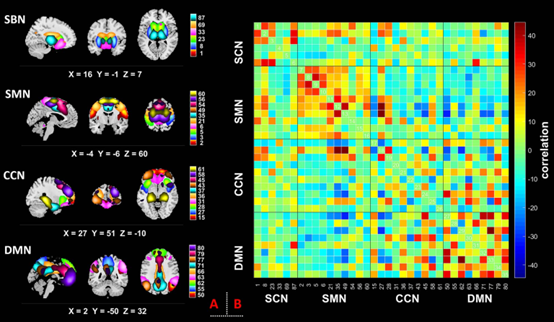
The selected independent components and functional brain networks. (A) shows the spatial distribution map of 35 selected independent components across four networks. (B) shows the subject-averaged functional connectivity matrix for each independent component pair.
The research results indicate that the classifier performed well in distinguishing FD patients. The classification accuracy for the cross-validation set was 0.84±0.03, and for the independent test set, it was 0.80±0.07.
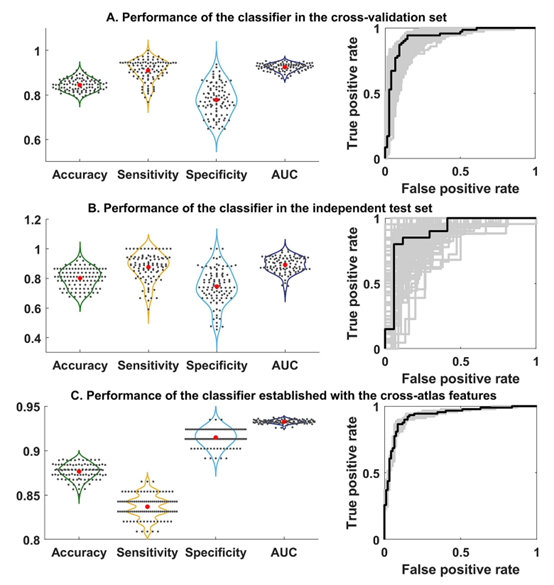
Performance of the classifier over 100 iterations.
Ultimately, 15 connections between the subcortical nuclei (thalamus and caudate nucleus) and the sensorimotor cortex, parahippocampal gyrus, and orbitofrontal cortex were identified as classification features.
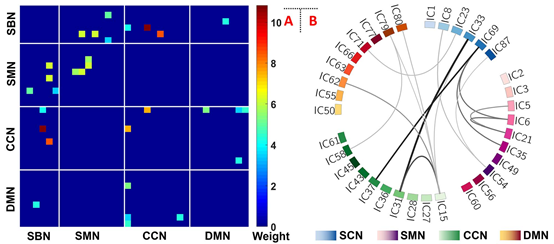
Classification features of FD patients versus HS patients.
Moreover, the results of the cross-brain map validation indicate that these classification features are very robust in identifying FD patients.
The functional connectivity between the subcortical nuclei (thalamus and caudate nucleus) and the sensorimotor cortex, parahippocampal gyrus, and orbitofrontal cortex is a key feature for accurately distinguishing FD patients. These findings suggest that using machine learning methods and functional brain network biomarkers to identify FD patients is promising, potentially providing a future method for objective and accurate diagnosis of FD.
Original source
Tao Yin, Ruirui Sun, Zhaoxuan He, Yuan Chen, Shuai Yin, Xiaoyan Liu, Jin Lu, Peihong Ma, Tingting Zhang, Liuyang Huang, Yuzhu Qu, Xueling Suo, Du Lei, Qiyong Gong, Fanrong Liang, Shenghong Li, Fang Zeng, Subcortical–Cortical Functional Connectivity as a Potential Biomarker for Identifying Patients with Functional Dyspepsia, Cerebral Cortex, 2021;, bhab419, https://doi.org/10.1093/cercor/bhab419
Written by | Imaging Xiao Sheng
Editor | beartwo For authorized reprints and tips, please contact the administrator of Meis Medicalbeartwo@Meis Medical (WeChat ID: medsci2jia)
These days, due to changes in the public account’s push rules, the timeline has been disrupted. If you have not marked us as a star or frequently clicked “Looking” on our posts, our pushes may be buried in your vast subscription list.
The editor is particularly afraid of losing touch with you, so we need you to mark Dyspepsia as a star, and every time you finish reading an article, click “Looking” at the end of the article or share it, so we can stay close and not drift apart!
