
AI technology is fundamentally transforming every field it touches, and the integration of AI technology in EDA is reshaping the entire automotive industry. With the application of AI technology in Electronic Design Automation (EDA), the automotive sector is undergoing profound changes. Experts predict that from 2022 to 2030, the global AI market will achieve a compound annual growth rate (CAGR) of 39.4%, reaching a total scale of $20.76 billion. These changes are bringing numerous innovations.
Among them, AI has had a profound impact on the development of Advanced Driver Assistance Systems (ADAS). Consumers not only expect cars to provide transportation services but also desire vehicles that are intelligently connected, capable of autonomous driving, and ensure comfort and safety. As AI technology is applied in the development of EDA tools, cars are becoming smarter and more autonomous. At the same time, AI is significantly changing the semiconductor industry, affecting everything from System on Chip (SoC) design and verification to packaging.
The widespread application of AI technology in product design and development teams helps tailor all future products to meet consumer expectations. The integration of machine learning technology into the Cadence design process has enhanced productivity for design teams, covering advancements in chip design, functional safety (FuSA), and computational fluid dynamics (CFD). The application of AI/ML technology in EDA allows for rapid and accurate decision-making at the edge (tinyML). Therefore, it can be said that AI technology in EDA is akin to AI in the automotive field. In this article, we will delve into the role of AI in the automotive revolution.
The Cadence automotive electronic solutions video series will gradually be available on Bilibili. We look forward to your attention!

How AI is Revolutionizing the Automotive Industry?
With advancements in semiconductor technology and rising consumer expectations, the automotive industry is undergoing a profound transformation. It is expected that by 2027, the market size for advanced driver assistance systems (ADAS), autonomous vehicles, and digital cockpits will reach $70 billion. Furthermore, with the proliferation of AI and edge computing technologies, autonomous vehicles are no longer a fantasy. Deep learning AI enhances accuracy, aiding vehicles equipped with ADAS technology to achieve higher autonomy. Additionally, embedded AI vision technologies with deep perception and panoramic views contribute to accident prevention, decision-making, and in-car assistance. These technological advancements make our vehicles safer, more efficient, and comfortable, providing a more enjoyable travel experience.
Although fully autonomous passenger vehicles (L5) are not yet on the road, the industry is closely monitoring the development of autonomous driving systems. Autonomous driving technology has been successfully and safely applied in last-mile delivery (LMD). LMD vehicles operate at lower speeds, thus requiring less perception distance, braking distance, and safety requirements. Moreover, the application of AI technology and autonomous vehicles helps improve productivity and reduce the overall costs of LMD.
AI in EDA
As SoCs integrate more functions, the budget remains very limited, putting significant pressure on designers. Traditional EDA tools rely on “rules of thumb,” requiring designers to optimize based on intuition. This modeling and simulation technology has several issues:
-
Inability to learn from previous designs, leading to limited productivity and inaccurate designs.
-
Multiple iterations increase design time.
-
HLS often requires more time to complete synthesis.
-
Layout and routing depend on the designer’s predictions/experience, which can increase runtime.
-
Manufacturing costs are high in terms of time and resources.
To ensure design correctness, we must perform design verification before manufacturing. Traditional random/automatic test pattern generation (ATPG) schemes cannot improve fault coverage. Artificial intelligence (AI) has fundamentally transformed the EDA industry. The training and inference used in AI enhance the productivity of chip designers, helping to design chips capable of handling computation and EDA tools, allowing designers to converge and verify faster while reducing costs and improving result quality.
How AI/ML Improves Design Space?
AI/ML is highly suitable for the EDA and automotive industries, accelerating design speed and undoubtedly saving designers a significant amount of effort by integrating it into EDA tools. Using EDA tools with AI capabilities can significantly alter the trajectory of design work and help address the aforementioned challenges. Benefits to design teams include:
-
Increased accuracy and efficiency.
-
Proactive visibility.
-
Meeting ambitious power, performance, and area (PPA) targets.
-
Superior data and chip layout with less human intervention.
-
Accelerated design convergence.
What are the Similarities Between AI in EDA and AI in Automotive?
In both the EDA and automotive industries, increasing productivity, achieving results faster, and improving PPA are primary goals. Through various applications and innovations, AI is expected to fundamentally change both the EDA and automotive industries. Whether it is autonomous vehicles, ADAS, or EDA, AI and ML algorithms provide opportunities for this electronic revolution and create a new renaissance. Integrating AI capabilities into existing EDA tools helps make the EDA design process more efficient and productive. Adopting AI and its derivative technologies helps automotive manufacturers leverage multidisciplinary analysis and optimization (MDAO) techniques to enhance overall design, resulting in faster and higher-quality outcomes. At the same time, precise behavioral modeling of systems improves product fidelity and safety.
Electronic Design Automation Systems (EDAS)
Cadence Products
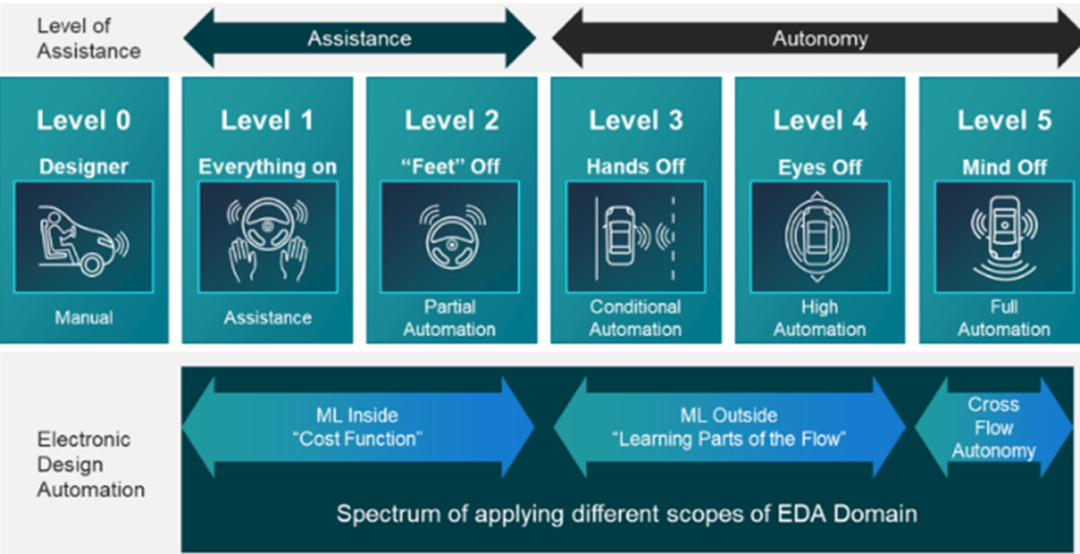
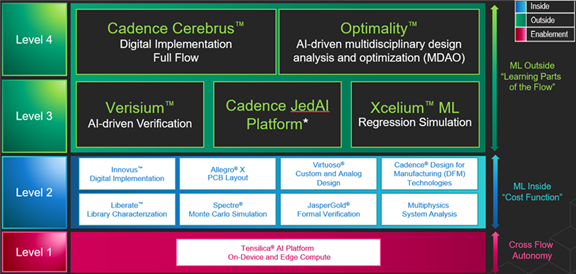
Cadence offers EDA tools with AI/ML capabilities that can produce better and more predictable results across different levels of automation, as follows. Our tools provide solution suggestions for common problems that, if evaluated by design teams, could take weeks or even months. At the same time, we are advancing ML and deep learning research aimed at improving IC design and verification convergence, continuously optimizing designs.
Cadence AI/ML Solutions/Technologies
Verisium AI-Driven Verification Platform
Represents a revolutionary shift in EDA algorithms, transitioning from single-run, single-engine algorithms to algorithms that utilize big data and artificial intelligence to optimize multiple runs of multiple engines throughout the SoC design and verification process. By deploying the Verisium platform, all verification data, including waveforms, coverage, reports, and log files, are integrated into the Cadence JedAI platform. We build ML models based on this data and mine other proprietary metrics to create a new suite of tools that significantly enhance verification efficiency.
“

”
For more information, please scan the code to view
Cadence Joint Enterprise Data and
AI (JedAI) Platform
Can accelerate AI-based chip design. It allows design teams to extract useful information from vast amounts of chip design data, improving productivity. Engineers can seamlessly manage structured and unstructured data. The Cadence JedAI Platform makes it easier for designers to tackle the complexities of designs in emerging consumer, hyperscale computing, 5G communications, automotive, and mobile applications.
“

”
For more information, please scan the code to view
Optimality Intelligent Chip Explorer
Is key to accelerating time-to-market to maintain competitive advantage. The multidisciplinary analysis and optimization (MDAO) technology of Optimality Explorer helps achieve optimal electrical design by exploring the complete design space, achieving a tenfold efficiency improvement, and can be used for Level 3 and above levels of automotive driving automation.
“

”
For more information, please scan the code to view
Cadence Cerebrus Intelligent Chip Explorer
Is a revolutionary, machine learning-based approach to optimizing chip design processes. It can be used for complex and large SoC systems targeting Level 3 and above autonomous driving technology, enabling engineers to optimize processes for multiple modules simultaneously, which is particularly important for large and complex SoCs. Additionally, Cadence Cerebrus employs end-to-end reinforcement learning techniques that can significantly enhance the efficiency of engineering teams.
“

”
For more information, please scan the code to view
Xcelium ML
Iteratively learns throughout the simulation regression process. The kernel engine performance is enhanced by matching the coverage of random test suites to reduce simulation cycles, thereby accelerating verification throughput, making it very suitable for Level 3 and above SoC designs.
“

”
For more information, please scan the code to view
Cadence Tensilica Processor IP
Supports high-performance data processing for ADAS (L2) applications such as LiDAR, radar, and autonomous driving cameras.
“

”
For more information, please scan the code to view
Cadence Design IP and
Cadence AWR RF to mmWave Solutions
Can help achieve high-performance, low-cost automotive radar front-end and beamforming antenna array technologies.
“

”
For more information, please scan the code to view
ADAS and Sensor Fusion
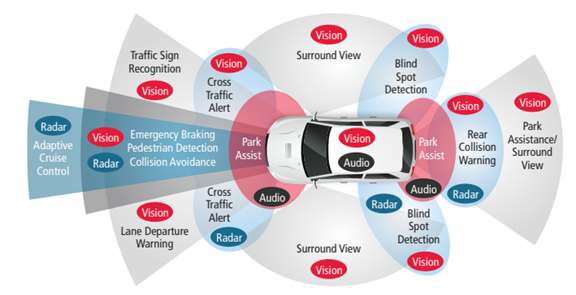
In addition, the Cadence automotive innovation platform provides strong support for automotive manufacturers, launching tools such as Innovus ML, Allegro ML, and Virtuoso ML for designing system-on-chips and PCBs for Level 2 and Level 3 autonomous driving applications.

In ADAS applications, leveraging AI is key to achieving vehicle automation. AI is helping automotive manufacturers reduce costs and increase efficiency, maintaining market leadership. The integration of AI is transforming hardware and software design, helping to meet limited PPA budgets and providing additional safety structures.
AI-based applications for visual and sensor blind spot monitoring, lane departure, and depth perception may bring us closer to realizing the dream of controlling autonomous vehicles.