0 Introduction
The unexpected arrival of the pandemic has made students experience an unprecedented “unforgettable” vacation. Conducting online teaching in various forms to effectively ensure that students “continue learning despite class suspension” has become the main theme of education at all levels during the pandemic. However, how to effectively conduct hardware practice courses that rely on physical devices is an urgent and challenging issue that needs to be addressed. In addition, the traditional practical teaching model itself has characteristics such as limited experimental hours, significant individual differences, and difficulties in personalized instruction, which restrict the improvement of teaching effectiveness.
In response to the above problems, foreign universities such as Lancaster have vigorously promoted the construction and application of virtual experimental environments [1-3], while domestic universities such as Beihang University have also emerged with a number of achievements in online practical teaching [4-8]. These provide beneficial references for the reform of practical teaching based on virtual simulation environments. However, current online practices mostly adopt software virtualization methods. Although this has the advantages of quick and simple experimental environment construction and diverse experimental functions, it does not truly integrate physical hardware into the online practice process. Students cannot access physical experimental equipment and run experiments in a real environment to obtain objective experimental results, thus making it difficult to effectively solve the problems faced by hardware practice teaching. Therefore, exploring a new teaching model that integrates physical hardware devices into online practical teaching under the conditions of informatization is of great significance for improving hardware utilization, enhancing students’ independent innovation capabilities, and promoting teachers to carry out blended practical teaching activities.
1 Characteristics of Traditional Hardware Practice Courses
There are many types of hardware practice courses set up in the computer science and technology major, which usually span both hardware and software teaching segments, characterized by a wide range of knowledge points and low-level abstraction. Although there are different emphases in teaching design, most include both theoretical lectures and hardware experiments. Generally, such courses have the following three characteristics.
1) Close connection between theory and practice.
Hardware practice courses are mostly arranged to teach theory first, followed by hands-on practice. During the specific implementation process, the theoretical part intersperses norms and knowledge points that need to be referenced in subsequent practices, while the practice part will also reinforce the theoretical content in return. Therefore, both are complementary and tightly interlinked, and the organic integration of theory and practice must be considered in the teaching process of such courses.
2) Content design progresses from shallow to deep.
The content of the hardware practice segment is usually closely aligned with the theoretical teaching content and is conducted in a progressive manner from easy to difficult. Students complete corresponding experimental tasks at different stages to achieve gradual improvement in practical abilities. In the early stages of practice, software simulation environments can be appropriately used to assist practical teaching, but in the middle and later stages, it is necessary to operate physical hardware devices for practice, as debugging and innovation of module functions cannot be separated from feedback from real environments. With the advancement of experimental content, practice teaching that is divorced from real hardware and objective environments cannot achieve actual teaching objectives and cannot meet students’ needs.
3) Tight scheduling of practice hours.
The allocation of study hours for hardware practice courses usually leans towards theoretical lectures. Taking the embedded system design course at our school as an example, out of a total of 60 study hours, only 14 hours are allocated for practice. Third-year students taking this course usually have a solid foundation in software theory and extensive experience in high-level language programming, but lack systematic hardware knowledge and have insufficient low-level programming experience. Familiarizing students with the practical process during class will inevitably occupy some study hours, leaving less time for advancing experimental tasks, making it unrealistic to require students to complete all experiments and elevate innovative designs under such circumstances. Therefore, there is an urgent need for a way to extend experimental time to allow students to conduct hardware experiments whenever they want, even outside the lab.
2 E-HIL Teaching Model
2.1 Overview of E-HIL
“Hardware in the Loop (HIL)” originally comes from the automotive industry and is a targeted black-box testing method that mainly combines software environments to achieve controllable, observable, and feedback-driven actual effects through the operation of hardware entities. Testing is conducted at the hardware controller level, allowing inputs and outputs to be controlled or observed, thus obtaining feedback effects consistent with actual execution. This method can focus on the execution testing of a specific physical device, obtaining real feedback while eliminating the influence of other physical components, effectively reducing testing costs while acquiring objective data.
Current research on online practical teaching often combines environmental simulation methods for simulation. Although this allows experimental subjects to exhibit performance and states close to real hardware, it is still essentially detached from physical devices, and students cannot operate physical hardware in a real environment. To address this issue, the industrial HIL method can be expanded in combination with the practical teaching design of embedded system design courses, adopting an online practical teaching model based on E-HIL (Enhanced Hardware in the Loop). Currently, most practical segments of computer hardware courses require operations through software environment simulation or connecting experimental boxes, circuit boards, and other hardware devices. This constitutes the “hardware in the loop” characteristic of this type of course’s practical education. This “hardware in the loop” experiment not only helps teachers and students design and test their ideas but also saves them a lot of time during project verification. The core idea of E-HIL is to extend the course teaching process that applies the HIL method, borrowing from the concept of blended teaching to move the hardware experimental environment online while providing students with a convenient platform to operate hardware experimental devices, allowing them to conduct hardware experiments anytime and anywhere.
2.2 Dual Loop Dual Drive Model
The core of the E-HIL online practical teaching model is the “dual loop dual drive” model (as shown in Figure 1), which consists of a practical teaching closed loop and an E-HIL sub-loop, while implementing comprehensive evaluations based on the entire practical process, with students as the main body of practical teaching.
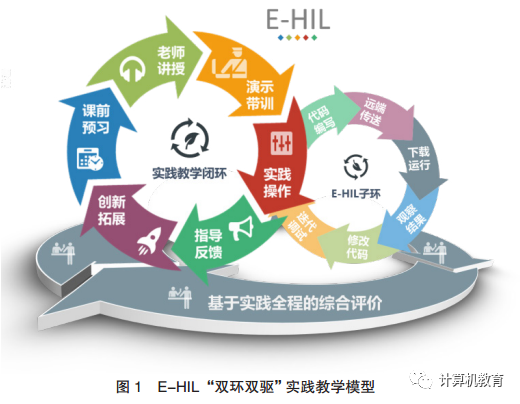
The practical teaching closed loop is the traditional way of advancing course practice segments. After students conduct pre-class preparation, attend lectures, and watch teacher demonstrations, they can begin practical operations. During the experiment, they can directly receive guidance from teachers when encountering problems, and after completing basic experiments, they can conduct innovative expansions based on personal foundation and interests before entering the next learning stage. The final assessment is based on comprehensive evaluation of performance throughout the practical process. The E-HIL sub-loop was initially designed to promote online teaching, allowing students to write and debug code on their local end. After successful compilation, they can send the source code files online to the server, while remotely controlling the server to receive and run the code. Since the experimental equipment on the server side has been connected, the experimental effects can be directly observed through a camera. If the effects do not meet expectations, further debugging can be conducted directly on the server.
As a sub-loop of the traditional practical teaching loop, E-HIL can integrate with the practical operation segment, allowing students to directly operate experimental equipment in the lab, while also enabling them to conduct practice through the E-HIL model after leaving the lab, achieving seamless integration of online and offline, creating a fully online practical environment for students, effectively solving the lack of pathways for online hardware practice courses, enhancing students’ autonomy in practice, improving the efficiency of their fragmented time utilization, and promoting learning outcomes. Problems encountered by students during online practice can be fed back to teachers either offline or online for timely guidance. At the same time, teachers can effectively grasp the quality and progress of students’ experiments, timely discover problems based on individual characteristics, and provide better differentiated guidance, helping students establish a positive development motivation for learning while providing objective support for optimizing and adjusting teaching strategies. After expanding the E-HIL sub-loop, the evaluation rules for course practice are also adjusted. Teachers will conduct comprehensive evaluations of students based on online learning dynamics, experimental processes, data code specifications, execution results, and other records. Due to the combination of online and offline comprehensive performance, the assessment points are more diverse, and the assessment results are more objective.
By jointly driving practical teaching through the above “dual loop” model, the teaching methods of hardware practice courses can be enriched, effectively increasing students’ experimental time, accelerating the advancement of experimental progress, and providing students with a more convenient platform to fully expand their innovations.
3 E-HIL Implementation Path
Based on the idea of the “dual loop dual drive” model, the implementation of the E-HIL teaching model can be promoted step by step according to specific course characteristics, following a “four-step” approach (as shown in Figure 2).
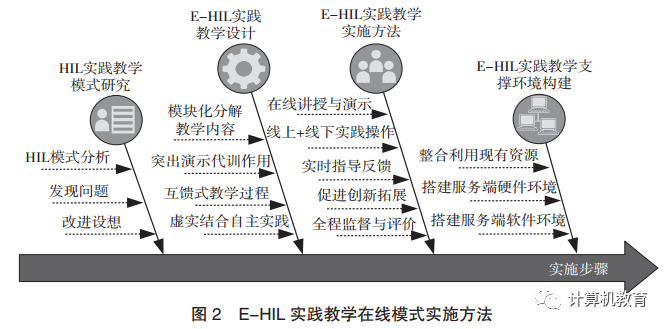
(1) HIL Practical Teaching Model. The application of the E-HIL model should first deeply study the characteristics of HIL model teaching. Currently, in the teaching design of computer hardware courses, operating physical hardware devices for experiments is the main form of practical segments. Students can deepen their understanding of relevant theoretical knowledge through hardware experiments. The HIL model can virtualize and online the experimental format, helping teachers and students design and test different ideas, and conveniently enhance innovative application capabilities through task expansion settings, while saving a lot of time for students to complete experimental tasks. However, under this model, the performance of online experimental subjects may differ from that of physical hardware entities during the experimental process. Under the influence of objective environments and human factors, different results may be obtained. Therefore, an improvement proposal is put forward: Implement targeted online improvements based on the characteristics of course experimental environments and processes to allow students to enjoy the convenience of online while remotely controlling physical devices and completing experiments in real environments.
(2) E-HIL Practical Teaching Design. The goal of this phase is to clarify how to organically introduce the operation of physical devices into the online practical teaching process. Based on the realization of online time-sharing sharing of hardware devices, better support students in conducting online experiments and engaging in independent innovation. To this end, it is necessary to fully analyze the course practice syllabus and the characteristics of E-HIL online practical teaching, scientifically design “hierarchical” practical teaching content, highlight the demonstration and guidance role of teacher-led demonstrations during the online experimental process, reasonably design feedback teaching processes, and inspire and guide students to independently expand their practice, thus achieving the effect of combining virtual and real to enhance teaching.
(3) Specific Implementation of E-HIL Practical Teaching. Based on the “dual loop dual drive” model, the E-HIL closed-loop teaching process is implemented with students as the main body of practical teaching. After students conduct preview, attend lectures, and watch experimental demonstrations, they enter the practical operation phase. The practical operation is divided into two segments: one segment is the traditional classroom advancement process, where students operate experimental equipment in groups in the lab to complete experimental tasks; the other segment is to use the E-HIL online practical platform for online software operations and local physical executions. The two segments are closely related and interconnected, effectively extending the experimental time. At the same time, students can receive guidance from experimental teachers both in class and outside of class, improving experimental efficiency and stimulating innovative momentum. Teachers can also observe students’ understanding of experiments, energy input, task completion progress, and depth from a longer experimental timeline for more objective comprehensive evaluation of students. Additionally, they can identify common problems based on students’ overall performance, which in turn guides the iterative improvement of the E-HIL model.
(4) Construction of E-HIL Practical Teaching Environment. The construction of the E-HIL environment is divided into three stages. In the early stage, effectively integrate existing resources, utilize existing online platforms to carry out online practical teaching, video live-streaming of experimental demonstrations, and conduct experiments using pure software simulation environments; in the mid-stage, build a server-side hardware environment consisting of PC clusters and experimental devices, ensuring that experimental devices are correctly connected and debugged in advance; in the later stage, build server-side software environments and construct experimental modules based on hierarchical content, supporting students to remotely operate different types of experimental devices according to personal needs. Through the construction of these three stages, a flexible, efficient, and normalized operating service environment is established.
4 E-HIL Application Practice
Based on the design of the online model of E-HIL practical teaching and the establishment of experimental platforms, the practical teaching segment of the embedded system design course is targeted to establish an E-HIL online practical environment.
4.1 Experimental Environment
The development board used in the embedded system design course experiments is the STM32 development board, which has strong scalability, rich on-board resources, and functions such as image acquisition, joystick control, and sensor data collection, capable of meeting the experimental teaching needs at different levels. The software debugging environment used for the experiments is Keil_v5, and the operating system is Win 7. The PC is connected to the STM32 development board via a J-Link debugger.
Based on the above offline experimental environment, the E-HIL online practical platform is established. A standard classroom is selected as the deployment site for the platform terminal, setting up five PCs as online practical service terminals. Each PC is connected to the development board via J-Link, and different functional modules are installed on the development board. Students can complete different experimental tasks and expansion designs through remote connection. The terminal PCs are installed with TeamViewer, allowing students to easily connect to remote desktop computers to access the experimental environment, choose different terminals for online experiments based on actual experimental needs, and observe the execution results of the development board through specially equipped high-definition cameras, achieving the same operational experience as in-class experiments.
4.2 Experimental Situation
After the deployment of the E-HIL platform, the guiding teacher can conduct online demonstrations, helping students quickly grasp the key points of the experiment and master the operational process. Students can also conduct experiments anytime through the platform outside of class, connecting to different PCs to debug various functions, advancing experiments through remote coding, local burning execution, and video feedback of actual running results, completing tasks not finished in class while also fulfilling innovative expansions based on personal needs. The platform terminals can increase interaction between teachers and students, allowing teachers to understand students’ experimental situations, and students can coordinate and assist each other, seeking help from teachers when encountering problems.
Currently, only five terminal PCs have been set up, so a maximum of five experimental tasks can be deployed. Therefore, after completing basic experiments, a questionnaire is used to understand students’ practical intentions, timely replacing and expanding modules, and adjusting the functions of the development board, truly setting experimental content from the students’ interest perspective to stimulate further practical motivation.
4.3 Effect Feedback
After applying the E-HIL practical teaching online model in the embedded system design course, there has been a noticeable advancement in students’ overall experimental progress. On the basis of completing all basic verification experiments, most students can also complete 6 to 7 advanced experimental projects. The number of students completing innovative design experiments has significantly increased compared to previous years.
Regarding the usage of the E-HIL online teaching platform, a survey was conducted among 19 students from a computer science and technology class to statistically analyze their usage experience. Among them, 73.68% believed that the E-HIL hardware experimental teaching concept is very good, and regarding how the teaching model should develop in the “post-pandemic” era, 94.73% of students believed that E-HIL should be retained, with 57.89% suggesting improvements in terms of increasing the number of terminals and enhancing automated management functions. The statistical results indicate that most students have positive feedback regarding the application of the E-HIL practical teaching online model.
In summary, the E-HIL practical teaching online model can effectively improve students’ utilization of fragmented time, stimulate their enthusiasm for hardware experiments, advance experimental progress, broaden experimental dimensions, and provide a good platform for close feedback between teachers and students, while simultaneously improving the teaching quality of teachers and the experimental efficiency of students.
5 Conclusion
The online model of E-HIL practical teaching can achieve the online operation of computer hardware experimental courses, allowing students to operate physical experimental equipment and run in a real environment to obtain objective experimental results, effectively solving the thorny issues of lacking pathways for online hardware practice segments and poor outcomes. This model not only breaks the time and space limitations of hardware practical teaching but also changes the relationships between teachers and students, as well as between students and students, while extending the lifecycle of practical teaching evaluations. The E-HIL teaching model has been piloted in the embedded system design course this semester. From the perspectives of students’ practical behaviors, experimental quality, and effect feedback, the E-HIL model is practical and effective, significantly enhancing students’ experimental efficiency and improving their analysis and design capabilities across software and hardware development. It provides a reference for the online development of other hardware practice courses and establishes a feasible path for students to advance hardware experiments at home during the pandemic. The next step will be to increase the number of terminal service machines, while also modularly improving the platform to enhance the degree of system automation management, thereby better leveraging the E-HIL model in hardware experimental teaching.
References
[1] Ayas M S, Altas I H. A virtual laboratory for system simulation and control with undergraduate curriculum[J]. Computer Applications in Engineering Education, 2016, 24(1): 122-130.
[2] Garijo M D, Senhadji N R. CcLAB: A tool for remote verification of FPGA-based circuits[J]. IEEE Latin America Transactions, 2016, 14(3): 1115-1121.
[3] Devine J, Finney J, Halleux P D, et al. MakeCode and CODAL: Intuitive and efficient embedded systems programming for education[J]. ACM SIGPLAN Notices, 2018, 53(6): 19-30.
[4] Li Lin, Chen Yufeng, Li Zhongjun, et al. Construction and practice of large-scale online virtual experimental teaching platform[J]. Experimental Technology and Management, 2018, 35(7): 150-153.
[5] Liu Xiaohua, Tang Guijin, Ji Xincun. Research on information electronics technology experimental teaching based on virtual simulation platform[J]. Software Guide, 2018, 17(11): 223-226.
[6] Qi Jianyu, He Song, Lu Peng. Application of virtual experimental platform in embedded system teaching[J]. Wireless Internet Technology, 2018, 15(14): 96-97, 108.
[7] Kuang Liqun, Zhang Yuan, Li Shunzheng, et al. Research on the construction of virtual simulation practical teaching platform for embedded system courses[J]. Computer Age, 2016(6): 95-97.
[8] Yang Xinxin, Diao Weimin, Wang Jun, et al. Design and teaching practice of virtual simulation experiments for embedded systems[J]. Modern Educational Equipment in China, 2018(4): 43-45, 48.
Funding Project: Strategic Support Force Information Engineering University Teaching Research and Reform Project (JXYJ2020C044).
First Author Introduction: Lou Rui, male, lecturer, research direction is embedded system security and Internet of Things security, [email protected].
Citation Format: Lou Rui, Wang Yisen, Lin Jian. Research and Application of Online E-HIL Teaching Model[J]. Computer Education, 2021(8):1-5.
(WeChat Editor: Shi Zhiwei)
(End)
More Exciting:
【Table of Contents】Computer Education, 2021 Issue 8
Professor Chen Daoxu from Nanjing University: Which is more important, teaching students to ask questions or teaching students to answer questions?
Xu Xiaofei from Harbin Institute of Technology │ Exploration and Reflection on the New Engineering Construction and Education Model Innovation Practice in Chinese Universities
【Table of Contents】Computer Education, 2021 Issue 7
【Editor-in-Chief’s Message】Insights from “Online Teaching Works”
【Table of Contents】Computer Education, 2021 Issue 6
5118 Courses! The Ministry of Education Officially Announced the First Batch of National First-Class Undergraduate Courses
The First Batch of National First-Class Undergraduate Courses Announced, Ministry of Education Explained in Detail
【Series on Words Ten】: Development Trends in Computer Disciplines and Their Impact on Computer Education
Professor Li Xiaoming from Peking University: From Interesting Mathematics to Interesting Algorithms to Interesting Programming—A Path for Non-Majors to Experience Computational Thinking?
【Table of Contents】Computer Education, 2021 Issue 5
Several Reflections on the Construction of First-Class Computer Disciplines
Professor Liu Yunhao from Tsinghua University Answers 2000 Questions on AI
【Table of Contents】Computer Education, 2021 Issue 4
【Table of Contents】Computer Education, 2021 Issue 3
【Table of Contents】Computer Education, 2021 Issue 2
【Table of Contents】Computer Education, 2021 Issue 1
Professor Zhan Dechen from Harbin Institute of Technology: A New Model to Ensure Teaching Quality in Higher Education—Synchronous and Asynchronous Blended Teaching
【Principal Interview】Accelerating the Promotion of Computer Science Education to Become a Pathfinder in Data Science Education—Interview with Professor Zhou Aoying, Vice President of East China Normal University
【Series on Words Ten】Analysis and Suggestions on Quality Issues in Undergraduate Computer Courses
Analysis and Insights from the Curriculum Setup of Computer Undergraduate Courses at the University of Tokyo
Teaching Reform and Practice of Artificial Intelligence Courses at Peking University
New Engineering and Big Data Major Construction
Lessons from Other Stones Can Polish Jade—Compilation of Research Articles on Computer Education at Home and Abroad