
Today
is
Programming Language Rankings: Python Tops, C++ Holds Steady – Why They Are Worth Learning?
STUDY
Share
1. Introduction: The “Twin Stars” Phenomenon in the Programming World
If you pay attention to the trends in programming languages, you will notice an interesting phenomenon: on major programming language rankings like TIOBE and PYPL, Python has surged in recent years, repeatedly claiming the top spot and becoming the undisputed “internet celebrity” language;
while the veteran powerhouse C++, despite its long history and reputation as a “hardcore” language, has consistently remained at the forefront, often ranking second.
Here is the latest TIOBE programming language ranking for 2025.
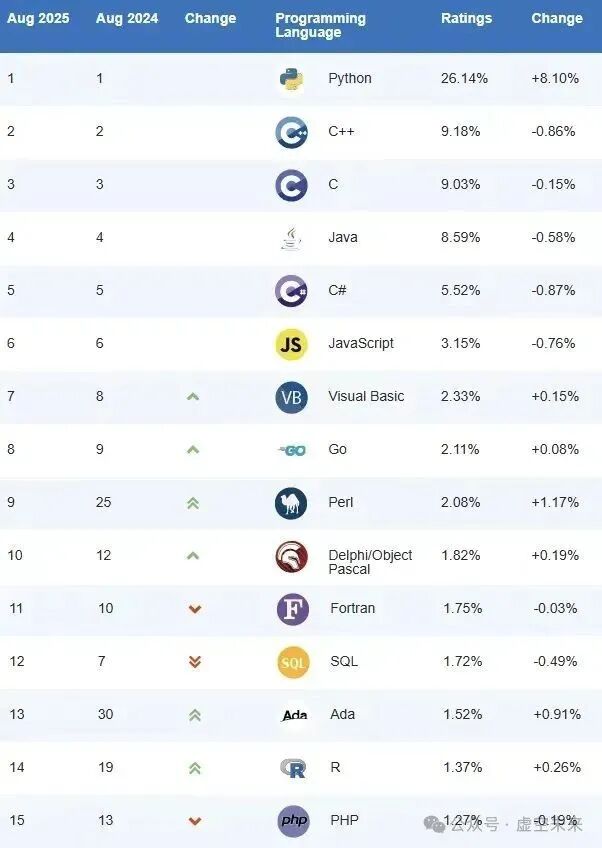
This raises the question: why has this situation arisen? Python and C++, one known for its “simplicity and efficiency” and the other for its “extreme performance”, what are their respective advantages? And in what scenarios are they applicable? Today, we will delve into this pair of “twin stars” in the programming world.
2. Phenomenon Interpretation: Why is Python on Top and C++ Steady?
2.1 The Rise of Python: The AI Wave and the Victory of “Universality”
The rise of Python is not accidental, but the result of multiple factors working together:
1. Driving Force of AI/Big Data Wave: This is the core reason for Python’s ascent. The fields of machine learning, deep learning, and data analysis have created unprecedented demand for Python. The emergence of powerful libraries like TensorFlow, PyTorch, NumPy, Pandas, and Scikit-learn has made Python the language of choice for data scientists and AI engineers.
2. Gentle Learning Curve, Easy to Learn and Use: Python’s syntax is clear and concise, with strong code readability, making it very close to natural language. This allows beginners to quickly get started, lowering the programming barrier and attracting many individuals from non-computer science backgrounds (such as data analysts and biologists) into the programming field.
3. High Development Efficiency: Python has a rich set of built-in and third-party libraries, allowing many complex functions to be implemented in just a few lines of code. This significantly shortens the development cycle, making it especially suitable for rapid prototyping and agile iteration.
4. Wide Cross-Domain Applications: In addition to AI/Big Data, Python also excels in web development (Django, Flask), automation scripts, web scraping, DevOps, scientific computing, and education, making it almost ubiquitous.
2.2 C++’s Resilience: The Performance King and Its “Cornerstone” Status
Despite Python’s momentum, C++ remains steadfast and holds a high position, thanks to its irreplaceable unique advantages:
1. Extreme Performance: C++ is a compiled language that can directly manipulate memory, providing strong control over hardware. The efficiency of the compiled code is extremely high, making it the first choice for applications that demand extreme performance.
2. Low-Level Control Capability: C++ allows programmers to directly manage memory and access hardware, which is crucial for low-level development such as operating systems, drivers, and embedded systems.
3. Complex Systems and Large Projects: C++ offers powerful object-oriented features and generic programming capabilities, enabling the construction of complex, large, and stable software systems. Many large commercial software, game engines, and high-performance computing applications rely on C++.
4. Historical Accumulation and Ecosystem: C++ has decades of development history, accumulating a vast codebase, mature toolchain, and an experienced developer community. Many core infrastructures and legacy systems are built with C++.
3. Python: The Efficient and Convenient “Universal Tool”
Why Choose Python? When you pursue development efficiency, code simplicity, cross-domain applications, and have strong community support, Python is your best choice.
3.1 Core Advantages
Easy to Learn and Use: Simple syntax, low learning cost, suitable for quick entry.
High Development Efficiency: Less code, with a large number of out-of-the-box libraries, accelerating the development process.
Rich Ecosystem: Boasts a vast array of third-party libraries and frameworks, covering almost all application domains.
Cross-platform capability allows it to run on various operating systems such as Windows, macOS, and Linux.
Interpreted Language: No need for compilation, runs directly, making debugging and testing convenient.
3.2 Typical Application Scenarios
1.Data Science and Machine Learning/Artificial Intelligence (AI/ML):
Libraries: NumPy (Numerical Computing), Pandas (Data Processing), Matplotlib/Seaborn (Data Visualization), Scikit-learn (Machine Learning), TensorFlow/PyTorch (Deep Learning).
Scenarios: Data cleaning, analysis, modeling, prediction, image recognition, natural language processing, recommendation systems, etc.
2. Web Development:
Frameworks: Django (Full Stack), Flask (Lightweight), FastAPI (High-Performance API).
Scenarios: Website backend, RESTful API development.
3. Automation Scripts and Operations:
Scenarios: System management, file operations, network configuration, log analysis, scheduled tasks, DevOps toolchain integration.
4. Web Scraping:
Libraries: Requests (HTTP Requests), BeautifulSoup (HTML Parsing), Scrapy (Web Scraping Framework).
Scenarios: Web data scraping, information collection.
5. Education and Scientific Computing:
Scenarios: As an introductory programming language, scientific computing and simulation in fields like physics, chemistry, and biology.
4. C++: The “Cornerstone” of Performance and Control
4.1 Core Advantages
Extreme Performance: Compiled to machine code for direct execution, with fine memory management and the highest execution efficiency.
Low-Level Control: Allows direct manipulation of memory and registers, enabling efficient interaction with hardware.
Object-Oriented and Generic Programming: Strong abstraction capabilities support the construction of complex and maintainable large systems.
Memory Management: Manual memory management (via new/delete or smart pointers) achieves optimal resource utilization.
Cross-Platform: Can run on different platforms after compilation, but usually requires adaptation for the platform.
4.2 Typical Application Scenarios
1. Game Development:
Engines: Unreal Engine, Unity (some core modules).
Scenarios: Game engines, large game clients, high-performance game servers, physics engines, graphics rendering.
2. Operating Systems and Drivers:
Scenarios: Core components of operating systems like Windows, macOS, Linux, and drivers for various hardware devices.
3. High-Performance Computing (HPC):
Scenarios: Scientific simulations, numerical computing, financial high-frequency trading systems, big data processing engines (like some components of Hadoop).
4. Embedded Systems and Internet of Things (IoT):
Scenarios: Resource-constrained devices (like smart appliances, automotive electronics, industrial control systems) that require efficient use of memory and CPU.
5. Desktop Applications and Graphical Interfaces:
Frameworks: Qt, MFC.
Scenarios: High-performance desktop applications, CAD software, image processing software.
6. Compilers and Interpreters:
Scenarios: Many programming language compilers and interpreters are themselves written in C++ (like the core of the Python interpreter CPython).
5. Heroes Appreciate Each Other: The “Dream Collaboration” of Python and C++
Interestingly, Python and C++ are not completely opposed; they often collaborate in the same project, complementing each other to form a powerful combination:
Python as the “Glue Language”: Python handles high-level logic, rapid prototyping, user interfaces, data preprocessing, and calls to low-level C++ modules.
C++ as the “Performance Engine”: C++ implements performance-sensitive core algorithms, compute-intensive tasks, and low-level libraries and drivers.
Typical Examples:
1. AI Frameworks: Deep learning frameworks like TensorFlow and PyTorch use C++ extensively for building and executing core computation graphs (such as matrix operations, neural network forward/backward propagation) to ensure extreme performance; users build models, train, and deploy through Python APIs.
2. Scientific Computing Libraries: Python libraries like NumPy and SciPy have many high-performance numerical algorithms implemented in C++ or Fortran at their core.
3. Game Development: The core logic and rendering pipeline of game engines are written in C++, while in-game scripts (like tasks and AI behaviors) may be implemented in Python or Lua, allowing designers to iterate quickly.
4. Desktop Applications: Interfaces are developed in Python (like PyQt/PySide), while complex calculations or graphics rendering parts are implemented in C++ and called through Python bindings.
This combination pattern allows development teams to balance development efficiency and runtime performance, achieving the best of both worlds.
6. Conclusion: There is no Best Language, Only the Most Suitable Tool
Python and C++ are at the top of programming language rankings because they each play an irreplaceable role in different fields.
Python, with its usability, high development efficiency, and rich ecosystem, has become the preferred choice in data science, AI, web, and automation, serving as a tool for rapid iteration and cross-domain development.
C++, on the other hand, holds a core position in gaming, operating systems, high-performance computing, and embedded systems due to its extreme performance, low-level control, and ability to build complex systems, serving as the cornerstone for performance and stability.
They are not in competition but rather complement each other. In actual projects, the choice of which language to use, or how to combine them, ultimately depends on your project requirements, performance needs, development efficiency, team technology stack, and future maintainability.
Understanding their strengths and weaknesses will enable you to make informed choices on your programming journey, finding the most suitable “weapon” for your project!
I hope this article helps you establish a correct understanding of Python and C++, and encourages you to take the first step towards mastering them! If you have any questions or insights, feel free to leave a comment for discussion.
——END——



Layout | Huang Yiyuan
Editor | Wei Xinkai