

Think Tank Highlights #Global Defense Dynamics #US Military Dynamics #Russian Military Dynamics #Taiwan Affairs #Available in WeChat Store
#South Korea #Raytheon #Japan #Electronic Warfare #Northeast Asia Military Dynamics #Unmanned
The following article is sourced from the Combat Training Directorate of the Ministry of Defense of the Russian Federation, reprinted from Unmanned Competition.
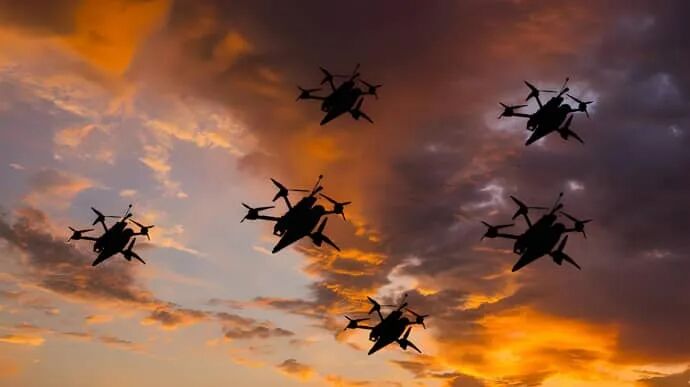
Introduction: When you are alone on the battlefield facing the overwhelming onslaught of machine killers, how do you save yourself? This practical manual, forged in the fires of war, tells soldiers that the best way to avoid being struck by enemy drones is: hide well and do not be discovered!
This article is translated from the “Handbook on Defense and Countermeasures Against Enemy Drones” compiled by the Combat Training Directorate of the Russian Ministry of Defense for special military operations in 2023. The content mainly includes the threats posed by small drones on the Russo-Ukrainian battlefield, the main defense and countermeasures against small drones, and the specific procedures and details for individual soldiers and task groups when implementing countermeasures.
During special military operations, one of the most severe problems faced by battalion, company, and platoon-level units is the large-scale use of drones by the enemy, primarily commercial small quadcopters.This manual provides practical recommendations for commanders (military personnel) of combined arms units performing combat missions during special military operations regarding the defense and countermeasures against enemy drones.
Threats from Small Drones (Unmanned Helicopters)

The characteristics of small drones include small geometric size, low thermal contrast, low flight speed, and small effective scattering area, which result in air defense missile systems (portable air defense missile systems) being unable to effectively engage them.These factors play a decisive role in organizing defense, countermeasures, and strikes against drones for units equipped with light weapons, using standard equipment and future products.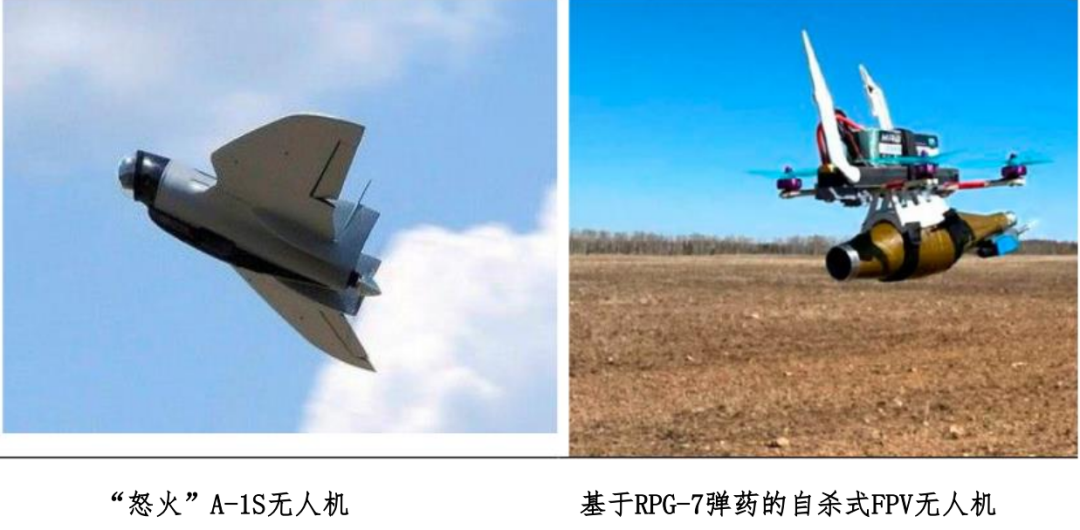
Typical Ukrainian-made small drone
With the help of small drones, the enemy can accomplish the following tasks:1. Conduct reconnaissance. Drones equipped with infrared night vision cameras or so-called forward-looking infrared systems pose a special threat. They can not only see people at night but can also see through tree canopies, camouflage nets, etc.2. Guidance and fire correction. When potential targets are identified, drones transmit video signals to the operator’s smartphone or tablet and guide artillery (tanks) using coordinates.3. Inflict casualties on personnel and damage equipment, including the use of suicide FPV drones.In addition to suicide drones, a relatively new and widely used method of inflicting damage is to drop modified or specially designed unguided munitions from hovering quadcopters (octocopters/six-copters). The most common commercial drone, such as the DJI Mavic 3, can carry a payload of no more than 400-500 grams.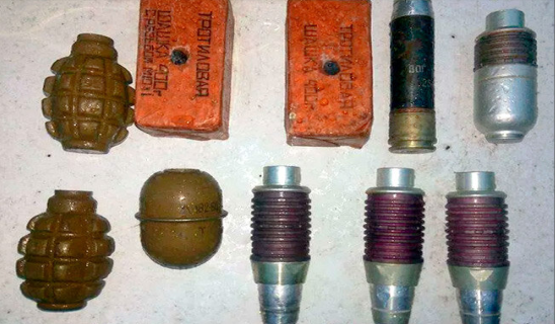
Typical munitions and improvised explosive devices dropped from drones
Munitions and improvised explosive devices dropped from drones include:RGD-5 (RGN) grenades;Hand-modified VOG-17 (30mm), VOG-25 (40mm);40x53mm NATO standard ammunition;Improvised devices based on TNT explosive blocks.F-1 grenades are either used on windless days with the Mavic 3 or on larger drones that can bear their weight.The most in-demand variant of VOG-17M ammunition in the special military operation zone is one with a fuse that has a 25-second self-destruct mechanism. Both the Russian military and the enemy have installed this ammunition on drones.
How to Defend Against Small Drones
Measures organized and implemented to protect personnel and military equipment from threats posed by enemy small drones and suicide drones include:Notification and dispersion of personnel and equipment;Camouflage and concealment of personnel and equipment;“Not being detected” – the best way to avoid being struck by enemy drones is to remain undetected, which means being able to deceive the enemy’s drone operators.In this case, the main focus is on the dispersion, camouflage, and concealment of personnel and military equipment.Dispersion refers to selecting distances between targets (deployment areas) to avoid simultaneous damage during small unmanned weapon operations. During dispersion, the following requirements must be met: it should not adversely affect the completion of assigned tasks, and it should not complicate command and coordination. Considering these requirements, the optimal distance between targets and units is usually chosen based on the expected damage radius of the enemy drone’s maximum power munitions.Therefore, the conclusion is: besides gathering equipment, do not place equipment in open spaces and close to each other! This rule also applies to personnel – do not crowd together! Especially in open areas that may be detected by drones.
Confusing Drones with Camouflage and Concealment
Camouflage and concealment refer to a series of measures aimed at reducing the visibility of personnel and equipment and defending against enemy (including small unmanned weapons) strikes. The main methods for conducting tactical camouflage tasks to counter enemy drones are concealment, simulation, and deception.If the position is located in a residential area, it is necessary to conceal as much as possible within houses, garages, porches, and sheds. Avoid operating in open areas unless absolutely necessary. Do not turn on handheld lights, tactical lights, or car headlights at night, as these lights can easily be detected by drone equipment.It should be noted that in hot weather with temperatures around 40°C, drones’ infrared cameras can hardly detect people, and in adverse weather conditions, drones cannot operate in strong winds, thick smoke, or thunderstorms.Use standard equipment and auxiliary materials. For example, lay glass shards or other reflective materials on the roofs of buildings and equipment to create obstacles for the drone’s cameras.If the position is obvious (large fortified areas, trench lines, no tree cover), it should be ensured that:Do not let the enemy know how many people are defending, where personnel, equipment, firing points, observation points, cover positions, and ammunition depots are located;Do not make fires, do not hang things out to dry in the open;Do not scatter garbage (military food boxes and other waste) around the position, and avoid unnecessary movement.If using an iron stove in a trench, a smoke vent branch system should be established leading outside. This way, smoke will not accumulate and expose the fortified area but will disperse along 4-7 narrow channels;If possible, dig “foxholes” at observation posts to prevent the enemy from determining the situation from above;Above your position, create a canopy with camouflage nets and insulation mats. Additionally, use branches to camouflage observation points, and cover vehicle paths with camouflage nets;The simplest camouflage method for soldiers in the position is to lay dense branches and wooden boards in certain places in the trench. In these places, dig “foxholes” or small shelters in the trench walls or breastworks;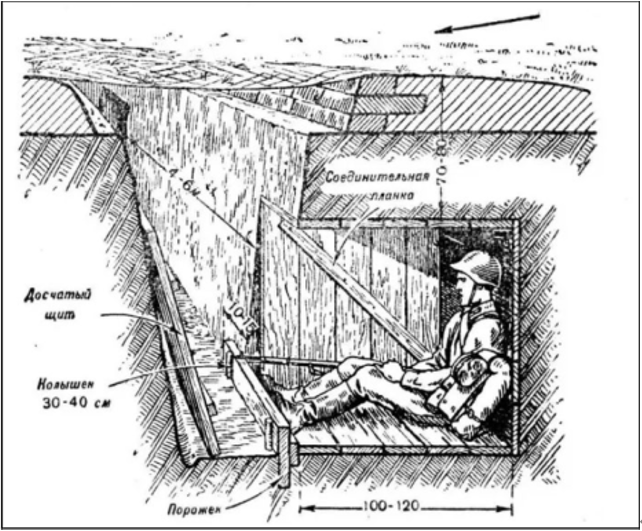
Constructing “foxhole” type shelters
Cover the observation points from above with the same wooden boards, and observe towards the enemy and flanks;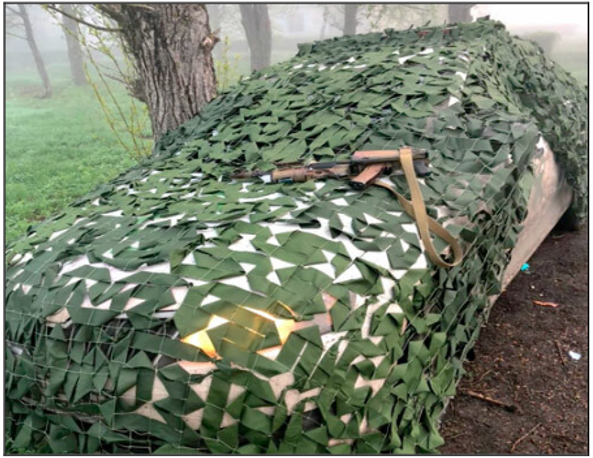
Vehicles under camouflage nets in the position
Trample down and create false paths next to your own position. Sudden interruptions in paths are undoubtedly signs of fortified areas or observation posts;Regularly fly drones around the position to assess the quality of camouflage;Make as little noise as possible, and do not talk loudly with companions. Some drones are equipped with powerful microphones. They can hover and listen to sounds. Stay quiet (within reasonable limits), not only to avoid detection but also to hear the sounds of enemy drones. When small drones descend to 100-150 meters or lower, they can be heard quite clearly.Every commander (leader) has the duty to continuously supervise subordinates’ compliance with camouflage discipline requirements.Simulation includes reproducing the exposure characteristics of troops (units), weapons and military equipment, terrain engineering constructions, and other targets. During simulation, create false targets (positions, areas, sections, zones, routes, bridges, and others) and use models of weapons and military equipment and physical field simulators to organize activity demonstrations.Remember, your task is to “blur” the number of real targets! Depending on the terrain conditions, the number of displayed equipment should also vary. For example, in densely wooded terrain, about 1/3 of the combat technical equipment should be displayed, while in open terrain, up to half of the authorized number can be displayed. In false areas in open terrain, up to 80% of combat and transport technical equipment must be displayed.To create exposure characteristics of simulated targets in the radar wavelength, standard radar reflectors can be used, such as metal corner reflectors, “pyramids,” “corners,” “ball-PR,” mobile technical equipment radar simulators; also including KFP-1-180 catalytic lamp core and other thermal simulators.
Physical field radar simulator
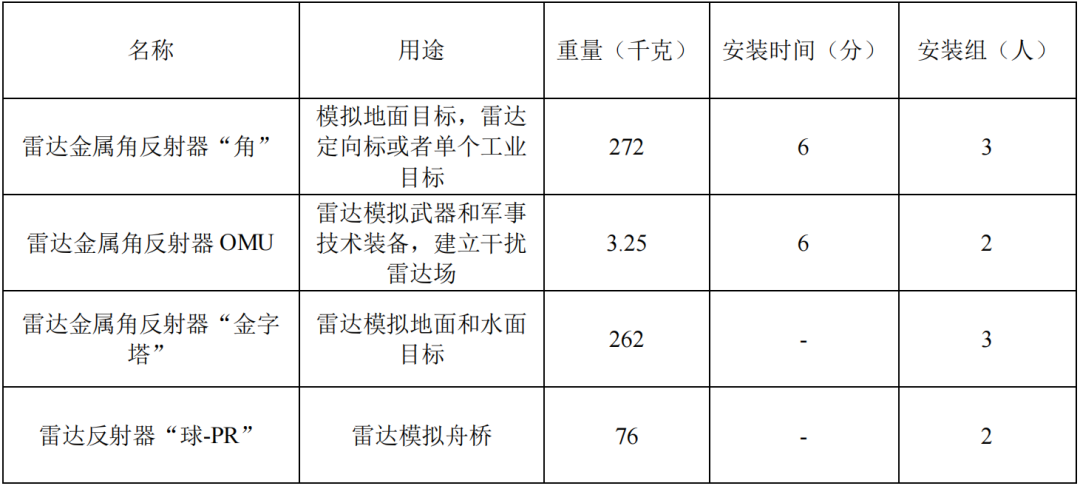 To demonstrate activities in false areas, show the movement of troops and individual vehicles, partially change the relative positions of models, increase the number of shelters and vehicle tracks, operate radio stations (for transmission), light fires, and set up light signals visible from the air.
Physical field thermal simulator

How to Resist Enemy Airdropped Bombs and Artillery
If you, your position, and equipment have been identified by enemy drone operators and exposed, the next course of action may be:If it is just a reconnaissance drone (“winged” or “quadcopter”), it will guide artillery, mortars, other (attack) drones, or if a direct attack is planned, it will correct the actions of assault groups.If the quadcopter is equipped with a throwing system, upon discovering your position or equipment, the operator will throw grenades, improvised “bombs,” or other explosive devices. At the same time, they will drop vertically from above you.If it is a suicide drone: FPV or “flying wing” (like the Blade), the attack will be conducted at a certain angle rather than vertically, but ultimately will be closer to a horizontal trajectory.Thus, it is essential to prepare everything in advance to minimize risks. First is the depth of the trenches.Trenches that are knee-deep and “jacuzzi-style” are inadequate. They must be dug deeper and deeper. Build shelters and other structures with labyrinthine entrances. If the ground is very bright, with strong contrasts (sand, clay, green land, or black soil against a leaf background), then camouflage shelters should be used. That is, cover the shelters with elements of the surrounding terrain. This makes it harder to detect the position.It is best to set the entrances of shelters and ammunition depots towards the trees. This way, the operator of the “flying wing” or FPV drone cannot approach the entrance for an attack from a convenient angle. The effectiveness of drone attacks will be poor, either missing the target or crashing into trees.Using camouflage nets and/or blankets above positions or observation posts is not only important for camouflage but also for deflecting thrown grenades and improvised explosive devices; anti-grenade nets should be used.Try to create canopies in the bends of trenches, using “foxholes” so that when munitions fall on the sides of the trench, shrapnel does not harm soldiers hiding in the pit. In summary, simulate where munitions might land and how to effectively resist shrapnel; soil blocks can be used to simulate shrapnel.In any case, explosions above the trench, in the air, or outside the breastwork are much safer than explosions inside the trench or underfoot. Because of these temporary “roofs,” munitions may ricochet and explode nearby. If you are frequently bombed, it is better to change positions and quickly establish a new observation point away from the old position.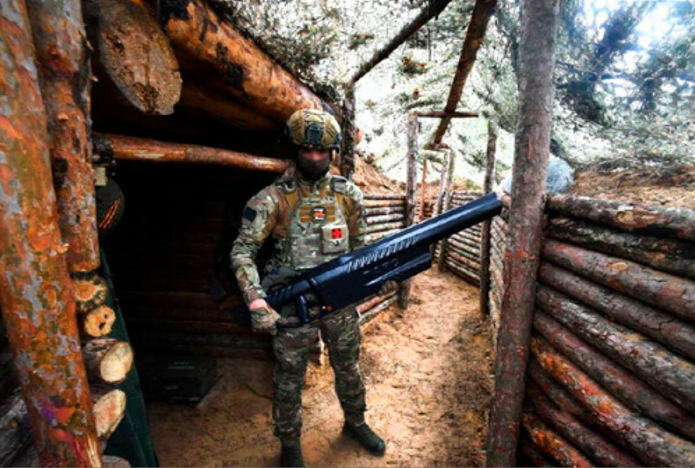
Soldiers equipped with anti-drone weapons, with their positions covered by wire mesh and camouflage nets
Similarly, it is necessary to organize protection for individual trenches and observation posts in front of the main line. Try to arrange them under flat trees, covered with some fabric, tarpaulin, or directly with scout headscarves in dry weather. Use environmental elements to camouflage the cloak from above.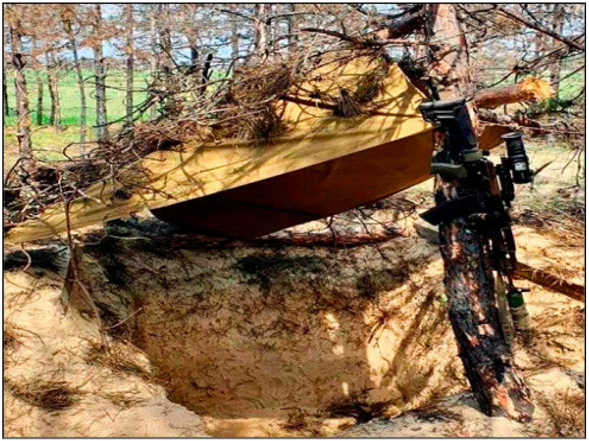
Individual trench camouflaged with pine branches from the surrounding forest
Passive Defense Measures for Equipment
To reduce losses and damage to military equipment caused by enemy drones, the following passive defense elements can be effective:
Protective Nets (Screens)
After the start of special military operations, when the issue of the “Javelin” anti-tank missile hitting the upper protrusions of Russian tanks was exposed, the Russian military installed what is known as “protective shields” – grid covers above the turret. The grid protective screens made of heavy steel welding are the simplest solution and often save the vehicle or at least the lives of its crew.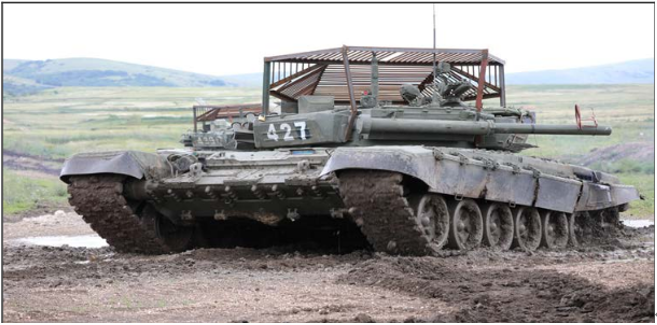
Tank equipped with a steel protective shield
Metal Protective Nets
Metal nets pose almost no threat to anti-tank missiles or portable anti-tank rocket launchers, but they are a good barrier against suicide drones, especially FPV drones.Almost all ground combat and auxiliary technical equipment that may be attacked by FPV drones can be fitted with grid protective shield kits.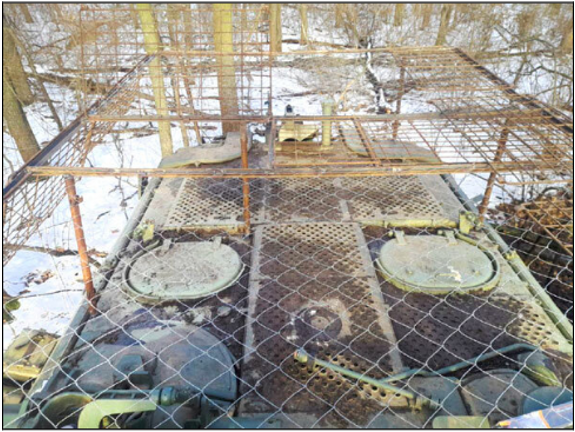
Grid protection for armored equipment against airdropped and improvised FPV suicide drones
Anti-Drone Grid Protection Shield (PDESR)
The complete anti-drone grid protection shield can be installed on almost any ground combat and auxiliary equipment that may be attacked by FPV drones.The anti-drone grid protection shield consists of the following components: a base part, a travel kit, and a combat kit.The base part – a set of fasteners and brackets fixed to combat equipment, such as being welded to the vehicle, can be as simple as welding a pipe to the vehicle body and drilling a hole in the pipe for installing a diagonal cross pin, or it can be some more complex embedded structures.The travel kit – a set of protective elements that must be used when transporting combat equipment, which partially restricts the vehicle’s operation. At the same time, the travel kit must provide maximum protective coverage against suicide drones.The combat kit – a set of protective elements that should not restrict the vehicle’s operation, but the protective area and effectiveness provided by the combat kit may not be as good as that of the travel kit.For example, the travel kit may prevent the tank turret from rotating 360 degrees but will cover the entire upper part of the tank, while the combat kit will not interfere with combat operations but will cover the turret and some nearby areas.What other requirements are there for the anti-drone grid protection shield?Quick assembly/disassembly – no more than 5-10 minutes.Safe destructible design – for example, if a tank with the travel kit is attacked and forced into combat, the turret rotation mechanism should safely remove the anti-drone grid protection shield without damaging the tank components. The anti-drone grid protection shield components must not hinder the evacuation of personnel.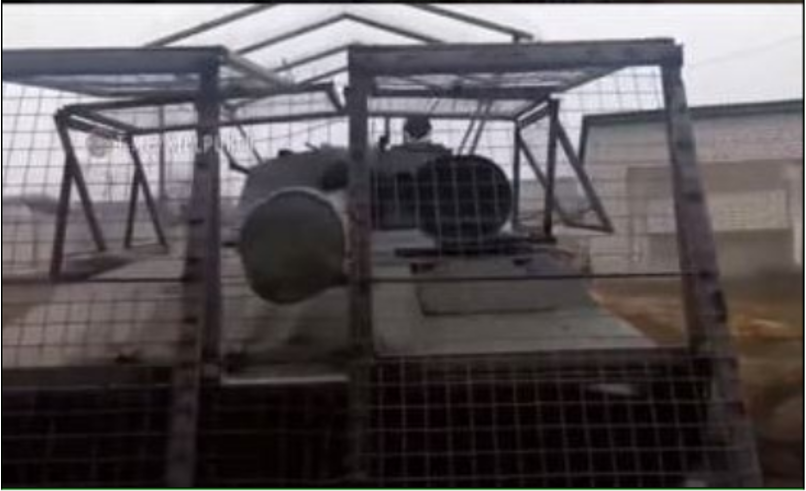
122mm 2S1 “Carnation” self-propelled howitzer covered with a net shield
Reprint Statement
This article is sourced from publicly available information on the internet or has been reprinted with authorization from the original public account. The copyright belongs to the original author. The content of the article does not represent the views of this platform or its authenticity. The purpose of reprinting is to convey information and for online sharing. If there are any copyright issues, please contact us promptly, and we will delete it as soon as possible.