February 13, 2025
| The primary benefit from subscribing to LWN is helping to keep us publishing, but, beyond that, subscribers get immediate access to all site content and access to a number of extra site features. Please sign up today! The primary benefit from subscribing to LWN is helping us maintain our publishing, but beyond that, subscribers also gain immediate access to all site content and many additional site features. Please register today! |
Reference:
-
Subscribe to LWN, https://lwn.net/subscribe/
-
Split PMD locks, https://lwn.net/Articles/568076/
-
Five-level page tables, https://lwn.net/Articles/717293/
-
Transparent huge pages in 2.6.38, https://lwn.net/Articles/423584/
-
Clarifying memory management with page folios
-
[RFC v2 0/9] khugepaged: mTHP support
-
https://elixir.bootlin.com/linux/v6.14-rc2/source/mm/khugepaged.c#L1267
-
[PATCH v2 00/17] khugepaged: Asynchronous mTHP collapse
-
[PATCH v2 07/17] khugepaged: Scan PTEs order-wise
-
[RFC v2 0/5] mm: introduce THP deferred setting
-
https://docs.kernel.org/admin-guide/mm/transhuge.html#sysfs
 Huge pages can increase the performance of many programs, but they can also have unfortunate performance impacts of their own. Over the last few years, multi-size transparent huge pages (mTHPs) have increasingly been seen as a happy medium that bring the benefits of huge pages at a lower cost. The system cannot benefit from mTHPs, though, if it does not create them; two developers have independently posted patches to enable the creation of mTHPs in the background.Huge pages can improve the performance of many programs, but they can also have unfortunate performance impacts of their own. Over the past few years, multi-size transparent huge pages (mTHPs) have increasingly been viewed as a compromise that offers the benefits of huge pages at a lower cost. However, if the system does not create mTHPs, it cannot benefit from them; two developers have independently posted patches to enable the creation of mTHPs in the background.
Huge pages
Huge pages are a feature that is implemented by the CPU and its memory-management unit; they enable the system to run with a mix of page sizes. Those sizes, though, are limited in number and entirely defined by the CPU’s memory architecture; they correspond to the levels of the page-table hierarchy. As a reminder, that hierarchy looks vaguely like this diagram (from this 2013 article):
Huge pages are a feature implemented by the CPU and its memory management unit; they allow the system to operate with a mix of page sizes. However, these sizes are limited in number and entirely defined by the CPU’s memory architecture; they correspond to the levels of the page table hierarchy. As a reminder, this hierarchy looks vaguely like this diagram (from this 2013 article):
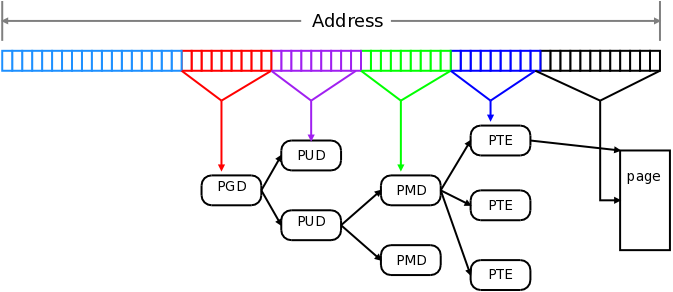
More recent systems can also have yet another level below the top of the hierarchy).More recent systems may also have another level below the top of the hierarchy.
On x86 systems, the base-page size is 4KB. The first level of huge pages is implemented by marking the entry in the page middle directory (PMD) level of the hierarchy — the one just above the bottom page-table entry (PTE) level. The PMD entry then refers directly to a page covering a larger part of the address space rather than to the PTE table. That results in a page size of 2MB; these pages are often referred to as “PMD huge pages”. Moving up to the next level directory (the page upper directory, or PUD) yields 1GB huge pages.
On x86 systems, the base page size is 4KB. The first level of huge pages is implemented by marking the entry in the page middle directory (PMD) level of the hierarchy — the one just above the bottom page table entry (PTE) level. The PMD entry then refers directly to a page that covers a larger part of the address space instead of referring to the PTE table. This results in a page size of 2MB; these pages are often referred to as “PMD huge pages.” Moving up to the next level directory (the page upper directory, or PUD) yields 1GB huge pages.
Huge pages that are implemented this way have some significant benefits. A single PMD huge page replaces 512 base pages, significantly reducing the overhead of memory management and the number of page faults the system must handle. It also frees as many as 512 entries in the translation lookaside buffer (TLB), a scarce processor resource that can often be a performance bottleneck. As a result, programs using huge pages can run more quickly. Initially, use of huge pages required special effort on the part of both the developer and the system administrator; the addition of transparent huge pages (THPs) in 2011 enabled the kernel to coalesce (or “collapse”) a process’s base pages into huge pages behind the scenes, making the performance benefits of huge pages available system-wide.
Huge pages implemented in this way have significant benefits. A single PMD huge page replaces 512 base pages, significantly reducing the overhead of memory management and the number of page faults the system must handle. It also frees up to 512 entries in the translation lookaside buffer (TLB), a scarce processor resource that can often be a performance bottleneck. As a result, programs using huge pages can run faster. Initially, using huge pages required special effort from both developers and system administrators; the introduction of transparent huge pages (THPs) in 2011 allowed the kernel to coalesce (or “collapse”) a process’s base pages into huge pages behind the scenes, making the performance benefits of huge pages available system-wide.
Unfortunately, huge pages are not entirely free. The cost of huge-page use can be internal fragmentation; if a process only uses part of a huge page, the rest of it is simply wasted. Enabling transparent huge pages can, as a result, significantly increase the memory use of a workload; if a system was running close to its limits without huge pages, turning them on can push it over the edge. For that reason, distributors have often left the feature disabled, and one can easily find advice on the net to leave it that way.
Unfortunately, huge pages are not entirely free. The cost of using huge pages can be internal fragmentation; if a process only uses part of a huge page, the rest is simply wasted. As a result, enabling transparent huge pages can significantly increase the memory usage of a workload; if a system was running close to its limits without huge pages, enabling them can push it over the edge. For this reason, distributors have often left this feature disabled, and it is easy to find advice online to keep it that way.
The multi-size option
Multi-size THPs are, as the name would suggest, an extension of the huge-page concept to more sizes — those that do not correspond to the page-table hierarchy. The mTHP concept was enabled by the transition to folios as a way of managing memory in the kernel; now it is possible to represent groups of physically contiguous pages of arbitrary (though power-of-two) sizes. Use of mTHPs will, once again, reduce memory-management overhead since they can be managed as a unit rather than as independent base pages. More recent CPUs have added TLB-coalescing features that allow an eight (x86) or 16-page (Arm) mTHP to be represented a single TLB entry, increasing the performance benefit that mTHPs can bring.
Multi-size THPs, as the name implies, are an extension of the huge page concept to more sizes — those that do not correspond to the page table hierarchy. The mTHP concept was enabled by the transition to folios as a method of managing memory in the kernel; it is now possible to represent groups of physically contiguous pages of arbitrary (though power-of-two) sizes. The use of mTHPs will again reduce memory management overhead since they can be managed as a unit rather than as independent base pages. More recent CPUs have added TLB coalescing features that allow an eight-page (x86) or 16-page (Arm) mTHP to be represented as a single TLB entry, increasing the performance benefits that mTHPs can provide.
Using mTHPs can thus bring much of the performance improvement seen with traditional huge pages, but with a lower internal-fragmentation cost. It is also much easier for the kernel to allocate an mTHP than a full PMD or PUD huge page, especially after the system has been operating for a while and memory has become fragmented. It is thus not surprising that a fair amount of effort has gone into improving the kernel’s ability to use mTHPs in recent years.
Using mTHPs can therefore provide many of the performance improvements seen with traditional huge pages, but with lower internal fragmentation costs. Additionally, it is much easier for the kernel to allocate an mTHP than a full PMD or PUD huge page, especially after the system has been running for a while and memory has become fragmented. Thus, it is not surprising that considerable effort has been directed toward enhancing the kernel’s ability to use mTHPs in recent years.
The THP page mechanism can inject huge pages into a process’s address space in a couple of ways. One of those is when the pages are initially allocated. Rather than satisfying a page fault with a base page, the kernel can allocate a huge page and read all of the contents in a single operation, for example. The other is to examine a process’s address space in the background and identify ranges of virtually contiguous pages that could be replaced with huge pages. When such a range is found, a huge page is allocated, the base pages are copied into it, then freed after the huge page replaces them in the page tables. This latter task is performed by the khugepaged kernel thread, which benefits from being able to observe which pages of memory a process is actually using. The khugepaged thread, though, can only create PMD huge pages; it predates mTHPs and does not create them. The two patch sets in question are both aimed at filling in that gap.
The THP page mechanism can inject huge pages into a process’s address space in a couple of ways. One way is when the pages are initially allocated. Instead of satisfying a page fault with a base page, the kernel can allocate a huge page and read all of the contents in a single operation, for example. The other way is to examine a process’s address space in the background and identify ranges of virtually contiguous pages that could be replaced with huge pages. When such a range is found, a huge page is allocated, the base pages are copied into it, and then freed after the huge page replaces them in the page tables. This latter task is performed by the khugepaged kernel thread, which benefits from being able to observe which pages of memory a process is actually using. However, the khugepaged thread can only create PMD huge pages; it predates mTHPs and does not create them. The two patch sets in question are both aimed at addressing that gap.
Before looking into them, there is one other bit of useful background relevant to both approaches. There is a sysctl knob, max_ptes_none, that controls how many new pages khugepaged can allocate to create a huge page. If, for example, a suitable range of address space contains 500 active pages, khugepaged would have to allocate 12 more pages to have the full 512 that make up a PMD huge page. If max_pte_none is set to at least 12, khugepaged will proceed, otherwise it will give up on that huge page. Creating mTHPs in khugepaged increases the amount of thought that must be put into this knob’s setting.
Before examining them, there is another useful background point relevant to both approaches. There is a sysctl knob, max_ptes_none, that controls how many new pages khugepaged can allocate to create a huge page. For example, if a suitable range of address space contains 500 active pages, khugepaged would need to allocate 12 more pages to reach the full 512 that constitute a PMD huge page. If max_pte_none is set to at least 12, khugepaged will proceed; otherwise, it will abandon that huge page. The creation of mTHPs in khugepaged increases the consideration that must be given to the setting of this knob.
Improving khugepaged
The first patch set, from Nico Pache, changes the core khugepaged scanning loop (called hpage_collapse_scan_pmd() in current kernels, though the series renames it to khugepaged_scan_pmd()). The current implementation will stop scanning a candidate huge page immediately if max_pte_none unmapped pages are found. In the modified version, instead, it will scan the entire address range for the huge page regardless and create a bitmap marking the places where an mTHP could be created within that page. The smallest size considered is order 3 (eight pages); that may change to allow an order 4 minimum on Arm systems in the future, matching the size at which TLB entries can be coalesced.
The first patch set, from Nico Pache, modifies the core khugepaged scanning loop (called hpage_collapse_scan_pmd() in current kernels, although the series renames it to khugepaged_scan_pmd()). The current implementation stops scanning a candidate huge page immediately if max_pte_none unmapped pages are found. In the modified version, it will scan the entire address range for the huge page regardless and create a bitmap marking the places where an mTHP could be created within that page. The smallest size considered is order 3 (eight pages); this may change to allow for a minimum order of 4 on Arm systems in the future, matching the size at which TLB entries can be coalesced.
When determining whether a given mTHP-size chunk could be turned into an actual mTHP, the patch scales the max_pte_none value accordingly. When looking at an eight-page chunk, max_pte_none will be divided by 64 (512/8) to determine how many pages must actually be present.
When determining whether a given mTHP-size chunk can be converted into an actual mTHP, the patch scales the max_pte_none value accordingly. When examining an eight-page chunk, max_pte_none will be divided by 64 (512/8) to determine how many pages must actually be present.
After a PMD has been scanned, khugepaged will first consider whether the whole thing can be turned into a PMD huge page. Failing that, the bitmap created during the scan will be consulted in an attempt to create the largest mTHPs possible given the pages that are actually resident in memory. Once the bitmap has been processed and any mTHPs created, khugepaged will move on to the next PMD to scan.
After scanning a PMD, khugepaged will first consider whether the entire thing can be converted into a PMD huge page. If that fails, the bitmap created during the scan will be referenced in an attempt to create the largest mTHPs possible given the pages that are actually resident in memory. Once the bitmap has been processed and any mTHPs created, khugepaged will proceed to scan the next PMD.
There is one problem with this approach that both patch sets must address; it has been called “creep“. Imagine that max_pte_none has been set to 511, which happens to be its default value. At that setting, even a single resident page is enough to cause khugepaged to populate the rest of a huge page, which may well be what the user wants. Things change a bit when dealing with mTHPs, though. When a PMD is scanned, each single page will lead to the creation of an eight-page mTHP, as expected. The next time the scan happens, though, those mTHPs will each be turned into 16-page mTHPs, since each contains enough pages to cause khugepaged to bump them up to the next size.
This approach has a problem that both patch sets must address; it has been referred to as “creep.” Imagine that max_pte_none has been set to 511, which happens to be its default value. At that setting, even a single resident page is enough to cause khugepaged to populate the rest of a huge page, which may be the user’s intention. However, the situation changes when dealing with mTHPs. When a PMD is scanned, each individual page will lead to the creation of an eight-page mTHP, as expected. The next time the scan occurs, those mTHPs will each be elevated to 16-page mTHPs, since each contains enough pages to prompt khugepaged to promote them to the next size.
Over time, these mTHPs will all “creep” up to the PMD size, which is just the result that the patch set was created to avoid. To keep this from happening, administrators will need to set max_pte_none to a value that is less than half of the PMD huge page size — a value of 255 or smaller.
Over time, these mTHPs will all “creep” up to the PMD size, which is precisely the outcome that the patch set was designed to prevent. To avoid this, administrators will need to set max_pte_none to a value that is less than half of the PMD huge page size — a value of 255 or smaller.
The second patch series, from Dev Jain, takes a slightly different approach. khugepaged begins by scanning in PMD-sized chunks as before, but if it is unable to collapse a given PMD range, it drops down to a smaller order and tries again. The code implementing this algorithm, being a mass of goto statements, is a bit hard to follow, but the intent is to scan each range of memory at the size that results in successful mTHP creation. Once a PMD entry has been completed, the order is reset to the maximum to start the next one.
The second patch series, from Dev Jain, takes a slightly different approach. khugepaged begins by scanning in PMD-sized chunks as before, but if it cannot collapse a given PMD range, it drops down to a smaller order and tries again. The code implementing this algorithm, being a mass of goto statements, is somewhat difficult to follow, but the intent is to scan each range of memory at the size that allows for successful mTHP creation. Once a PMD entry is completed, the order is reset to maximum to begin the next one.
This series takes a stricter approach to the creep problem; it will only perform mTHP collapse if max_ptes_none is set to either zero or 511. In the former case, mTHPs will only be created if all of the base pages it would replace are already present; in the latter case, creep up to the full PMD size is explicitly allowed.
This series adopts a stricter approach to the creep problem; it will only perform mTHP collapse if max_ptes_none is set to either zero or 511. In the former case, mTHPs will only be created if all of the base pages they would replace are already present; in the latter case, creeping up to the full PMD size is explicitly permitted.
Pache posted another patch setthat could conceivably be used with either of thekhugepagedmTHP implementations. In current kernels, mTHPs of various sizes can be explicitly enabled or disabled by way of a set of sysctl knobs (documented inDocumentation/admin-guide/mm/transhuge.rst). The setting ofalwayscauses the kernel to try to create mTHPs of that size, whileneverdisables that size. Pache adds a new setting ofdeferthat will cause the kernel tonotuse the given size in response to page faults, but will allow khugepagedto collapse to that size. The purpose here is to limit mTHP allocations to memory where it has been shown to be useful, hopefully further reducing the costs of mTHP usage while enjoying their benefits.
Pache released another patch set that could potentially be used with either of the khugepaged mTHP implementations. In current kernels, mTHPs of various sizes can be explicitly enabled or disabled through a set of sysctl knobs (documented in Documentation/admin-guide/mm/transhuge.rst). The setting of always causes the kernel to attempt to create mTHPs of that size, while never disables that size. Pache adds a new setting of defer that will cause the kernel to not use the specified size in response to page faults but will allow khugepaged to collapse to that size. The aim here is to restrict mTHP allocations to memory where their utility has been demonstrated, ideally further reducing the costs of mTHP usage while still reaping their benefits.
Both of these patch sets are freshly posted as of this writing; neither has yet generated any real review discussion beyond a request for benchmark results from Andrew Morton. So there is no way to predict which (if either) of the patch sets will be accepted, or how much change may be needed before that can happen. There is a clear desire to make better use of mTHPs, though, so the goal behind this work is easy enough to understand; sooner or later, the kernel will almost certainly gain some sort of ability to create mTHPs in the background while a process is running.
Both of these patch sets have just been posted as of this writing; neither has yet generated any significant review discussion beyond a request for benchmark results from Andrew Morton. Therefore, it is impossible to predict which (if either) of the patch sets will be accepted or how much modification may be required before that can occur. However, there is a clear desire to make better use of mTHPs, so the objective behind this work is straightforward enough to grasp; sooner or later, the kernel will almost certainly acquire some capability to create mTHPs in the background while a process is executing.