
Click the blue text above to follow us





Gift to readers
👨💻 Conducting research involves a profound system of thought, requiring researchers to be logical, meticulous, and earnest. However, effort alone is not enough; often leveraging resources is more important than sheer hard work. One must also have innovative insights and inspirations. When a philosophy teacher asks what science is or what electricity is, do not dismiss these questions as trivial. Philosophy is the mother of science, pursuing ultimate questions and seeking those self-evident questions that only children would ask but you cannot answer. It is recommended that readers browse in order to avoid suddenly falling into a dark maze without finding their way back. This may not reveal all the answers to your questions, but if it can evoke clouds of doubt in your mind, it may create a beautiful sunset. If it brings you a storm in your spiritual world, take the opportunity to brush off the dust that has settled on your ‘lying flat’ state. Perhaps, after the rain, the sky will be clearer…🔎🔎🔎


1 Overview
First, a brief review of previous work on the numerical-analytical coupling method for steady-state thermal analysis of laminated printed circuit boards (PCBs) is presented. This method combines the Fourier series analytical solution with the finite volume method for thermal modeling of PCBs. To further simulate PCBs with components, thermal resistance parameters of the components are used to relate component temperatures to the variable array in the coupling equations. To further consider radiative heat transfer between the PCB and the environment, an iterative method is proposed. During this iteration process, the radiative equivalent heat transfer coefficients for each surface element and each component can be updated. Additionally, to improve efficiency, a multigrid strategy is integrated into the coupling method, generating three levels of discrete elements in the metal layer and PCB surface area. To verify the effectiveness of the iterative method, a comparison is made between a simple single-layer structural model and a model constructed in COMSOL Multiphysics. The modeling results of a virtual DC-DC power PCB under radiative heat transfer conditions are also presented and discussed, with modeling accuracy estimated using Richardson extrapolation.
Full article can be found in Section 4.
1. Research Background and Significance
PCB (Printed Circuit Board) thermal management is a core issue for ensuring the reliability of electronic devices. Traditional numerical-analytical methods often neglect radiative heat transfer or simplify component temperature calculations during modeling, leading to significant deviations from reality, especially in high-temperature or densely packed scenarios where radiative heat transfer is significant. This study proposes an improved numerical-analytical method that combines the Fourier series analytical solution with the finite volume method, introducing a radiative heat transfer module and component thermal resistance parameters to achieve more accurate thermal modeling, providing a reliable theoretical basis for PCB thermal design.
2. Core Innovations of the Improved Method
- Coupling Fourier Series Analytical Solution with Finite Volume Method
- Fourier Series Analytical Solution: Used to describe the temperature distribution on the PCB surface, simplifying calculations by assuming an average heat transfer coefficient (HTC), but traditional methods cannot directly analyze radiative heat transfer.
- Finite Volume Method: Discretizes the solution region, transforming continuous heat transfer problems into algebraic equations, suitable for thermal analysis of complex geometries.
- Coupling Strategy: Combines the advantages of both methods, discretizing only the metal layer and surface area to reduce computational load while retaining the accuracy of the analytical solution.
-
Stefan-Boltzmann Law: Calculates the radiative heat transfer between components and the substrate surface, between components, and between the PCB and the environment, with the formula:
 Editor
<span>Where, <img alt="MATLAB | Improved Numerical-Analytical Method for PCB Thermal Modeling Considering Radiative Heat Transfer and Component Temperature Calculation" src="https://boardor.com/wp-content/uploads/2025/11/e9df93d6-8497-490f-8367-0098d3eafb57.png"/> is the emissivity, <img alt="MATLAB | Improved Numerical-Analytical Method for PCB Thermal Modeling Considering Radiative Heat Transfer and Component Temperature Calculation" src="https://boardor.com/wp-content/uploads/2025/11/b73ab6c0-d551-4ddc-a2c7-4c5b9cd28831.png"/> is the Stefan-Boltzmann constant, <img alt="MATLAB | Improved Numerical-Analytical Method for PCB Thermal Modeling Considering Radiative Heat Transfer and Component Temperature Calculation" src="https://boardor.com/wp-content/uploads/2025/11/1154442a-5285-465b-8d43-bbbbf7dcc14b.png"/> is the surface area, <img alt="MATLAB | Improved Numerical-Analytical Method for PCB Thermal Modeling Considering Radiative Heat Transfer and Component Temperature Calculation" src="https://boardor.com/wp-content/uploads/2025/11/d091b68b-86ea-4106-8f11-71ee11cbca70.png"/> and <img alt="MATLAB | Improved Numerical-Analytical Method for PCB Thermal Modeling Considering Radiative Heat Transfer and Component Temperature Calculation" src="https://boardor.com/wp-content/uploads/2025/11/8de5239d-5a4e-4fdc-b1f8-4d2118ecc87a.png"/> are the surface temperatures.</span> |
- Radiative Network Model: Transforms the radiative heat transfer problem into a circuit network problem, calculating the radiative coupling between components through angular coefficients, incorporated into the overall thermal balance equation.
- Optimization of Component Temperature Calculation
-
Thermal Resistance Parameter Association: Uses the thermal resistance parameters of components (such as junction-to-case thermal resistance RθJC and case-to-sink thermal resistance RθCS) to relate component temperatures to the variable array in the coupling equations, with the formula:
Tj=Tc+P⋅RθJC
<span>Where, <img alt="MATLAB | Improved Numerical-Analytical Method for PCB Thermal Modeling Considering Radiative Heat Transfer and Component Temperature Calculation" src="https://boardor.com/wp-content/uploads/2025/11/7f2abc54-e6d5-47ed-adec-4e97ed8c3444.png"/> is the junction temperature, <img alt="MATLAB | Improved Numerical-Analytical Method for PCB Thermal Modeling Considering Radiative Heat Transfer and Component Temperature Calculation" src="https://boardor.com/wp-content/uploads/2025/11/d30edbe1-b296-4377-a29c-fed75f135573.png"/> is the case temperature, <img alt="MATLAB | Improved Numerical-Analytical Method for PCB Thermal Modeling Considering Radiative Heat Transfer and Component Temperature Calculation" src="https://boardor.com/wp-content/uploads/2025/11/98ed20a4-96a6-4c79-a084-a28fb0cdb732.png"/> is the power dissipation.</span> |
- Iterative Method: Updates the radiative equivalent heat transfer coefficients for surface elements and components through iteration, improving computational efficiency.
- Multigrid Strategy
- Generates three levels of discrete elements in the metal layer and PCB surface area to accelerate convergence speed and enhance computational efficiency.
3. Technical Implementation and Verification
- Model Construction Steps
- Geometric Modeling: Defines the laminated structure of the PCB, component layout, and material properties.
- Radiation Module Integration: Calculates radiative heat transfer based on the Stefan-Boltzmann law, establishing a radiative network model.
- Coupling Equation Solving: Combines the Fourier series analytical solution with the finite volume method to solve the overall thermal balance equation.
- Iterative Optimization: Iteratively updates the radiative equivalent heat transfer coefficients until results converge.
- Modeling Parameters: PCB dimensions 300mm×300mm, thickness 4mm, effective thermal conductivity 54 W/(m·K), effective convective coefficient 15 W/(m²·K).
- Result Analysis: Calculates component temperature rise using the mirror heat source method, determines the influence of multiple heat sources using the superposition principle, and estimates modeling accuracy based on Richardson extrapolation. Results show that the improved method has an error of less than 5% compared to the COMSOL model.
- Comparison with COMSOL: Compares the simple single-layer structural model with the model constructed in COMSOL Multiphysics to verify the effectiveness of the iterative method.
- Virtual DC-DC Power PCB Case:
4. Key Technologies and Advantages
- Accurate Simulation of Radiative Heat Transfer
- Traditional methods neglect radiative heat transfer or simplify calculations, leading to significant errors in high-temperature scenarios. The improved method accurately calculates radiative heat transfer using the Stefan-Boltzmann law and radiative network model, enhancing model accuracy.
- By introducing component thermal resistance parameters, the method relates component temperatures to the variables in the coupling equations, avoiding the simplified assumptions in traditional methods and improving junction temperature prediction accuracy.
- By coupling the Fourier series analytical solution with the finite volume method, the method reduces the discretization area and, combined with the multigrid strategy, accelerates convergence speed, balancing computational accuracy and efficiency.
- The method has been implemented in MATLAB and provides parameterized programming and detailed comments, suitable for course design, final projects, and graduation projects for students in computer, electronic information engineering, mathematics, and other majors.
5. Application Scenarios and Prospects
- High-Power Electronic Devices
- Such as LED driver boards, power amplifiers, DC-DC power supplies, the improved method can accurately predict thermal distribution, optimize heat dissipation design, and prevent overheating failures.
- In servers, switches, and other devices, PCB thermal management directly affects system stability. The improved method can provide theoretical support for optimizing heat dissipation solutions.
- In extreme temperature environments, radiative heat transfer is significant. The improved method can enhance thermal modeling accuracy, ensuring equipment reliability.
- Multiphysics Coupling: Combine fluid-solid coupling analysis to simulate thermal behavior under forced air cooling or liquid cooling scenarios.
- Intelligent Optimization Algorithms: Integrate machine learning or genetic algorithms to achieve automatic optimization design of heat dissipation structures.
- Advanced Packaging Technologies: Expand the application range of thermal modeling methods for new structures such as Chip-on-Board (CoB) and 3D packaging.
2 Operating Results
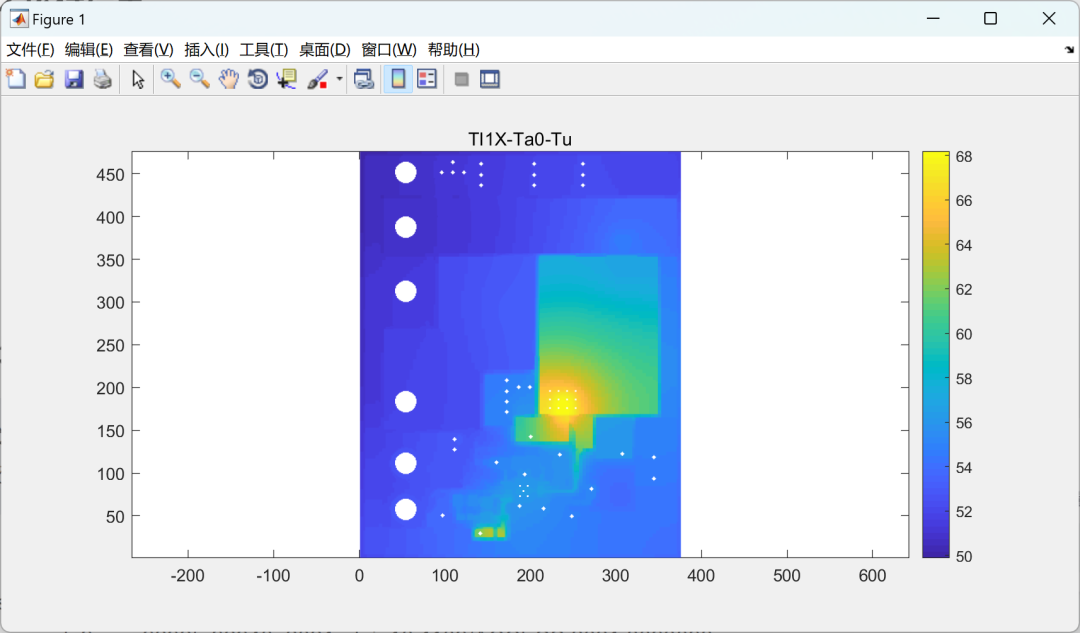
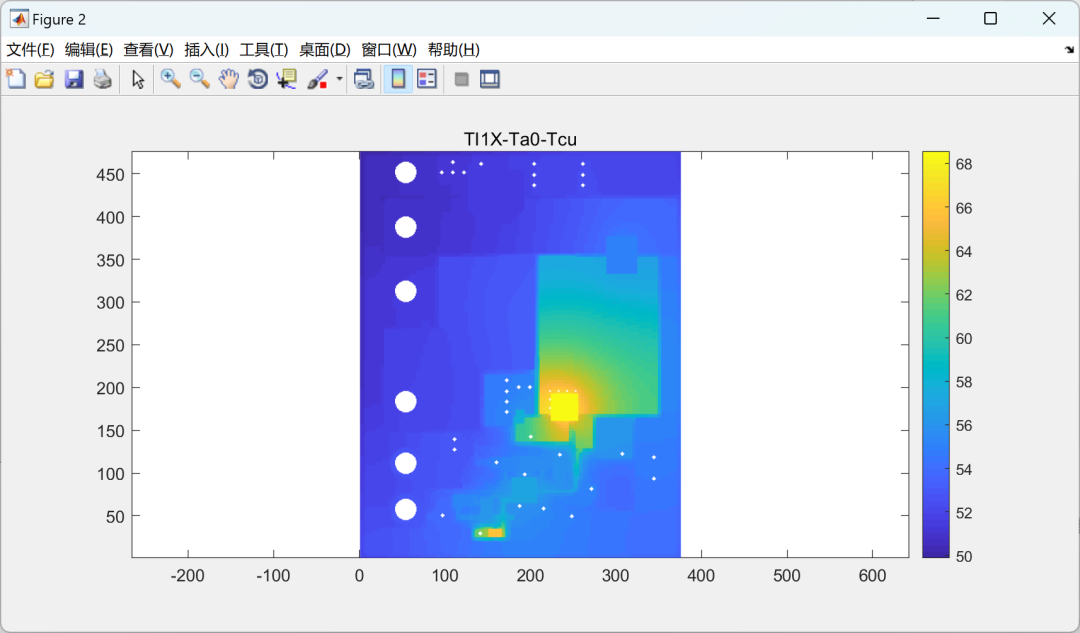
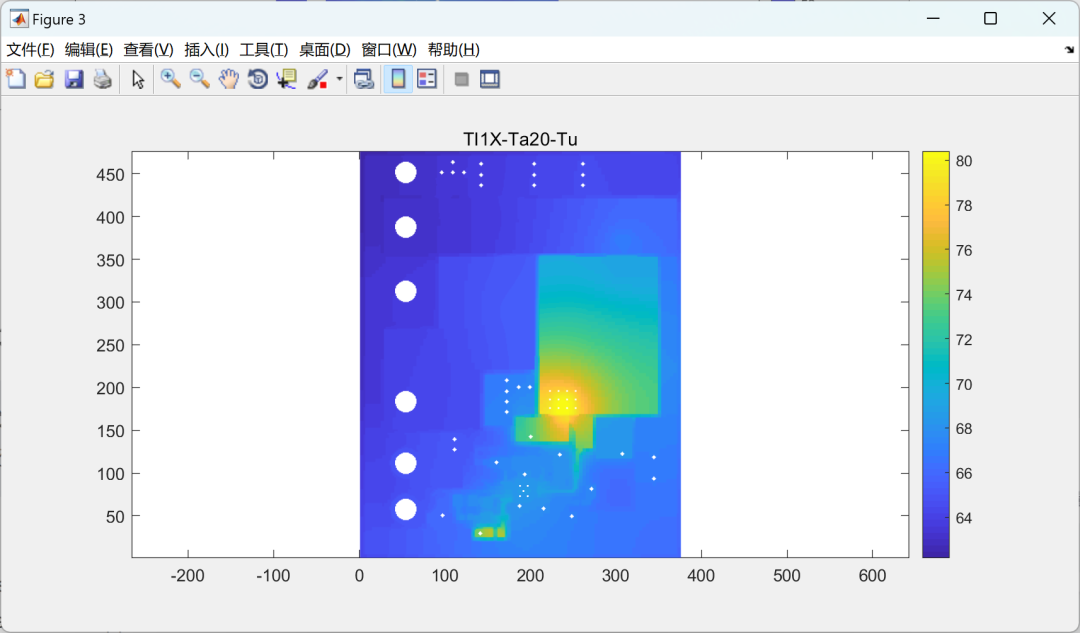
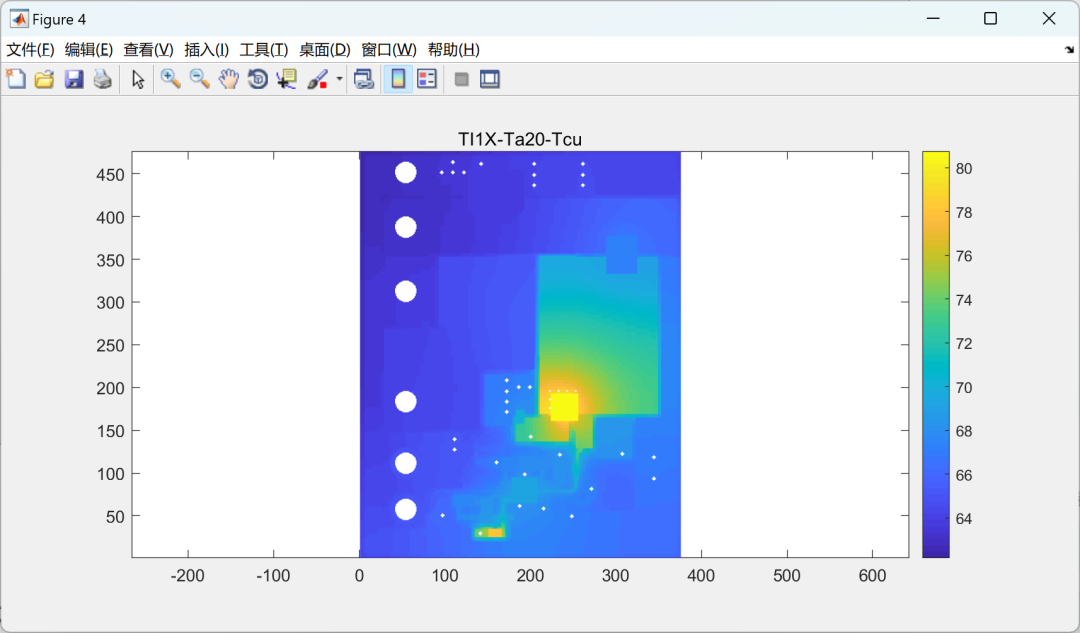
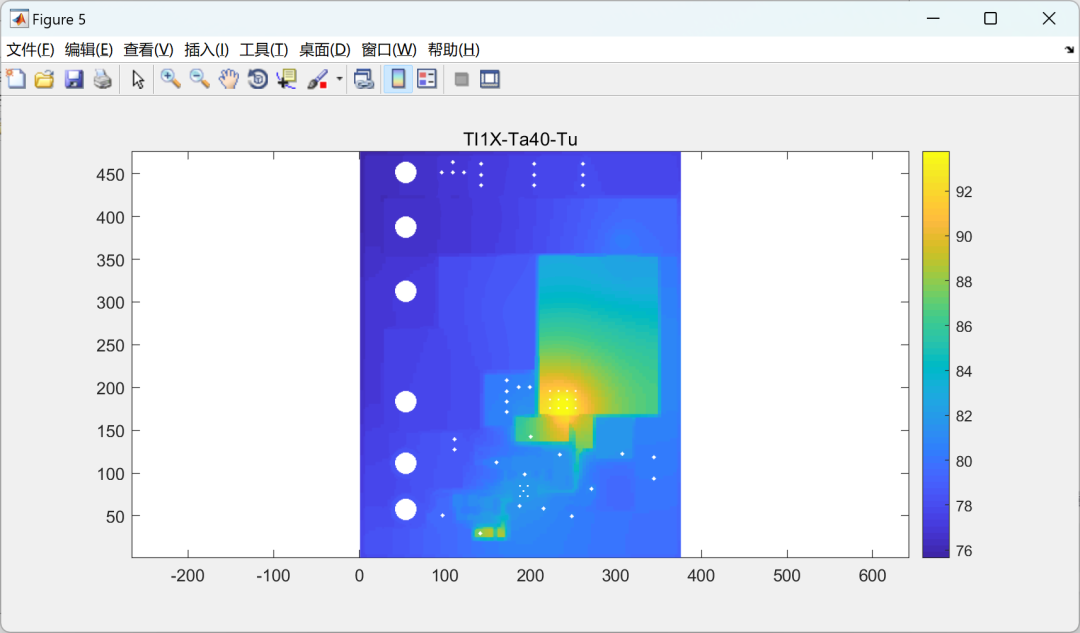
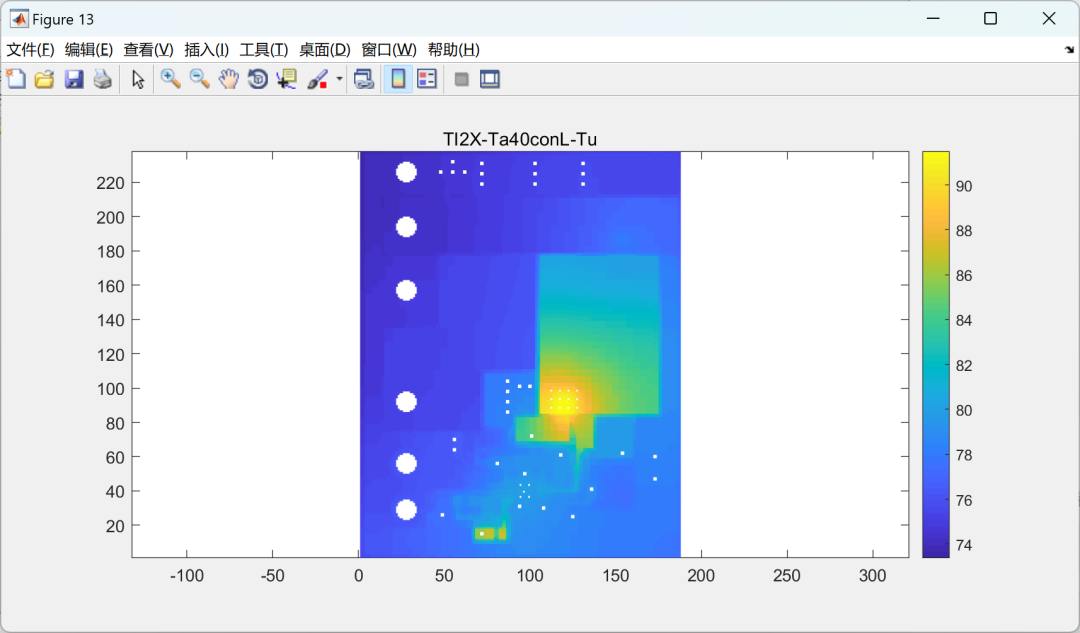
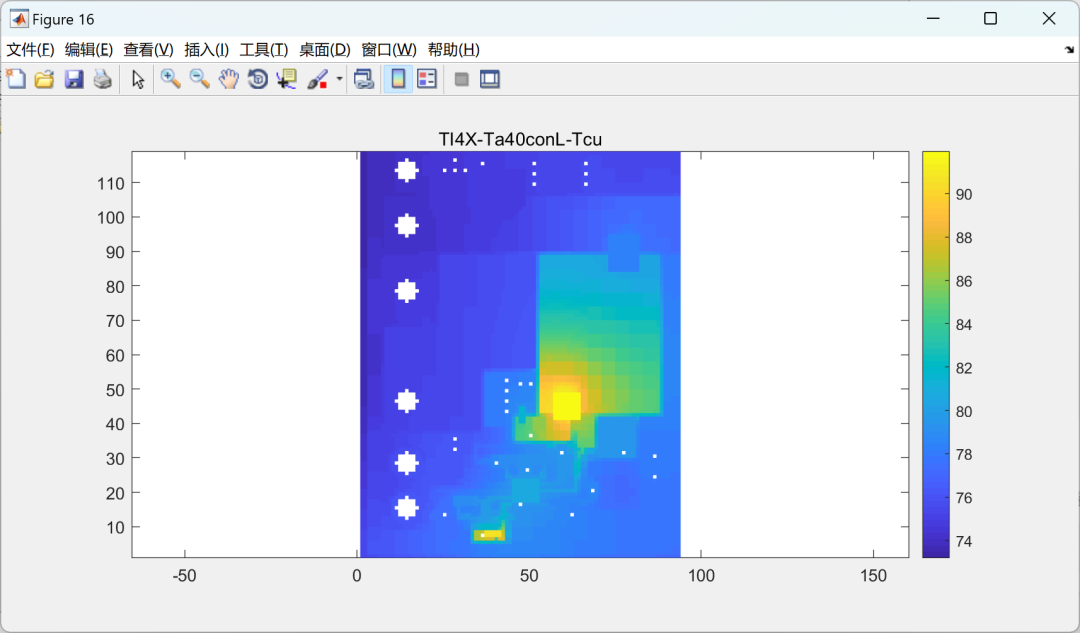
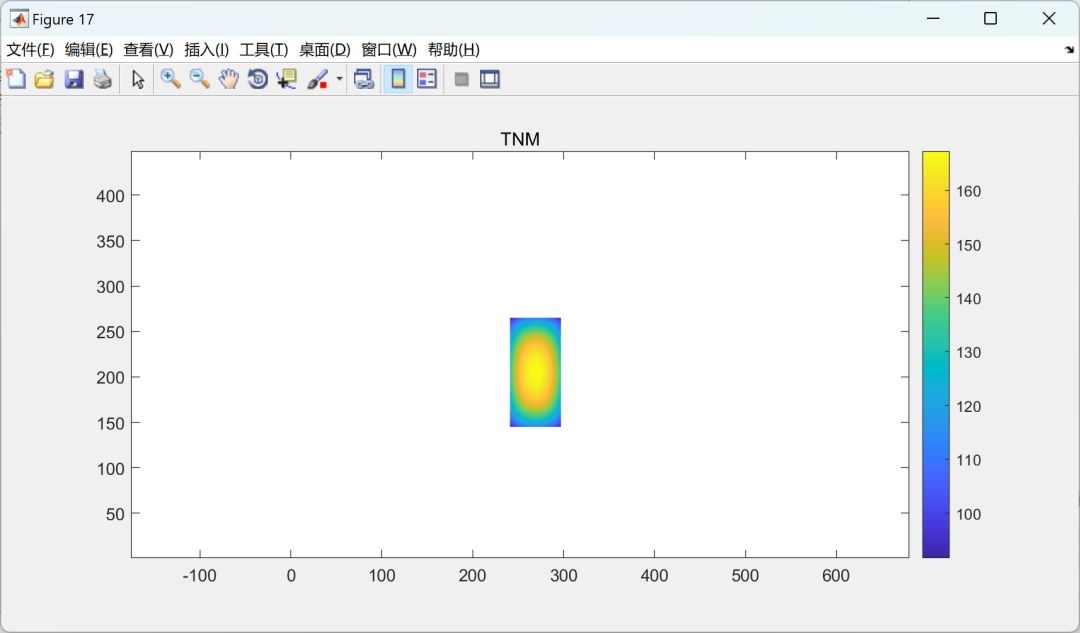
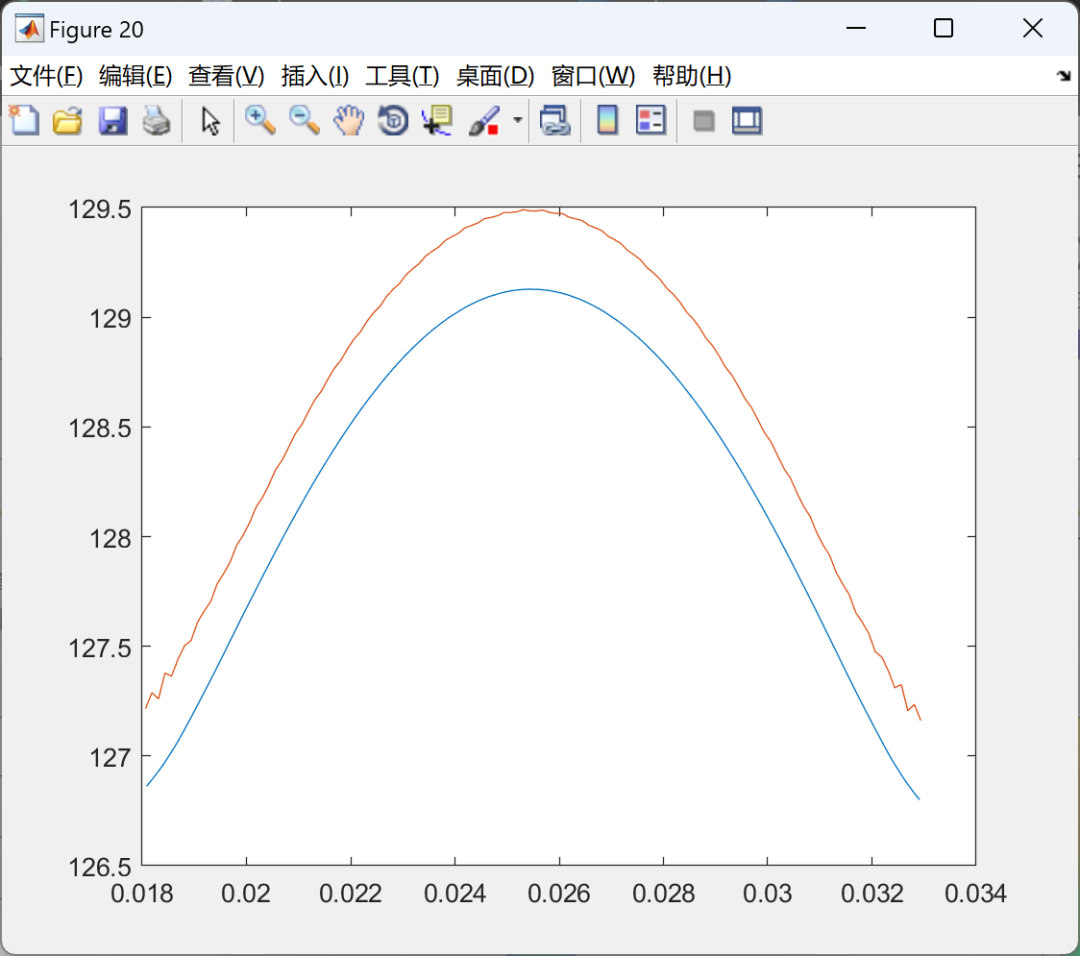
All operating results:
Link:
https://pan.baidu.com/s/1mr1H1oIGb4djQtg_p1cbCQ Extraction code: 5e5p –Shared by Baidu Cloud Super Member V5

% The total radiation power is composed of three parts, including the part from the components,% the part from the top metal layer, and the part from the insulating region of the top side.function [qRS21,qRM,qRI,qRall]=Radiationbylaw(sigma,Sc,Tc,Ta,dc2,TMu,TIu,LF16,LF4,LPRP,PFMAP,LINS16,LINS)% The part from the components was denoted by the array of qRS21:qRS21=zeros(21,1);qRS21(1:3)=sigma*0.9*Sc(1:3).*((Tc(1:3)+273.15+Ta).^4-(273.15+Ta)^4); % the part from M1, D1, andU1qRS21(4)=sigma*0.9*Sc(4)*((Tc(4)+273.15+Ta).^4-(273.15+Ta)^4); % the part from L1if zero R胃Jtop of the inductor is assumedqRS21(5)=sigma*0.88*Sc(5)*((Tc(5)+273.15+Ta).^4-(273.15+Ta)^4); % the part from Rfb2qRS21(6:14)=sigma*0.94*Sc(6:14).*((Tc(6:14)+273.15+Ta).^4-(273.15+Ta)^4);% the part from ceramic capacitorsqRS21(15)=sigma*0.88*Sc(15).*((Tc(15)+273.15+Ta).^4-(273.15+Ta)^4); % the part from Rfb2qRS21(16:21)=sigma*0.88*Sc(16:21).*((Tc(16:21)+273.15+Ta).^4-(273.15+Ta)^4);% the part from SMD resistors% The part from the top metal layer was denoted by the array of qRM:qRM=zeros(LPRP,1);qRM(1:LF16)= sigma*0.9*16*dc2*((TMu(1:LF16)+273.15+Ta).^4-(273.15+Ta).^4); qRM(LF16+1:LF16+LF4)=sigma*0.9*4*dc2*((TMu(LF16+1:LF16+LF4)+273.15+Ta).^4-(273.15+Ta).^4); qRM(LF16+LF4+1:LPRP)=sigma*0.9*dc2*((TMu(LF16+LF4+1:LPRP)+273.15+Ta).^4-(273.15+Ta).^4); qRMTr=qRM(LF16+LF4+1:LPRP);qRMTr(PFMAP)=0; % exclude the calculation of radiation power of the metal cells covered by the componentqRM(LF16+LF4+1:LPRP)=qRMTr;% The part from the insulating region was denoted by the array of qRI:qRI=zeros(LINS,1);qRI(1:LINS16)=sigma*0.9*16*dc2*((TIu(1:LINS16)+273.15+Ta).^4-(273.15+Ta).^4); qRI(LINS16+1:LINS16+LINS4)=sigma*0.9*4*dc2*((TIu(LINS16+1:LINS16+LINS4)+273.15+Ta).^4-(273.15+Ta).^4); qRI(LINS16+LINS4+1:LINS)=sigma*0.9*dc2*((TIu(LINS16+LINS4+1:LINS)+273.15+Ta).^4-(273.15+Ta).^4); % % The total radiation power was calculated as follows:qRall=sum(qRS21)+sum(qRM) +sum(qRI);Conclusion
The numerical-analytical coupling method for steady-state thermal analysis of printed circuit boards (PCBs) has been further improved to incorporate the analysis of radiative heat transfer, predict component temperature information, and consider the actual impact of components covering the PCB surface. Compared to a single uniform grid, a multigrid strategy was employed to generate three levels of discrete elements, significantly reducing computational burden. By using the component’s RθJC and RθJC(top), the junction temperature and average case temperature can be related to the temperature distribution on the layer surface. Ultimately, the thermal behavior of the overall PCB laminated structure and components was modeled. This numerical-analytical modeling strategy has the potential to be applied to the analysis of other engineering problems.
The proposed iterative method associates radiative heat transfer with the radiative equivalent heat transfer coefficients of each discrete element and component. The small difference in results between the simple single-layer structure solver and the COMSOL model verifies the feasibility of the iterative method mechanism. The iterative method may further be used to solve other temperature-dependent heat transfer problems.
Based on the modeling results of the virtual DC-DC power PCB, the consistency, stability, convergence, and conservation of the improved modeling method were further verified. Of course, if component manufacturers could more clearly and comprehensively declare thermal parameters, the thermal model of the PCB could be constructed more accurately. Components with low thermal resistance and small heat dissipation can primarily be viewed as thermal conduction paths that facilitate heat diffusion within the PCB. On the other hand, the heat diffusion effect of the metal layer in the PCB is significant, and compared to components, the PCB surface may be the main contributor to radiative heat transfer. Therefore, reducing PCB size depends not only on the electrical design rules of the layout but also on the impact of thermal analysis.
3References
Some content in this article is sourced from the internet, and references will be noted. If there are any inaccuracies, please feel free to contact us for removal.

[1]Y. Zhang, “Improved Numerical-Analytical Thermal Modeling Method of the PCB With Considering Radiation Heat Transfer and Calculation of Components’ Temperature,” in IEEE Access, vol. 9, pp. 92925-92940, 2021, doi: 10.1109/ACCESS.2021.3093098.
4 MATLAB Code, Data, Article
For resource acquisition, more fan benefits, MATLAB | Simulink | Python resources available