~Welcome to leave a message for interaction and communication~
When it comes to Da Vinci in real life, many people know the artist through classic works like “The Smile of Mona Lisa.” However, the name Da Vinci represents not just a great artist but also an expert in various fields. Da Vinci made outstanding contributions in painting, music, architecture, mathematics, geometry, anatomy, physiology, zoology, botany, and astronomy. Of course, the name Da Vinci also exists in the current medical field, representing not just a painter but also an advanced robotic surgery system. 01Da Vinci Robot Surgery and Its Connection to Da Vinci
Why is robotic surgery named after Da Vinci? What is its relationship with the Da Vinci we are familiar with? Was it invented by Da Vinci?
Firstly, due to the rapid development of modern medicine, there is no direct relationship between Da Vinci robotic surgery and Da Vinci himself, nor could it have been invented by Da Vinci. The reason for choosing Da Vinci’s name is to pay tribute to him. This is because Da Vinci was not only a great artist, scientist, and inventor of the Renaissance but also conducted extensive and profound research in biology. He is famous for his studies of human anatomy and his artistic works. Therefore, the name of the Da Vinci robotic surgery is derived from Da Vinci’s name to emphasize the innovation and advancement of this technology, aiming to convey the high precision, flexibility, and artistry of this technology. Similarly, this naming method is also a tribute to Da Vinci’s talents in multiple fields, linking his name with modern medical technology, showcasing the continuous progress and innovation of humanity in science and art, and highlighting the value and significance of the inheritance of scientific art.
02Can the Da Vinci Robot Perform Surgery?
Since Da Vinci robotic surgery has such significant implications, what exactly is it used for? Who developed it?
Firstly, the Da Vinci robotic surgical system is based on robotic surgical technology developed by the Massachusetts Institute of Technology. Intuitive Surgical subsequently collaborated with IBM, MIT, and Heartport to further develop this system. The design concept is to perform complex surgical procedures using minimally invasive methods. Secondly, regarding the uses of robotic surgery, the FDA has approved the Da Vinci robotic surgical system for general surgery, thoracic surgery, urology, gynecology, head and neck surgery, and cardiac surgery for both adults and children.
So, how does the robot perform surgery? What role does the doctor play during the surgery?
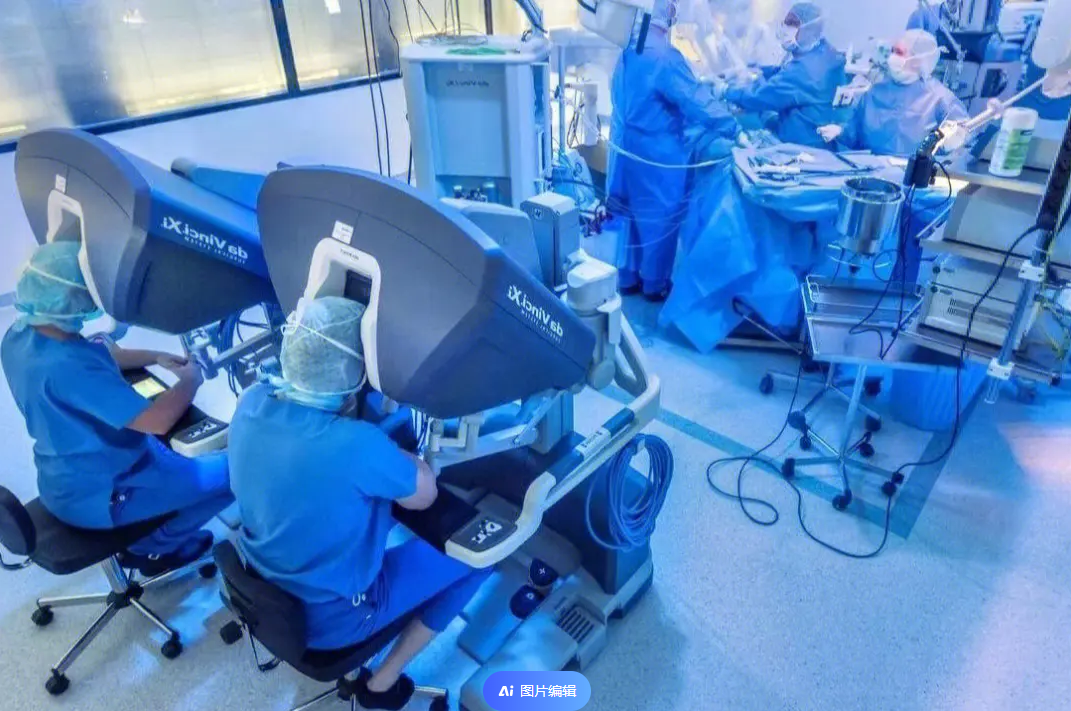
In terms of composition,the Da Vinci robot consists of three parts: the surgeon’s control console, bedside robotic arms, and an imaging system.During the surgical process, the system consists of a robot and a control console. The surgical robot serves as a powerful tool for the surgeon, itself lacking any intelligent functions. Additionally, it has multiple safety devices and synchronizes 1500 times per second to avoid delays, ensuring that every operation is executed by the surgeon’s commands; without the surgeon, it cannot perform any actions, eliminating the risk of losing control. The surgeon operates the robot through the control console to complete the surgery.
The Da Vinci robotic surgical system consists of multiple robotic arms and a high-definition camera. The surgeon sits at the control console and controls the robot’s movements using handles and foot pedals. The robot’s mechanical arms can precisely mimic human hand movements and can rotate 360 degrees. Therefore, during the surgery, the surgeon observes the patient’s internal condition through the display screen on the console and uses the robot’s mechanical arms to perform cutting, suturing, and tissue removal operations.
In simple terms,the Da Vinci robot is an advanced laparoscopic system. Consequently, due to the robot’s more precise and stable operations, Da Vinci robotic surgery can achieve smaller incisions and more refined operations, reducing surgical trauma and blood loss, and shortening recovery time for patients. Today, Da Vinci robotic surgery is widely used in various fields and has many outstanding characteristics and advantages.
03What Are the Differences Between Da Vinci Robot Surgery and Traditional Surgery?
In current clinical applications, Da Vinci robotic surgery operates through smaller incisions, reducing surgical trauma and blood loss. Compared to traditional open surgery, patients experience shorter recovery times and less pain, thus exhibiting minimally invasive characteristics. Secondly, in the operation of Da Vinci robotic surgery, the surgeon no longer relies on manual operations but instead operates through handles and foot pedals on the control console, allowing for more precise operations and improved surgical success rates. Additionally, the Da Vinci robotic surgical system is equipped witha high-definition camera, allowing the surgeon to observe the patient’s internal conditions through the display screen on the console. Thisthree-dimensional vision provides clearer and more detailed images, and compared to laparoscopic (two-dimensional vision), the three-dimensional vision can magnify by 10-15 times, helping doctors to perform surgeries more accurately and facilitating quicker recovery for patients.
Moreover, in traditional surgeries, the stability of the doctor’s arm and hand movements is influenced by many subjective factors. The robotic surgical system’s mechanical arms have stability, which can reduce tremors and instability during surgery, especially since the robot’s arms can work in limited narrow spaces, creating a relatively relaxed working environment for the surgeon, which helps to reduce fatigue and allows the doctor to concentrate better, enhancing the safety and success rates of the surgery. Finally, the application range of Da Vinci robotic surgery is broad; in addition to certain surgical applications, it can be used for complex surgical procedures such as tumor removal and organ transplantation.
For instance, in the field of urology, Da Vinci robotic surgery can be used for kidney removal, prostatectomy, bladder removal, and other surgeries. Particularly, the precision and stability of robotic surgery can reduce damage to surrounding tissues during surgery, improving success rates. Additionally, in thoracic surgery, Da Vinci robotic surgery can also be used for complex surgeries such as lobectomy, esophageal surgery, and mediastinal tumor removal. In gynecology, Da Vinci robotic surgery is also used for surgeries like uterine fibroid removal, endometriosis surgery, and ovarian cyst removal. Finally, with continuous technological development, the application range of Da Vinci robotic surgery in the medical field is constantly expanding.
 Clean Garden BooksMedical Construction BooksGuidelines, Standards, Specifications
END

Clean Garden | Building Safer Hospitals in China
★★★★★※※※※※※★★★★★
Infection Control| Medical Testing | Integration of Epidemic Prevention | Stem Cell Transplantation
Composite Operating Room| ICU Wards | Day Surgery Rooms | Integrated Operating Rooms | Laboratories
HVAC| Medical Equipment | Medical Materials | Environmental Protection and Energy Saving
★★★★★※※※※※※★★★★★