The world’s most advanced chip technology has reached 3 nanometers, and it is soon to be upgraded to 2 nanometers.
Interestingly, 75% of global chips are made using mature processes of 28 nanometers and above, while only about 25% are produced using more advanced processes below 28 nanometers.
Among these 25% of advanced chips, the main types are CPU (computer processors), GPU (graphics cards), SoC (mobile chips), and AI chips; most other chips use mature processes.
In the past, these four types of advanced chips were primarily imported, as domestic design and manufacturing capabilities were indeed weaker than those of the United States and its allies. This is why the U.S. has often used these four chips to exert pressure on us. However, in recent years, we have not stopped making breakthroughs, aiming to increase self-sufficiency and reduce dependency, so that we are not easily constrained by others regarding chips.
Looking at it now, we are indeed close to catching up with the United States in these four types of advanced chips.
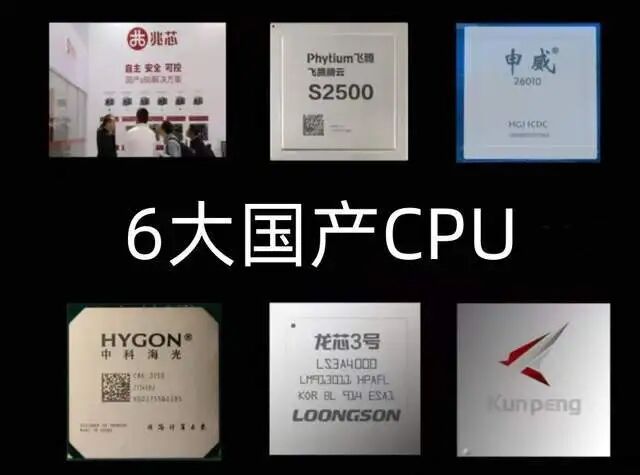
First, let’s talk about CPUs, which are the processors used in computers. The main players in the U.S. are Intel and AMD, while domestically we have brands like Loongson, Zhaoxin, Haiguang, Kunpeng, Shenwei, and Feiteng. In terms of self-developed technology, the gap between Loongson’s CPU and Intel has narrowed to 1-2 years; Haiguang’s X86 architecture CPU is also only 1-2 years behind Intel. Additionally, Shenwei is used in supercomputers, and Kunpeng is used in servers, with only a small gap remaining compared to U.S. CPUs. Currently, the domestic CPU localization rate has exceeded 20%.
Next, we look at GPUs, which are standalone graphics cards (not including AI acceleration cards). The current localization rate of domestic GPUs has reached 30%, with brands like Moore Threads, Jingjia Micro, and Xixia. The CPUs from Loongson, Haiguang, and Zhaoxin also integrate GPU functionality. Although there is still a gap compared to AMD, NVIDIA, and Intel, the difference is shrinking, and domestic GPUs have already established a foothold.
Then we have SoCs, which are mobile chips. Without mentioning MediaTek, looking at domestic chips, Xiaomi’s Xuanjie O1 uses a 3-nanometer process, Huawei has Kirin chips, and Unisoc is also making strides. Domestic SoCs may be slightly weaker compared to high-end Qualcomm chips, but the gap is not significant.
Finally, regarding AI chips, NVIDIA has acknowledged that Huawei’s AI chips have reached the level of their H200 – this is a certification from a competitor, so it must be accurate. Moreover, AI chips have a characteristic that allows performance to be aggregated through clustering, making them very effective in practical use.

Therefore, in terms of CPU, GPU, AI, and SoC, we are indeed catching up with the United States. Although due to market reasons, it is not realistic to completely replace imports in the short term, the localization rate is continuously increasing.
As for chips using mature processes (28 nanometers and above), we need not worry, as this is our strong suit. Currently, domestic chip production capacity is rapidly increasing, and exports are also rising quickly; China’s mature chips have begun to enter the global market. In the future, it is possible that the U.S. will even rely on our mature process chips.
In summary, in the realm of chips, time is on our side. If we persist for a few more years, chips may very well become as cheap as “cabbage,” and at that point, American companies may truly find themselves in a difficult position against Chinese enterprises. If you don’t believe it, let’s just wait and see.