The operating frequency band of UHF (Ultra High Frequency) RFID generally ranges from 860 to 960 MHz, with slight variations across different regions worldwide. The frequency band in North America is 902 to 928 MHz, in Europe it is 865 to 868 MHz, in Japan it is 916 to 924 MHz, and in China, the designated frequency range for UHF RFID communication is 920 to 925 MHz. Compared to RFID products operating in other frequency bands, UHF RFID tags have a higher transmission rate and can perform bulk reading, allowing for the rapid reading of a large number of electronic tags in a short time. Therefore, they are particularly suitable for large-scale application scenarios, significantly improving supply chain management efficiency and other applications.
With the maturation and improvement of the industrial chain in recent years, the cost of UHF RFID has been greatly optimized, leading to a rapid increase in the usage of UHF RFID tags. Currently, UHF RFID products are the most widely used and have the largest shipment volume among the various RFID frequency bands, with the most players in the industry and the highest level of attention.
China’s UHF RFID Passive Internet of Things
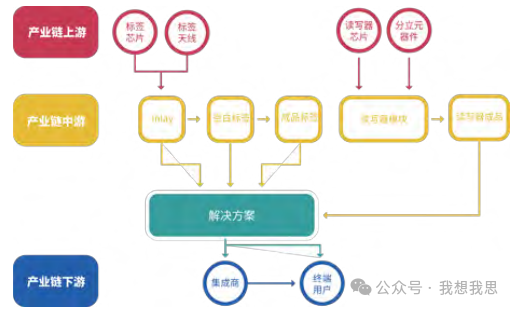
China is a major producer of UHF RFID tags and readers, so the UHF RFID industrial chain is primarily concentrated in the Chinese market. The product categories of UHF RFID market include tags and readers, which are two completely different industrial chains. Tag products are characterized by low cost, high standardization, and a focus on the production process, while reader products have high technical barriers, high customization, and a focus on solutions.
Analysis of UHF and HF Dual-Frequency RFID
Passive Internet of Things RFID is divided into low frequency, high frequency, and ultra-high frequency based on frequency bands. In fact, some market scenarios are using “high frequency + ultra-high frequency” dual-frequency RFID solutions.
Dual-frequency RFID is a relatively special application market with a simpler industrial chain. Besides integrating UHF and HF into the same IC, some market scenarios also adopt a solution that combines UHF tags with HF tags.
In addition to the chip barriers, the design and manufacturing difficulty of dual-frequency tags is also greater than that of ordinary tags, because the working principles of HF and UHF in two different frequency bands are completely different. One is near-field coupling, and the other is far-field radiation, requiring two different antenna combinations. Moreover, since the usage of dual-frequency products is currently not large, both dual-frequency RFID chips and tags are relatively expensive.
Advantages of Dual-Frequency RFID
The advantages of dual-frequency RFID products are reflected in the following aspects:
Advantage 1: Retains the bulk rapid inventory function of UHF RFID
The greatest advantage of UHF RFID is its long transmission distance and ability to perform bulk reading, making it very suitable for scenarios requiring rapid inventory, especially in B-end warehousing logistics and inventory counting.
Advantage 2: Retains the ability of HF RFID to interact with mobile phones
Since NFC on mobile phones is a type of HF RFID technology, HF RFID tags can directly interact with mobile phones, greatly expanding the boundaries of RFID usage. In everyday consumer goods, there is a demand for authenticity verification and anti-counterfeiting traceability for more valuable items.
Therefore, dual-frequency RFID tag products can meet the B-end needs for asset management and efficiency turnover, as well as the C-end demand for anti-counterfeiting traceability, forming a good commercial closed loop.
Market and Application Introduction of Dual-Frequency RFID
The application scenarios of dual-frequency RFID products mainly have the following characteristics:
-
The usage scenarios need to combine the high efficiency of ultra-high frequency inventory with the interaction characteristics of high frequency with mobile phones, which requires a large and concentrated application volume to create a demand for bulk inventory; and the product’s anti-counterfeiting traceability attributes are strong, requiring direct interaction with consumers.
-
The unit price of products in the application scenarios is relatively high, which stimulates consumer demand for anti-counterfeiting traceability. In addition, dual-frequency RFID tag products are also much more expensive than single-frequency tags, requiring high-value scenarios to bear such cost investments.
-
There is a strong demand for authenticity verification, but the market lacks products backed by authoritative institutions. Such products require consumers to identify authenticity themselves, necessitating the use of technological means.
Based on this logic, we believe that the following fields are more suitable for adopting dual-frequency products.
-
High-end alcoholic products
This field is a scenario where dual-frequency RFID products are being used in large quantities. High-end alcoholic products, such as Moutai and Wuliangye, have annual shipment volumes in the tens of millions or even hundreds of millions, creating a demand for inventory counting. Additionally, the unit price of high-end liquor ranges from hundreds to thousands of yuan, which can fully cover the investment cost of dual-frequency tags, and consumers have a high demand for authenticity verification of liquor.
-
Luxury goods
For example, high-end watches, bags, and other products are very expensive, and consumers have a strong need for authenticity verification for such products. The market scale is also large, requiring rapid inventory, so dual-frequency usage is also common in these scenarios.
-
Collectibles
Collectibles include precious stones, antiques, and various crafts. These products are expensive, but the ability to distinguish authenticity requires high professional skills, making it difficult for ordinary people to identify. Therefore, RFID tags are needed for technical identification.
-
Libraries
Currently, some libraries in China are adopting dual-frequency solutions. However, this is a legacy issue of industrial development. In the early days, many libraries adopted high-frequency tags, but with the maturity and cost reduction of UHF RFID, UHF solutions have become mainstream, leading many libraries that adopted high-frequency solutions to transition to dual-frequency solutions.
Latest Trends in China’s UHF RFID Passive Internet of Things Industry
-
The market recognition of domestic UHF RFID chips is increasing
Whether for UHF RFID tag chips or reader chips, the market recognition of domestic products is gradually increasing. Domestic chips have already achieved large-scale applications among domestic end users and are currently being introduced into some overseas major projects. As product iterations continue, the performance gap between domestic and foreign chips is gradually narrowing.
-
More and more powerful players are actively laying out the RFID passive Internet of Things
In recent years, the RFID passive Internet of Things industry has been breaking boundaries, attracting some major enterprises to lay out, such as Huawei and China Mobile in the telecommunications sector, which are actively investing in passive Internet of Things, while logistics giants like JD.com, Cainiao, SF Express, and China Post have already deeply laid out.
-
5G-A cellular passive standards will be frozen in the second half of 2025, benefiting the RFID industry
The 5G-A standards for cellular passive will be officially frozen in the second half of 2025. Once confirmed, it will integrate the passive Internet of Things industry into the cellular communication network, bringing enormous market potential and significant benefits to the UHF RFID industry. Firstly, the tag industrial chain will directly benefit, as the production processes and players for 5G-A tags and UHF RFID tags are the same. We believe that RFID readers will also benefit to some extent.
-
The majority of domestic tags adopt the “Inlay + Composite” business model, with composite production capacity exceeding that of inlay
There are two main reasons for this. On one hand, with price competition, domestic tag manufacturers can earn very low gross margins if they only focus on either inlay or composite. By engaging in both processes, they can earn additional profits from each step. On the other hand, the largest market for inlay is the ARC market, which domestic binding manufacturers currently cannot enter, but the composite process is open, allowing domestic tag manufacturers to receive more composite orders. Regarding later stages such as data writing and printing, domestic companies are relatively fewer, as this stage is closer to the user and generally distributed according to the factory locations of major users.
-
The popularity of RFID in the domestic footwear and retail market is increasing
In the past year or two, we have seen a rapid increase in the adoption of RFID in the domestic footwear and retail market. Leading brands such as Anta, Bosideng, Miniso, and Xixifu Bookstore are adopting RFID tags, and the proportion of domestic brand enterprises using RFID tags has become relatively high.
-
RFID tags on domestic express packages will start from high unit price scenarios and have already made progress
Express packages are the most noteworthy market for the domestic RFID industry. However, due to the low unit price and thin profit margins in this industry, RFID tags are not affordable. Nevertheless, we have seen breakthroughs in the application of RFID in the domestic express industry, such as JD.com’s large item warehouses and Cainiao’s overseas packages in Europe, which are beginning to use RFID tags on a large scale. Currently, Cainiao’s international express services are only using RFID tags on large packages, but this is also a consumable, and the volume is relatively considerable.
-
Asset management scenarios such as “dumb resources” are worth paying attention to
In the telecommunications industry’s “dumb resources” management market, there has been increasing attention in recent years, and it has already formed an application scale of hundreds of millions of PCS. The potential of this market is in the tens of billions of PCS, and the current industry driving force is also strong, making it worth monitoring.
-
RFID industry going overseas is gradually becoming a consensus
Of course, many years ago, due to excessive competition in the domestic market, everyone wanted to enter overseas markets. However, in the past year or two, the overseas expansion of RFID companies has gradually transitioned from an idea to implementation. We have seen that domestic RFID companies, whether tag manufacturers or reader manufacturers, have made significant investments in overseas markets, such as forming overseas teams, participating in overseas exhibitions and events, and allocating more promotional budgets for overseas channels. The overseas market is vast, and if each company differentiates its approach, it can avoid much of the competition seen in the domestic market, with unique opportunities in regions such as Japan, South Korea, the United States, Europe, Southeast Asia, Russia, and South America.
-
AI is transforming the RFID industry
In recent years, AI has begun to integrate into various industries. RFID companies have been relatively slow to respond to AI, but in the past year, we have seen an increasing number of domestic RFID companies, especially reader manufacturers, actively using AI to upgrade products, even using AI to create more perfect solutions, solve technical problems that pure radio frequency cannot address, or bring new product functionalities. This is currently a focus for many companies.
-
Environmental protection remains important, and the application of eco-friendly RFID tags continues to advance
RFID tags are consumables that have become popular in the footwear and retail sectors. Compared to traditional paper tags, RFID tags have some level of pollution. Driven by environmental and sustainable development concepts, many companies in the industry are working towards making RFID tags more environmentally friendly.
Firstly, there is the antenna production process. Traditional etching processes cause significant chemical pollution, while die-cutting and printing processes reduce pollution during antenna production.
Secondly, the choice of materials for antennas is crucial. Whether using aluminum or copper for antennas, the final tags have some pollution. However, some companies are researching special ink formulations that can reduce the metal content while ensuring the electrical performance of the antennas, achieving a degradable purpose.
Finally, replacing difficult-to-degrade materials like PET, which require etching processes, with ordinary paper materials in printing processes allows for natural degradation.
Although the current shipment volume of eco-friendly tags is still small, our research indicates that major tag manufacturers are still placing great importance on eco-friendly tags, continuously investing resources to optimize products. This is a significant trend, and while commercial results may not be visible in the short term, the long-term trend is clear.
Source: China RFID Passive Internet of Things Industry White Paper