SoC is an abbreviation for “System on a Chip”. In the past, it was typically composed of numerous chips, but with the development of related technologies, the current SoC refers to components that integrate CPU and other logic ICs, various IPs, and different types of memory onto a single chip, also known as system LSI.
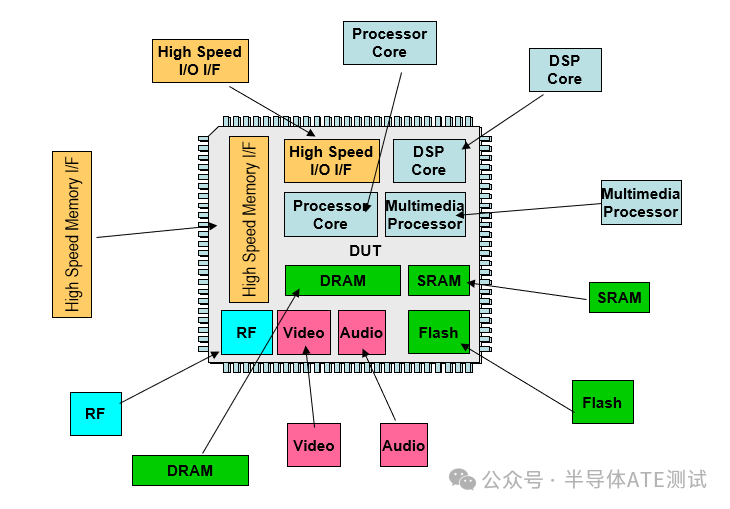
Types of Components
MPU = Micro Processing Unit (Microprocessor)
A micro processing unit is an IC used in the heart of a computer (specifically, the brain).
For example, 🌰 Intel: Pentium and Celeron; Spansion: K6 and K7 processors.
MCU = Micro Controller Unit (Microcontroller)
Compared to MPU, it is a logic IC more dedicated to specific functions. MCUs are more compact than MPUs and are widely used in home appliances.
For example, 🌰 Hitachi: SH microcomputer.
DSP = Digital Signal Processor (Digital Signal Processor)
As the name suggests, it is a processor dedicated to digital signal processing (processing of sound, images, etc.).
It can be embedded in devices like modems or connected to computers to help the CPU share some processing tasks.
ASIC = Application Specific Integrated Circuit
ASICs are special-purpose ICs, customized according to customer requirements.
Since they are custom ICs, ASICs are usually produced in small quantities with a variety of types.
ASICs can be categorized into two types.
USIC (User Specific IC) is an IC designed for specific users and specific purposes. USICs are often referred to as ASICs.
For example, 🌰 ICs used in Epson printers (ICs with multiple restrictions).
Gate Array
A gate array refers to a semi-custom IC with pre-designed basic chip circuits.
With a gate array, it can then be customized according to customer requirements…
It has advantages such as a short development cycle and cost control even for small production volumes!
ASSP (Application Specific Standard Product) is an IC designed for specific purposes.
For example, 🌰 ICs for automotive use and ICs for printers.
Taking automotive ICs as an example, they can be used in Nissan cars as well as Toyota cars, as they are not limited to specific users.
SoC Testing Systems
The general model of SoC testing systems can test any type of component (memory chips, logic chips, analog chips, LCDs).
However, for specific purpose components like memory, LCD drivers, and image sensors, which have dedicated functional systems inside, specialized equipment is usually used for testing.
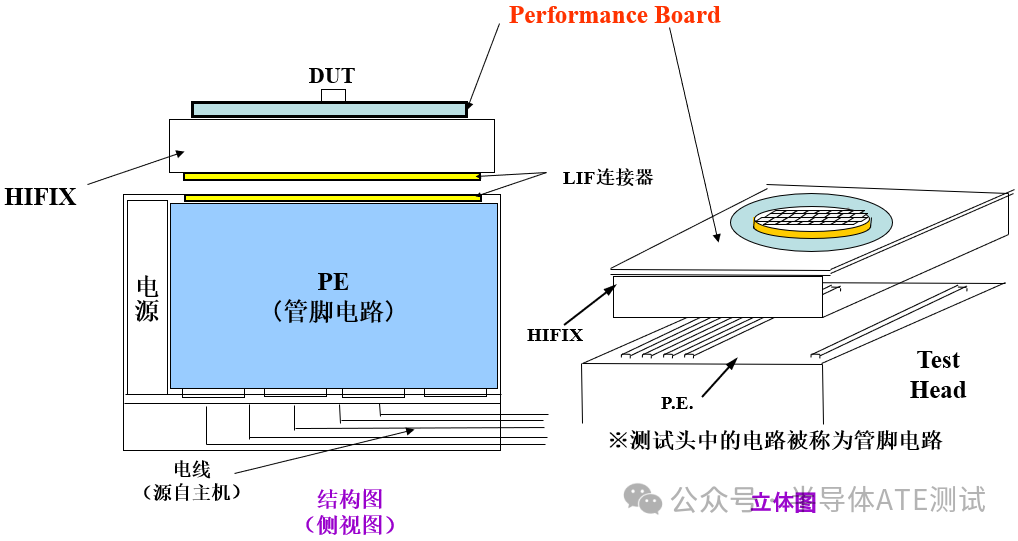
The connection device between the testing system and the tested components. By setting up a multilayer printed circuit board on the test head, signal communication between the testing system and the components can be completed.
Tools that directly apply waveforms generated by the testing device to the components. In logic testing, this is also referred to as converting HIFIX. In memory testing, it can also be used as a substitute for the test interface board.
Multifunctional System
Can test various logic components (small quantities and multiple varieties).
The SoC testing system can simultaneously determine various components such as logic, memory, and analog.
To meet various demands, the testing system is equipped with diverse functions.
Per-Pin Structure
The memory testing system can be divided into Per Site type and shared resource type based on hardware structure, while the SoC testing system adopts a Per-pin resource type structure.
Per-pin means that each pin is independently equipped with resources such as timing generators.
Differences Between Central Resource Type and Per-pin Type
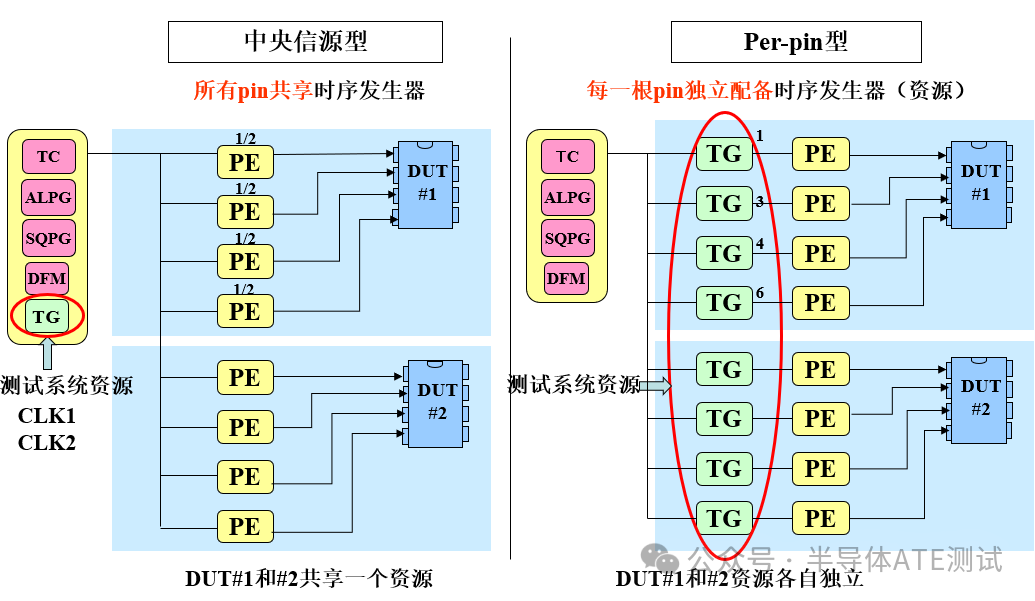
While increasing the internal functions of components can enhance the added value of products, testing them requires repeated different tests for each pin.
For example, in a shared resource ATE testing machine,
since the timing for each pin must be set, it requires a longer processing time.
Using a shared timing generator is not conducive to flexible applications.
Compared to the central resource type, the advantages of the Per-pin type are…
Each pin is independently equipped with a timing generator, and there is no need to allocate resources to each pin.
Designers are not restricted and can freely create waveforms. Error correction can be flexibly set or changed for specific pins as needed, making it easy to link with the test program generation system and CAD.
All steps from programming to testing can be completed in a short time, effectively shortening the development cycle.
|
SoCTesting System |
Memory Testing System |
|
|
Features |
・Can determine various (logic, memory, analog) components in a multifunctional system |
・Can test several simultaneously ・System functions are specialized according to the updates of memory components (speed, Pin count) |
|
Testing Time |
Short (in seconds) |
Long (in seconds) |
|
Number of Simultaneous Tests (per 1 STN) |
Few 1,2,4 *Depending on the needs of the components, it can also be 8,16,32 |
Many 256*Since the testing time for memory is longer, to reduce the testing cost per component, the number of simultaneous tests is highly valued. |
|
Pin |
All pins use I/Opin structure *Applicable to any type of component |
Composed of Dr (input) pin and I/Opin structure |
|
Hardware Structure |
Per-pin type (previously dominated by central resource type 20 years ago) |
Central resource type and Per-site type |
To be continued, that’s all for today~
Welcome everyone to join the group for communication and mutual learning~