With the continuous advancement of electronic technology and the increasing maturity of chip manufacturing processes, embedded systems have gradually been applied in various fields such as civilian, commercial, industrial, and military.
In fields such as smart electronic products, industrial control, military equipment, and aerospace, there is a need for a system that can accept and process external events or data quickly enough, with results that can control the production process or respond rapidly to processing systems within a specified time, coordinating all real-time tasks to run harmoniously.
This is the Embedded Real-Time Operating System (Embedded Real-time Operation System, abbreviated as RTOS).
1. VxWorks
Developed by Wind River Systems in the USA, VxWorks is a high-performance, scalable real-time operating system with a strong capability for continuous development, a high-performance kernel, and a user-friendly development environment. It supports almost all processors on the market and offers good reliability and exceptional real-time performance.
2. Nucleus
One of the most popular embedded operating systems in the world, Nucleus is widely used in the embedded field as a real-time operating system. It was originally designed by an American company as a preemptive multitasking operating system kernel for real-time embedded applications, with about 95% of its code written in ANSI C, making it very portable and able to support most types of processors, while also providing support for modules such as networking, graphical user interfaces, and file systems.
3. QNX
QNX is a commercial, POSIX-compliant Unix-like real-time operating system produced by QNX Software Systems in Canada. It is one of the most successful microkernel operating systems, widely used in the automotive sector, such as in the music and media control systems of Porsche sports cars and the control systems of the US Army’s unmanned Crusher tank, as well as in RIM’s Blackberry PlayBook tablet. It features a unique microkernel real-time platform that is real-time, stable, reliable, and extremely fast.
4. Windows CE
Designed and developed by Microsoft, Windows CE is an embedded operating system characterized by its openness and upgradability. It supports a wide range of hardware platforms, and programs developed for the desktop operating system Windows family can run directly on Windows CE. It is sometimes referred to as a streamlined version of Windows 95. Windows CE inherits the excellent user interface tradition of the Windows family and is an operating system based on handheld smart electronic devices.
5. RT-Linux
Developed by the Mexican Institute of Technology in the USA, RT-Linux is an embedded real-time operating system based on Linux, providing source code and open-source software. RT-Linux uses a refined kernel and treats the standard Linux core as a real-time core process, scheduling it alongside user real-time processes. This results in minimal changes to the Linux kernel and allows for the full utilization of the rich software resources available under Linux.
6. uC/OS-II
Originally known as uC/OS, it was first designed and developed by American embedded systems experts in 1992, with uC/OS-III now also available. uC/OS-II is characterized by high execution efficiency, small footprint, excellent real-time performance, and strong scalability, with a minimum kernel that can be compiled to 2KB. UC/OS-II has been ported to almost all well-known CPUs and is one of the most widely researched embedded real-time operating systems in China.
7. FreeRTOS
FreeRTOS is a small embedded real-time operating system that uses a mini kernel. Since embedded real-time operating systems require some system resources (especially RAM), only a few real-time operating systems like QNX, uC/OS-II, and FreeRTOS can run on small RAM microcontrollers. Compared to commercial operating systems like QNX and uC/OS-II, FreeRTOS is a completely open-source operating system, characterized by open code, portability, cutability, and flexible scheduling strategies, making it easy to port to various microcontrollers.
8. RT-Thread
Developed by the open-source community in China, the RT-Thread system not only includes a real-time operating system kernel but also a complete application ecosystem, containing various components related to embedded real-time operating systems: TCP/IP protocol stack, file system, Libc interface, graphical user interface, etc., with significant development potential.
9. MQX
Originally from a company in Ottawa, Canada, MQX occupies only 6KB of ROM storage space when loaded with the system kernel, interrupt management system, semaphores, queues, and memory management system, resulting in low hardware resource overhead. MQX is comparable in scale to UC/OS-II but far exceeds it in user experience and the richness of system services.
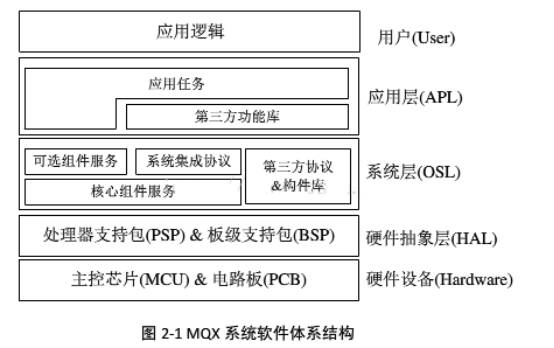
PSP mainly focuses on processor cores, implementing core operating system functions such as context switching and hardware interrupt response. The differences in PSP among different chips with the same processor architecture are not significant.
BSP mainly focuses on hardware device modules and peripheral circuits outside the processor core, providing device driver and other extension services for the MQX system software. A typical example is the system tick generated by timer interrupt cycles, which serves as the basis for providing time services to the system.
The embedded real-time operating system is a dedicated computer system centered on applications, based on computer technology, where software and hardware can be tailored to meet strict requirements for functionality, reliability, cost, size, and power consumption. Mastering it is an important skill that tests an embedded engineer.


Click below to read the original text and immediately experience joy.