Author|Yang Zhiyong “Co-author of ‘Innovations in Automotive Insurance'”Article|’China Insurance’ Issue 6, 2025
Industry Collision: Imbalance of Supply and Demand in New Energy Vehicle Insurance
Neither automotive professionals nor insurance practitioners anticipated that, in the face of the rapid development of new energy vehicles, the insurance issues faced by vehicle owners would become a focal point of societal concern. The challenges on the demand side for new energy vehicle insurance, such as difficulty in obtaining coverage, high premiums, and stringent claims processes, correspond to the high accident rates, high payout ratios, and industry-wide losses from the perspective of insurance companies. Moreover, phenomena such as premium increases, additional coverage requirements, and selective customer targeting have emerged. When insurance meets new energy vehicles, it is no longer merely an issue for the insurance industry, prompting the Financial Regulatory Bureau to collaborate with the Ministry of Industry and Information Technology, the Ministry of Transport, and the Ministry of Commerce to jointly issue documents promoting the high-quality development of new energy vehicle insurance.
As insurance encounters new energy vehicles, the original business rules of cost competition and premium-for-repair exchanges are gradually becoming ineffective. Colleagues in the insurance industry almost unanimously hope that automotive manufacturers can reduce repair costs and share vehicle data, but these seemingly reasonable logics do not necessarily become reasons that manufacturers will accept without question.
Industry Iteration: The Technological Revolution in the Automotive Sector
If you ask what the differences are between cars in 2025 and those from ten years ago, many people’s first reaction would be that they are drastically different. In terms of products, the “four major components” of fuel vehicles have been upgraded to the “new four components” in the era of new energy: the three electric systems (battery, motor, electronic control), body, intelligent cockpit, in-vehicle communication, and intelligent assisted driving. The application of new technologies such as integrated die-casting, battery chassis integration (CTB/CTC), centralized electronic and electrical architecture, in-vehicle connectivity and OTA, and autonomous driving (assisted) has made the manufacturing, usage, and maintenance costs of vehicles distinctly different from traditional fuel vehicles. Beyond their role as transportation tools, automotive products are also endowed with the roles of intelligent terminals and digital ecosystems.
In terms of services, the online ordering, delivery, and service processes of new energy vehicles, through real-time applications between the vehicle and mobile devices, have significantly improved the information asymmetry and price transparency issues that existed in traditional offline transactions between automotive manufacturers and authorized dealers. Users completing vehicle purchases, usage, and maintenance through mobile devices has become the mainstream way for manufacturers to serve vehicle owners, reshaping the relationship between people, vehicles, and manufacturers through informatization.
Model Innovation: Opportunities for Insurance in the Service-oriented Manufacturing Industry
Japanese scholar Yuko Yamauchi mentioned in her book ‘Service Culture’ that the service-dominant logic proposed by Steve Vargo and Bob Lusch emphasizes that service is fundamental, and goods are merely vehicles for service. Lyu Yenan, Vice President of Property and Casualty Insurance at Qianhai Reinsurance, pointed out that the service-oriented transformation of manufacturing integrates the value chain through the product lifecycle and revitalizes manufacturing by combining products and services to create more sustainable, customer-centric business models.
Apple’s AppleCare+ (Apple device warranty service) achieves a combination, integration, and value addition of physical products and service products by providing extended warranties and replacement services. In my book ‘Innovations in Automotive Insurance’, I dissected its insurance product logic, revealing the operational context of insurance companies providing actuarial pricing and risk control. This service plan not only generates considerable cash flow for Apple but also effectively enhances user loyalty and engagement.
Ecological Restructuring: The Role Transformation of Automotive Manufacturers and Insurance Companies
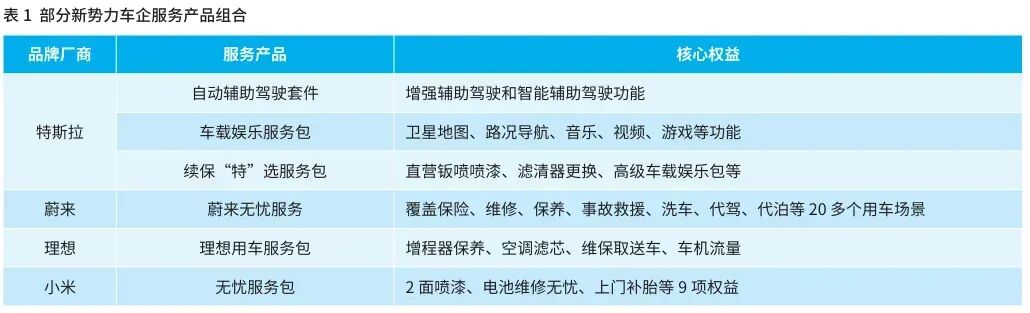
The arrival of the new energy era, especially the infrastructure benefits of mobile connectivity, has brought new opportunities for the service-oriented transformation of manufacturing. Represented by the “new forces in car manufacturing”, automotive companies are continuously innovating in service products, providing vehicle owners with an impressive service “cake” based on various rights and service combinations. Automotive manufacturers overlay their own products and rights with those of cooperative suppliers, integrating them into various worry-free services or “worry-free packages”, with insurance products serving as one of the embedded components, becoming an important part of the service package.
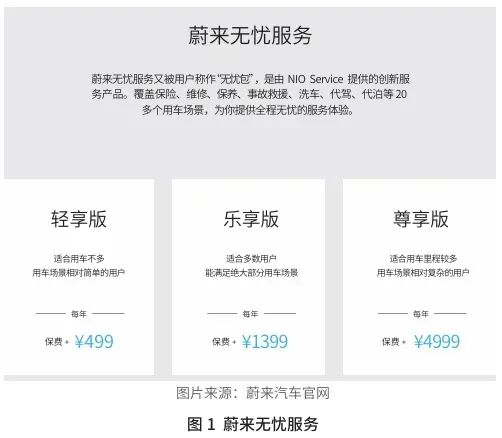
NIO’s “Worry-Free Service” package is a typical case, which synchronously displays vehicle insurance premiums in the scenario of customers purchasing or renewing service packages through total cooperation with insurance companies, achieving scenario-based, one-click insurance. This model reduces the difficulty of selling and renewing vehicle insurance, but automotive manufacturers are gradually replacing insurance companies as the main entities interacting directly with vehicle owners.
Future Outlook: The Ideal Form of Embedded Insurance
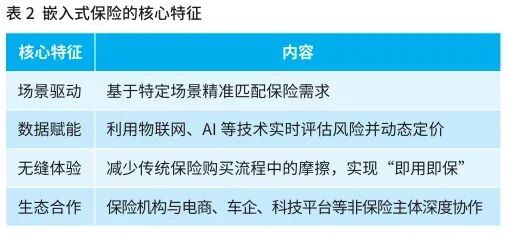
Embedded insurance integrates insurance products seamlessly into the transaction processes of non-insurance goods or services, essentially serving as scenario-based risk solutions. Deloitte predicts that by 2030, global embedded insurance premiums will reach $700 billion, accounting for 16% of total industry premiums. In the automotive sector, this model uses technology to embed insurance into users’ daily behavioral scenarios, providing personalized, relevant, and seamless customer experiences.
I propose the “CREAM” model of embedded insurance based on intelligent connected vehicle scenarios (as illustrated in the accompanying data chart: relevant data charts to be published), which encompasses six levels: sales embedding, service embedding, product embedding, solution embedding, capability embedding, and value embedding. Its core lies in deeply embedding insurance services into the entire lifecycle and usage ecology of vehicles, achieving a seamless integration of risk protection and user experience.
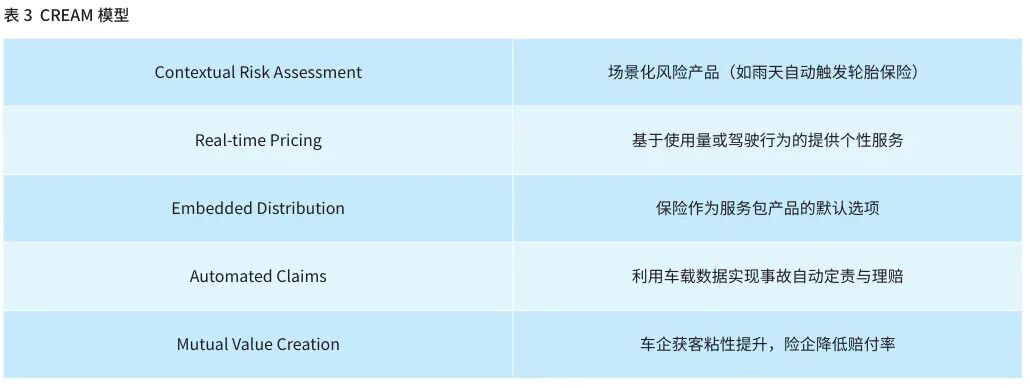
As intelligent connected vehicles enable manufacturers to directly connect with users, grasp vehicle owner data, and provide lifecycle service capabilities, how insurance products and business models related to vehicles will be restructured in the future becomes a strategic issue worthy of high attention. Source: China Insurance (End)
◩ About Us
China Insurance Consulting (51 Buy Brand Network) has29 years of industry experience and has been engaged in insurance intermediary equity transactions for over eight years. Successfullyoperated 42 national insurance intermediary company equity acquisitions, leading in the industry, and making friends worldwide!