Recently, both ARM and the Chinese side confirmed the establishment of a joint venture, with the Chinese side holding 51% and ARM holding 49%.
Dongfeng Nissan, Dongfeng Honda, FAW Toyota, GAC Honda, GAC Toyota, FAW Mazda, Changan Mazda, GAC Mitsubishi… all have the Chinese side holding 51% and foreign brands holding 49%.
It seems that Chinese chip design may also need to reference the old path of the Chinese automotive industry.
ARM is a chip architecture design company founded by a team from the University of Cambridge in the UK, which later underwent multiple rounds of financing, leading to a more complex equity structure, and was subsequently acquired by SoftBank and voluntarily delisted.
During the period of complex equity at ARM, there were many stakeholders, and ARM’s performance grew year by year.
However, after being acquired by SoftBank, it fell into temporary losses in 2017. In the first half of 2017, rumors began circulating in the industry that SoftBank would seek to establish a joint venture for ARM in China. The purpose of this Chinese joint venture subsidiary has two main functions:
1. Strengthening the legal protection of intellectual property rights and the collection of licensing fees in the Chinese market.
2. Preventing antitrust crackdowns; this form of joint venture has many precedents, with Intel, IBM, Qualcomm, and HP all participating in joint ventures, otherwise it would be difficult to pass through the antitrust barriers of various governments.
Now, ARM is backed by SoftBank, and behind SoftBank are major Western investment banks and Western investment funds.
The following image shows the foreign shareholding situation of SoftBank over five consecutive semi-annual reports;
As of September 2017, foreign shareholding in SoftBank reached 40.2%:
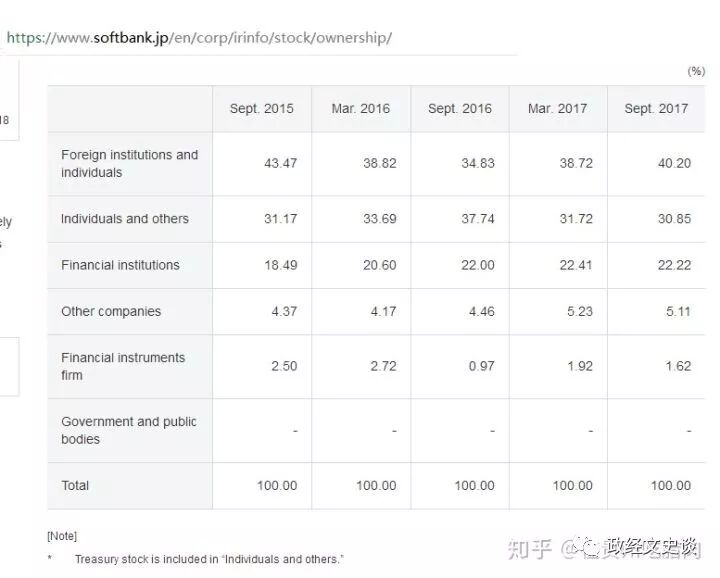
Even Masayoshi Son himself obtained a U.S. green card as early as the 1980s, and there are doubts about whether he later held U.S. citizenship. This means that without the guidance of American financial groups, it would be difficult for ARM to establish a joint venture with China.
American financial groups should have fully weighed the pros and cons from their own perspective.
It is estimated that in the future, Chinese companies will find it easier to obtain licenses when using ARM’s newer design architectures, but it will also be more difficult to evade licensing and patent fees. Currently, Chinese companies are using ARM’s public version designs, and very few can modify the ARM architecture, leading to weak bargaining power for Chinese companies in obtaining ARM architecture licenses.
The rules for charging intellectual property fees have always been a powder keg for trade litigation, trade negotiations, and even trade wars against our country.
The ARM joint venture in China will play an important legal role in settling licensing fees and patent fees.
In addition to the core level of processors, similar joint ventures have also emerged in the SOC design field in China.
In 2017, the international communication SOC design giant Qualcomm established a joint venture with a subsidiary of China Datang Telecom.
Previously, ARM’s joint venture in China had the Chinese side holding 51% and ARM 49%. Qualcomm and Datang Telecom are different; both are merely initiators, with Qualcomm holding 24.133% and Datang Telecom’s subsidiary (Unisoc Technology Co., Ltd.) also holding 24.133%. Neither party can be considered an absolute controlling shareholder, and neither holds more than 50%.
The shareholders of the joint venture, apart from Qualcomm and Datang, include the Guizhou Semiconductor Industry Investment Center (Limited Partnership), which contributed 103,396.50 million yuan in cash, accounting for 34.643% of the registered capital of the joint venture; and the Guizhou Strategic Emerging Industry Investment Center (Limited Partnership), which contributed 51,008.94 million yuan in cash, accounting for 17.091% of the registered capital of the joint venture.
In other words, no legal entity in this joint venture has veto power, and several large-scale Chinese integrated circuit industry investment funds have formed a community of interests with Qualcomm.
This joint venture is specifically authorized for low-end chips.
Qualcomm’s high-end chips hold an absolute oligopoly position in the Chinese communication market, and administrative measures cannot shake this (unless violating WTO rules), so Qualcomm does not need joint venture authorization at all.
Similar to ARM, the role of this Qualcomm-backed Chinese joint venture has two main functions:
1. Strengthening the legal protection of Qualcomm’s low-end chips in the Chinese market and the collection of licensing fees.
2. Preventing antitrust crackdowns. Previously, Qualcomm was fined $1 billion by the Chinese antitrust system. Joint ventures can effectively avoid antitrust penalties.
Companies within the Datang Telecom system, companies within the Jianguang Semiconductor Investment system, and companies under the Zhilu Strategic Emerging Industry will use their profound influence and extensive connections to pave the way for Qualcomm’s shared licensing fee collection.
The management of the industry is not without gains; while giving benefits to Qualcomm in the SOC design market, as a condition of exchange, Chinese chip manufacturer SMIC has received stable low-end chip foundry orders from Qualcomm (with processes lagging behind TSMC and Samsung’s latest processes by two or three generations), mainly for the chips represented by Qualcomm and Datang Telecom. This is also one of the important measures for the state to support the Chinese chip manufacturing sector.
The news is as follows:
On the evening of July 3, 2017, Beijing time, Qualcomm announced that its Snapdragon processors would be manufactured by Chinese foundry SMIC.
The agreement with SMIC indicates that Qualcomm plans to expand production capacity to meet future demand, while also improving Qualcomm’s relationship with the Chinese government.
Qualcomm stated in a press release that it will cooperate with SMIC to produce Snapdragon processors using 28nm technology. Currently, Qualcomm Snapdragon processors are widely used in smartphones from various manufacturers.
SMIC had previously manufactured power management and other chips for Qualcomm, and the agreement to manufacture Snapdragon processors will strengthen the cooperation between the two companies.
As for whether the gains and losses of this cooperation are worth it, industry reactions are mixed. Zhao Weiguo, the head of the Unisoc group, despises this cooperation:
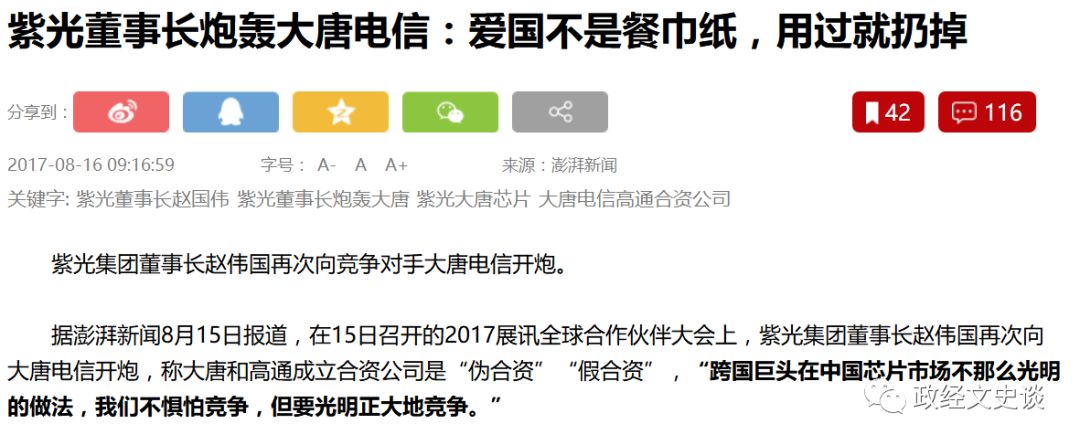
Those in the industry who support this cooperation (mostly from the chip manufacturing sector, likely mostly Taiwanese, as the upper management of SMIC is mostly Taiwanese) are of course relatively low-key.
I do not fully agree with the way this cooperation gives benefits, but if another team were to negotiate, they might not achieve a better result.
This also shows that chip manufacturing is receiving more attention from higher-ups.So, why is the chip manufacturing sector so important?
In fact, in the chip industry chain, the output value and profit of the integrated circuit design sector are much lower than those of the manufacturing sector (the entry threshold for chip designers is also much lower than that for manufacturers; even countries like Turkey have chip designers), in 2016, the annual profit of processor architecture designer ARM was just over 400 million pounds, not even a fraction of TSMC’s, to be precise, ARM’s revenue at that time was only slightly higher than that of SMIC, in 2017 ARM even fell into intermittent losses.
TSMC, Samsung Electronics, and Intel are known as the three giants of semiconductors, and the added value of the manufacturing sector for advanced process chips is much higher than that of the design sector. TSMC, Samsung Electronics, and Intel, along with their stake in ASML, monopolize 70% of the profits in the global chip industry chain.
Even if Qualcomm adds up the revenues from its communication patent licensing and other departments, its net profit in the first quarter of 2018 was only $400 million, which is less than a fraction of Samsung Electronics’ quarterly profit, which reached $10.8 billion, comparable to that of the Industrial and Commercial Bank of China.
Although China is eager to partner with the three giants in the chip manufacturing sector, due to the strict restrictions of the Wassenaar Arrangement on Fab equity, joint ventures between China and foreign chip fabs have always been difficult to achieve.
————
Regarding the three giants of semiconductors under the Wassenaar system, TSMC, Samsung, Intel, and their stake in the chip lithography machine giant ASML, as well as the decline of the Japanese semiconductor industry chain, I have discussed a lot in previous articles.
For historical data or to reply “Wassenaar”, check my WeChat public account for the article published on March 12, 2017, titled “Talking about the Global Semiconductor Industry Chain under the Wassenaar Arrangement from TSMC”.
For historical data or to reply “Samsung Electronics”, check my WeChat public account for the article published on July 15, 2017, titled “What Advantages Does Samsung Have in the 5G Era”.
For historical data or to reply “TSMC Power Outage”, check my WeChat public account for the article published on August 18, 2017, titled “Taiwan’s Power Crisis and the Global Semiconductor Industry Chain”.
This article can be reproduced!