When we are working on wireless sensors and device networking, we often use wireless transmission methods such as 433M ASK and LoRa.
When multiple nodes use the same frequency and transmission parameters, such as spreading factor, at the same time to send data, packet collisions or co-frequency interference can occur, which prevents the gateway from correctly interpreting the signal, leading to data loss.
It’s like a group of people crowded into a room shouting; no one can hear anyone clearly.
Many beginners, and even some engineers with a few years of experience, find this issue daunting, thinking it is due to coding errors or unstable hardware. They may try increasing transmission power or data retransmission, but these are not the root causes of the problem.
Resolving multi-node conflicts does not rely on a single technology but rather a combination of protocol design, network planning, and application layer strategies to maximize the integrity of data transmission.
We generally focus on the following aspects:
First: Before sending data, use CAD (Channel Activity Detection) to listen and check if there are other LoRa signals in the air.
This action, although it adds a few milliseconds of overhead, can fundamentally avoid most conflicts and is cost-effective.
Second: The design of the wireless networking protocol
This is also crucial. Taking our alarm host and detector’s LoRa networking as an example:
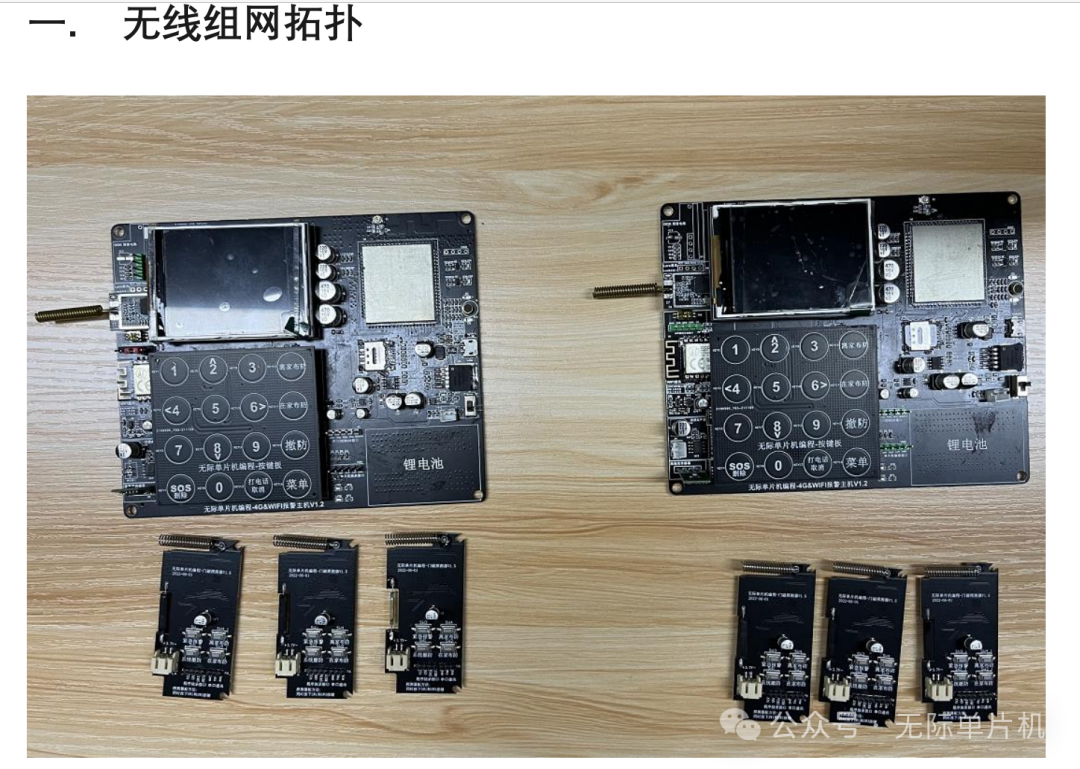
I have specifically discussed wireless sensor networking protocol design in my project tutorial.
The essence is to improve data transmission efficiency. For protocol design, shortening the length of data frames is one way to enhance efficiency. The frequent interaction data between our sensors and the gateway does not exceed 6 bytes per frame, allowing for quick transmission.
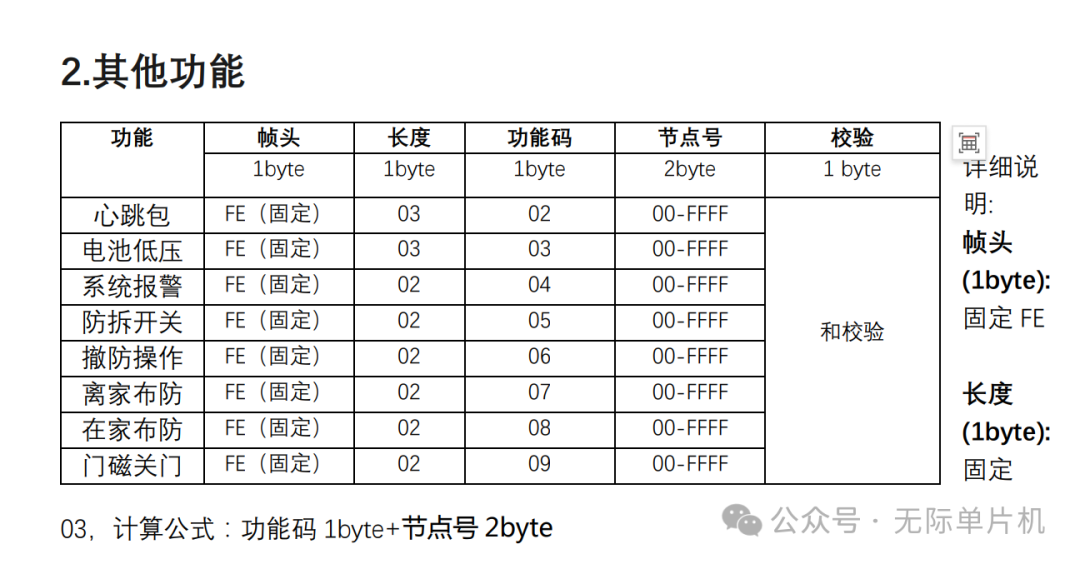
Third: Spreading Factor (SF): One of the significant advantages of LoRa is that different spreading factors (SF) are almost orthogonal and do not interfere with each other.
Orthogonal means that you can think of them as different dialects. If you only understand Mandarin, even if many people are speaking different dialects at the same time, your brain can miraculously lock onto Mandarin. In this scenario, the dialects and Mandarin are “orthogonal”.
Different spreading factors (SF) in LoRa play the role of different languages. A gateway configured to receive SF7 can successfully decode SF7 signals while treating incoming SF8, SF9…SF12 signals as unrelated noise.
Therefore, when planning the network, different SF values can be assigned to different services and nodes at varying distances, logically isolating them.
Fourth: You can make adjustments at the application layer. Do not let all nodes report data at the same time; give each node a random delay, even if it is a few seconds to a few minutes, it can significantly reduce the probability of collisions. This is similar to staggered traffic restrictions in urban areas—simple but effective.
These are just four methods; actual products may have others. However, it is not necessary to apply all methods; as long as the product requirements are met, that is sufficient.
end