(Click the public account above to quickly follow)
Source: NetEase Technology
http://tech.163.com/18/0209/07/DA6GET0600097U7R.html
According to foreign media Venturebeat, Google announced today that starting in July this year, the address bar of the Chrome browser will mark all HTTP sites as insecure. This is the third step in Google’s campaign against HTTP sites.
HTTPS is the upgraded version of the HTTP protocol, providing a more secure and reliable connection. The security connection protocol between internet users and websites is considered a necessary measure to reduce user risk; otherwise, users may suffer from eavesdropping, man-in-the-middle attacks, or data tampering.
For years, Google has been promoting the HTTPS protocol, and last year it accelerated its efforts by making some changes to the Chrome user interface.
Starting with Chrome 56 released in January 2017, HTTP pages that collect passwords or credit card data were marked as “insecure.” If users are using Chrome 62, released in October 2017, HTTP pages with input data and all HTTP pages viewed in incognito mode will be marked as “insecure.”
The effectiveness of these measures is evident. In the Google and Mac ecosystem, over 78% of traffic in the Chrome browser is using HTTPS. In the Android and Windows ecosystems, 68% of Chrome’s traffic comes from HTTPS. But Google is not stopping there.
Chrome 68, released in July this year, will display the following in the address bar:
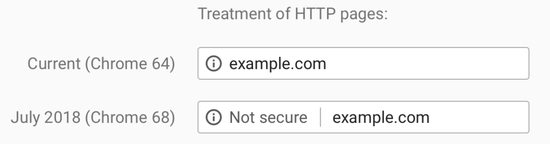
Regarding this change, Google explained:
The new Chrome interface will help users understand that all HTTP sites are insecure, encouraging them to adopt secure HTTPS sites. HTTPS is more convenient and cheaper than ever, providing performance improvements and powerful new features that HTTP lacks.
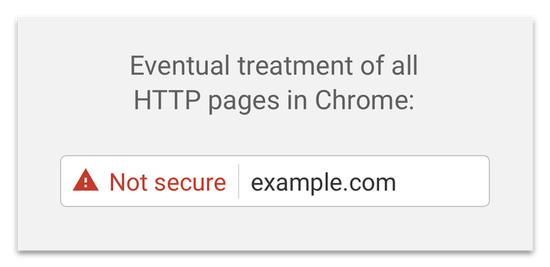
Currently, Chrome marks “insecure” in black text, but eventually Google will mark “insecure” in red and add a red warning icon next to it to further emphasize that HTTP sites should not be trusted.
Google has also released the latest version of Lighthouse, an automated website performance assessment tool that provides content auditing features to help developers transition to HTTPS sites. This new tool will show developers which website sources are using HTTP and which sites can be upgraded to HTTPS simply by changing sub-resource references.
If you found this article helpful, please share it with more people.
Follow “Frontend All-in-One” to enhance your frontend skills.