GitHub Trending List | Overview of Popular C++/C#/C Projects (2025.11.22) – 15 Projects Listed
Data statistics time: 2025-11-22 06:32:38
1. Snapchat/Valdi
 📊 Data Metrics:
⭐ stars : 12.1k | 🍴 forks : 407
🔗 https://github.com/Snapchat/Valdi
Project Overview
Framework Positioning
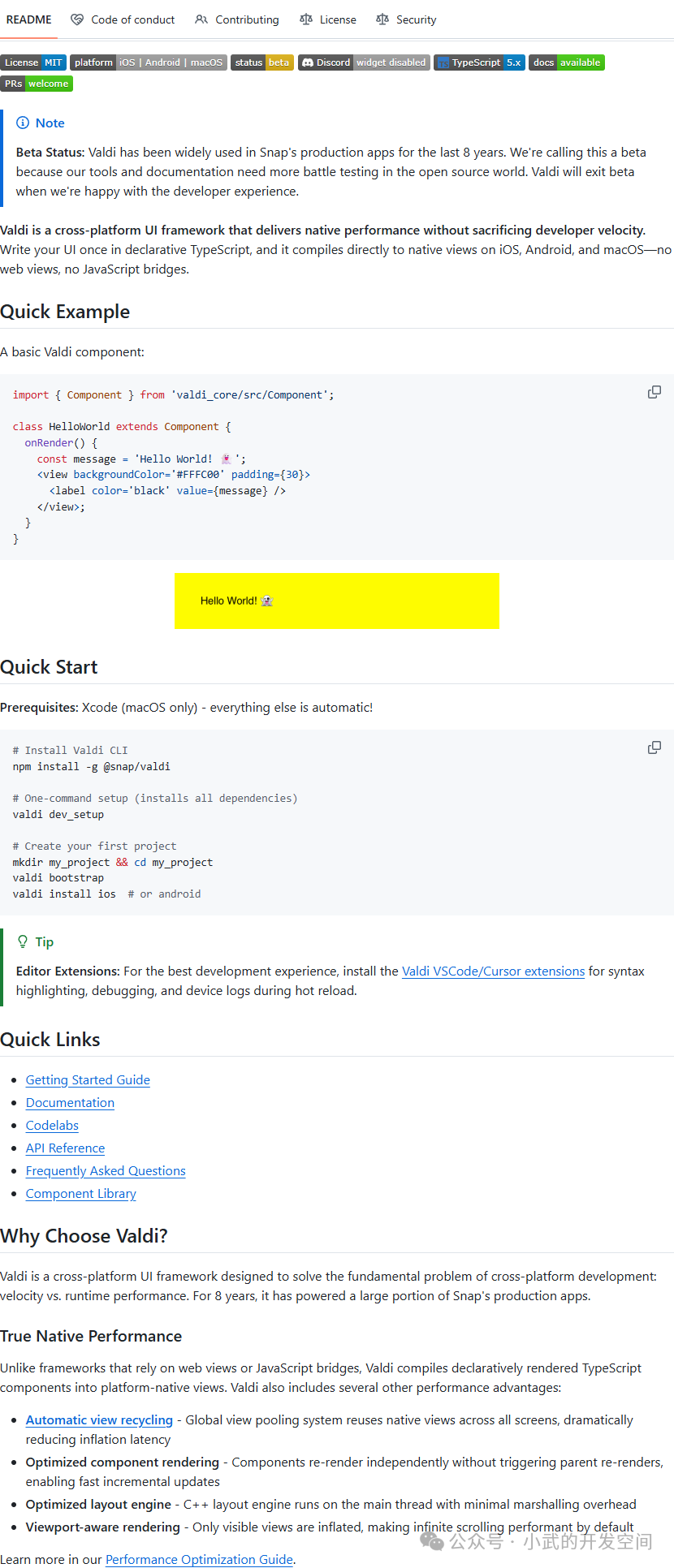
Valdi is a high-performance cross-platform UI framework designed for teams pursuing native performance and development efficiency. It allows developers to write UI components in declarative TypeScript, which are directly compiled into native views on iOS, Android, and macOS without relying on WebView or JavaScript bridging technology, ensuring optimal runtime performance.
Core Advantages
The framework possesses true native rendering capabilities, built-in automatic view recycling, optimized layout engines, and viewport-aware rendering mechanisms, significantly enhancing the responsiveness of complex interfaces. It also supports instant hot reloading, full-featured debugging in VSCode, and TSX syntax, greatly shortening the development iteration cycle while balancing development experience and performance.
Integration and Extension
Valdi supports progressive integration, allowing it to be embedded into existing native applications or to embed native components into the Valdi interface. It provides multi-language module support, compatible with C++, Swift, Kotlin, etc., and automatically generates type-safe cross-platform binding code for easy access to underlying APIs and third-party libraries.
Practical Validation
It has been stably running in multiple core production applications at Snapchat for 8 years, supporting advanced animations, real-time rendering, and complex gesture systems, demonstrating reliability and maturity for large-scale applications.
2. francescopace/espectre
 📊 Data Metrics:
⭐ stars : 3.2k | 🍴 forks : 210
🔗 https://github.com/francescopace/espectre
🛜 ESPectre Project Introduction
🎯 Project Overview
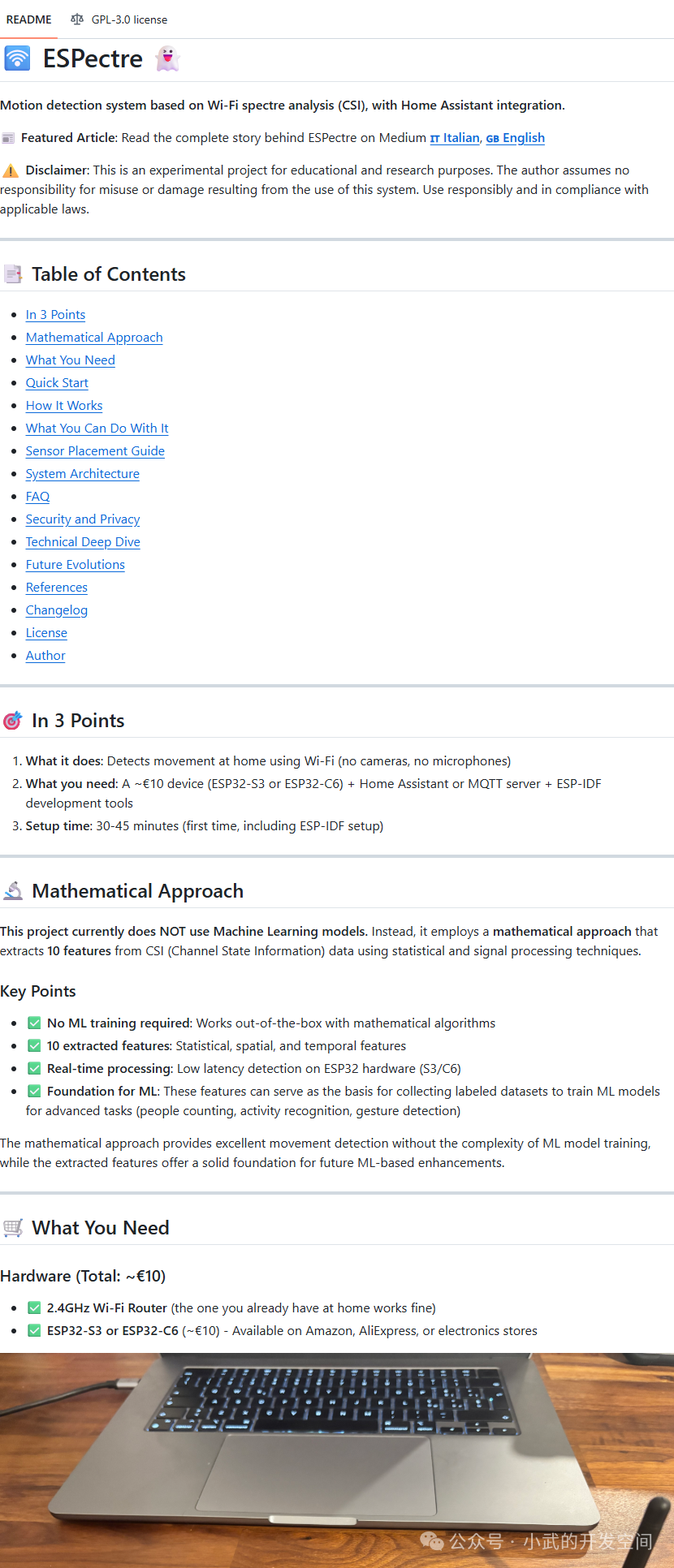
ESPectre is a motion detection system based on Wi-Fi channel state information (CSI), utilizing changes in signal within the environment to achieve non-intrusive human activity perception. This system does not require cameras or microphones; it can detect indoor movement by analyzing disturbances in Wi-Fi waves, balancing privacy protection and low-cost deployment.
🔬 Technical Principles
The system employs mathematical signal processing methods to extract 10 statistical, spatial, and temporal features from CSI data, combined with a Moving Variance Segmentation (MVS) algorithm to achieve real-time motion recognition. Processing is done directly on ESP32-S3 or ESP32-C6 devices, featuring low latency and supporting seamless integration with smart home platforms like Home Assistant via MQTT protocol.
💡 Application Scenarios
It is suitable for home security, elderly care, smart lighting, and energy control scenarios. A single device can cover an area of approximately 50 square meters, supporting multi-sensor networking for whole-house coverage. Since the signal can penetrate walls, it is suitable for non-line-of-sight monitoring and does not rely on wearable devices.
⚙️ System Architecture
The system consists of data collection at the ESP32 end, local signal filtering, feature extraction, and state judgment, sending lightweight JSON data to the MQTT server only when motion is detected. It supports a web monitoring interface for real-time debugging and parameter configuration, facilitating quick deployment and sensitivity optimization for users.
3. vicinaehq/vicinae
 📊 Data Metrics:
⭐ stars : 4.3k | 🍴 forks : 99
🔗 https://github.com/vicinaehq/vicinae
Project Overview
Core Features
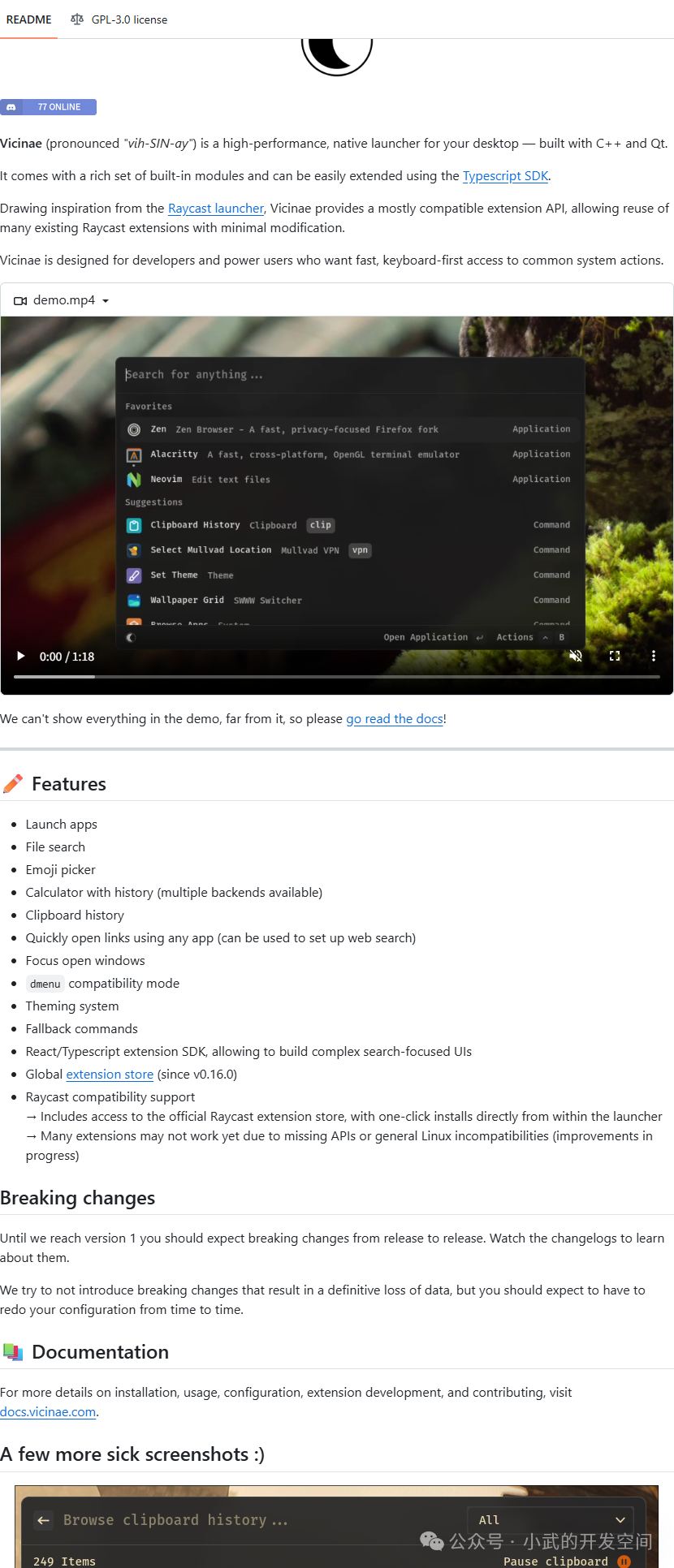
Vicinae is a high-performance, native desktop launcher built with C++ and Qt, designed for developers and power users. It supports keyboard-first operation, providing quick access to applications, files, windows, and system functions. It includes rich modules such as application launching, file searching, emoji selector, calculator with history, clipboard history, etc.
Extension Ecosystem and Compatibility
Vicinae offers an extension SDK based on TypeScript and React, supporting the construction of complex search-oriented interfaces. Since version 0.16.0, it has introduced a global extension store and is compatible with Raycast extension API, allowing for one-click installation of numerous official Raycast extensions, greatly enhancing extensibility, although some features may not be fully complete due to platform differences.
Themes and Customization
It supports a complete theming system and dmenu compatibility mode, allowing for deep personalization of appearance and behavior. Configuration is flexible, suitable for users pursuing efficiency and aesthetics. Detailed documentation can be found at docs.vicinae.com.
4. browseros-ai/BrowserOS
 📊 Data Metrics:
⭐ stars : 7.7k | 🍴 forks : 726
🔗 https://github.com/browseros-ai/BrowserOS
Project Introduction
What is BrowserOS?
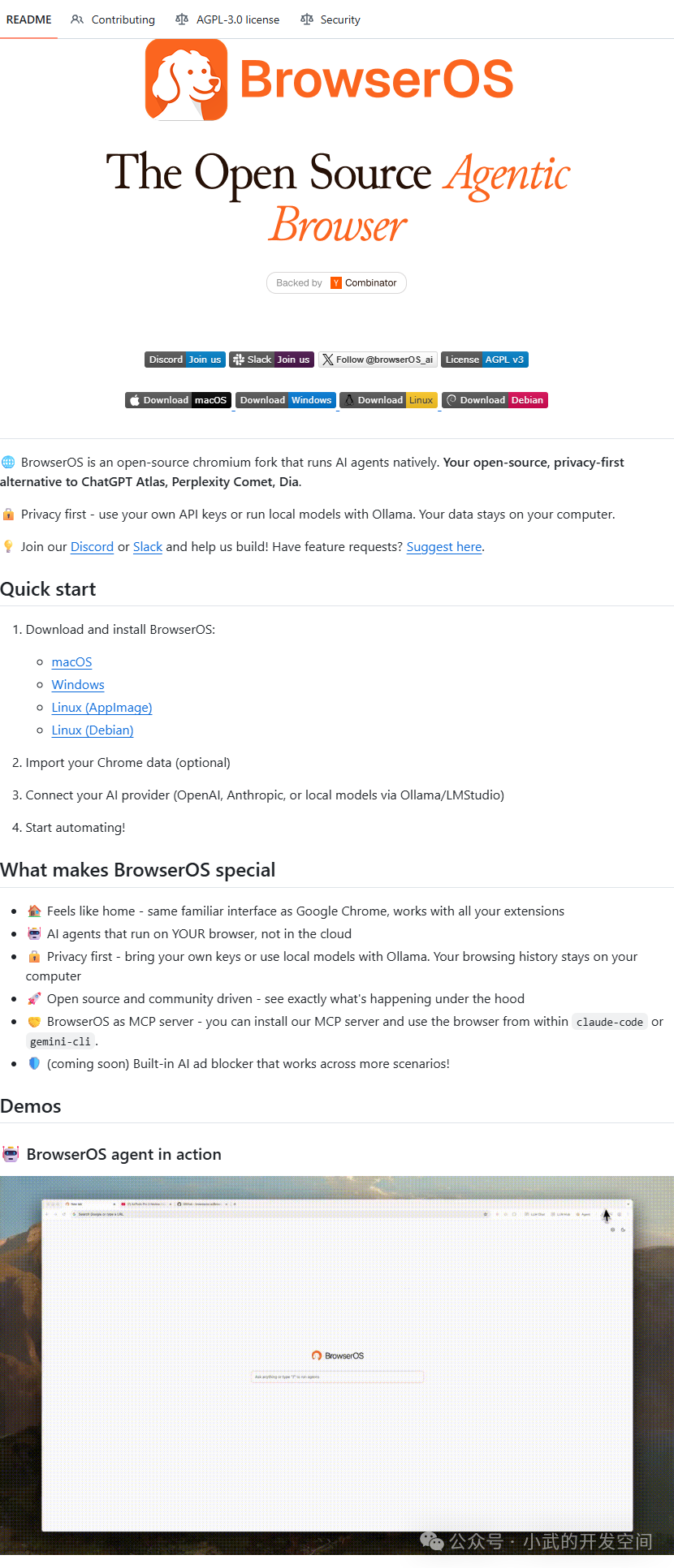
BrowserOS is an open-source Chromium-based browser designed for running AI agents locally. It provides a privacy-first, open, and transparent browsing experience, making it an ideal alternative to closed-source products like ChatGPT Atlas, Perplexity Comet, and Dia. Users can use their own API keys or run local large models through Ollama, ensuring all data remains on local devices.
Core Features
BrowserOS has a Chrome-like interface, is compatible with existing extensions, and has built-in AI automation capabilities. AI agents run directly in the browser without relying on cloud processing, ensuring user privacy. The project supports the MCP protocol, allowing remote control by tools like claude-code or gemini-cli, and plans to introduce AI-based intelligent ad-blocking features.
Open Source and Community Driven
As an open-source project under the AGPL-3.0 license, BrowserOS encourages community contributions. Developers can submit issues on GitHub, suggest features, or join the Discord and Slack communities to collaborate. Its open architecture allows users to fully control the code logic, creating a truly user-owned next-generation intelligent browser.
5. oceanbase/seekdb
 📊 Data Metrics:
⭐ stars : 397 | 🍴 forks : 32
🔗 https://github.com/oceanbase/seekdb
Project Introduction
Core Positioning
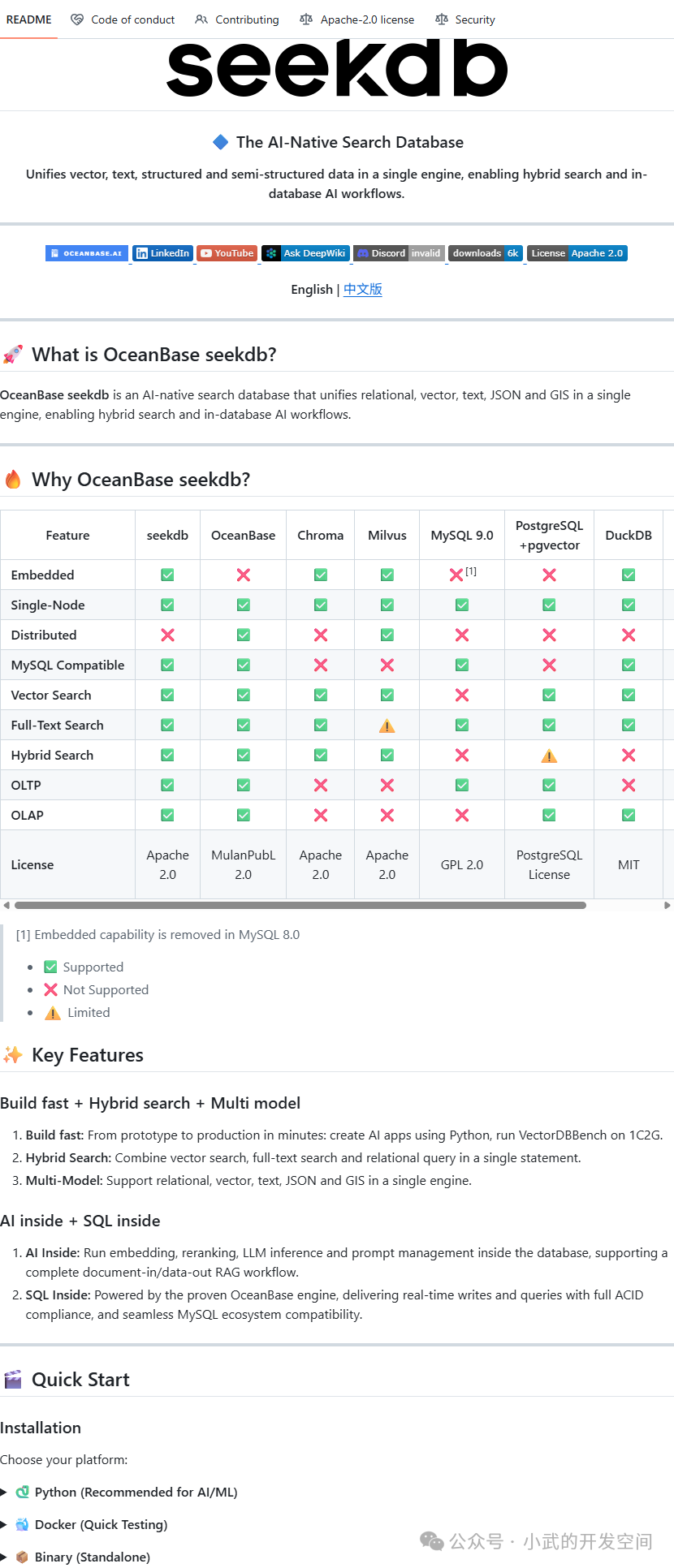
OceanBase seekdb is a native search database aimed at the AI era, dedicated to unifying the storage and querying of vector, text, structured, and semi-structured data within a single engine. It not only supports hybrid search but also has built-in AI capabilities, enabling “AI workflows within the database” to efficiently implement scenarios like RAG and intelligent search.
Key Features
seekdb has multi-model fusion capabilities, supporting relational data, vectors, JSON, GIS, and full-text search, and seamlessly integrates into existing ecosystems through MySQL-compatible protocols. Its lightweight architecture supports embedded deployment, suitable for all-scenario applications from edge devices to the cloud, while providing ACID guarantees and real-time read/write capabilities.
Application Scenarios
It is widely used in RAG knowledge retrieval, semantic search engines, intelligent agents (Agentic AI), AI programming assistance, enterprise intelligence systems, and edge AI devices. Combined with mainstream AI frameworks like LangChain, LlamaIndex, and HuggingFace, it builds an end-to-end intelligent application system.
Ecology and Open Source
seekdb has integrated multiple AI development platforms such as Dify, Coze, FastGPT, and DB-GPT, supporting Python SDK, SQL, and Docker for rapid deployment. The project is licensed under the Apache 2.0 open-source license, encouraging community participation in co-construction, facilitating a smooth evolution from prototype to production for developers.
6. microsoft/agent-framework
 📊 Data Metrics:
⭐ stars : 5.3k | 🍴 forks : 787
🔗 https://github.com/microsoft/agent-framework
Project Introduction
Framework Overview
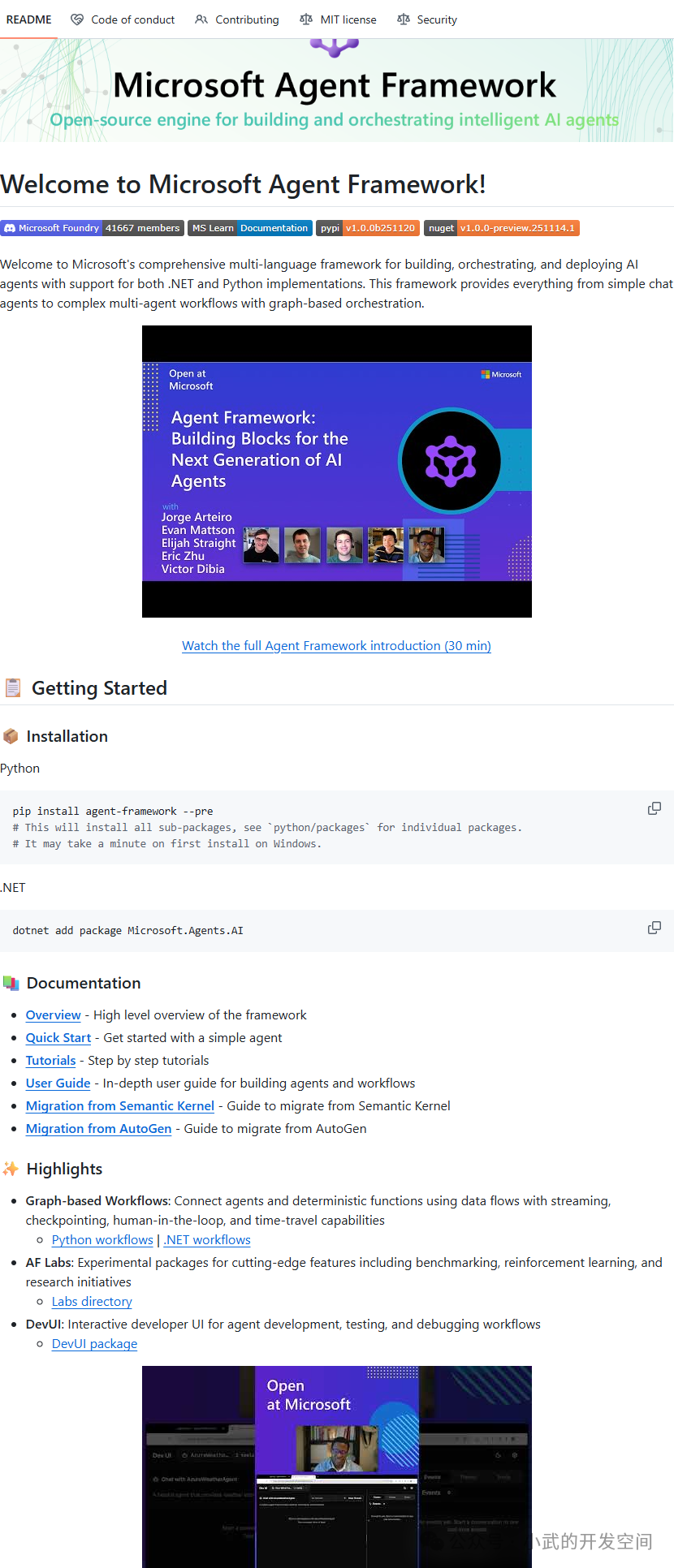
Microsoft Agent Framework is a cross-language AI agent development framework launched by Microsoft, supporting both Python and .NET platforms, aimed at simplifying the construction, orchestration, and deployment of workflows from single agents to complex multi-agent systems. The framework provides a unified API, compatible with various large model services (such as Azure OpenAI, OpenAI, etc.), suitable for building chatbots, automation processes, and complex decision systems.
Core Features
It supports graph-structured workflow orchestration, with capabilities for streaming, checkpoints, human-machine collaboration, and “time-reversal” debugging. It includes a DevUI developer interface for interactive debugging; integrates OpenTelemetry for full-link observability. It also provides a middleware mechanism, supporting request-response handling and custom pipeline extensions.
Quick Start and Ecosystem
Quickly start by installing the preview version via pip or NuGet, providing detailed documentation, migration guides (supporting Semantic Kernel and AutoGen migration), and rich examples. It includes an experimental AF Labs module covering cutting-edge research directions such as reinforcement learning and benchmarking, helping developers explore new paradigms for AI agents.
7. DearVa/Everywhere
 📊 Data Metrics:
⭐ stars : 3.5k | 🍴 forks : 194
🔗 https://github.com/DearVa/Everywhere
Project Introduction
Everywhere: Your Intelligent Assistant Anytime, Anywhere
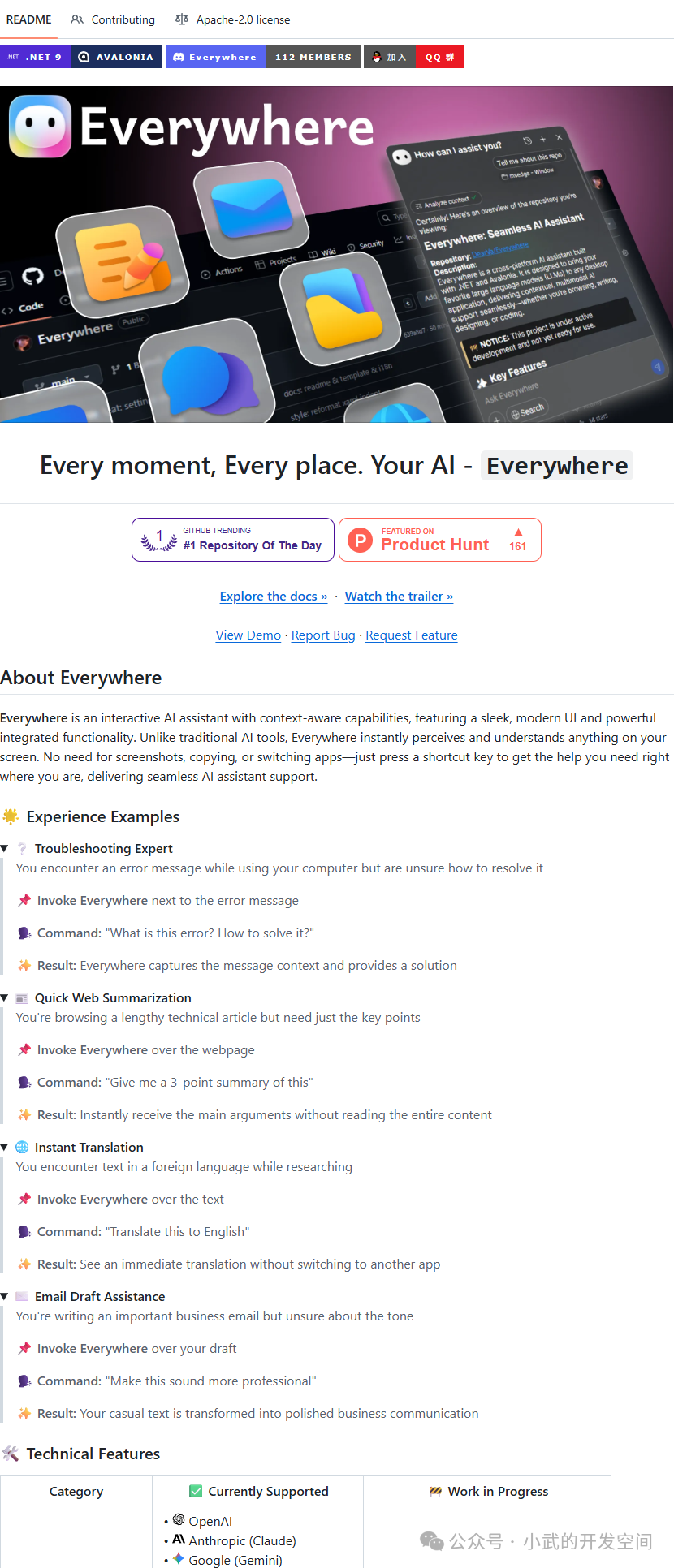
Everywhere is a modern, interactive AI assistant application with context-aware capabilities, able to instantly understand screen content when users need it. No need for screenshots or switching applications; just press a shortcut key to get AI support directly on the current interface, achieving seamless assistance.
Core Functions and Technical Features
This tool supports various mainstream large language models (such as OpenAI, Claude, Gemini, Ollama, etc.) and integrates tools like browsers, file systems, and terminals. It is built using Avalonia for cross-platform UI, currently supporting Windows, with macOS and Linux versions in development. The interface adopts a modern frosted glass style, supporting multiple languages and shortcut operations to enhance user experience.
Community and Open Source Ecology
Everywhere has an active Discord and QQ community, encouraging users to provide feedback, suggest features, and contribute. The project follows the Apache 2.0 license, with code signing certificates sponsored by Certum China, and has been recommended by Product Hunt, receiving widespread attention and support from developers.
8. game1024/Speedy
 📊 Data Metrics:
⭐ stars : 13.2k | 🍴 forks : 929
🔗 https://github.com/game1024/Speedy
Project Introduction
Basic Information
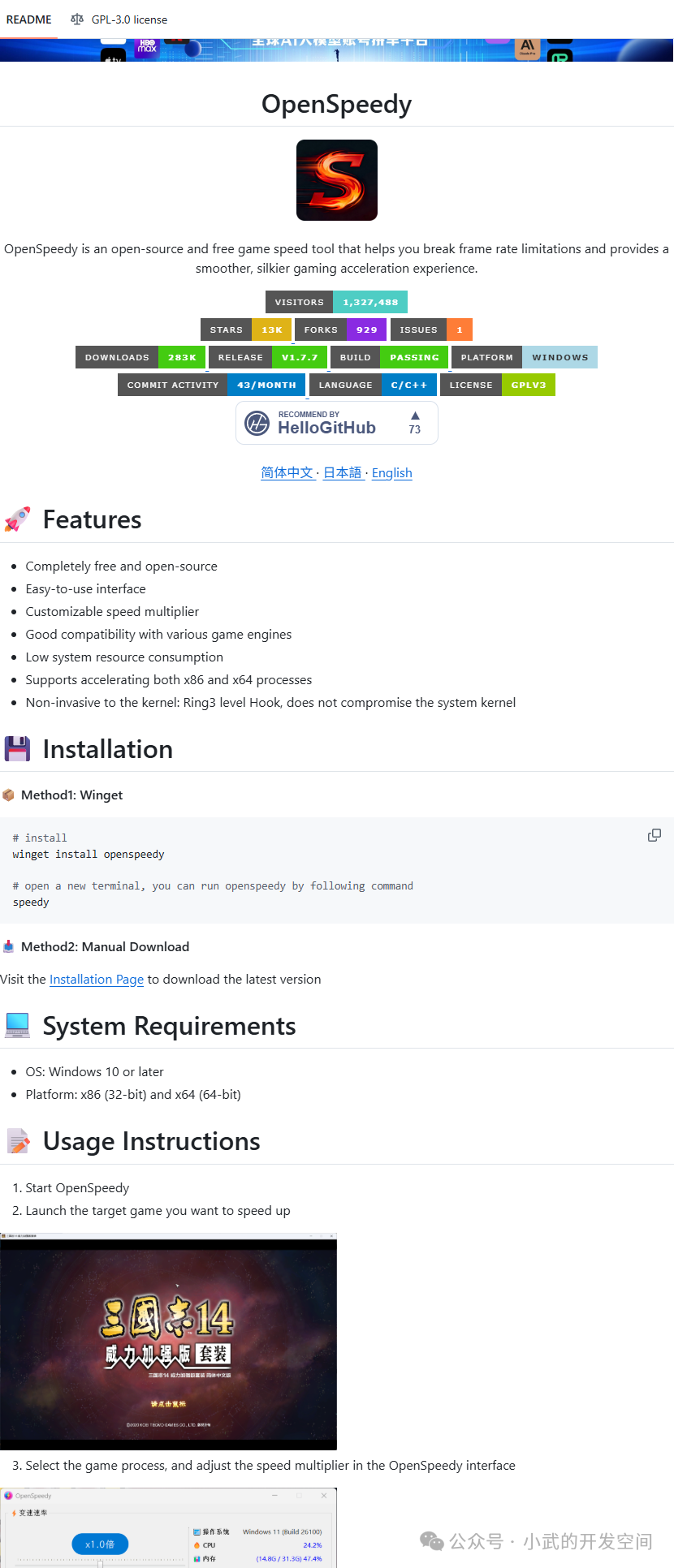
OpenSpeedy is an open-source free game acceleration tool designed to help users break through game frame rate limits, providing a smoother and more fluid acceleration experience. The project is developed based on C/C++ and runs on Windows 10 and above, supporting both 32-bit and 64-bit platforms.
Function Features
This tool achieves precise control over game running speed by hooking Windows system time-related APIs at the Ring3 level (such as Sleep, timeGetTime, QueryPerformanceCounter, etc.). It supports custom speed adjustments, is compatible with various game engines, has low resource usage, and does not require kernel permissions, ensuring safety and non-intrusiveness.
Usage and Ecology
OpenSpeedy provides a simple and easy-to-use graphical interface, can be quickly installed via Winget or manually downloaded. The project has received widespread recognition from the community, recommended by platforms like HelloGitHub, and integrates well-known open-source components like MinHook and Qt. It follows the GPLv3 license, encouraging learning and research, but warns users to avoid using it in online competitive games to prevent account bans.
9. DreamMaoMao/mangowc
 📊 Data Metrics:
⭐ stars : 1.3k | 🍴 forks : 57
🔗 https://github.com/DreamMaoMao/mangowc
Project Introduction
Lightweight and Efficient, Quick to Build
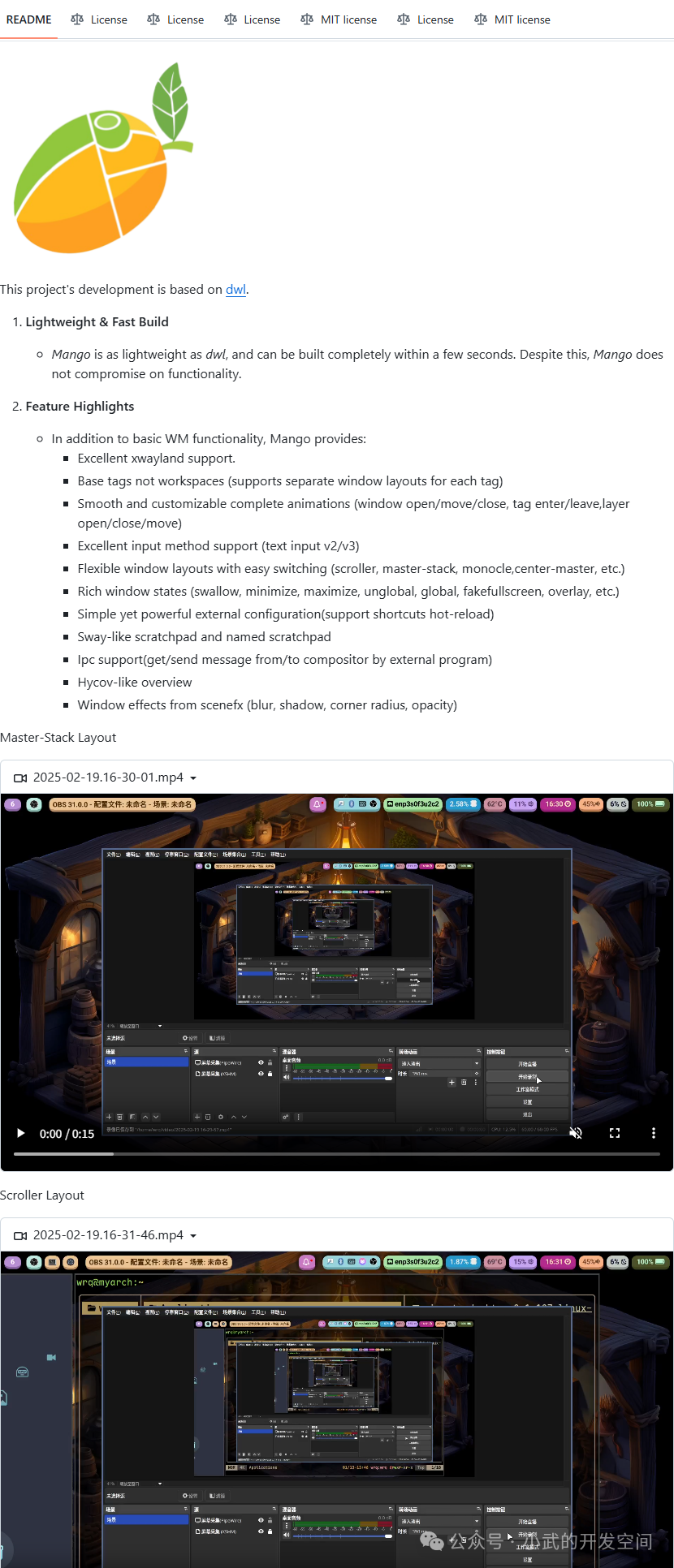
MangoWC is a lightweight Wayland compositor developed based on dwl, inheriting the simplicity and efficiency of dwl, capable of compiling in seconds. Despite its small size, MangoWC does not sacrifice functional completeness, making it suitable for users who pursue both performance and aesthetics.
Rich Core Features
MangoWC supports XWayland, tabbed workspaces (supporting independent layouts for each tab), smooth customizable animation effects (window opening/closing, tab switching, etc.), and provides various window layout modes (such as master-slave, scrolling, centered master control, etc.). It also supports multiple window states (minimized, pseudo-fullscreen, overlay, etc.) and Sway-style floating terminals and named sticky notes.
Highly Configurable and Extensible
The project supports external IPC communication, allowing programs to dynamically send commands, combined with scenefx to achieve visual effects like blur, shadows, and rounded corners. Configuration is flexible, supporting hot reloading of shortcut keys, and provides an overview view similar to Hycov. With modular support from NixOS and Home-manager, it is easy to integrate into modern Linux desktop environments.
10. ZyperWave/ZyperWinOptimize
 📊 Data Metrics:
⭐ stars : 5.1k | 🍴 forks : 281
🔗 https://github.com/ZyperWave/ZyperWinOptimize
ZyperWin++ 4.1 Project Introduction
Lightweight and Efficient Windows Optimization Tool
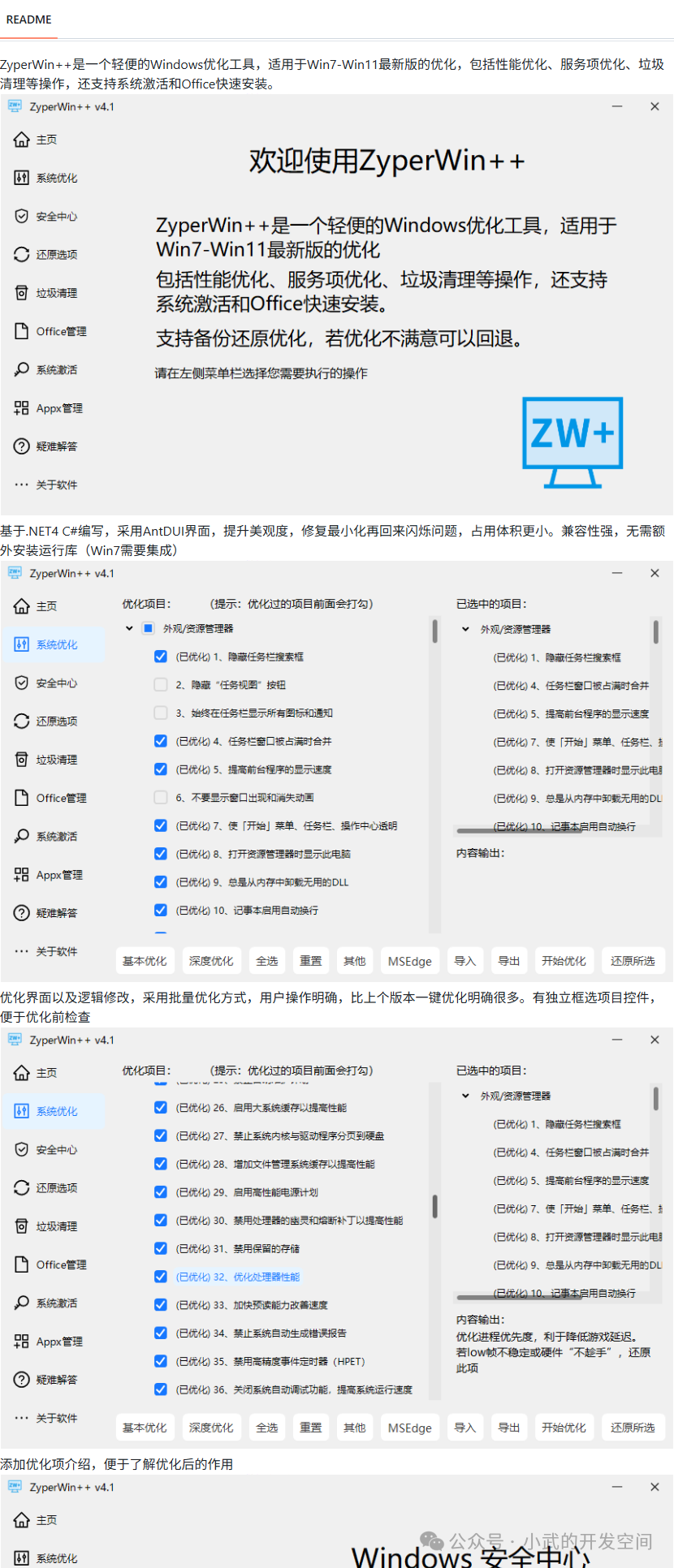
ZyperWin++ 4.1 is a lightweight optimization tool designed for Windows 7 to Win11 systems, developed based on .NET 4.0 and C#, featuring an AntDUI beautified interface to enhance visual experience and operational fluency. The software does not require additional runtime libraries (except for Win7), is compact, highly compatible, and suitable for batch rapid optimization in personal and educational environments.
Comprehensive Optimization and Personalized Configuration
It supports performance tuning, service item management, garbage cleaning, Defender control, and other multi-functional integrations. It adopts a batch selection optimization logic, allowing users to clearly choose optimization items and preview and verify through independent controls. New optimization item explanation prompts help users understand the impact of each operation. It supports importing and exporting configurations, automatically saving schemes after optimization for easy restoration or reuse of personalized settings.
Practical Extension Functionality Integration
It includes a powerful uninstall feature for the Edge browser, thoroughly removing it without residue; provides one-click installation for Office and C2R uninstallation support, fully automated online deployment. A new Appx application management module allows for the free uninstallation of pre-installed system applications. Additionally, a troubleshooting page is included to assist users in dealing with common issues, enhancing usability.
11. kunkundi/crossdesk
 📊 Data Metrics:
⭐ stars : 809 | 🍴 forks : 74
🔗 https://github.com/kunkundi/crossdesk
Project Introduction
Cross-Platform Remote Desktop Solution
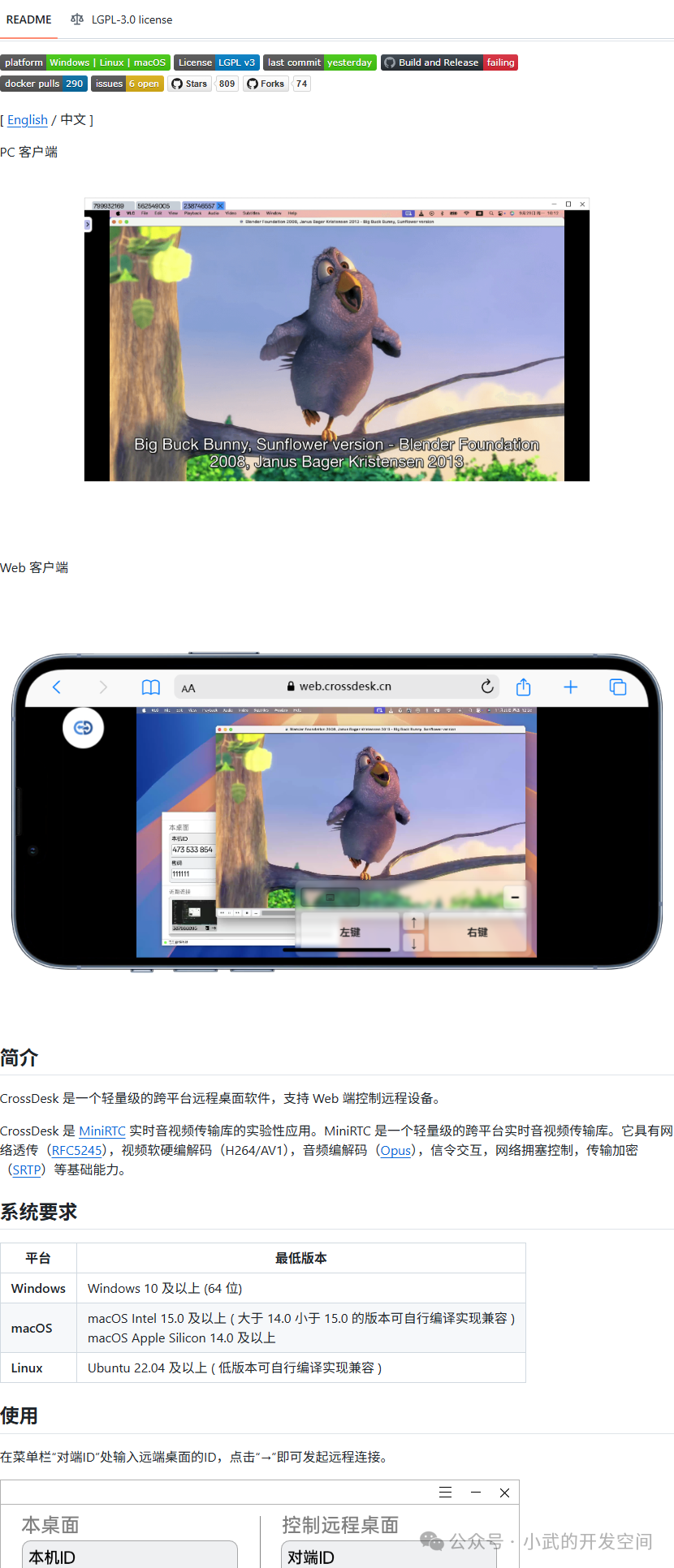
CrossDesk is a lightweight cross-platform remote desktop software that runs on Windows, Linux, and macOS systems, providing web-based remote control functionality. Users can connect to remote devices directly through a PC client or browser, achieving efficient and convenient remote operations.
Real-Time Transmission Capability Based on MiniRTC
As an experimental application of the MiniRTC real-time audio and video transmission library, CrossDesk features NAT traversal, H264/AV1 video encoding/decoding, Opus audio encoding, and SRTP encrypted transmission, ensuring smooth, secure, and low-latency remote desktop visuals.
Functionality and Usage
Multi-Device Access and Password Verification
It supports initiating remote connections by entering the peer ID and connection password, ensuring access security. The web client can run in mainstream browsers like Safari, enabling cross-device control, such as iOS remote controlling Win11.
Self-Hosted Server Deployment
It is recommended to deploy the CrossDesk Server using Docker, supporting custom public IP, port range, and certificate configuration to meet enterprise-level intranet penetration and high availability needs. It also provides scripts for generating SSL certificates, simplifying the deployment process.
Development and Compilation Support
The project is built on xmake, supporting enabling CUDA hardware encoding/decoding to enhance performance. To facilitate developers, it provides pre-configured Ubuntu Docker images for an out-of-the-box compilation environment.
12. PRBonn/rko_lio
 📊 Data Metrics:
⭐ stars : 385 | 🍴 forks : 24
🔗 https://github.com/PRBonn/rko_lio
Project Overview
RKO-LIO: A Robust LiDAR-Inertial Odometry Without Sensor-Specific Modeling
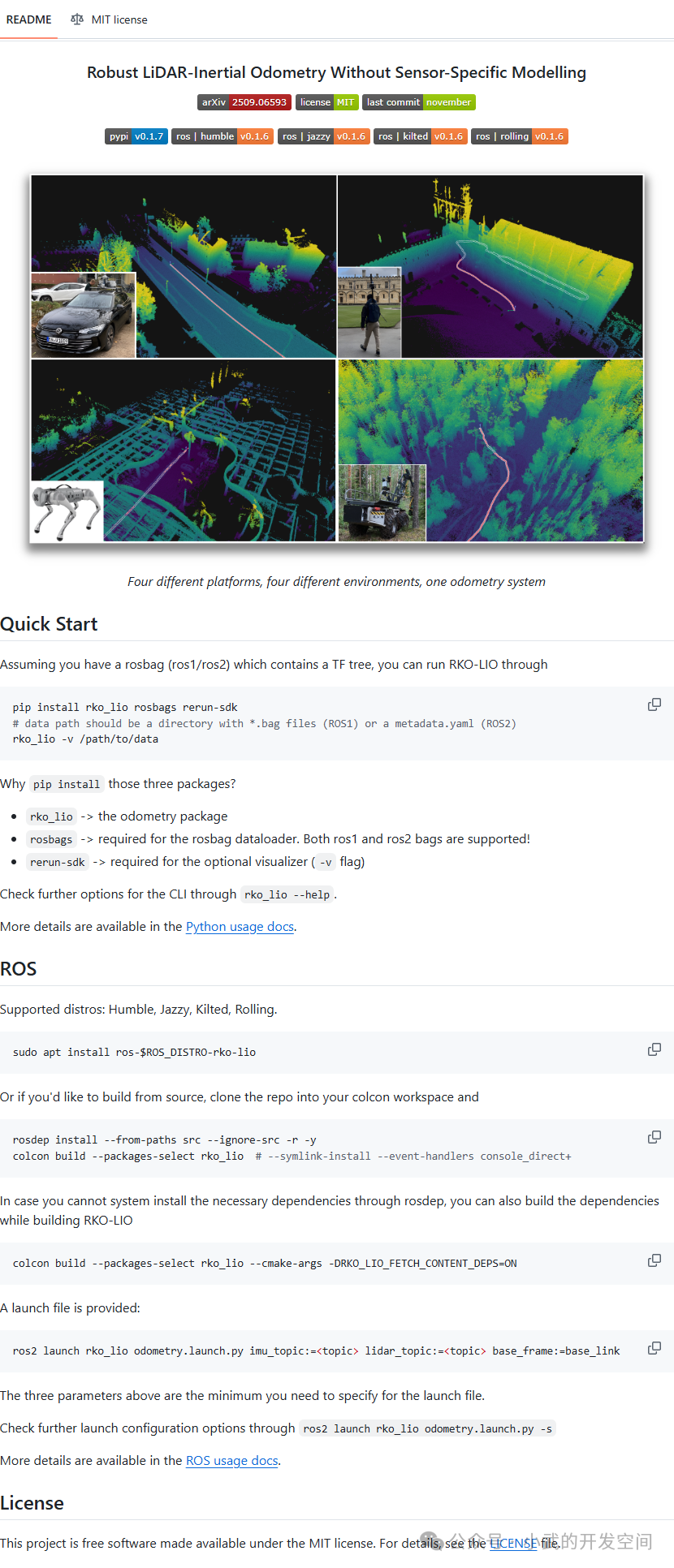
RKO-LIO (Robust LiDAR-Inertial Odometry) is a general-purpose, robust laser radar-inertial odometry algorithm capable of achieving high-precision state estimation without relying on specific sensor models. The system fuses LiDAR point clouds with IMU data, suitable for various platforms and complex environments, demonstrating excellent cross-scenario adaptability.
Core Features and Usage
RKO-LIO supports multiple ROS 1/2 distributions and can be quickly installed via pip or APT. Users can directly process ROS package files using command-line tools, read data using rosbags, and visualize using rerun-sdk. The system provides Python interfaces and ROS launch files for easy integration and debugging, requiring only the specification of IMU and LiDAR topics and the base coordinate system for minimal configuration.
Open Source License and Academic Contributions
The project is open-sourced under the MIT license, encouraging community use and improvement. Related research results have been published on arXiv and submitted to RA-L. Developers are encouraged to cite their paper when using it and give GitHub stars for support. The project is inspired by excellent tools like KISS-ICP and Rerun, particularly benefiting from Rerun’s efficient visualization capabilities.
13. kavan010/black_hole
 📊 Data Metrics:
⭐ stars : 1.8k | 🍴 forks : 270
🔗 https://github.com/kavan010/black_hole
Project Introduction
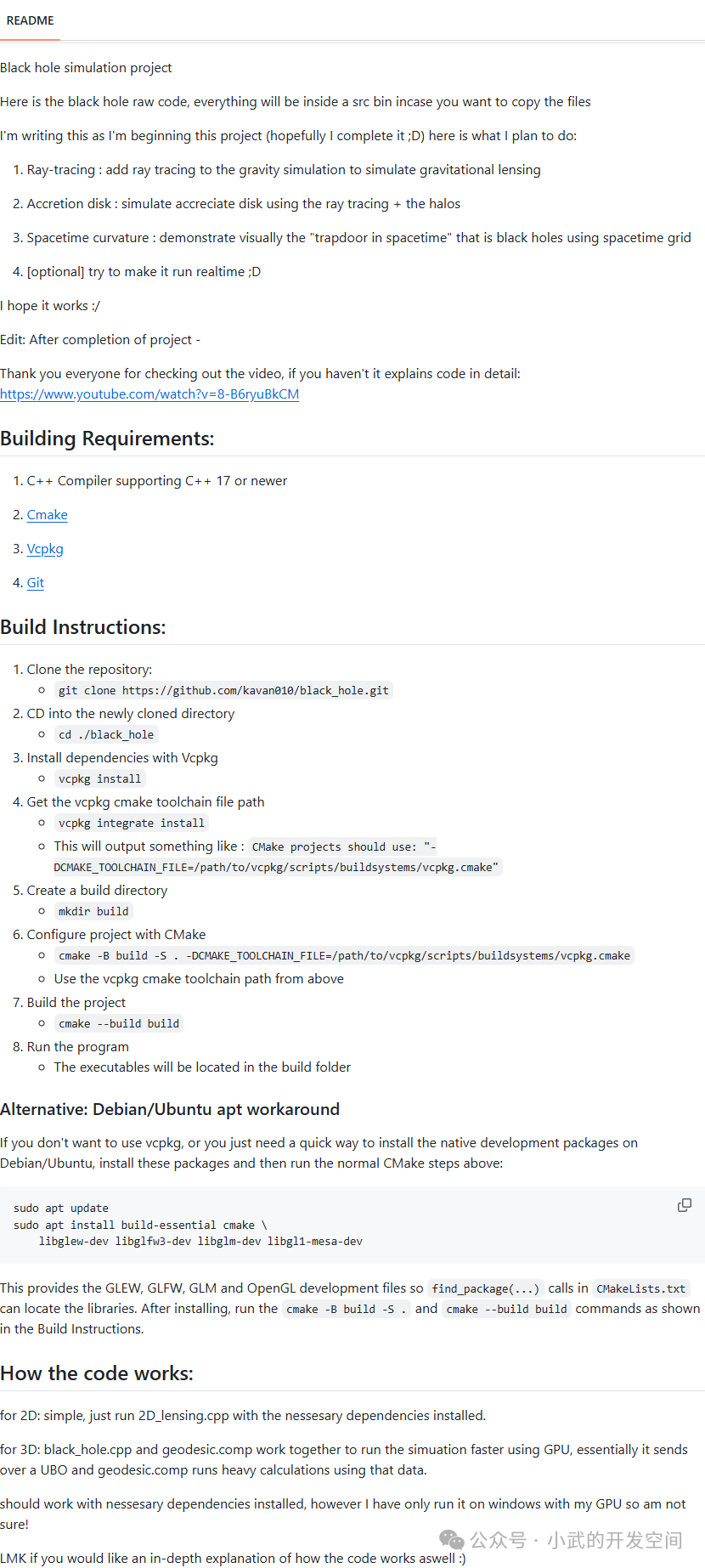
Black Hole Simulation Project Overview
This project is a visualization simulator of black hole physical phenomena based on C++ and GPU acceleration, aimed at showcasing key concepts in general relativity through computer graphics technology. The core of the project includes visualizing gravitational lensing effects, accretion disk structures, and spacetime curvature, helping to understand the complex spacetime geometry around black holes.
Core Functionality Implementation
The system uses ray tracing algorithms to simulate the deflection paths of light in strong gravitational fields, combined with compute shaders (geodesic.comp) to efficiently solve geodesic equations on the GPU. The 2D version achieves gravitational lensing through simple light deflection, while the 3D version utilizes uniform buffer objects (UBO) and OpenGL for data interaction, enhancing computational performance.
Technical Architecture and Build
The project uses the CMake build system, relying on graphics libraries such as GLFW, GLEW, GLM, and OpenGL, supporting cross-platform compilability through vcpkg for unified management of third-party libraries. It also provides an alternative solution for apt package management under Linux, ensuring real-time rendering potential.
14. OHF-Voice/piper1-gpl
 📊 Data Metrics:
⭐ stars : 1.7k | 🍴 forks : 177
🔗 https://github.com/OHF-Voice/piper1-gpl
15. utkarshdalal/GameNative
 📊 Data Metrics:
⭐ stars : 1.4k | 🍴 forks : 45
🔗 https://github.com/utkarshdalal/GameNative
Project Introduction
Overview
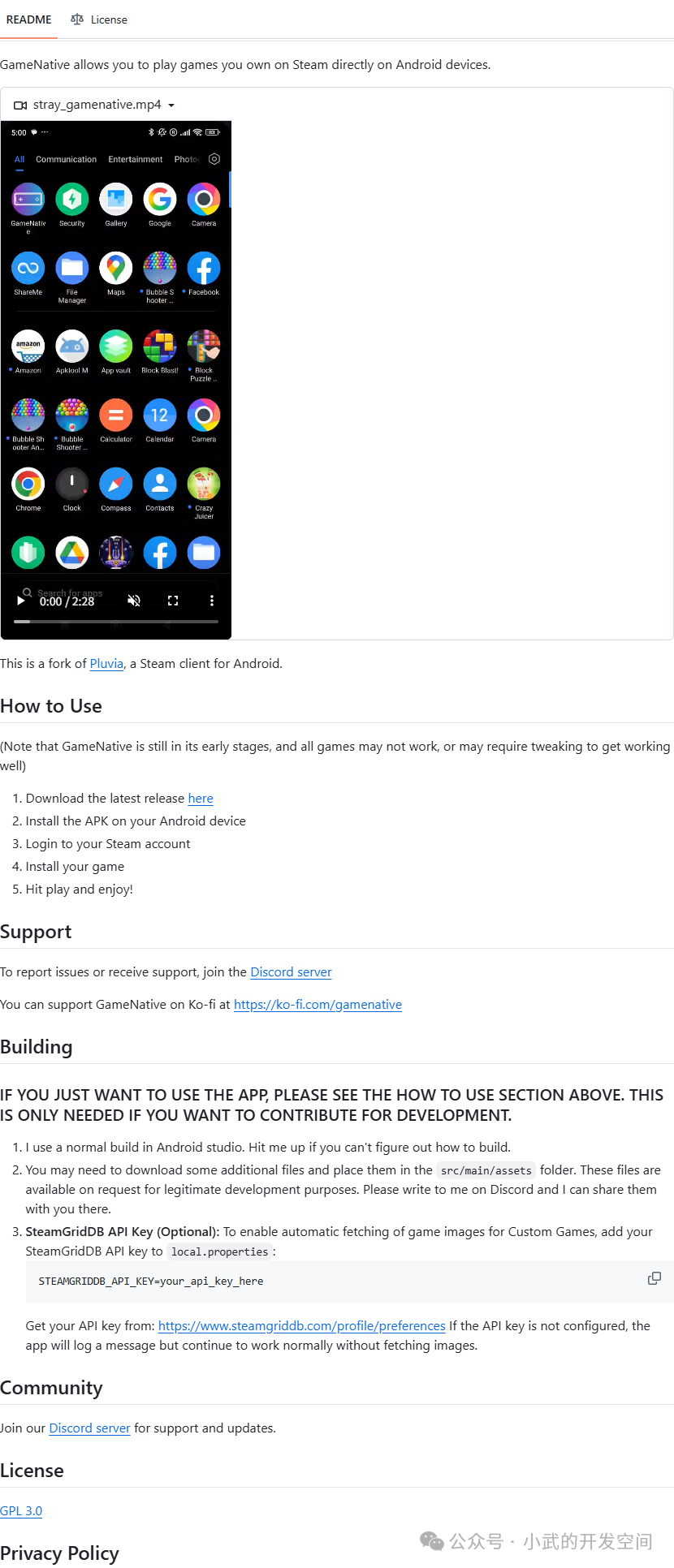
GameNative is a Steam client designed for Android devices, allowing users to run their legally owned Steam games directly on their phones. As a branch of the Pluvia project, it inherits the lightweight characteristics of the original project while optimizing and expanding upon it, aiming to provide a smoother mobile gaming experience.
Function Features
It supports logging into Steam accounts, installing local games, and launching them with one click. Currently, the project is still in its early stages, and some games may require manual adjustments to run properly. By integrating the SteamGridDB API (optional), it can automatically fetch custom game cover images, enhancing the visual appeal of the interface.
Development and Support
The project is open-source, released under the GPL 3.0 license, and welcomes developer contributions. Specific resource files are required during the build process, which can be obtained through Discord for support. Users can sponsor project development through the Ko-fi platform and receive help and updates in the Discord community.