For the GESP Level 3 exam: GESP202406 Level 3 – Finding MultiplesThe difficulty of this problem lies in multi-layer input. Many candidates are familiar with one or two layers, but struggle with how to input three layers.Look at the problem: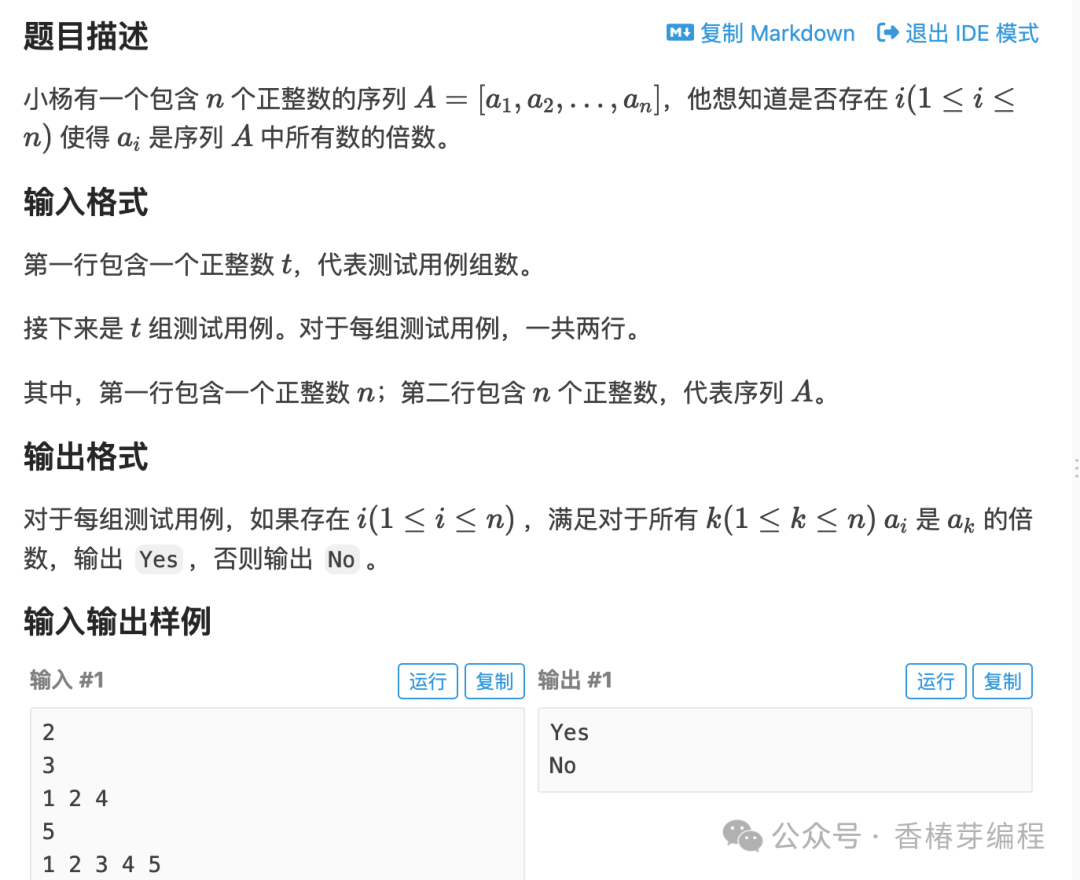
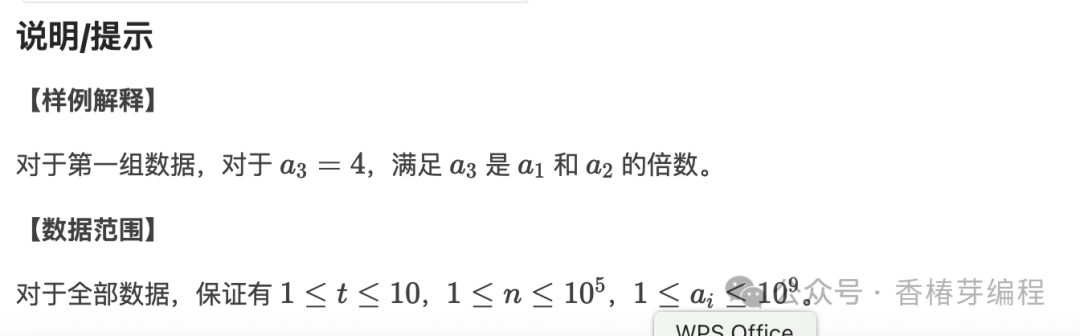
Solution Approach:
1. First, we will record the input into an array. How to write for three layers?
#include <bits/stdc++.h>using namespace std;int main(){ int t; cin >> t; // First layer input for (int i = 0; i < t; i++)// t groups of data. { int n; cin >> n;// Second layer input int a[n];// Array length is n for (int j = 0; j < n; j++) { int numb; cin >> numb;// Third layer input a[j] = numb;// Store n numbers in the array } } return 0;}2. The problem requires that the last number is a multiple of the previous numbers, which means the last number must be the largest. There are two solutions:
1. Find the maximum value and then check if it is a factor.
int maxnumb=0;maxnumb = max(a[i], maxa);string flg = "Yes";for (int j = n - 1; j >= 0; j--) { if (maxa% a[j] != 0) { flg = "No"; break; } } cout << flg << endl;2. Sort from smallest to largest and then check if it is a factor.
sort(a, a + n); string flg = "Yes"; for (int j = n - 1; j >= 0; j--) { if (a[n - 1] % a[j] != 0) { flg = "No"; break; } } cout << flg << endl;3. Complete code for sorting processing
#include <bits/stdc++.h>using namespace std;int main(){ int t; cin >> t; for (int i = 0; i < t; i++) { int n; cin >> n; int a[n]; for (int j = 0; j < n; j++) { int numb; cin >> numb; a[j] = numb; } sort(a, a + n); string flg = "Yes"; for (int j = n - 1; j >= 0; j--) { if (a[n - 1] % a[j] != 0) { flg = "No"; break; } } cout << flg << endl; } return 0;}4. The logic for handling flg is not elaborated here. Reference:GESP Level 3 C++ Programming (45C++): Zeroing ArraysHave you learned it?