Click the above“Mechanical and Electronic Engineering Technology”to follow us1D Rod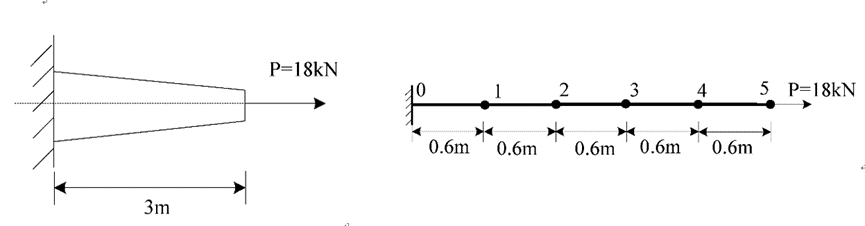
from feon.sa import *
import numpy as np
from feon.tools import pair_wise

if __name__ == "__main__":
    E = 210e6
    P = 18
    X = np.linspace(0,3,6)
    _X = X - 0.3
    A = [0.002 + 0.01 * val / 3. for val in _X[1:]]
    A.reverse()

    nds = [Node(x, 0) for x in X]
    els = []
    count = 0
    for nd in pair_wise(nds):
        els.append(Link1D11(nd, E, A[count]))
        count += 1

    s = System()
    s.add_nodes(nds)
    s.add_elements(els)
    s.add_fixed_sup(0)
    s.add_node_force(nds[-1].ID, Fx=18)
    s.solve()

    import matplotlib.pyplot as plt
    from matplotlib import cm
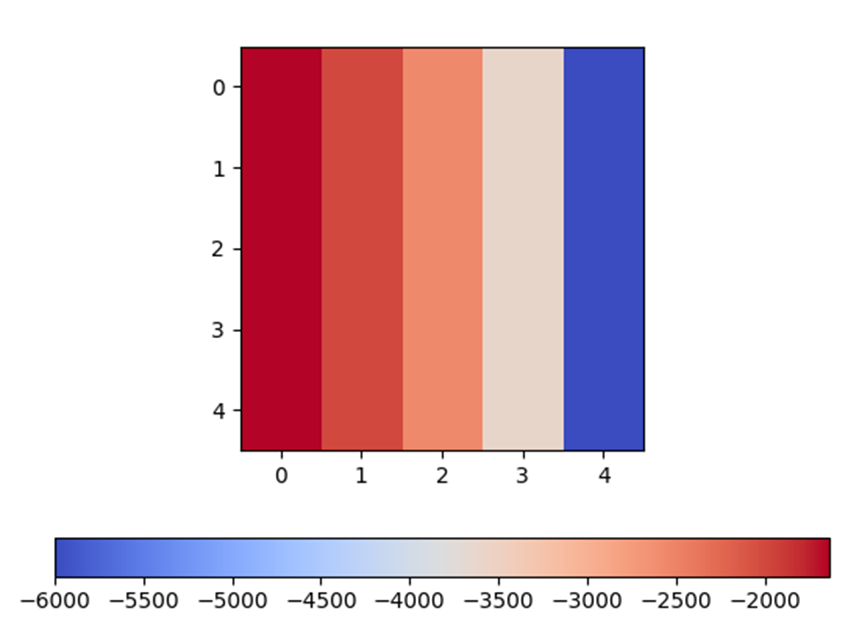
    stress = np.array([el.sx[0][0] for el in els])
    a = np.zeros((5, 5))
    fig, ax = plt.subplots()

    for i in range(5):
        a[i, :] = stress
    cax = ax.imshow(a, interpolation='nearest', cmap=cm.coolwarm)
    cbar = fig.colorbar(cax, orientation='horizontal')

    plt.show()
2D Rod
from feon.sa import *

if __name__ == "__main__":
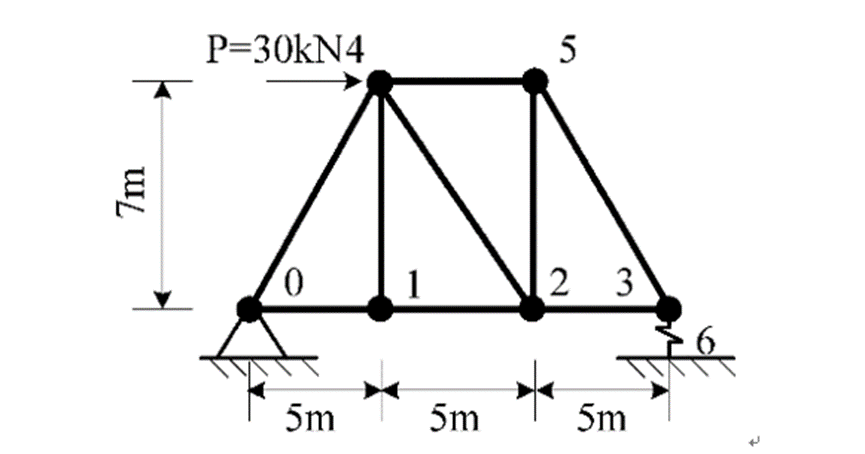
    E = 210e6
    A = 0.005
    K = 79e3
    n0 = Node(0, 0)
    n1 = Node(5, 0)
    n2 = Node(10, 0)
    n3 = Node(15, 0)
    n4 = Node(5, 7)
    n5 = Node(10, 7)
    n6 = Node(15, -1)

    e0 = Link2D11((n0, n1), E, A)
    e1 = Link2D11((n1, n2), E, A)
    e2 = Link2D11((n2, n3), E, A)
    e3 = Link2D11((n4, n0), E, A)
    e4 = Link2D11((n4, n1), E, A)
    e5 = Link2D11((n4, n2), E, A)
    e6 = Link2D11((n4, n5), E, A)
    e7 = Link2D11((n5, n2), E, A)
    e8 = Link2D11((n5, n3), E, A)
    e9 = Spring2D11((n3, n6), K)

    s = System()
    s.add_nodes(n0, n1, n2, n3, n4, n5, n6)
    s.add_elements(e0, e1, e2, e3, e4, e5, e6, e7, e8, e9)
    s.add_node_force(4, Fx=30)
    s.add_fixed_sup(0, 6)
    s.solve()

    print(e9.force)
    print(n3.disp)
{‘N’: array([[ 14.],
[-14.]])}
{‘Ux’: 0.00023809523809523858, ‘Uy’: -0.00017721518987341803,
‘Phz’: 0.0}
3D Rod
from feon.sa import *

if __name__ == "__main__":
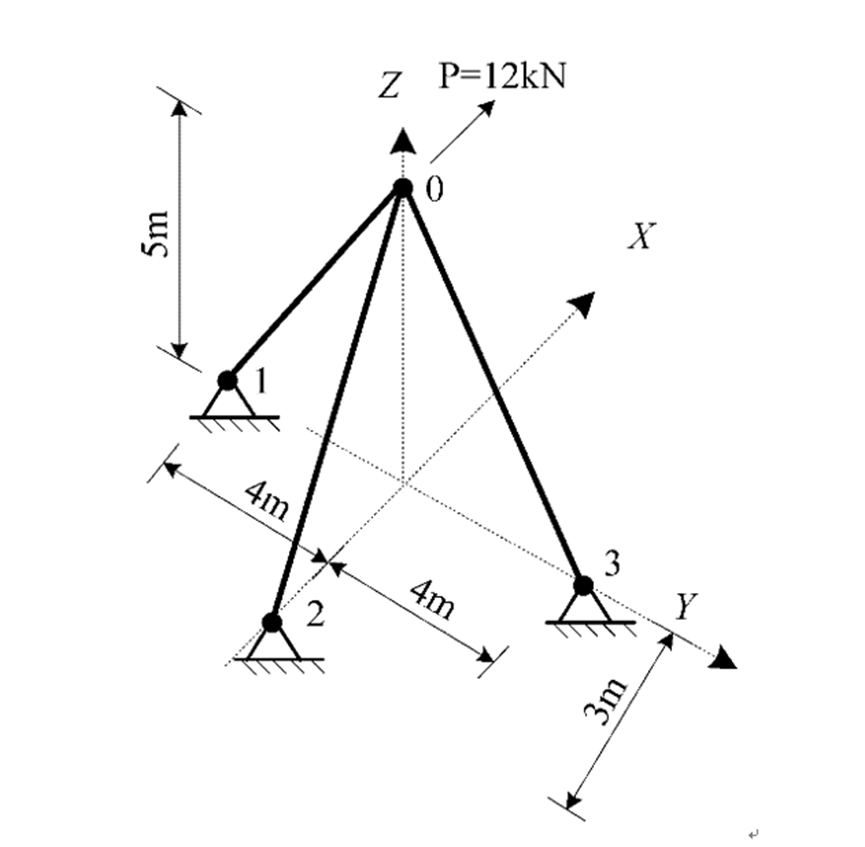
    E = 200e6
    A1 = 0.001
    A2 = 0.002

    n0 = Node(0, 0, 0)
    n1 = Node(0, -4, -5)
    n2 = Node(-3, 0, -5)
    n3 = Node(0, 4, -5)

    e0 = Link3D11((n0, n1), E, A1)
    e1 = Link3D11((n0, n2), E, A2)
    e2 = Link3D11((n0, n3), E, A1)

    s = System()
    s.add_nodes(n0, n1, n2, n3)
    s.add_elements(e0, e1, e2)
    s.add_node_force(0, Fx=12)
    s.add_fixed_sup(1, 2, 3)
    s.solve()

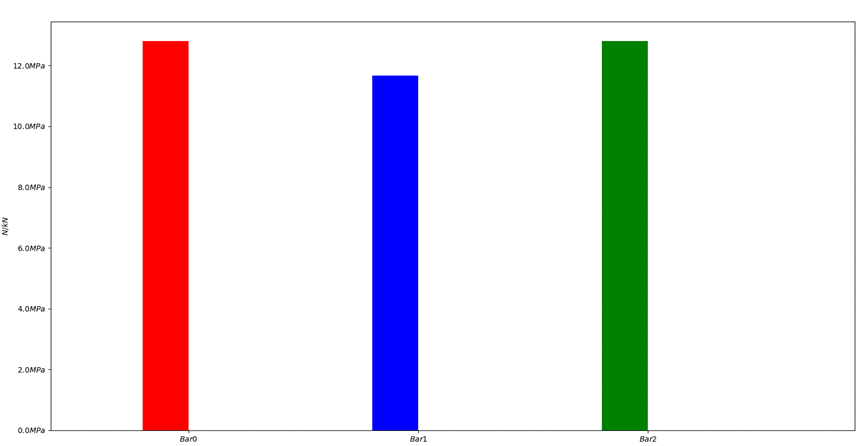
    from matplotlib.ticker import FuncFormatter
    import matplotlib.pyplot as plt
    import numpy as np

    def stresses(x, pos):
        return "$%1.1fMPa$" % (x * 1e-3)

    x = np.arange(3)
    stress = [abs(el.sx[0][0]) for el in [e0, e1, e2]]
    formatter = FuncFormatter(stresses)

    fig, ax = plt.subplots()
    ax.yaxis.set_major_formatter(formatter)
    plt.bar(x, stress, 0.2, color=["r", "b", "g"])
    ax.set_xticks(x + 0.1)
    ax.set_xticklabels(("$Bar 0$", "$Bar 1$", "$Bar 2$"))
    ax.set_ylabel("$N/kN$")
    ax.set_xlim([-0.5, 3])

    plt.show()
Truss

from feon.sa import *
from feon.tools import pair_wise
from feon.sa.draw2d import *
import matplotlib.pyplot as plt
from matplotlib.ticker import MultipleLocator

if __name__ == "__main__":
    E = 210e6
    A1 = 31.2e-2
    A2 = 8.16e-2
    nds1 = []
    nds2 = []

    for i in range(13):
        nds1.append(Node(i, 0))
    for i in range(11):
        nds2.append(Node(i + 1, -1))

    el = []
    for e in pair_wise(nds1):
        el.append(Link2D11((e[0], e[1]), E, A1))
    for e in pair_wise(nds2):
        el.append(Link2D11((e[0], e[1]), E, A1))

    for i in range(6):
        el.append(Link2D11((nds1[i], nds2[i]), E, A2))
    for i in range(6):
        el.append(Link2D11((nds2[i + 5], nds1[i + 7]), E, A2))
    for i in range(11):
        el.append(Link2D11((nds1[i + 1], nds2[i]), E, A2))

    s = System()
    s.add_nodes(nds1, nds2)
    s.add_elements(el)
    s.add_node_force(nds1[0].ID, Fy=-1000)
    s.add_node_force(nds1[-1].ID, Fy=-1000)
    for i in range(1, 12):
        s.add_node_force(nds1[i].ID, Fy=-1900)
    s.add_fixed_sup(nds1[0].ID)
    s.add_rolled_sup(nds1[-1].ID, "y")
    s.solve()

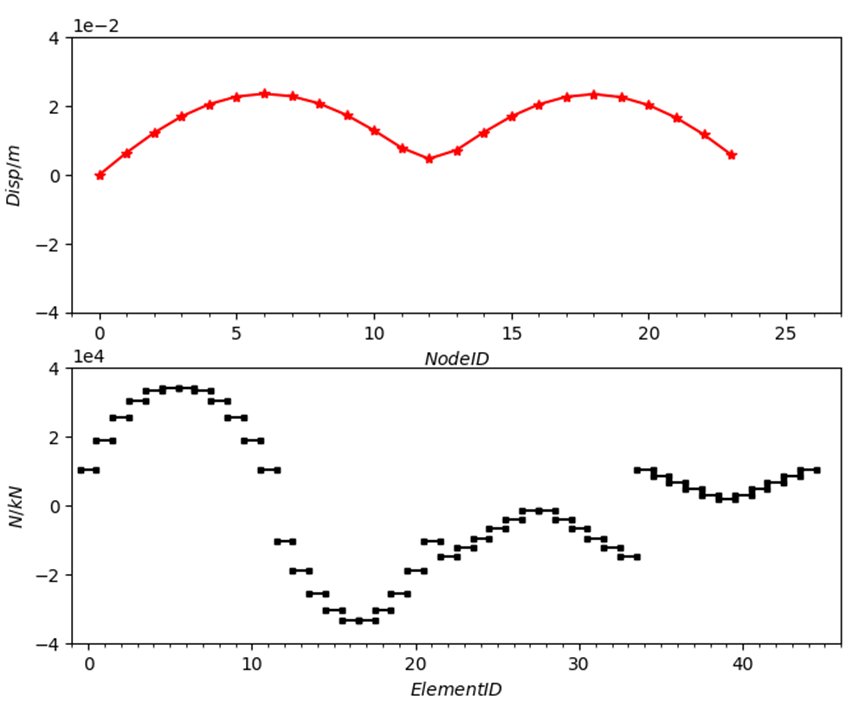
    disp = [np.sqrt(nd.disp["Ux"]**2 + nd.disp["Uy"]**2) for nd in s.get_nodes()]
    eforce = [el.force["N"][0][0] for el in s.get_elements()]

    fig = plt.figure()
    ax = fig.add_subplot(211)
    ax.yaxis.get_major_formatter().set_powerlimits((0, 1))
    ax2 = fig.add_subplot(212)
    ax2.yaxis.get_major_formatter().set_powerlimits((0, 1))
    ax.set_xlabel(r"$Node ID$")
    ax.set_ylabel(r"$Disp/m$")
    ax.set_ylim([-4e-2, 4e-2])
    ax.set_xlim([-1, 27])
    ax.xaxis.set_minor_locator(MultipleLocator(1))
    ax.plot(range(len(disp)), disp, "r*-")
    ax2.set_xlabel(r"$Element ID$")
    ax2.set_xlim([-1, 46])
    ax2.set_ylabel(r"$N/kN$")
    ax2.set_ylim(-40000, 40000)
    ax2.xaxis.set_minor_locator(MultipleLocator(1))
    for i in range(len(eforce)):
        ax2.plot([i - 0.5, i + 0.5], [eforce[i], eforce[i]], "ks-", ms=3)

    plt.show()
1D Beam
from feon.sa import *

if __name__ == "__main__":
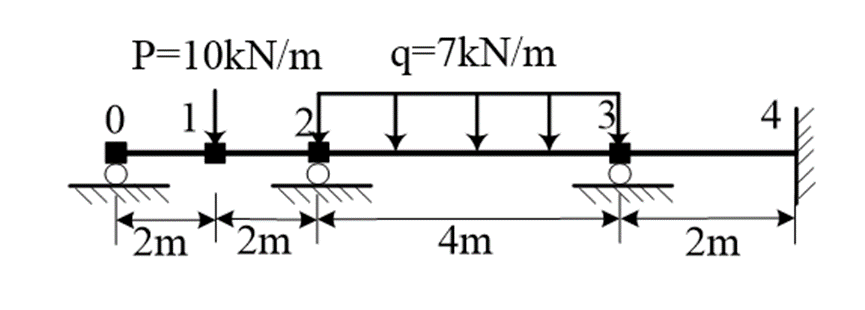
    E = 210e6
    A = 0.005
    I = 5e-5

    n0 = Node(0, 0)
    n1 = Node(2, 0)
    n2 = Node(4, 0)
    n3 = Node(8, 0)
    n4 = Node(10, 0)

    e0 = Beam1D11((n0, n1), E, A, I)
    e1 = Beam1D11((n1, n2), E, A, I)
    e2 = Beam1D11((n2, n3), E, A, I)
    e3 = Beam1D11((n3, n4), E, A, I)

    s = System()
    s.add_nodes(n0, n1, n2, n3, n4)
    s.add_elements(e0, e1, e2, e3)

    for nd in [n0, n2, n3]:
        s.add_rolled_sup(nd.ID, "y")
    s.add_fixed_sup(4)
    s.add_element_load(2, "Q", -7)
    s.add_node_force(1, Fy=-10)
    s.solve()

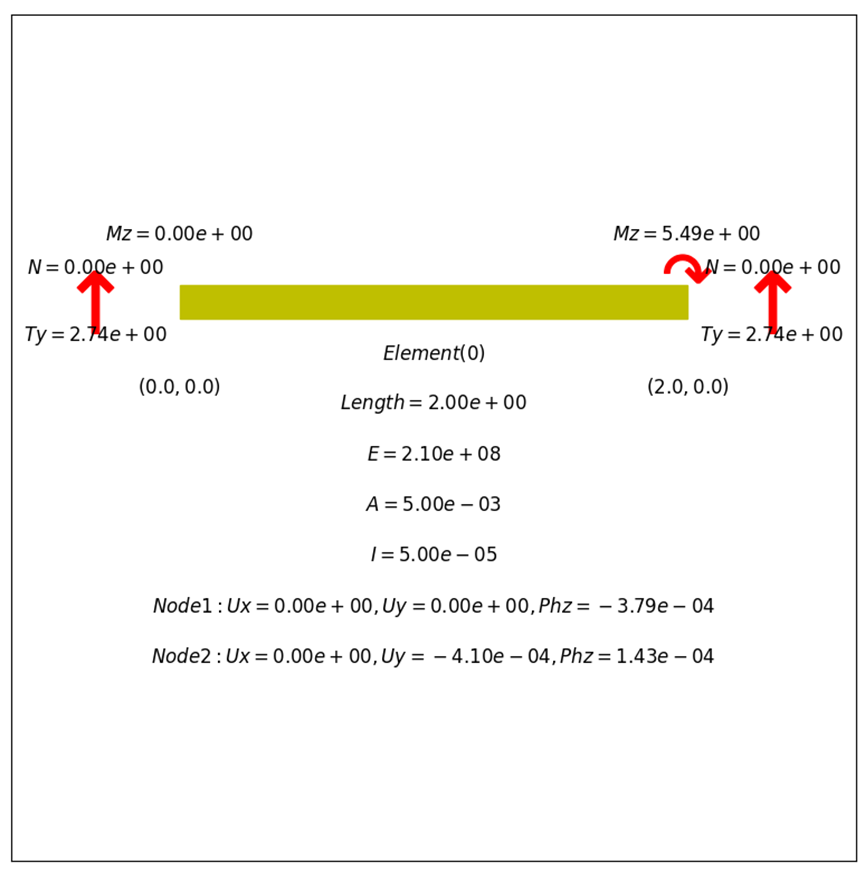
    from feon.sa.draw2d import *
    for el in [e0, e1, e2]:
        draw_bar_info(el)
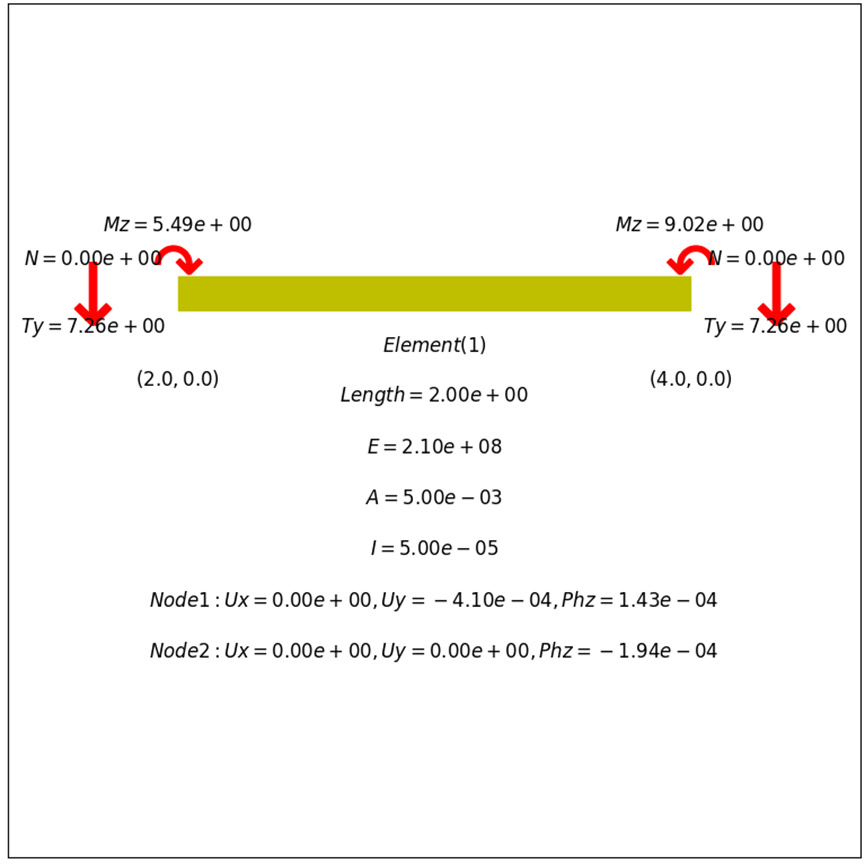
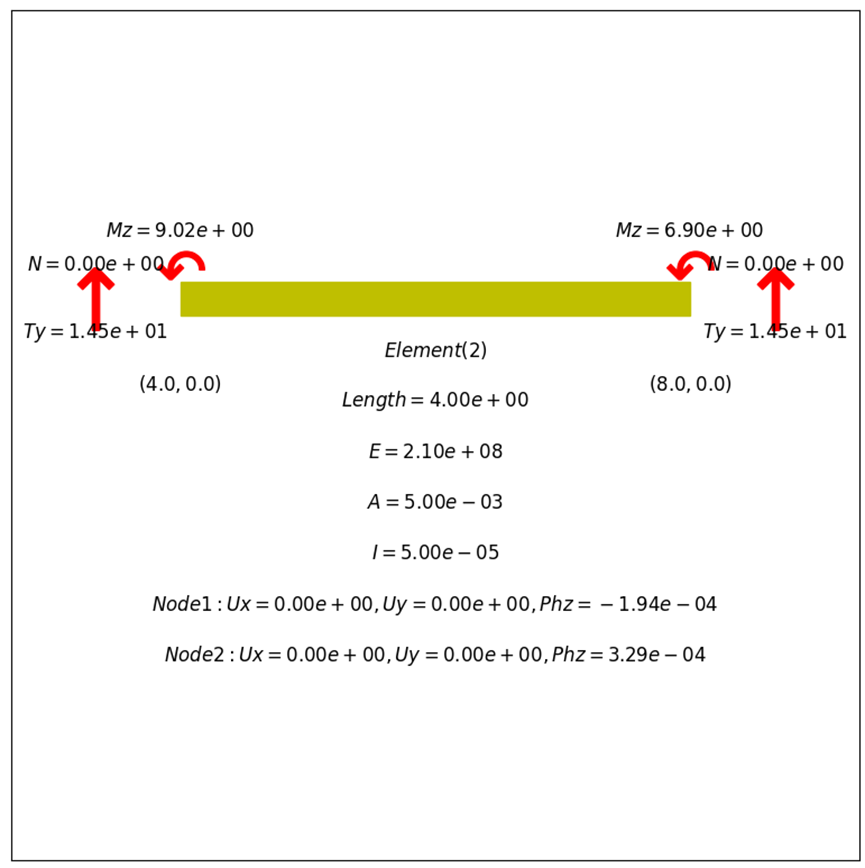

Want to know more?
Quickly scan the code to follow us