
Click the blue text above to follow us

📋📋📋 The content of this article is as follows: 🎁🎁🎁
Directory
💥1 Overview
📚2 Operating Results
🎉3 References
🌈4 Matlab Code Implementation



1 Overview
In response to the energy crisis and the deteriorating environment, clean energy generation technologies such as photovoltaic power, wind power, and tidal energy are widely applied. These technologies are characterized by their convenience in power generation, ability to meet the growing demand for electricity, environmental friendliness, and suitability for supplying power to remote areas. However, the large integration of distributed generation (DG) into the distribution network can have negative effects, such as altering the magnitude and direction of short-circuit currents after faults, complicating the structure of the distribution network. This not only poses challenges to traditional relay protection devices, fault section location algorithms, and recovery and reconstruction research methods but also raises the quality requirements for grid safety, power stability, and self-healing capabilities. Although the “13th Five-Year Plan” calls for a significant increase in the level of distribution automation and investment in distribution networks, the increasingly complex and variable structure of distribution networks, along with the rising electricity consumption in factories and households, especially due to the continuous penetration of distributed generation technologies, leads to frequent issues such as distribution system faults and power outages for factories and residents. The growing complexity of the distribution network structure, the decreased sensitivity of relay protection devices, and the increased likelihood of misoperation or failure to operate have resulted in the following problems in the distribution network [4.5]: (1) Poor grid stability: The stability of power supply is affected by various parts of the grid. Since the distribution system is directly connected to the load, most residents rely on a single power source. If a section of the line fails and there is no backup power supply, the inability to switch power in time can lead to prolonged outages. Aging and faults in power equipment can also worsen the stability of the distribution network. (2) Unreasonable fault handling methods: Due to the different geographical locations of each area, the transmission and distribution lines vary, making it impossible to equip the distribution system with a unified intelligent detection device. Some areas may not even provide detection devices, and when a system fault occurs, individuals must rely on personal experience to determine the fault section and cause, making this method particularly unreliable. (3) Low quality of power delivery: The requirements for power delivery are reliability, quality, and economy. The complexity of distribution lines and low voltage levels increase power losses and costs in the distribution network. Excessive losses can directly affect the grid frequency, preventing the supply and distribution system from operating effectively. Therefore, it is necessary to reasonably reduce voltage levels and system impedance while ensuring that the three-phase voltage of the system remains stable and within limits. With the increasing scarcity of traditional resources, green and environmentally friendly energy generation technologies such as wind and photovoltaic power are rapidly developing. Their integration into the distribution system can effectively improve power quality and energy utilization. However, the direction of power flow and the topology of the distribution system can also change with the integration of distributed generation (DG), leading to poor performance of traditional fault location methods and recovery and reconstruction methods. Therefore, it is imperative to study rapid and accurate fault location and recovery methods in the context of distributed generation integration into the distribution network. This includes analyzing the impact of distributed generation integration on fault location and power flow calculations. The integration of distributed generation can cause traditional relay protection methods to lose selectivity, leading to misoperation or failure to operate, which affects the reliability of the distribution network and consequently impacts fault location. A forward-backward power flow calculation based on node layering is proposed, and the impact of DG integration on the voltage and network losses of the distribution network is verified through the IEEE 33 node distribution system. For the fault section location problem involving distributed generation, a fault section location method based on particle swarm optimization (PSO) is proposed, establishing a mathematical model for fault sections in the distribution network and simulating single faults, multiple faults, and location information distortion in distribution lines. Due to the premature convergence and local convergence issues of single-objective intelligent optimization algorithms, an optimized multi-objective particle swarm optimization algorithm is also employed for the same simulation analysis to verify the rationality and effectiveness of the algorithm.
1. Basic Principles of Particle Swarm Optimization Algorithm (PSO)
PSO is a heuristic optimization algorithm based on swarm intelligence, simulating the collaborative foraging behavior of birds or fish. Its core is to find the optimal solution through information sharing and iterative search among particles.
1. Algorithm Process
-
Initialization: Randomly generate a swarm of particles, each representing a potential solution (such as fault location or parameter combination), and assign initial velocity and position.
-
Fitness Evaluation: Calculate the fitness value of each particle using the objective function (such as fault indicator error).
-
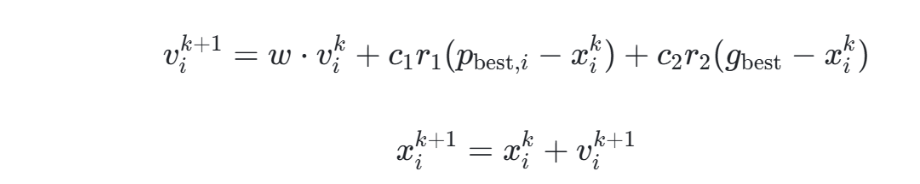
Velocity and Position Update:
-
Where, w is the inertia weight, c1 and c2 are learning factors, and r1 and r2 are random numbers.
-
Iteration Termination: Stop when the preset number of iterations is reached or when fitness converges.
2. Characteristics and Advantages
- No Gradient Information Required: Suitable for non-convex and nonlinear optimization problems.
- Memory: Retains individual historical best (pbest) and global best (gbest) information.
- Fewer Parameters, Fast Convergence: Compared to genetic algorithms, it does not require crossover and mutation operations, making it structurally simpler.
2. Limitations of Traditional Power System Fault Location Methods
Traditional methods mainly rely on electrical parameter analysis and have the following issues:
- Impedance Method: Estimates fault distance by measuring line impedance, but is greatly affected by transient resistance and line parameter errors, limiting accuracy.
- Traveling Wave Method: Uses traveling wave signals generated by faults for location, but requires high-frequency sampling equipment and is insensitive to high-resistance faults.
- Differential Protection: Relies on synchronous measurement of currents at both ends, and its reliability decreases with communication delays or data loss.
- High Computational Complexity: Traditional algorithms are prone to local optima in complex distribution networks (such as those with distributed generation) and have slow convergence speeds.
3. Current Research Status of Fault Location Based on PSO
1. Improvement Strategies
- Parameter Optimization: Use adaptive inertia weights (such as linearly decreasing) to balance global and local search capabilities.
- Hybrid Algorithms:
- PSO-GA: Combines the mutation mechanism of genetic algorithms to avoid premature convergence.
- Immune-PSO: Introduces antibody concentration regulation to enhance diversity and improve fault tolerance.
- Binary Encoding: Encodes fault section states as 0/1 vectors to simplify fitness function design.
2. Fault Tolerance and Adaptability
- Information Distortion Handling: Even when FTU (Fault Terminal Unit) data is distorted, accurate location can still be achieved through weighted correction of the fitness function.
- Compatibility with Distributed Generation (DG): Reduces the impact of DG integration through topological partitioning (such as main network and bypass network).
3. Typical Cases
- IEEE 33 Node System:
- Single fault location accuracy exceeds 97%, and fault tolerance for multiple faults is significantly better than traditional methods.
- The improved SFLA-BPSO algorithm increases optimization speed by over 60%.
- Distribution Network with DG:
- Employs a hierarchical control strategy, with PSO combined with exhaustive search for rapid fault section location, adapting to complex network structures.
4. Key Technical Challenges in Fault Section Division
- Fuzzy Section Boundaries: Periodic changes in impedance phase angles make it difficult to determine section boundaries, necessitating the introduction of crossover numerical tables to enhance reliability.
- Impact of Transient Resistance: High-resistance faults cause impedance characteristics to shift, requiring the construction of a “coherent resistance” model to correct distance measurement errors.
- Multi-source Interference: DG integration alters fault current direction, necessitating real-time updates of topology through synchronized phasor measurement (PMU).
- Communication Anomalies: When PMU communication is interrupted, dynamic adjustments to measurement section divisions are required to ensure continuous location.
5. Application Cases and Effect Evaluation
1. IEEE 33 Node System Simulation
- Scenario Settings: Types of faults include single-phase grounding, two-phase short circuits, etc., with fault resistance ranging from 0-100Ω.
- Results:
- PSO average location error <1%, convergence time <50 iterations.
- The improved BPSO algorithm maintains 97% accuracy even with FTU information distortion.
2. Distribution Network with DG
- SFLA-BPSO Algorithm: In the 9-node and 33-node systems, accuracy improved by 22.7% and 393.1%, respectively, with optimization speed increased by over 60%.
- Economic Analysis: After optimizing DG capacity and location, active power losses decreased by 30%-50%, and voltage stability improved.
6. Future Research Directions
- Multi-objective Optimization: Simultaneously optimize location accuracy, computation speed, and fault tolerance.
- Integration of Deep Learning: Utilize LSTM networks to process time-series fault data, enhancing dynamic adaptability.
- 5G Communication Integration: Based on low-latency communication architecture, achieve real-time topology updates and distributed collaborative location.
Conclusion
The PSO algorithm demonstrates significant advantages in power system fault location, especially in complex distribution networks and scenarios with DG, where its global search capability and fault tolerance outperform traditional methods. Future improvements in algorithms and integration of multiple technologies are expected to further enhance location accuracy and real-time performance, supporting the reliable operation of smart grids.
2 Operating Results
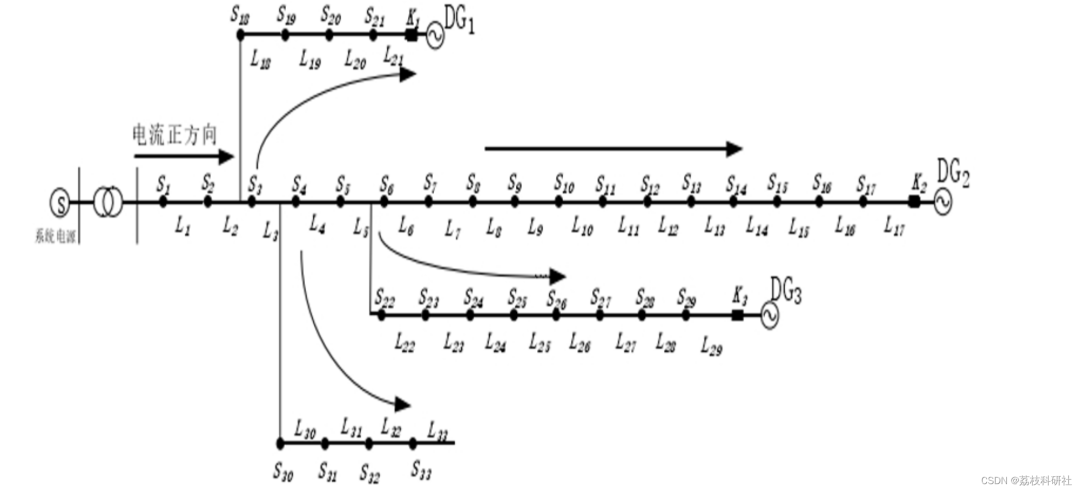
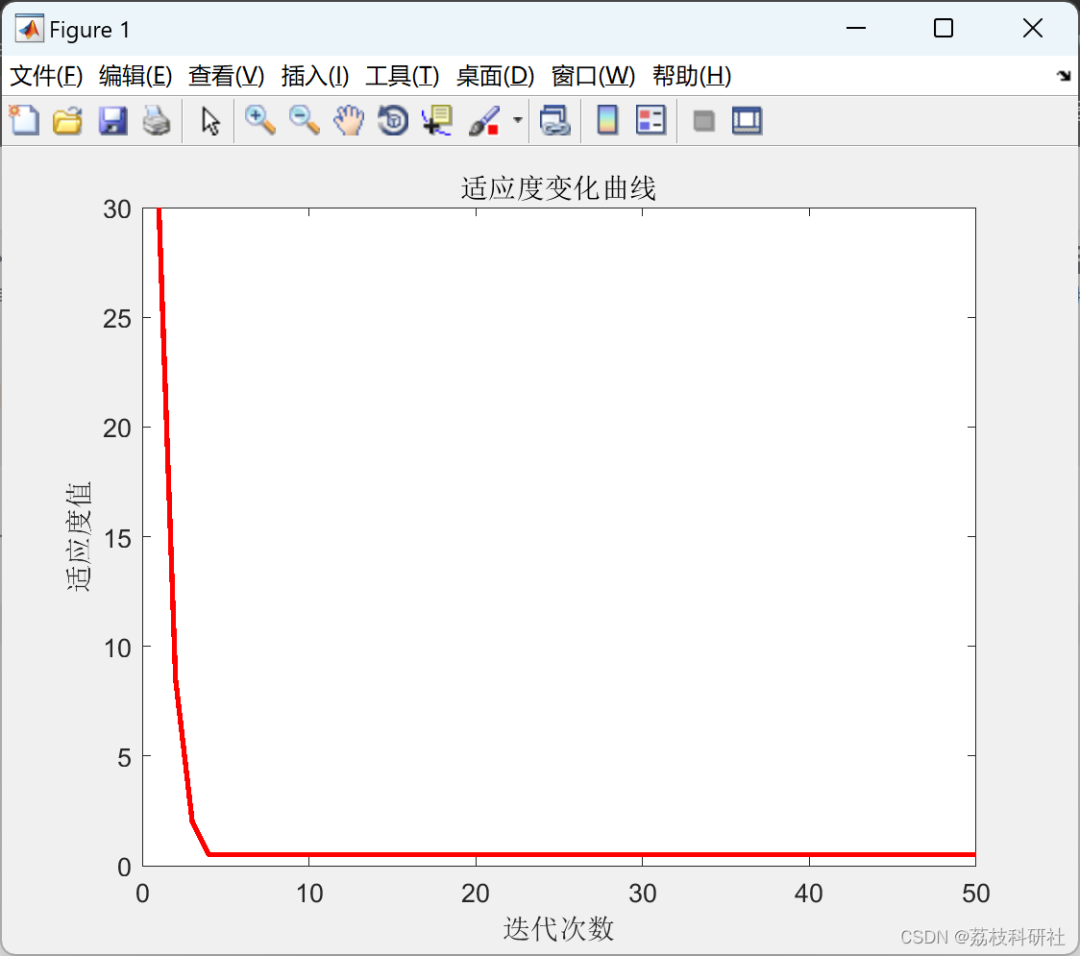
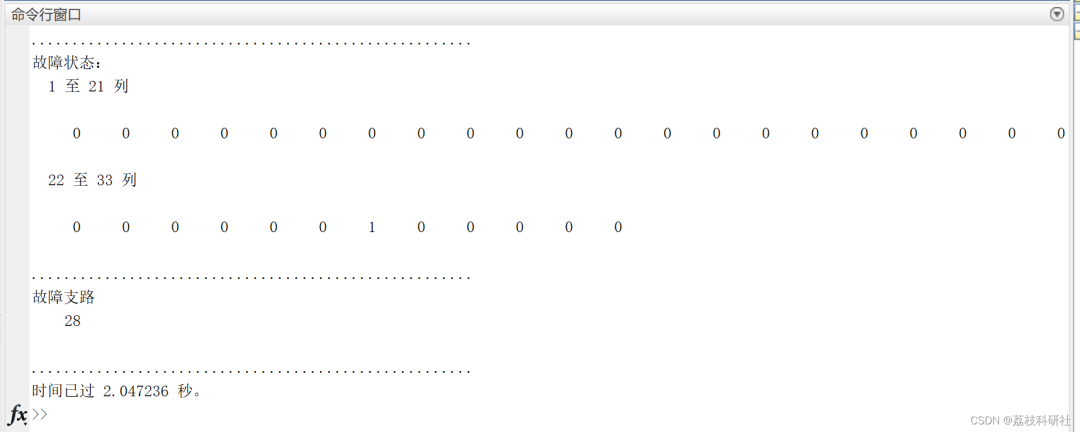
3References
Some theories are sourced from the internet; please contact us for removal if there is any infringement.

[1] Ma Yong. Research on Fault Location and Recovery Methods for Distributed Generation Accessing Distribution Networks [D]. Ningxia University, 2022. DOI:10.27257/d.cnki.gnxhc.2022.001792.

4 Matlab Code Implementation
Previous Recommendations
MATLAB|【Active-Power and Reactive-Power Coordination Optimization】Research on Active-Power and Reactive-Power Coordination Optimization of Distribution Networks Based on Improved Multi-Objective Particle Swarm Optimization Algorithm
MATLAB|【Islanding Identification】Intelligent Partitioning and Islanding Identification Method for Distribution Networks Based on Reachability Matrix
MATLAB|Research on Fault Reconstruction Methods for Distribution Networks【IEEE 33 Node】【SOP】
MATLAB|Active Distribution Network Blockage Management Based on Master-Slave Game
MATLAB|Research on Elastic Partitioning Model of Distribution Networks [IEEE 33 Node]
Research on Active Distribution Network Optimization Scheduling Considering “Source-Load-Storage” Collaborative Interaction [IEEE 33 Node] (Matlab Code Implementation)
【Multi-Microgrid】Distribution Network Game Optimization Scheduling with Shared Energy Storage of Multiple Microgrids (Matlab Code Implementation)
Distribution Network Day-Ahead Two-Stage Optimization Scheduling Model with Distributed Generation (Matlab Code Implementation)
Research on Unified Model of Reconstruction and Islanding Division for Active Distribution Network Fault Recovery (Matlab Code Implementation)
MATLAB|【Reactive Power Optimization】Reactive Power Optimization Algorithm for Distribution Networks Based on Second-Order Cone Programming [IEEE 33 Node]
MATLAB|【Distribution Network Reconstruction】Distribution Network Reconstruction Considering Demand Response under High Proportion of Clean Energy Access [IEEE 33 Node]
Research on Distribution Network Reconstruction Based on Genetic Algorithm (Matlab Code Implementation)
【Distribution Network Planning】N-1 Expansion Planning Research for Distribution Networks (Matlab Code Implementation)
Cluster Division and Cluster Voltage Coordination Control of Distribution Networks with Distributed Photovoltaics (Matlab Code Implementation)
Optimal Power Flow Solution for Active Distribution Networks Based on Second-Order Cone Programming (Matlab Code Implementation)
Fault Location in Distribution Networks Based on Genetic Algorithm (Matlab Code Implementation)
Application of Improved Binary Particle Swarm Algorithm in Distribution Network Reconstruction (Matlab Implementation) [Paper Reproduction]
【Electric Vehicles】Research on Multi-source Collaborative Operation Optimization of Active Distribution Networks—Monte Carlo Simulation of Large-scale Electric Vehicles (Matlab Code Implementation)
【Optimal Power Flow】Application of Second-Order Cone Relaxation in Optimal Power Flow Calculation of Distribution Networks (Matlab Code Implementation)
Distribution Network Power Flow Calculation Using Forward-Backward Method (Python & Matlab Implementation)
Research on the Impact of Distributed Generation on Fault Location in Distribution Networks (Python Code Implementation)
Reconstruction of Distribution Networks Based on Novel Heuristic Algorithm SOE Random (SDNR) (Matlab Code Implementation)
Distributed Voltage Reactive Power Optimization Considering Equipment Action Losses in Distribution Networks (Matlab Code Implementation)
Distribution Network Reconstruction Solving Based on Dragonfly Optimization Algorithm (Python Code Implementation) [IEEE 123 Node Example]
Distribution Network Power Flow Calculation Using Forward-Backward Method (Python & Matlab Implementation)