The TCP/IP protocol stack is structured in layers, with the TCP/IP protocol stack adopting a layered model. From the physical layer to the application layer, each layer implements specific network functions through standardized protocols, ensuring modularity and scalability in network communication. Additionally, inter-layer collaboration facilitates end-to-end data transmission. This layered design allows for fault diagnosis to be localized by layer, and protocol optimization can be targeted, forming the underlying logical framework for network engineers to conduct technical work.
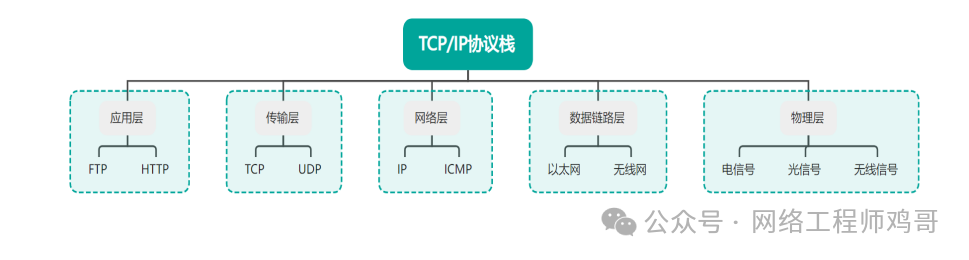
1、Physical Layer
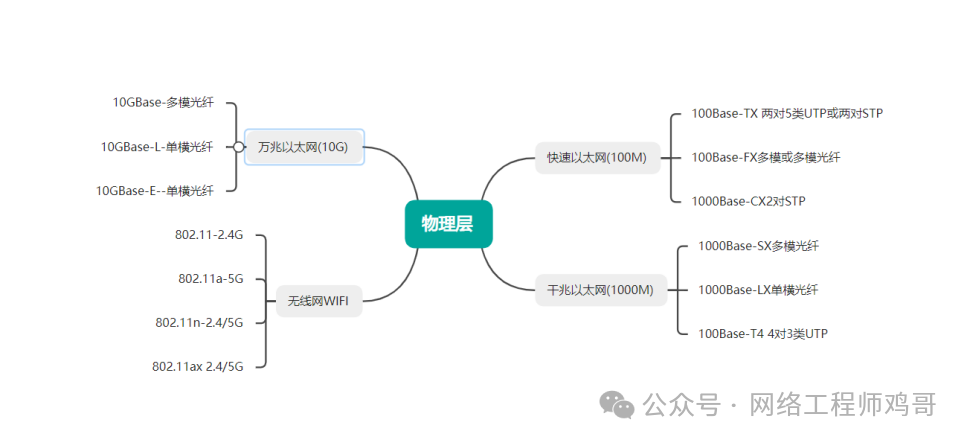
The physical layer defines the electrical characteristics, mechanical properties, and signal transmission specifications of the network’s physical media (such as twisted pair cables, optical fibers, and wireless spectra). It serves as the “hardware connection layer” for data communication. Technologies like Ethernet and WIFI are based on this. For example, standards like Fast Ethernet (100M) such as 100Base-TX and 100Base-FX specify parameters like transmission media (twisted pair, optical fiber), transmission rates (100Mbps), and transmission distances (100 meters to 40 kilometers), providing a standardized basis for wired LAN physical connections. The WIFI 802.11 series standards (such as 802.11ax) specify wireless frequency bands (2.4G/5G), modulation methods, and transmission power, supporting wireless device access and signal transmission. The precise design of physical layer protocols ensures reliable data transmission over physical media.
2、Data Link Layer
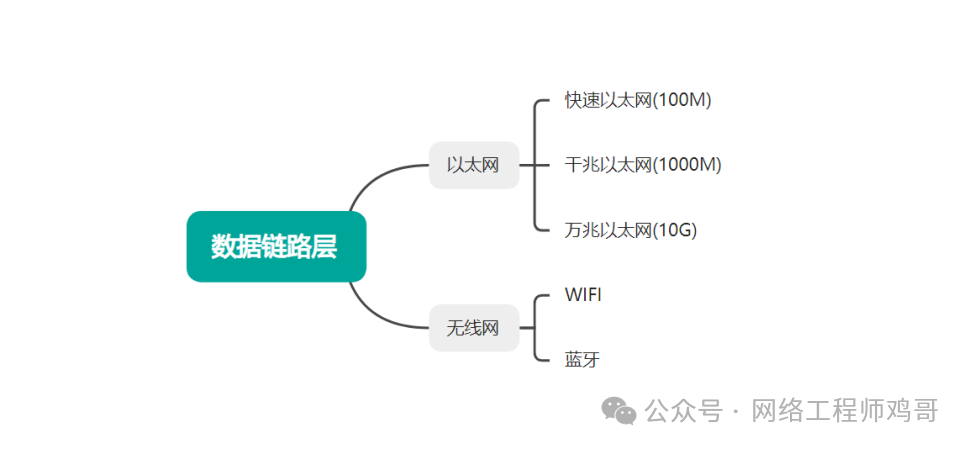
The data link layer focuses on the encapsulation and transmission of “frames”. By adding frame headers and trailers, it converts physical layer signals into network layer data while also managing link access control and error detection.
Ethernet (802.3): As the core protocol for wired LANs, it defines the Ethernet frame format (including destinationMAC, sourceMAC, type fields, etc.) and the media access control mechanism (CSMA/CD). In enterprise campus networks and data center interconnect scenarios, the Ethernet protocol ensures efficient data exchange between devices through standardized frame transmission, serving as the “cornerstone protocol” for wired LAN communication.
WIFI (802.11): For wireless LANs, it addresses channel allocation, collision avoidance, and frame transmission issues in wireless environments. The evolution from 802.11b to 802.11ax continuously optimizes transmission rates, frequency band compatibility, and multi-device concurrency, supporting scenarios like mobile office and wireless coverage, achieving reliable data transmission over wireless links.
The 802 LAN system: As a collective term for the data link layer, it integrates technologies like Ethernet and WIFI to construct a standardized framework for data link transmission in LANs, serving as the “intermediary layer” for LAN communication, ensuring effective conversion of physical layer signals into frame data that can be processed at the network layer.
3、Network Layer
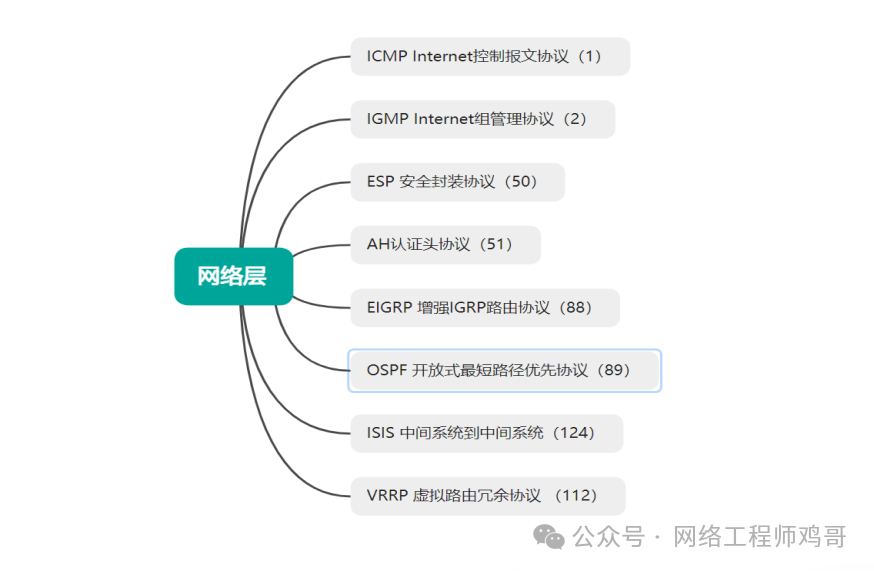
The network layer, centered around the IP protocol, enables addressing and routing across different networks and segments, serving as the key support for data “cross-domain transmission”.
The IP protocol: As the “soul protocol” of the network layer, it assigns a uniqueIP address (IPv4/IPv6) to devices, constructing a logical addressing system for networks. IPv4 is still widely used in existing networks due to its mature deployment ecosystem; IPv6 , with its vast address space and efficient routing mechanisms, is gradually promoting network upgrades. The IP protocol guides the forwarding path of data packets through header fields (such as version, header length, and time to live), serving as the “addressing engine” for cross-segment communication.
Auxiliary protocol group:
ICMP (Internet Control Message Protocol): Responsible for network diagnostics and control functions, it performs tasks such asecho requests/responses (based on the ping command), timeout messages, and destination unreachable messages, enabling network connectivity testing and fault localization (such as packet loss analysis). It is a “basic tool protocol” for network operation and maintenance troubleshooting.
IGMP (Internet Group Management Protocol): Specifically designed for multicast, it supports devices dynamically joining/leaving multicast groups, avoiding broadcast storms in scenarios like video conferencing and IPTV, ensuring efficient transmission of multicast data. It is the “core protocol” for building multicast networks.
Routing protocols (OSPF,EIGRP,BGP): OSPF (Open Shortest Path First) uses a link-state algorithm to autonomously calculate the optimal route within enterprise networks, adapting to dynamic topology changes and ensuring efficient internal network forwarding; EIGRP (Enhanced Interior Gateway Routing Protocol) combines the advantages of distance vector and link state, achieving rapid convergence and low resource consumption in Cisco device environments; BGP (Border Gateway Protocol), as an external gateway protocol, supports routing exchanges between autonomous systems on the Internet backbone, determining routing policies across operators and regions, serving as the “routing coordinator” for wide-area Internet communication.
4、Transport Layer
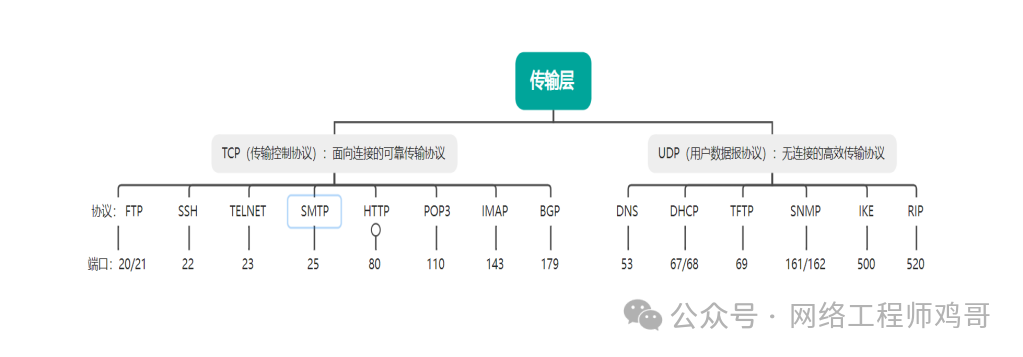
The transport layer ensures “reliability” and “efficiency” of end-to-end transmission through the TCP and UDP protocols, adapting to application data transmission needs as a “quality controller”.
TCP (Transmission Control Protocol): A connection-oriented reliable transmission protocol that establishes a connection through a three-way handshake and releases it through a four-way handshake. It ensures “no loss, no disorder” transmission through sequence numbers, acknowledgment responses, and retransmission mechanisms.
1) File transfer (FTP, relying on TCP 20/21 ports)
2) Web browsing (HTTP/HTTPS, relying on TCP 80/443 ports)
3) Email sending and receiving (SMTP/POP3/IMAP, relying on TCP 25/110/143 ports)
4) Remote login (SSH, relying on TCP 22 ports)
UDP (User Datagram Protocol): A connectionless efficient transmission protocol that operates on the principle of “best effort delivery”, sacrificing some reliability for low latency and high throughput.
1) DNS resolution (relying on UDP 53 ports, pursuing fast response)
2) DHCP auto-configuration (relying on UDP 67/68 ports, quickly completing IP allocation)
3) TFTP simple file transfer (relying on UDP 69 ports, suitable for efficient transfer of small files)
5、Application Layer
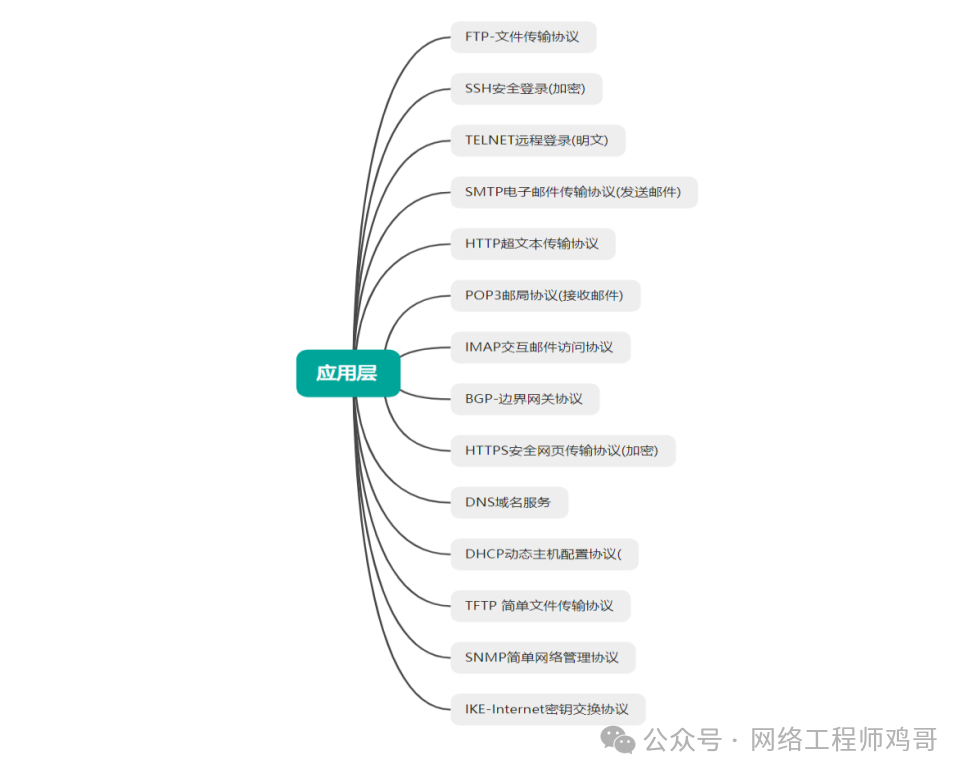
The application layer focuses on user business needs, transforming network capabilities into specific services through standardized protocols. It serves as the direct interface for users to perceive the value of the network..
HTTP/HTTPS: Hypertext Transfer Protocol, HTTP supports basic web access through plaintext transmission; HTTPS ensures data transmission security through SSL/TLS encryption, serving as the “core protocol” for web applications and Internet services, driving network interactions for various businesses such as e-commerce, information, and social networking.
Email protocol suite (SMTP/POP3/IMAP):SMTP is responsible for sending emails, while POP3/IMAP enables email reception and synchronization, constructing a complete email service system that supports email business processes for enterprise office and personal communication.
Remote management protocols (RDP/SSH):RDP (port 3389) enables remote desktop control of Windows systems, while SSH supports secure tunneling (SSH port forwarding) in addition to remote login, ensuring remote and secure operations. It is an essential tool for network device management and server maintenance.
Network management protocol (SNMP): Based on UDP 161/162 ports, it enables monitoring of network device status (such as port traffic, device CPU/memory usage), configuration management, and fault warning, serving as the “basic protocol” for automated and intelligent network operations, supporting efficient management of large-scale networks.
6、Collaboration of Layered Protocols
In actual network communication, protocols at each layer do not operate in isolation but collaborate through the “data encapsulation – decapsulation” process. For example, when a browser accesses an HTTP webpage:
Physical Layer: The terminal device sends electrical signals through wired physical media;
Data Link Layer: The Ethernet protocol encapsulates the signal into frames, adding link information such as MAC addresses, and transmits it within the LAN;
Network Layer: The IP protocol adds source/destination IP addresses, and routing protocols plan the transmission path across networks, enabling data forwarding across networks;
Transport Layer: The HTTP protocol, based on TCP protocol, establishes a secure connection through a three-way handshake, ensuring reliable data transmission;
Application Layer: The browser parses the HTTP data, presenting webpage content and completing user interaction.
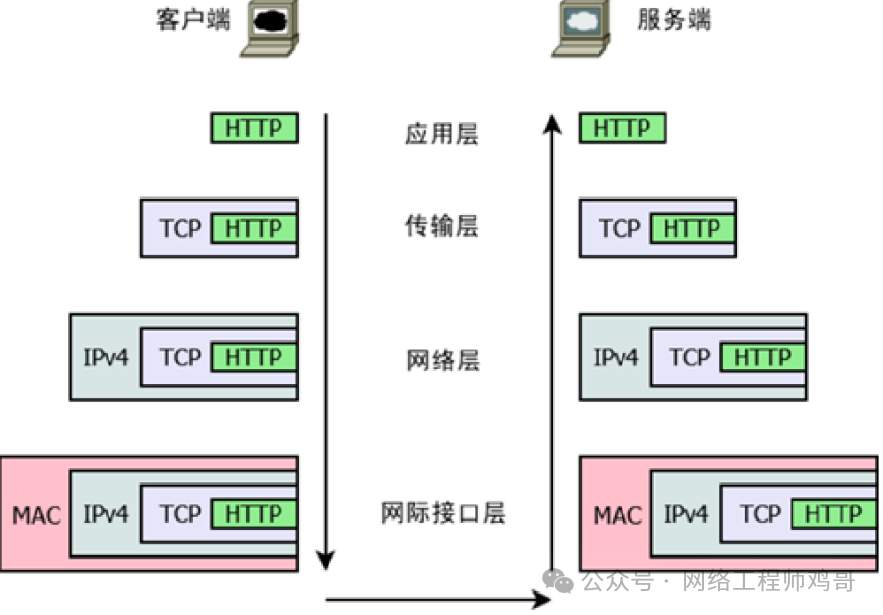
This inter-layer collaboration constructs a complete communication chain from physical signals to business applications, reflecting the systematic and scientific nature of the TCP/IP protocol stack.