In the vast realm of PLC engineering practice, projects often resemble complex mazes, with numerous input and output points acting as checkpoints within the maze. Have you ever been troubled by a sudden failure of a physical point in your PLC? When such situations arise, if the program is directly bound to the actual I/O addresses, you will face the daunting task of modifying all related input and output points in the program, which is undoubtedly a daunting “battle.” But don’t worry! The IO address mapping technology we are going to introduce today is like a magical key that can easily unlock this problem, significantly reducing the heavy burden of program maintenance.
The charm of IO mapping technology goes beyond this; it is also a powerful assistant in promoting program modularization and standardization. Imagine that once you have established a standardized program framework, when faced with devices that have the same functions but different I/O configurations, you only need to slightly adjust the IO address mapping relationship, just like tweaking a magical recipe, to perfectly adapt the program without the need for cumbersome secondary development. Doesn’t that feel like a significant boost in work efficiency?
So, how is this magical technology implemented? The core idea is quite simple: it builds a bridge between the input and output terminals of the actual PLC hardware and the memory addresses within the PLC (such as M registers), establishing a mapping relationship. Next, let’s delve into the specific solutions for implementing IO address mapping.
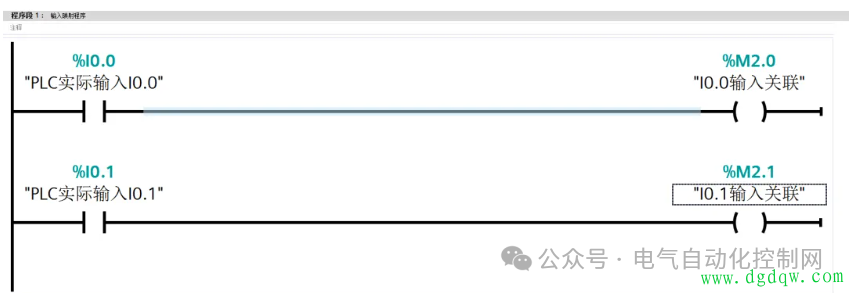
1. Mapping of PLC Input Program
Here is a clever method. Taking I0.0 and I0.1 as examples, connect their contacts to coils, and then let M2.0 act as the mapping for PLC’s I0.0, while M2.1 serves as the mapping for I0.1, completely breaking away from the traditional mode of directly using I0.0 and I0.1.
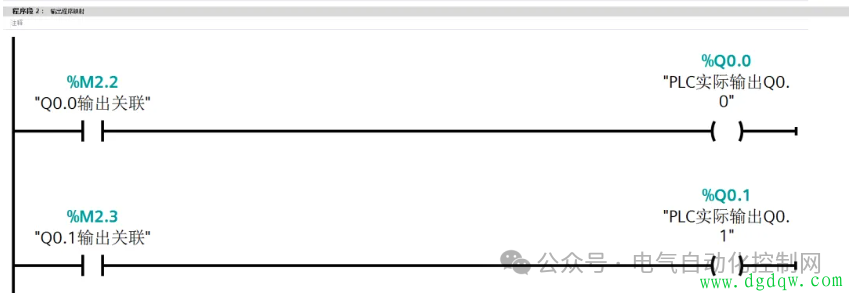
2. Mapping of PLC Output Program
Similarly, for Q0.0 and Q0.1, connect the contacts to coils, and in the program, let M2.2 become the mapping for PLC’s Q0.0, while M2.3 serves as the mapping for Q0.1, no longer directly relying on Q0.0 and Q0.1.
This programming method brings numerous significant benefits:
1. Convenient program modification: Once a fault occurs at the external I/O points of the PLC, there is no need to panic and make large-scale program modifications. You can easily adjust the corresponding mapping program to quickly modify and replace points, like performing a small “surgery” on the program, quickly and accurately.
2. Anti-interference filtering advantages: The input and output points of this mapping program can also serve as a “stage” for anti-interference filtering programs. For example, connecting a time relay after the intermediate relay M provides the PLC with a layer of “protective clothing,” effectively preventing interference from causing erroneous actions in the PLC, allowing it to operate stably even in complex electromagnetic environments.
IO address mapping technology is undoubtedly a powerful tool in the field of PLC engineering. It not only solves the problem of program modification caused by physical point failures but also provides strong support for the modularization and standardization of programs, while possessing anti-interference advantages. In practical engineering, the reasonable application of this technology can significantly enhance the flexibility, maintainability, and stability of PLC programs, allowing us to approach PLC programming with greater confidence and composure.
(If you have different insights, feel free to share your thoughts in the comments section)Thank you for reading this article, and don’t forget to click the bottom right toshare Like
Like 👍👇Click to follow and set as a star mark to receive updates immediately.If you find it useful, please give me a follow, thank you!