Continuing from the previous article discussing your concerns about WiFi 7 SoC and technology (Part 1), let’s take a look at Broadcom’s masterpiece. This chip is also targeted at the mobile market and is set to launch very soon. However, as shown in the image below, it is clearly different from MTK’s SiP solution. This chip adopts a fully integrated solution, which is more complex to design and consequently more expensive.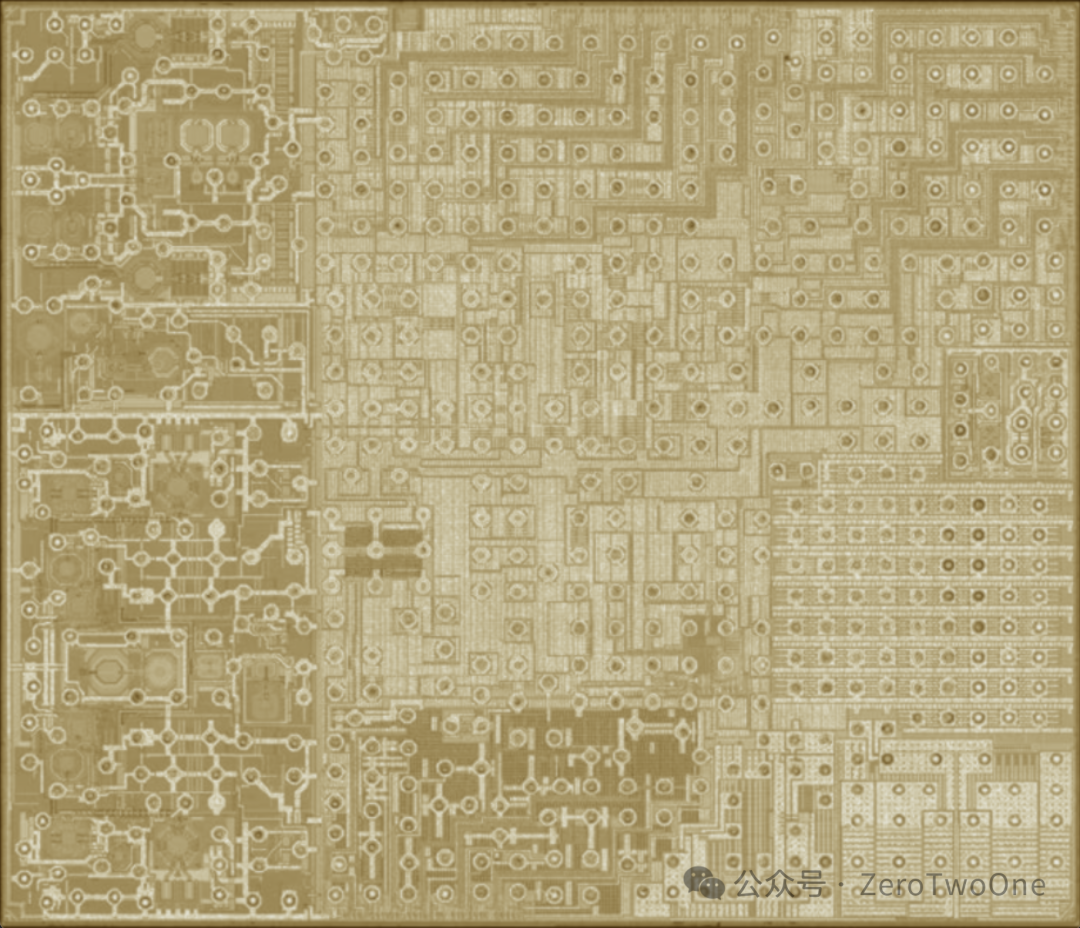 The chip uses a standard SoC layout, concentrating the RF transceiver on one side, while the remaining area is allocated for digital logic and various interface IPs. The overall size is approximately 5.3mm x 4.6mm, with the RF transceiver occupying about 30% of the area. Roughly comparing with the previous MTK solution, the area of the transceiver is less than half of that, but the remaining digital portion is nearly 40% larger than MTK’s. It should be noted that this simple and crude comparison is meaningless for chip cost assessment; it is merely to establish some intuitive understanding.In terms of technology, Broadcom’s chip also uses TSMC’s 7nm process, but adds five layers on top of MTK’s twelve-layer interconnect, bringing the total to a staggering seventeen layers. As this is a first-generation trial product, it similarly opts for maximum performance in supporting protocol features, with single-path support for 320MHz bandwidth and a maximum rate of 4096QAM.Interestingly, this product quickly reduced its specifications in its iteration a year later, halving the supported peak rate. Such operations have become a standard practice for leading manufacturers. Their first-generation products are usually industry-leading, and the product form has a high degree of uncertainty. Initially maximizing performance serves two purposes: showcasing strength and ensuring that there are no performance gaps when testing in various niche markets. Subsequently, manufacturers typically adjust based on feedback from application demands and quickly launch iterative products. At this point, product definitions are often more precise than the first generation, and cost reduction naturally becomes a higher priority consideration.Cost reduction stems not only from the reduction in product form but also from cutting a large amount of overhead reserved for technical uncertainties in the first-generation design. For example, in Broadcom’s second iteration, the SoC size was significantly reduced to 4.2mm x 4.1mm, only 70% of the first-generation product, while the area of the RF portion was further reduced from 30% to 25%. This represents a significant cost reduction for the precious 7nm process. Readers unfamiliar with the industry may not grasp this concept, so let me provide a more relatable example. Currently, the top residential project in Shanghai, Cuihu Tiandi, has a price per square meter comparable to that of a 7nm chip per square millimeter.In this iteration, Broadcom first eliminated support for the 320MHz bandwidth, which is one of the main upgrades of the WiFi 7 protocol compared to the previous generation. From this point alone, it is clear that Broadcom’s product planning for the Station side is very pragmatic. To explain this further, we need to delve into some technical content, but even elementary school students should be able to understand.The theoretical maximum rate for a single channel in WiFi 6/6e can reach 1.2Gbps, while WiFi 7 further enhances this to 2.88Gbps. This doubling in performance is primarily due to two factors: the use of a more complex modulation scheme, 4096QAM, and the doubling of the maximum channel bandwidth to 320MHz. Not clear? No problem, let’s use a more relatable analogy involving cars. WiFi 6 is like a regular bus with ten rows of seats, but the seats are narrow, allowing only one person per row. WiFi 7 upgrades to a luxury bus with twelve rows of seats, each row upgraded to a double sofa, thus increasing passenger capacity by 12/10*2=2.4 times.However, the ideal is often far from reality. Although the luxury bus has a high passenger capacity, the existing road network is designed for narrow lanes, and only a few newly paved roads offer wide lanes, which severely limits the operational scenarios for the luxury bus. From a fleet operation perspective, spending a lot of money on a luxury bus that can only operate in a few situations means it will spend most of its time parked in the garage, leading to significant losses.At this point, Broadcom’s adjustment strategy becomes very clear. In reality, apart from standalone villas in the suburbs, whether in common multi-story residential buildings or various commercial structures, the radio environment is very complex, and it is rare to find a clean 320MHz channel available for devices. Designing chips for scenarios that are almost never used incurs significant costs, from the RF front end to baseband signal processing, including the processing capabilities of the chip and the operating frequencies of peripherals, all of which are linked to communication rates. Reducing support for 320MHz on the Station side has no impact on 99% of usage scenarios. As for the remaining 1% of demand, the first-generation product, being an all-rounder, can still meet those needs, and users with such requirements are generally less sensitive to price, so they won’t mind the cost.Another interesting point is that Broadcom not only made reductions but also added features, such as incorporating Thread and Zigbee capabilities into the next-generation chip to meet IoT demands. This addition is not limited to the chips on the Station side; similar functionalities have also been added to the AP side, aiming to address the redundancy of multi-mode gateways in existing application solutions.This point was mentioned in previous articles, such as “Observations on the Smart Home Consumer Market (Part 3): Can Xiaomi’s Ambition Succeed?” Currently, in the smart home ecosystem, due to the large existing base of devices like Zigbee, most home routers do not support such devices, requiring users to purchase an additional multi-mode gateway to connect Zigbee devices to the cloud for remote control.However, this solution has many pain points. First, the devices are not small, taking up extra space and requiring additional power outlets. For users who prioritize aesthetics, this makes the already cramped weak current box even more congested. Secondly, there is the additional cost. Taking Xiaomi as an example again, their WiFi 6 router costs just over 100 yuan, while the multi-mode gateway is priced above 200 yuan. As previously analyzed, this undoubtedly adds an extra burden for budget-conscious users. Furthermore, while today’s multi-mode gateways use single-chip solutions that integrate WiFi, Zigbee, and BLE functionalities, WiFi can only serve as a data channel to connect to the main router, unable to simultaneously act as an AP, which significantly reduces their practicality. Of course, this is not a technical implementation issue but rather a commercial consideration.If the main router were to add support for multi-mode protocols, then such gateways would no longer be necessary. This is actually akin to the design philosophy of SoC chips, which aims to integrate as many downstream functionalities as possible upstream to achieve a more streamlined and efficient overall solution.In summary, Broadcom’s product definition and iteration strategy for WiFi 7 is an efficient approach gradually explored by leading industry players in the face of a highly uncertain market environment. Compared to MTK’s solution, from a chip design perspective, it is both more challenging and not cost-effective. However, when considering the subsequent packaging and testing processes, the overall cost differences will further narrow.Overall, MTK’s use of SiP solutions cleverly keeps the RF chip platform on a 22nm FDX process, thus transforming the most uncertain part of communication chip design into a more certain one. As products and protocols continue to iterate, the more variable digital modules can migrate to advanced processes as needed to further enhance performance and reduce costs, without affecting each other. This two-step strategy is undoubtedly the preferred choice for pursuing stability and cost-effectiveness.For Broadcom, the overall SoC design undoubtedly requires a greater investment, but integrated design can deliver better product performance, which is indisputable. Facing future product upgrades and iterations, if a change in process platform is required, the entire RF analog front end will need to be redesigned. The technical risks, R&D investments, and time costs are all significantly higher than the SiP approach, but for a strong player like Broadcom, this may not pose a significant problem, as their strength has been tested countless times in the market over the years.In conclusion, as mentioned in the previous article, only what suits you best is truly the best. Up to this point, I have not discussed the difficulty of designing WiFi 7 chips. However, long-time readers should remember that I previously wrote about the importance of always choosing the difficult but correct path in the article on Espressif’s private placement review. It is indeed challenging; the design of WiFi 7 chips is not on the same level as that of WiFi 6 chips, let alone the now ubiquitous WiFi 4. It is astonishing that even in this day and age, some companies with only WiFi 4 technology are hoping to secure funding by proposing WiFi 6 projects; if this succeeds, it would undoubtedly be a major joke in the primary market.In the previous analogy, the addition of two rows of seats to the luxury bus was briefly mentioned, but in reality, the true challenge of the overall design stems from this. When upgrading from WiFi 4 to WiFi 6, the modulation scheme jumped from 64QAM to 1024QAM, similar to upgrading from six rows of seats to ten. In practice, companies lacking technical strength have abandoned the pursuit of ten rows of seats, settling for a reduced version with eight rows, which illustrates the difficulty. WiFi 7 takes this a step further, adding two more rows of seats, making the difficulty increase exponentially; just the clocking aspect alone can trip up many competitors.As for WiFi 6e, it mainly adds support for the 6GHz band on top of WiFi 6, which, while challenging, does not involve significant changes. The greater challenges in WiFi 7 design lie in the subsequent upgrades in Modem and Mac, which place extremely high demands on a company’s R&D and financial capabilities. As a side note, compared to the price per square meter of the luxury residential project Cuihu Tiandi, the price of 22nm (non-FDX) process technology is roughly at the level of Tangzhen.A few days ago, Mr. Zhang from Broadcom Integration announced in public that the development of WiFi 7 chips is on the agenda. Does this mean there will be a wave of capital operations in the future? And what will be the path for Espressif, which is under scrutiny? After reading this article, what are your thoughts? Feel free to share your insights in the background. Have a great weekend!