 Memory is divided into two main categories: RAM and ROM, with a focus on ROM here.ROM was originally non-programmable, meaning whatever content it had when it left the factory was permanent and inflexible.Later, PROM was developed, which could be written once; if a mistake was made, the chip had to be replaced, leading to unfortunate consequences. As human civilization progressed, the erasable programmable ROM (EPROM) emerged, which could be erased and rewritten, but required the chip to be exposed to ultraviolet light for erasure. Imagine needing to add a line of code after programming a microcontroller, only to find you had to expose it to UV light for half an hour before you could reprogram it. This process could take all day with only a few changes made.As history advanced, the great EEPROM was introduced, saving many programmers by allowing them to modify the contents of ROM freely.EEPROM stands for “Electrically Erasable Programmable Read-Only Memory,” which is a type of ROM that can be erased electrically, as opposed to ultraviolet erasure. Today, various EEPROM variants exist, making it a general term for a class of memory.
Narrow Definition of EEPROM:
This type of ROM is characterized by the ability to randomly access and modify any byte, allowing for writing 0s or 1s into each bit. This is the most traditional form of EEPROM, which retains data for up to 100 years after power loss and can be rewritten 1 million times. It has high reliability, but the circuitry is complex and costly. Therefore, current EEPROMs typically range from tens to hundreds of kilobytes, with very few exceeding 512K.For example, the commonly seen 24C02:
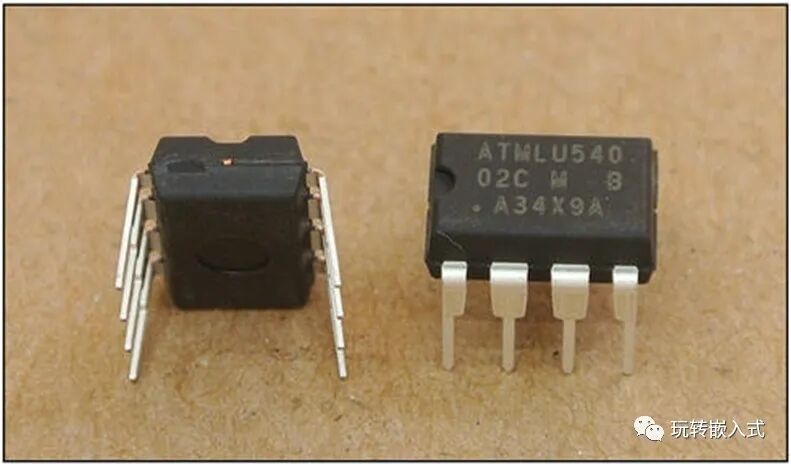
Broad Definition of EEPROM:
FLASH is considered a broad type of EEPROM because it is also electrically erasable. However, to distinguish it from the typical byte-wise erasing EEPROM, we refer to it as flash.The improvement in flash is that it erases data in blocks rather than bytes, simplifying the circuitry, increasing data density, and reducing costs. Most ROMs in the megabyte range are flash, such as the W25Q128JVSIQ:
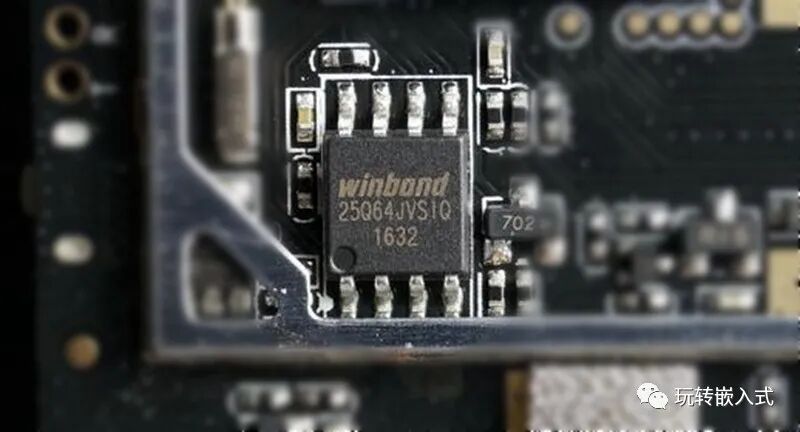
Flash is divided into NOR flash and NAND flash.
NOR Flash:
NOR flash separates data lines and address lines, allowing for random addressing similar to RAM, enabling the reading of any byte. However, it still requires block erasure. For instance, the W25Q128JVSIQ.
NAND Flash:
NAND flash also erases in blocks, but it multiplexes data and address lines, preventing random addressing via address lines. Reading can only be done by pages (NAND flash erases by blocks and reads by pages, while NOR flash does not have pages), for example: W29N01HVSINA
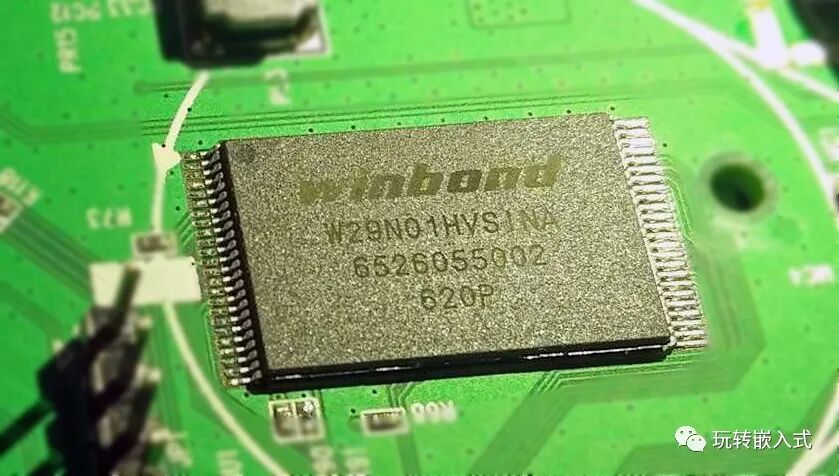
Due to the multiplexing of pins in NAND flash, its read speed is slightly slower than that of NOR flash, but its erase and write speeds are significantly faster. The internal circuitry of NAND flash is simpler, resulting in higher data density, smaller size, and lower cost. Therefore, high-capacity flash is mostly NAND type, while small-capacity flash (2-12M) is often NOR type.In terms of lifespan, NAND flash can endure many more erase cycles than NOR flash. Additionally, NAND flash can mark bad blocks, allowing software to skip them, whereas once NOR flash is damaged, it cannot be used again.Because NOR flash allows for byte addressing, programs can run directly from NOR flash. Embedded systems often use a small-capacity NOR flash to store boot code and a large-capacity NAND flash for the file system and kernel.
[1] Still confused about serial communication? This article will help you understand it.
[2] Eight-layer PCB display, showcasing beautiful computer motherboard PCBs.
[3] The number of times a microcontroller program can be burned.
[4] Key considerations before purchasing flash.
[5] RAM, ROM: A summary of microcontroller memory, taking the 51 as an example.
[6] Sharing EMC standard circuits, making EMC no longer difficult!