Review of the Last Session: The previous lecture systematically organized the style and maintainability suggestions for C language, emphasizing the importance of unified naming, reasonable comments, modular division, macro usage, avoiding magic numbers, and team style specifications for code quality and subsequent maintenance. It demonstrated the significant improvement in engineering efficiency through comparisons of erroneous and optimized code and flowcharts.
1. Step-by-Step Explanation of the Theme Principles and Details
1.1 Why Does C Language Need Testing and Assertions?
- • C language is flexible but lacks type safety and system protection, many errors only manifest at runtime, and compiler warnings cannot uncover all hidden dangers.
- • Testing and assertions are important means to enhance code reliability, locate bugs, and ensure logical correctness, especially in low-level development, embedded systems, or safety-sensitive scenarios.
1.2 What is an Assertion (assert)?
- • The C standard library
<span><assert.h></span>provides the<span>assert(expr)</span>macro. - • When
<span>expr</span>is false, assert will print an error message and terminate the program (usually used during the debugging phase). - • In the release version, assert can be disabled by defining the NDEBUG macro (i.e.,
<span>#define NDEBUG</span>, making the assert macro a no-op).
1.3 Challenges of Unit Testing Practices in C Language
- • C language lacks a built-in testing framework (compared to Python, Java, etc.).
- • It requires manually writing test functions or using third-party testing frameworks (such as CUnit, Check, Unity, etc.).
- • Test cases, boundary conditions, and exceptional paths must be explicitly covered.
2. Typical Traps/Defects Explanation and Cause Analysis
2.1 Misuse of Assertions
- • Misusing assert in critical business logic can lead to exceptions interrupting the production environment.
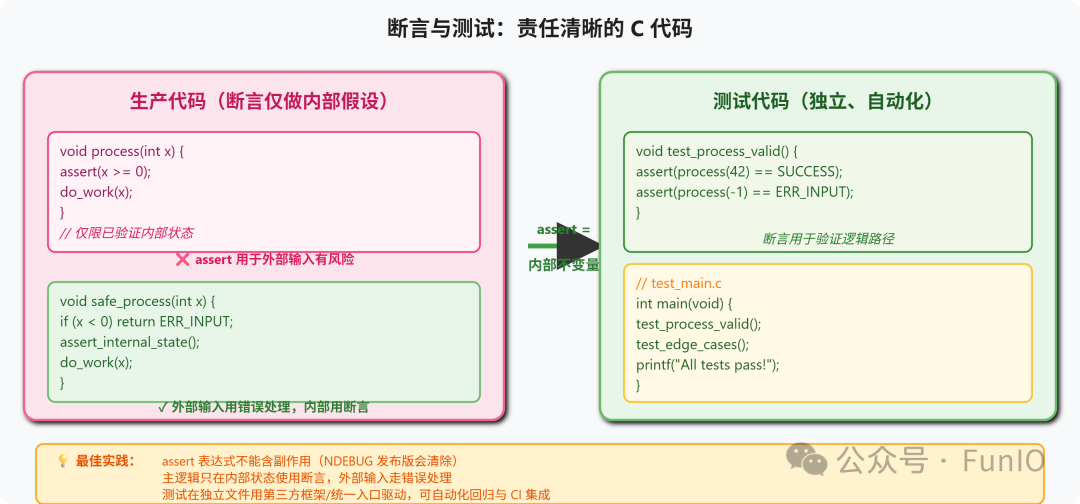
- • Using assert to check external inputs or uncontrollable conditions (such as user input, network data) is dangerous; error handling should be used in production environments instead of assertions.
2.2 Ignoring Testing and Assertions, Leading to Hidden Bugs
- • Without unit tests, relying on manual checks can easily overlook boundary conditions and exceptional branches.
2.3 Side Effects of Assertion Expressions
- • Expressions with side effects like assert(expr++) may skip the side effects in the release version (after defining NDEBUG), leading to inconsistent behavior.
2.4 Only Using printf Instead of Testing
- • Relying solely on print output to determine correctness makes it difficult to automate regression testing and result comparison.
2.5 Coupling Test Code with Production Code
- • Test code mixed with main functional code is hard to maintain and isolate.
3. Avoidance Methods and Best Design Practices
3.1 Use Assertions to Ensure Internal Logic Consistency
- • Only validate program state during development/debugging phases, protecting invariants and pre/post conditions.
3.2 Separate Error Handling from Assertions
- • External inputs, resource acquisition, IO, etc., should be handled with error codes/exception branches; assertions should only check the program’s own logic.
3.3 Assertion Expressions Should Have No Side Effects
- • Assert statements should be pure expressions with no side effects to avoid inconsistent behavior between release/debug versions.
3.4 Use Independent Test Code and Automated Testing Frameworks
- • Separate test functions from main code; it is recommended to use automated testing tools like CUnit, Check, etc.
- • Tests should cover all boundaries, exceptions, and typical paths.
3.5 Unified Test Entry and Result Summary
- • Unified entry for test code, automatically outputting a summary of test results, facilitating regression and CI integration.
3.6 Use Conditional Compilation to Distinguish Test/Production Code
- • Use macros like
<span>#ifdef TEST</span>to distinguish test code, ensuring no test logic in the production environment.
4. Comparison of Typical Error Code and Optimized Correct Code
Error Example 1: Assertion Used for External Input
void process(int x) {
    assert(x >= 0); // User input may be negative, causing exceptions in production environment
    ...
}
Optimized Example 1:
void process(int x) {
    if (x < 0) {
        fprintf(stderr, "Invalid input: x=%d\n", x);
        return; // or other fault-tolerant handling
    }
    ...
}- • Assertions should only be used to ensure internal logic; external inputs should use error handling.
Error Example 2: Assertion Expression with Side Effects
int i = 0;
assert(i++ < 10); // After defining NDEBUG, i will not increment, leading to inconsistent behavior
Optimized Example 2:
int i = 0;
assert(i < 10); // No side effects
i++;            // Explicit increment
Error Example 3: Test Code Mixed with Main Code
int add(int a, int b) {
    int result = a + b;
    printf("Test: %d + %d = %d\n", a, b, result); // Test code mixed
    return result;
}
Optimized Example 3:
// add.c
int add(int a, int b) {
    return a + b;
}

// test_add.c
#include <assert.h>
void test_add() {
    assert(add(2, 3) == 5);
    assert(add(-1, 1) == 0);
}- • Test code is completely separated from functional code.
5. Supplementary Explanation of Underlying Principles
- • Assertion Implementation Mechanism: Compiled as
<span>if (!(expr)) { ... abort(); }</span>, outputting the filename, line number, and expression content to assist in locating issues. - • NDEBUG Macro: After defining, the assert macro becomes a no-op, suitable for masking debug assertions in release versions.
- • Automated Testing Frameworks: Tools like CUnit, Check, etc., support organizing test cases, automatic result statistics, and failure localization, integrating into CI/CD systems.
6. Illustration: Separation of Assertions and Test Code
7. Summary and Practical Recommendations
- • Testing and assertions in C language are important tools for enhancing code reliability and maintainability.
- • Assertions should be used to protect internal logic, consistency, and pre/post conditions, and should not be used for external inputs or fault-tolerant logic.
- • Assertion expressions should have no side effects to avoid inconsistent behavior between release/debug versions.
- • Test code should be completely separated from functional code, using automated testing frameworks and unified test entry to ensure continuous integration and regression efficiency.
- • Always maintain high test code coverage, testing and asserting all boundaries, exceptions, and typical branches.
“C code without tests is like having no safety net.” Developing good testing and assertion habits can greatly enhance code quality, fault tolerance, and maintenance efficiency, making it an indispensable skill for professional C developers!