🌍 Introduction: When Carbon Capture Meets Water Extraction in the Air
Traditional Direct Air Capture (DAC) of carbon dioxide is criticized for its high-temperature regeneration (>130℃) and the high energy consumption of vacuum pumps. However, today, a groundbreaking study has been published in a Nature journal: requiring only 100℃ low temperature, no vacuum equipment, and simultaneously producing 97.7% pure CO₂ and drinking water — the “Vapor Promoted Desorption” (VPD) technology developed by an Australian team directly converts solar energy into desorption power, reducing energy consumption by 20%, opening a new path for distributed carbon capture.
Source: Wang et al., Nat. Commun. (2024).
⚙️ 1. Technological Revolution: How Does Water Vapor Solve the Regeneration Dilemma?
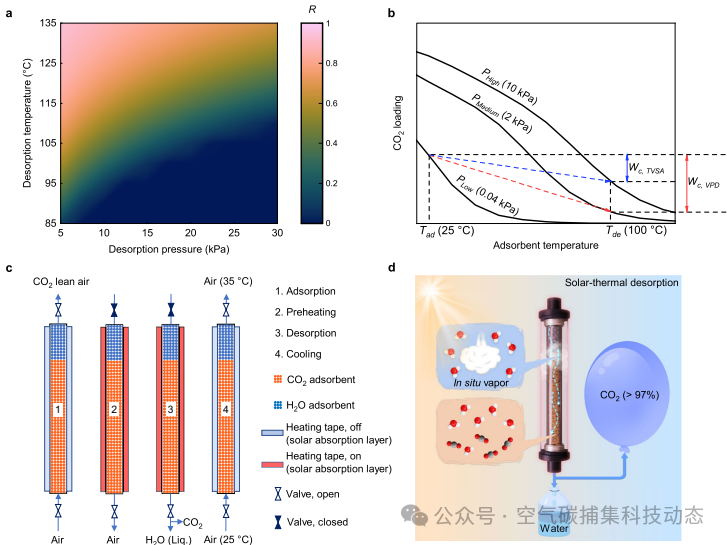
The traditional TVSA process requires vacuum pumps to reduce pressure to 5-30 kPa (accounting for 30% of energy consumption), while the VPD technology achieves “self-sufficiency” through two innovative steps:
- Water-Carbon Co-Capture
- In a dual-layer adsorption column, the upper layer amine resin captures CO₂ (1.11 mmol/g), while the lower layer silica gel captures water molecules (>10 wt% humidity adsorption capacity)
- The higher the humidity, the greater the CO₂ adsorption (62.5% increase at 85% humidity), breaking the traditional understanding of “humidity suppressing carbon capture” (Figure 2c)
- When heated to 100℃, the silica gel releases water vapor which reduces the CO₂ partial pressure to below 2 kPa (Figure 1b), replacing the function of vacuum pumps
- Water vapor forms a protective layer, preventing high-temperature oxidation of amine materials (zero capacity degradation after 9 cycles)
☀️ 2. Solar Energy Driven: Zero Carbon Regeneration Practical Data
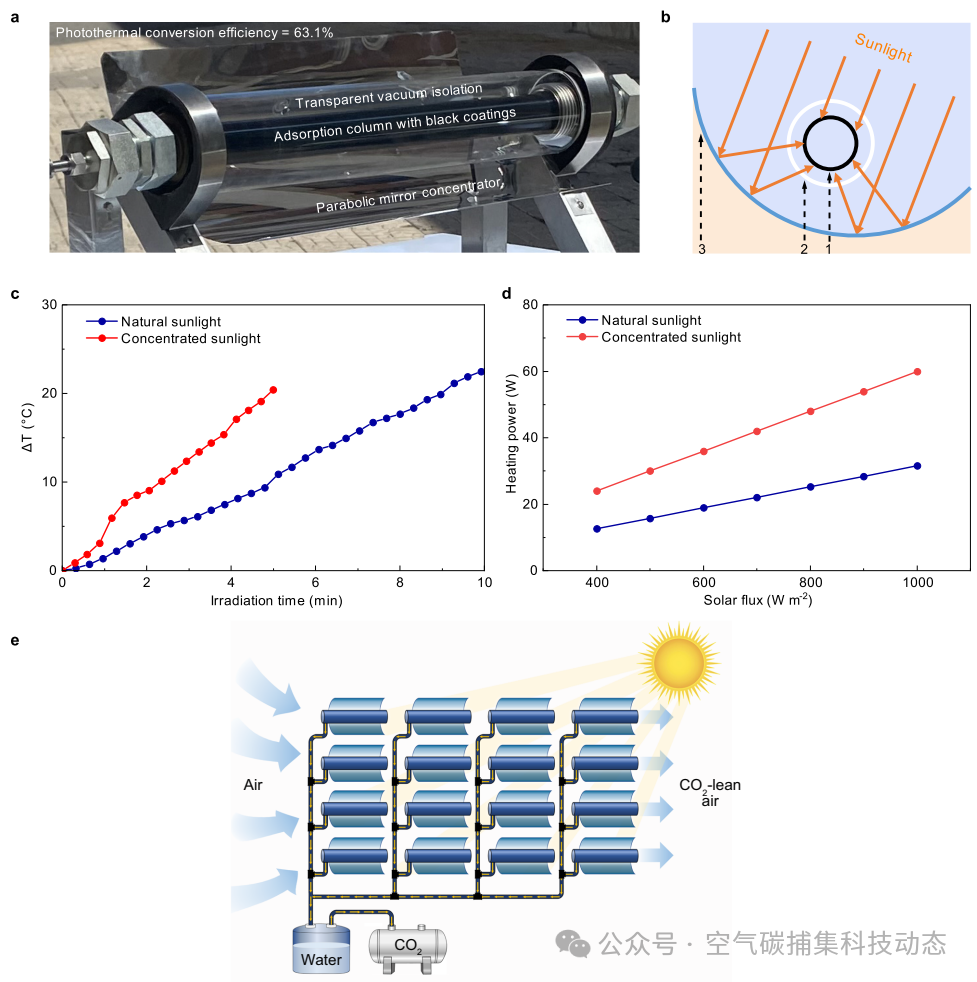
The team constructed a photovoltaic-thermal integrated DAC device (Figure 5a), with key performance overturning industry perceptions:
- Solar Thermal Conversion Efficiency 63.1% parabolic mirrors focus sunlight, heating the adsorption column to 110℃ within 60 seconds (Figure 5c)
- Low-Temperature Efficient Desorption at 100℃ with 98% CO₂ desorption rate, desorption rate reaching 0.06 mmol/g/min (Figure 3f)
- Co-Production of Pure Water produces 1.3 tons of drinking water for every ton of CO₂ captured, with pH=7.0-7.5 (Figure 4c)
📊 3. Cost Killer: Energy Consumption Reduction and Commercial Value
Compared to the traditional TVSA process (Table 1), the VPD technology achieves triple cost reduction:
| Indicator | VPD Process | Traditional TVSA | Reduction |
|---|---|---|---|
| Regeneration Temperature | 100℃ | 130-150℃ | 30%↓ |
| Thermal Energy Consumption | 10.4 MJ/tCO₂ | 12-15 MJ/tCO₂ | 20%↓ |
| Equipment Savings | Vacuum Pump + Steam Boiler | – | $400,000↓ |
| Total Cost | $111-313/tCO₂ | $600/tCO₂ | 50%↓ |
Data Source: Figure 6d and supplementary Table 3 Distributed deployment potential: In desert areas (humidity 20-25%), 90% desorption rate can still be maintained, suitable for remote distributed fuel synthesis (e.g., solar methanol production).
🌱 4. Industrial Path: From Laboratory to Carbon Farm
Technology transfer has initiated a three-step process:
- Patent Layout PCT patent submitted in 2023 (PCT/AU2023/050429)
- Module Optimization Silica gel/resin volume ratio reduced from 1:1 to 1:4, decreasing the amount of water-absorbing materials (Figure 4a)
- Scenario Expansion
- Collaboration with Australian mining companies to store captured CO₂ in mine shafts
- Middle East pilot of “Freshwater-Carbon Co-Production” device to address both water scarcity and carbon emissions issues
💎 Conclusion: Air Will Become the Largest Resource Factory
“This is not merely carbon capture, but constructing a new paradigm of air resource utilization.” — Corresponding author Gang Kevin Li points out the essence of the technology. When carbon capture, water extraction, and solar energy are closed-looped in distributed devices, humanity may be on the brink of the most imaginative technological breakthrough of the carbon neutrality era: transforming endless air into sustainable carbon and water sources.
[Private message or click the original text to obtain the PDF original]
#CarbonCaptureRevolution #DistributedDAC #SolarFuel #NegativeEmissions #NatureFrontiers Original: https://doi.org/10.1038/s41467-024-53961-4