With the gradual implementation of 5G, the maturity of technologies such as artificial intelligence, edge computing, and big data, and the gradual development of application scenarios on the demand side, the IoT industry chain has entered a golden period of development and is gradually reflecting scale effects. According to Statista, the global IoT market size reached $248 billion in 2020, and it is expected to exceed $1.5 trillion by 2025, with a compound annual growth rate of 44.59%.01.Overview of the IoT IndustryThe Internet of Things (IoT) refers to the “internet of everything connected.” Through information sensing devices such as RFID (Radio Frequency Identification) and sensors, items are connected to the internet according to agreed protocols for information exchange and communication, enabling intelligent identification, positioning, tracking, monitoring, and management of items.The development of the IoT can be divided into three phases: the budding phase, the initial development phase, and the rapid development phase.Budding Phase (1991-2004): In 1991, Professor Kevin Ashton of MIT proposed the concept of IoT. In 1995, Bill Gates envisioned interconnection of objects in his book “The Road Ahead,” but it did not attract widespread attention at the time. In 1999, MIT first defined IoT as a network that connects all items through information sensing devices like RFID and barcodes to achieve intelligent identification and management, leading to increased attention to IoT.In 2003, “Technology Review” in the U.S. listed sensor network technology as the top technology that will change people’s lives in the future. In 2004, the term “Internet of Things” began to appear in various book titles and spread through the media.Initial Development Phase (2005-2008): On November 17, 2005, the International Telecommunication Union (ITU) released the “ITU Internet Report 2005: The Internet of Things,” stating that the ubiquitous “Internet of Things” communication era is approaching, where all objects in the world can actively exchange through the internet. RFID, sensor technology, nanotechnology, and intelligent embedded technology will be more widely applied, marking the initial development stage of the IoT industry and deepening public understanding of the concept.The first iPhone was released in 2007, providing consumers with a new way to interact with connected devices. The first International IoT Conference was held in Zurich, Switzerland in 2008.Rapid Development Phase (2009-Present): In January 2009, the U.S. government recognized new energy and IoT as national strategies. In June 2009, the European Commission published the European IoT Action Plan, proposing to strengthen management of IoT and promote industry development. In August 2009, Premier Wen Jiabao proposed “Perceiving China” during an inspection in Wuxi, where the city established the “Perceiving China” research center, and the Chinese Academy of Sciences, operators, and several universities set up IoT research institutes, marking the beginning of China’s strategic deployment in the IoT industry. The deployment plans of the EU, China, and the U.S. in the IoT industry signify the entry of IoT into a rapid development phase.According to data and forecasts from the China Industrial Information Network, the number of global IoT devices reached 10.7 billion in 2019, and it is expected to reach 25.1 billion connections by 2025, maintaining a growth rate of over 12%. In terms of market size, Statista shows that the global IoT market size reached $248 billion in 2020, and it is expected to exceed $1.5 trillion by 2025, with a compound growth rate of 44.59%.With support from policies and technology, China’s IoT market is booming. According to data from the China Industrial Development Research Institute, in 2020, China’s IoT market size reached 1.66 trillion yuan, and it is expected to reach 2.12 trillion yuan by 2022.The IoT can be divided into four layers: the perception layer, transmission layer, platform layer, and application layer. The perception layer is the lowest layer of the IoT, primarily responsible for collecting data through tools such as chips, cellular modules/terminals, and sensing devices to gather information from the physical world. The transmission layer serves as the pipeline of the IoT, mainly responsible for transmitting data and further relaying the information collected and recognized by the perception layer to the platform layer.The transmission layer mainly uses wireless transmission methods, which can be categorized into long-distance and short-distance transmission. The platform layer is responsible for processing data and plays a bridging role in the IoT system, primarily aggregating, processing, and analyzing data from the perception layer, including PaaS platforms, AI platforms, and other capability platforms. The application layer is the top layer of the IoT, primarily solving specific industry problems based on data from the platform layer, including consumer-driven applications, industry-driven applications, and policy-driven applications. Currently, IoT has been practically applied in various fields such as home, public services, agriculture, logistics, services, industry, and healthcare, with each sub-scenario having huge development potential.The participants and products at each layer construct the IoT industry chain. The main participants in the perception layer are sensor manufacturers, chip manufacturers, and terminal and module producers, with products mainly including sensors, system-on-chip, sensor chips, and communication modules as the underlying components; the participants in the network layer are communication service providers, providing communication networks, which can be divided into cellular communication networks and non-cellular networks; the participants in the platform layer are various platform service providers, whose products and services can be divided into IoT cloud platforms and operating systems, completing the storage and analysis of data and information; the application layer includes smart hardware and application services, where smart hardware can be divided into 2C and 2B based on the target audience, and application services can be further segmented based on application scenarios.02.Perception Layer – The Hub of Physical SensingSensors are the starting point for connecting objects, serving as the basic hub that converts received physical perceptions into electrical signals. After decades of development, sensor technology has been able to collect and convert most physical state information in various scenarios into electrical signals that electronic information systems can process. Information such as temperature, humidity, pressure (weight), atmospheric pressure (tire pressure), light intensity, gas composition, fingerprint, facial recognition, speed, and displacement can all be collected and perceived through sensors. These sensing functions closely cooperate with downstream scenarios such as smart homes, logistics, vehicle safety monitoring, energy conservation, and security, forming rich application patterns. ▲ Global Sensor Market Type Distribution
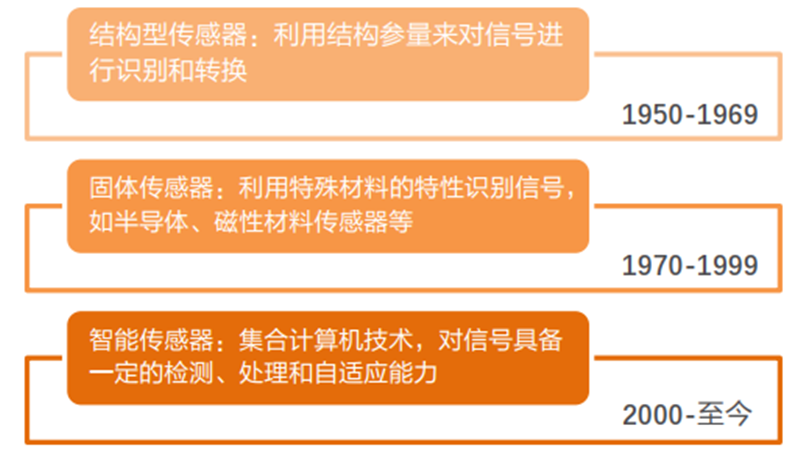 ▲ Sensor Development History
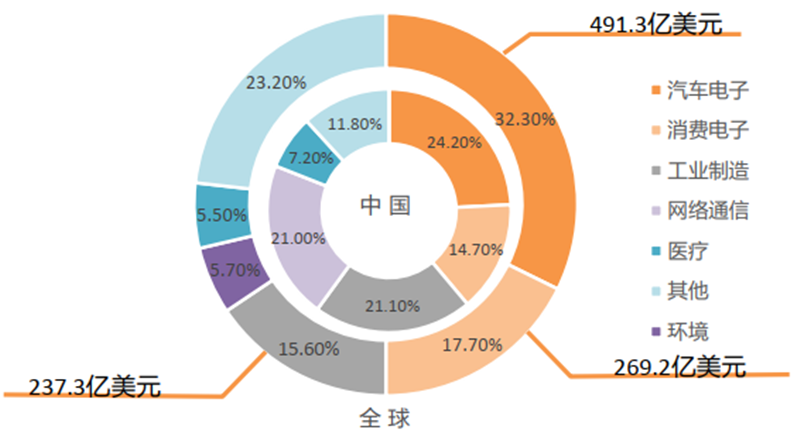 ▲ Distribution of Global and Chinese Sensor Applications in 2019The core of IoT terminal function control and realization is the MCU chip. The MCU, also known as a microcontroller, consists of a CPU, memory, various ports, etc., and is the core component of intelligent control, which can be simply understood as a microcomputer.The information collected by sensors, commands input through interfaces (buttons, APP remote control, etc.), and other inputs are analyzed and processed by the MCU, which then controls actuators (motors, variable frequency compressors, audio devices, etc.) to realize the final functions of the IoT.
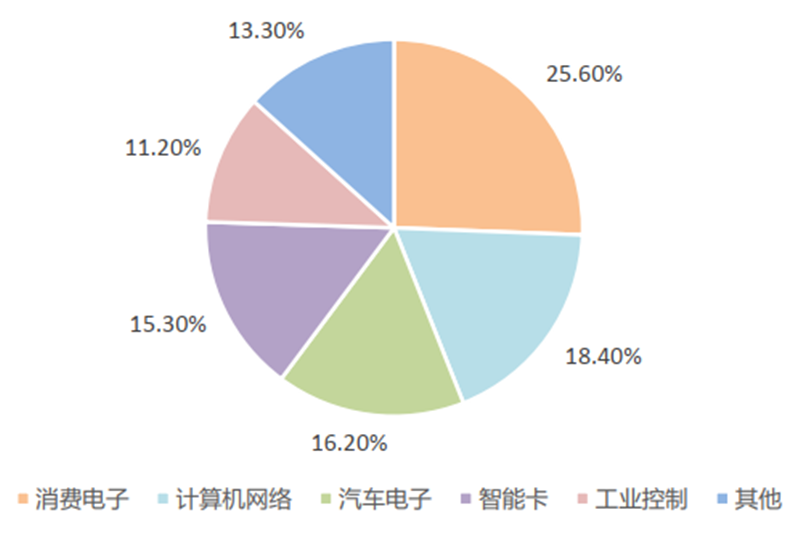 ▲ Distribution of MCU Application Areas in China in 2019The industrial chain of the perception layer can be divided into chip companies, cellular modules/terminals, and sensing devices.Players in the chip-related industrial chain include companies like Aojie Technology, Semtech, Guoxin Microelectronics, Huawei HiSilicon, MediaTek, Unisoc, Yichip Communication, Qualcomm, NXP, and others.Players in the cellular module-related industrial chain include companies such as Quectel, GCT, Meig Smart, Rihai Intelligent, and others.Players in the sensing device-related industrial chain include companies like Orbbec, Goertek, Hanwei Technology, Honeywell, and others.03.Transmission Layer – The Pipeline of Information TransmissionThe transmission layer of the IoT primarily relies on wireless transmission, which can be divided into local area networks (LAN) and wide area networks (LPWAN) based on transmission distance. Local area networks include familiar technologies such as Bluetooth and WiFi, characterized by relatively short communication distances, generally within 200 meters, suitable for indoor and low-mobility scenarios (smart homes, smart warehouses, etc.). Wide area networks include NB-IoT, Sigfox, etc., characterized by large communication ranges, capable of exceeding 15 km, suitable for large-scale and mobile scenarios (vehicle networking, logistics tracking, asset positioning, etc.).
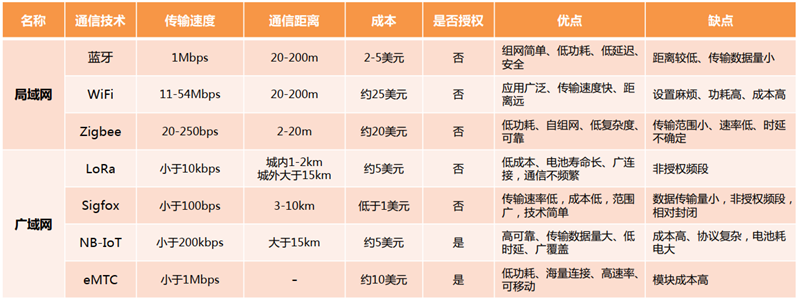 ▲ Different Communication Technologies Have Different Characteristics, Applied in Daily Work and LifeAccording to transmission speed, IoT services can be divided into high-speed, medium-speed, and low-speed services. High-speed services primarily use 3G, 4G, and WiFi technologies, applicable to scenarios such as video surveillance and in-vehicle navigation; medium-speed services mainly use Bluetooth and eMTC technologies, applicable to high-frequency usage scenarios such as smart homes and lockers; low-speed services, namely LPWAN (Low Power Wide Area Network), primarily use NB-IoT, LoRa, Sigfox, and ZigBee technologies, applicable to low-frequency usage scenarios such as smart parking and remote meter reading.Globally, about 60% of the IoT market belongs to low-speed services, which require capabilities to support massive connections, low terminal costs, low terminal power consumption, and strong coverage. Due to their own development and cost issues, companies are moving towards low-cost and low-power directions. In the low-speed domain, China mainly focuses on developing NB-IoT (Narrowband IoT).In practical industrial chain implementation, due to the complexity of standards, patents, and RF technologies in the wireless transmission field, professional manufacturers generally create IoT modules that encompass the overall functions related to wireless data transmission. Downstream manufacturers of household appliances can quickly achieve network connectivity after installing and debugging IoT modules.IoT modules are modular components that integrate chips, memory, and other electronic devices onto circuit boards, serving as the basic hub for enabling device connectivity. Depending on the network standards, wireless modules can be classified into 4G modules, 5G modules, NB-IoT modules, etc., and based on application scenarios, they can also be divided into smart modules and automotive-grade modules.
 ▲ Main Categories of IoT ModulesPlayers in the transmission layer industrial chain can be divided into hardware carriers and software platforms.Hardware carrier players include Huawei, ZTE, Ericsson, Arm, Dell Technologies, HP, Lenovo, Cisco, and Intel.Major software platform players include AWS Wavelength, Azure IoT Edge, Alibaba Cloud Link Edge, Baidu Cloud BIE Intelligent Edge, and others.04.Platform Layer – The Bridge for Application RealizationOnce the hardware has IoT capabilities, a platform is required to implement the entire network and application. Platforms can be roughly divided into four types based on functionality, and many general-purpose platforms have multiple functions.1) CMP/DMP Management Platform: Management of device connections. For example, when you buy a robot vacuum, you activate it at home and bind it with a mobile APP; these are realized through the management platform.2) AEP Application Enablement Platform: Many traditional companies (such as power strip manufacturers) want to upgrade to IoT remote-controlled power strips, but lack the necessary technical personnel. They can pay to use the AEP platform, which aggregates many IoT solutions, allowing the power strip factory to set product parameters (number of sockets), functional modules (mobile control switch, timing switch, etc.) on the platform to directly generate the required IoT functions.3) BAP Business Analysis Platform: IoT collects a large amount of user data, and there are dedicated platforms for analyzing user data, making device functions smarter through big data, and enabling customized marketing through analysis of user habits, among other extended functions.
 ▲ Four Major Platforms in the IoT Platform LayerMain players in the platform layer include Alibaba Cloud Link Platform, JD.com Xiao Jingyu, Tencent Cloud IoT Explorer, Xiaomi IoT Platform, IBM Watson IoT, ThingWorx, Inspur Cloud Industrial Internet Platform, and others.05.Application Layer – Diverse Applications Driving Major Development of the Industry ChainThe application layer provides actual application scenario services and is the layer closest to the application market. As the demand for intelligent development in society increases, the development space for IoT applications gradually expands. As the service entity closest to end users, most enterprises in the industry are closely monitoring market trends and actively exploring and responding to user application needs, leading to continuous expansion of IoT application fields, with competition being the most intense, exhibiting characteristics of “diversification” and “fragmentation”.The application layer can be divided into consumer-driven applications, policy-driven applications, and industry-driven applications. Consumer-driven applications include smart travel, wearable technology, smart healthcare, and smart homes; policy-driven applications include smart cities, public utilities, smart security, smart energy, smart fire protection, and smart parking; industry-driven applications include smart industry, smart logistics, smart retail, smart agriculture, vehicle networking, and smart real estate.Here we take smart homes as an example. Smart homes use residential platforms to integrate technologies such as network communication, automatic control, IoT, cloud computing, and artificial intelligence with home devices, creating a convenient, comfortable, healthy, safe, and environmentally friendly living environment. As the penetration of various technology application scenarios accelerates and the transformation and upgrading of China’s consumer structure occurs, the categories of smart home products continue to innovate and expand, mainly including smart security, smart connectivity control, smart appliances, smart home energy management, smart lighting, and smart home entertainment.The market for smart home IoT in China has exceeded 100 billion yuan and is growing rapidly, with a CAGR of 20% over the past four years. According to estimates by EEO Intelligence, the overall market size in 2020 was approximately 435.4 billion yuan, and it is expected to exceed 800 billion yuan by 2025.In 2019, the scale of various sub-markets in China showed that the appliance market, due to its large scale, early development of intelligence, and high penetration rate, was the largest in the smart home market, reaching 282.2 billion yuan; the smart connectivity control and smart home security markets ranked second and third, at 36.4 billion yuan and 18.6 billion yuan, respectively, while the smart home entertainment and smart lighting markets were 18 billion yuan and 9.9 billion yuan, respectively, with the smallest market size being the smart home energy management market at 7.8 billion yuan.
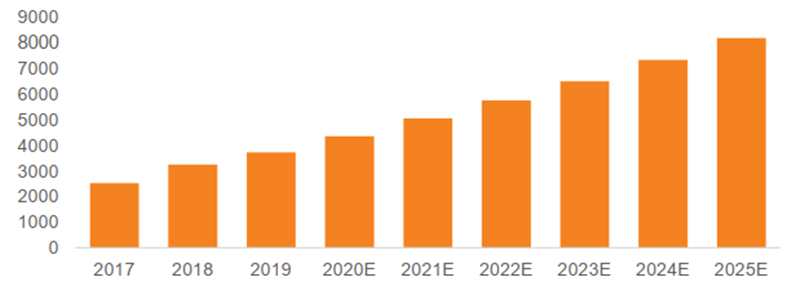 ▲ China’s Smart Home Market Size (Billion Yuan)
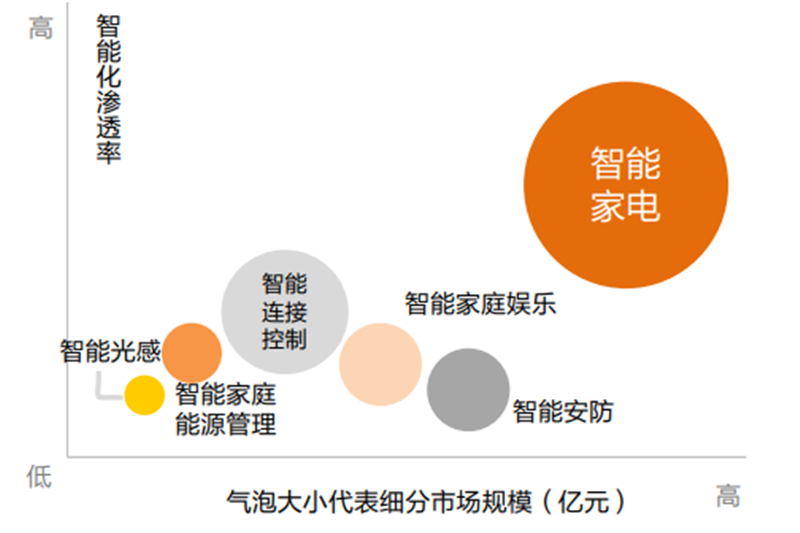 ▲ 2019 China’s Smart Home Sub-market SizeThe main players in the smart home industry chain are shown in the diagram below:
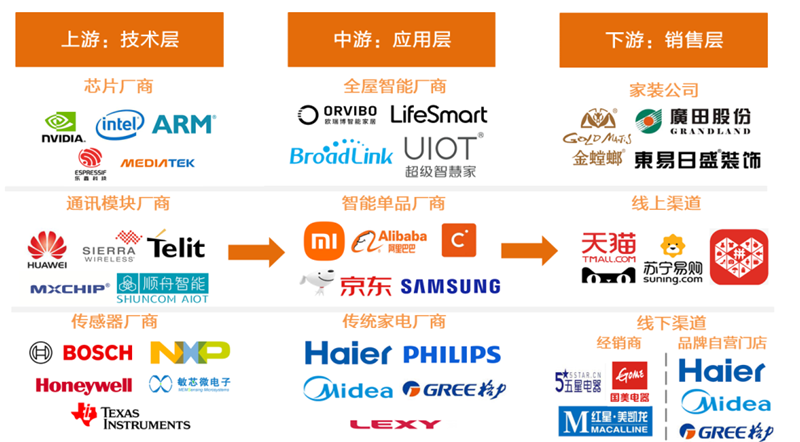 ▲ Smart Home Industry MapWhen discussing the application layer, it is impossible not to mention the recently released 2.0 version of Huawei Harmony, which aims to achieve the interconnection and intelligence of everything as a new generation operating system for the IoT era. Harmony will gradually cover all scenario terminal devices of 1+8+N: “1” represents smartphones, “8” represents PCs, tablets, smartwatches, smart screens, AI speakers, secondary devices, AR/VR glasses, and car systems, while “N” represents IoT ecological products, providing intelligent services for consumers in all aspects of life. Wang Chenglu, the person in charge of the Harmony operating system, stated in an interview that by 2021, conservatively, there would be 300 million devices equipped with Harmony, including 200 million Huawei smartphones and over 30 million Huawei self-owned Pads, smartwatches, smart screens, and speakers.The launch of Harmony marks a transition from the past twenty years of “Internet+” innovation represented by PCs and smartphones to the IoT era represented by cars, XR, and homes, signaling the start of a new ten-year innovation cycle. As one of the important infrastructures for the digital economy, IoT is a crucial means for the digital transformation of traditional industries and an internal combustion engine for achieving high-quality economic development. Driven by multiple factors including policies, technology, applications, and industry leaders, it is ushering in a golden period of development. The IoT industry chain is long, involving a complete technological chain from underlying components to overall solutions, with numerous opportunities to explore. From the report, it can be seen that there are already many players laying out in the perception layer, transmission layer, platform layer, and application layer of IoT, including several major players. However, in many niche fields, entrepreneurs still have many opportunities.