 For more in-depth information, reports, and knowledge about sensor technology, sensor testing technology, IoT sensor technology, etc., please follow the Sensor Expert WeChat public account and set it as a star to view past content.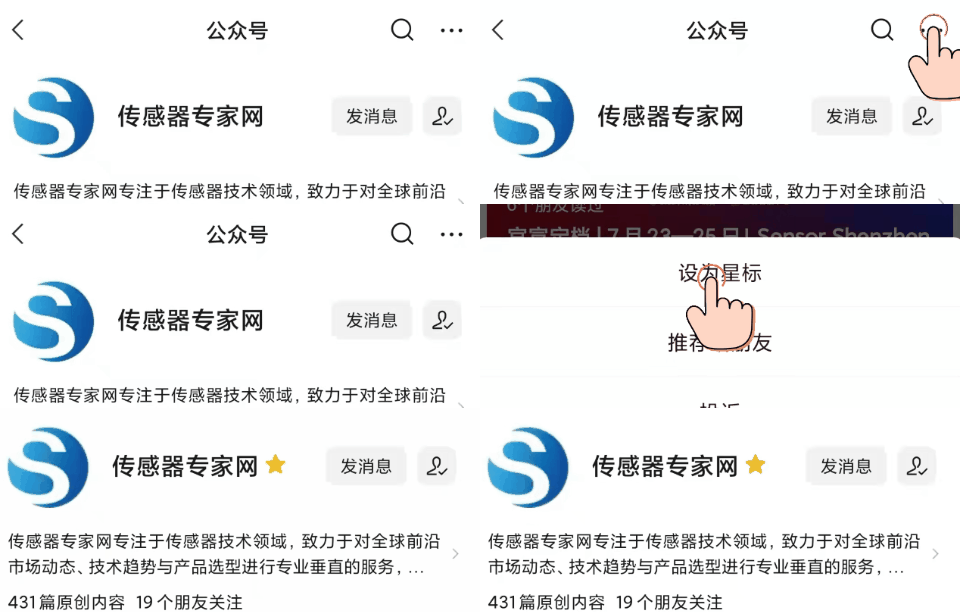
The displacement sensor is a key device in the field of industrial measurement, widely used in mechanical displacement monitoring, structural health assessment, robotic control, and other scenarios. Faced with a plethora of technical specifications and types, how to scientifically select a sensor has become an essential skill for engineers and technicians. This article will systematically analyze the classification, core parameters, and selection strategies of displacement sensors to help you accurately match application requirements.
1. Technical Map Analysis of Displacement Sensors
Displacement sensors measure displacement through the conversion of physical quantities, with core differences in measurement principles and applicable scenarios. The mainstream technical routes can be divided into two categories: contact and non-contact:
-
Contact Sensors
-
Potentiometric: Changes resistance by sliding a wiper on a resistive track, suitable for small displacement measurements (<100mm), but has mechanical wear issues.
-
Inductive (LVDT): Detects displacement through changes in mutual inductance of coils, offering high linearity and stability, suitable for harsh industrial environments.
-
Magnetostrictive: Measures displacement through the interaction of magnetic fields and mechanical waves, with an accuracy of up to 0.01mm, commonly used for hydraulic cylinder monitoring.
Non-contact Sensors
-
Photoelectric Encoders: Converts displacement into light signal pulses, with resolutions reaching the nanometer level, suitable for high-precision rotational measurements.
-
Laser Triangulation Sensors: Utilizes laser projection and CCD imaging technology, with measurement ranges reaching several meters, adaptable to complex surfaces.
-
Ultrasonic Sensors: Calculates displacement by measuring the time of flight of sound waves, suitable for liquid media or high-dust environments.
-
Capacitive Sensors: Detects changes in capacitance caused by variations in plate spacing, suitable for measuring small displacements (μm level).
Emerging Technologies
-
Fiber Optic Sensors: Resistant to electromagnetic interference, suitable for high-temperature and high-pressure environments.
-
MEMS Sensors: Integrated design reduces size, suitable for consumer electronics and IoT devices.
2. In-depth Analysis of Six Core Selection Parameters
-
The Art of Balancing Measurement Range and Resolution
-
Select the range based on the measured displacement, typically reserving a 20% margin. For example, if measuring 50mm displacement, choose a 75mm range sensor.
-
Resolution must meet minimum detection requirements: CNC machine tools require 0.1μm level, while building settlement monitoring can accept 0.1mm level.
The Dialectical Relationship Between Accuracy and Linearity
-
Accuracy includes absolute and relative errors, with industrial-grade sensors typically requiring <0.5% FS.
-
Linearity reflects the degree of deviation of the output-input curve, and non-linear errors need to be compensated through calibration.
Frequency Response and Dynamic Performance Matching
-
Static measurements (e.g., bridge deformation) focus on steady-state accuracy, while dynamic measurements (e.g., vibration monitoring) require bandwidth >5 times the highest frequency.
-
Phase delay indicators affect the design of real-time control systems.
Four-Dimensional Assessment of Environmental Adaptability
-
Temperature range: Ordinary sensors -20~85℃, high-temperature environments require ceramic packaging or fiber optic sensors.
-
Protection level: IP67 is suitable for outdoor use, IP69K can withstand high-pressure cleaning.
-
Interference resistance: Photoelectric sensors need to consider strong light interference, while capacitive sensors need to shield against electric field effects.
Output Methods and System Integration
-
Analog output (4-20mA/0-10V) is suitable for long-distance transmission, while digital output (RS485/CAN) facilitates networking.
-
Smart sensors provide IO-Link/Modbus interfaces, supporting parameter self-diagnosis.
Economic Balance of Cost and Lifespan
-
Consumer-grade sensors can be as low as hundreds of yuan, while industrial-grade can reach tens of thousands.
-
Lifespan indicators: Contact sensors have a mechanical lifespan of about 1 million cycles, while photoelectric sensors can reach 100 million cycles.
3. Typical Application Scenarios and Selection Strategies
-
Precision Manufacturing
-
Case: CNC machine tool workbench monitoring
-
Solution: Use a grating ruler (resolution 0.1μm) + laser interferometer combination to ensure nanometer-level positioning accuracy.
Infrastructure Monitoring
-
Case: Dam deformation monitoring
-
Solution: Use GPS displacement sensors (range ±1m) + wireless transmission module for remote real-time monitoring.
Robot Control
-
Case: Six-axis robotic arm joint feedback
-
Solution: Integrate magnetic encoders (accuracy 0.01°) + CANopen interface to meet high dynamic response requirements.
Automotive Testing
-
Case: Suspension travel detection
-
Solution: Use a cable-type displacement sensor (range ±300mm) + IP67 protection to adapt to complex road condition testing.
4. Guidelines for Avoiding Selection Traps
-
Risk of Over-Design: Blindly pursuing high accuracy may increase costs; reasonable accuracy should be determined through error allocation methods.
-
Omission of Environmental Parameters: Failure to consider chemical corrosion leading to sensor failure; select corrosion-resistant materials or coatings.
-
Installation Error Compensation: Inclined installation angles affect measurement results; choose sensors with angle compensation.
-
Electromagnetic Interference Countermeasures: Use fiber optic or magnetic shielded sensors near frequency converters.
-
Lifecycle Management: Plan calibration cycles in advance (usually 6-12 months) and establish sensor replacement plans.
5. Future Development Trends
With the advancement of Industry 4.0, displacement sensors are showing three major development directions:
-
Intelligence: Integrating edge computing functions to achieve predictive maintenance.
-
Wireless Technology: Bluetooth 5.0/LoRa technology reduces wiring costs.
-
Material Innovation: Graphene strain gauges enhance sensitivity, and ceramic packaging expands the working temperature range.
Conclusion
The selection of displacement sensors is a combination of technical rationality and artistic intuition. It is recommended to adopt the “three-step decision-making method”: first, clarify the boundary conditions of measurement requirements; second, establish a technical parameter matrix; and finally, validate through prototype testing. Remember, there is no perfect sensor, only the most suitable solution. In the era of IoT, displacement sensors are evolving from a single measurement tool to the sensory nerve of intelligent systems, and the selection process should incorporate system thinking to truly unlock the value of industrial data.
Engage in discussions in China’s largest sensor community: Sensor Exchange Circle.
What are your thoughts on this article? Feel free to leave a comment and share!
Share and click to view, passing on the dynamics of China’s sensor industry to more people!
Starred content = content you care about, according to the WeChat public account recommendation principle, if you do not set the Sensor Expert WeChat public account homepage as a star, you will not be able to receive the latest information in the sensor industry in a timely manner!
Disclaimer:Reproducing this article is for the purpose of conveying more information. If there are any errors in source attribution or infringement of your legal rights, please contact us, and we will correct or delete it promptly. Thank you.
If you have any submission or interview requests, please email:
.
Recommended Reading:
- China’s sensors rely on you! Summary of sensor research information from 30 top universities
- Finally understood, modern warfare is all about sensors
- China’s chip tycoon actually comes from sensors
- Woke up to find that Chinese companies can no longer design sensors?!