In the rapidly evolving field of information technology, operating systems serve as the cornerstone of the digital world, supporting the efficient operation of various devices and software. Among the vast landscape of operating systems, Linux shines with its unique charm. Its open-source nature attracts countless developers worldwide to contribute to its continuous refinement; its high stability makes it a pillar in the server domain, ensuring business continuity; and its excellent customizability allows it to excel in diverse scenarios such as embedded systems and supercomputers.
The key to Linux’s standout position among operating systems lies in its kernel—this core architecture of the operating system. The Linux kernel is akin to the load-bearing structure of a building, firmly controlling the allocation of hardware resources, from CPU computation resource distribution to memory space management, and the coordinated operation of various hardware devices, all under its precise regulation. It is also a master of process management, methodically scheduling numerous processes to ensure that each program runs reasonably without interference. At the same time, it creates a stable and secure operating environment for applications, allowing developers to focus on functionality implementation. Are you curious about the intricate components that make up the Linux kernel? How do they collaborate seamlessly to endow Linux with such powerful vitality? Next, let us delve into the mysterious world of the Linux kernel, comprehensively analyzing its foundational architecture and exploring the secrets of the operating system’s core.
Introduction: The Position of the Linux Kernel
The Linux kernel occupies a central position in the entire computer system, abstracting computer hardware into a virtual machine for user processes through virtualization. When processes run, they do not need to know how the hardware works; they only need to call the virtual interfaces provided by the Linux kernel. At the same time, the Linux kernel is responsible for multitasking, where multiple tasks use computer hardware resources in parallel. The kernel’s task is to arbitrate resource usage, creating the illusion for each process that it has exclusive access to the system. Process context switching requires changing the program status word, the contents of the page table base address register, the task_struct instance pointed to by current, and the PC, which also changes the files opened by the process and the execution space of the process’s memory.
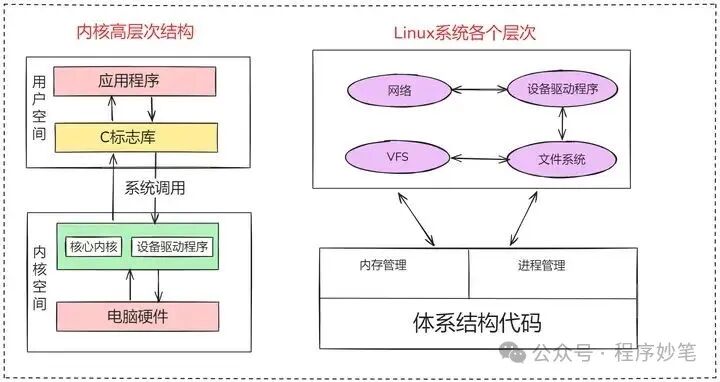
The overall architecture of the Linux kernel is centered around the process scheduler, with all other subsystems relying on it, as they need to block and resume processes. When a process needs to wait for a hardware action to complete, the corresponding subsystem will block that process; when the hardware action is complete, the subsystem will resume that process, and this blocking and resuming action relies on the process scheduler. The process scheduler depends on the memory manager, as when a process resumes execution, it needs the memory manager to allocate memory for it to run. The IPC subsystem relies on the memory manager, as the shared memory mechanism is a method of inter-process communication, allowing two processes to use the same shared memory space for information transfer. The VFS relies on the network interface to support the NFS network file system; the VFS also relies on the memory manager to support ramdisk devices. The memory manager depends on the VFS because to support swapping, it can swap out temporarily inactive processes to the swap partition on the disk, putting them into a suspended state.
The Linux kernel adopts a highly modular design, facilitating collaboration. Only a few programmers need to work across multiple modules, which occurs only when the current system needs to rely on another subsystem. The hardware device drivers, file system modules, network device drivers, and network protocol modules have the highest scalability.
The data structures in the Linux kernel include task lists, memory mappings, I-nodes, etc. Each process’s data structure, task_struct, contains a pointer mm pointing to its memory mapping information, a pointer files pointing to its opened files, and a pointer to the network sockets opened by that process. All data structures are rooted in the task list linked list maintained by the process scheduler.
The subsystem architecture of the Linux kernel includes the process scheduler, memory manager, IPC subsystem, VFS, etc. The process scheduler is the most important subsystem in the Linux kernel, controlling access to the CPU, which includes not only user processes’ access to the CPU but also other subsystems’ access to the CPU. The process scheduler consists of scheduling policy modules, architecture-specific modules, architecture-independent modules, and system call interface modules. The scheduling policy module determines which process gets access to the CPU, ensuring that all processes share the CPU as fairly as possible. The architecture-specific module designs a set of unified abstract interfaces to shield the hardware details of specific architecture interface chips, interacting with the CPU to block and resume processes.
The architecture-independent module interacts with the scheduling policy module to determine the next executing process, then calls architecture-specific code to resume that process’s execution while also calling the memory manager’s interface to ensure that the blocked process’s memory mapping information is correctly saved. The system call interface module allows user processes to access resources explicitly exposed to them by the Linux kernel, decoupling user applications from the Linux kernel through a set of defined, mostly invariant interfaces, ensuring that user processes are not affected by kernel changes.
1. Process Scheduling: The “Traffic Police” of CPU Resources
In the vast system of the Linux kernel, process scheduling plays a key role as the “traffic police,” responsible for managing the allocation of CPU resources to ensure that various processes can run in an orderly manner. In a computer system, multiple processes often exist simultaneously; for example, when using a computer, one might be browsing the web in a browser, playing music, and editing a document—all corresponding to different processes. However, the CPU can only handle one process at a time, necessitating process scheduling to coordinate.
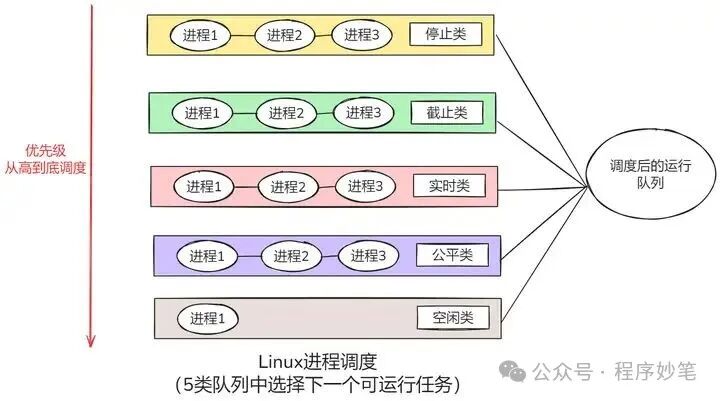
The core task of process scheduling is to select a process from the ready queue according to a certain scheduling algorithm and allocate CPU usage rights to it, allowing it to enter the running state. The Linux kernel employs a priority-based preemptive scheduling algorithm, where each process is assigned a priority, and higher-priority processes are given precedence in obtaining CPU resources. When a higher-priority process enters the ready queue, the currently running lower-priority process may be paused, and the CPU will execute the higher-priority process, ensuring that important tasks are handled promptly.
For example, in a simple server scenario, a server may simultaneously run web service processes, database service processes, and logging processes. The web service process needs to respond to client requests promptly, so it has a higher priority; the database service process is responsible for data storage and queries, with a lower priority; and the logging process only periodically records system operation logs, having the lowest priority. When a large number of client requests flood in, process scheduling will prioritize allocating CPU resources to the web service process, ensuring that users receive quick responses; during the web service process’s request handling, the database service process can obtain CPU time for data operations; while the logging process will only be scheduled for execution when system resources are relatively idle. Through this scheduling mechanism, the Linux kernel can efficiently manage CPU resources, ensuring the normal operation of various processes in the system and improving overall system performance and response speed.
2. Memory Management: The Bridge Between Virtual and Physical
Memory management is a key component of the Linux kernel, acting like a bridge that connects virtual memory and physical memory, providing stable and reliable memory resource support for processes in the system. Memory resources in a computer system are limited, while multiple processes running simultaneously need memory to store program code, data, and runtime states. The main task of memory management is to allocate and reclaim memory resources, ensuring that each process can use memory reasonably and efficiently, avoiding issues like memory leaks and overflows, and ensuring stable system operation.
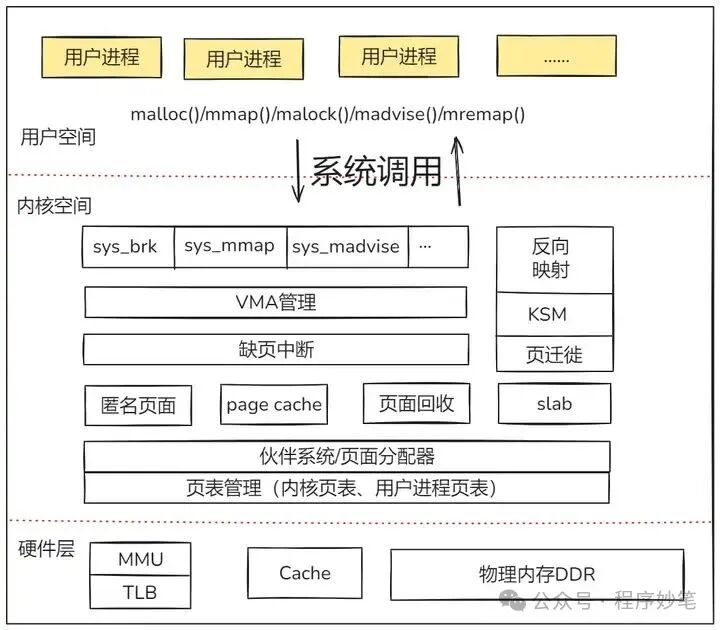
In memory management, virtual memory is an important technology. Virtual memory technology allows processes to use an address space larger than the actual physical memory, combining physical memory and disk space to provide processes with a continuous, virtual memory space. Each process has its own independent virtual address space, which isolates memory between processes, ensuring that one process’s memory operations do not affect others, enhancing system security and stability. Virtual memory achieves the mapping from virtual addresses to physical addresses through a page table mechanism. When a process accesses a virtual address, the kernel looks up the corresponding physical address based on the page table; if the page is in physical memory, it is accessed directly; if not, a page fault interrupt is triggered, and the kernel reads the page from the disk’s swap space into physical memory and updates the page table.
For example, when using a graphics processing software for high-definition image processing, the software may require a large amount of memory to store image data and intermediate results of processing algorithms. If relying solely on physical memory, it may not meet its needs, leading to slow operation or even failure to run. However, virtual memory technology can store temporarily unused data in the disk’s swap space and read it back when needed, allowing the software to run normally under limited physical memory conditions. Memory management is also responsible for memory allocation and reclamation. When a process needs memory, the memory management module allocates an appropriately sized memory block from the free memory pool based on certain algorithms; when a process no longer needs a memory block, the memory management module promptly reclaims that memory block and returns it to the free memory pool for other processes to use. Through efficient memory allocation and reclamation mechanisms, the Linux kernel can improve memory utilization, avoid waste of memory resources, and ensure that all processes in the system can obtain the necessary memory resources, thereby enhancing overall system performance.
3. Virtual File System: The Magic of Unified Device Interfaces
The Virtual File System (VFS) is a kind of magic within the Linux kernel, building a bridge for various types of physical file systems to communicate with operating systems and applications, allowing us to operate different file systems in a unified manner without worrying about the specific implementation details of the underlying file systems.
In the world of Linux, the supported file systems are rich and diverse, such as ext2, ext3, ext4, FAT32, NTFS, XFS, etc. These file systems differ in data storage methods, file organization forms, metadata management, etc. Without a unified abstraction layer, it would be a chaotic nightmare for applications to interact directly with various file systems. The emergence of VFS perfectly resolves this issue.
It provides a universal interface for all file systems, allowing applications to operate files through the interface provided by VFS, while VFS is responsible for mapping these operations to specific physical file systems. This is akin to using a computer without needing to understand the complex structure and workings of the internal hardware; one can easily complete various tasks through the simple interface provided by the operating system (such as a graphical interface or command line). VFS serves as this “simple interface” at the file system level in the Linux operating system, hiding the diversity and complexity of the underlying file systems, enabling applications to access different file systems in a consistent manner.
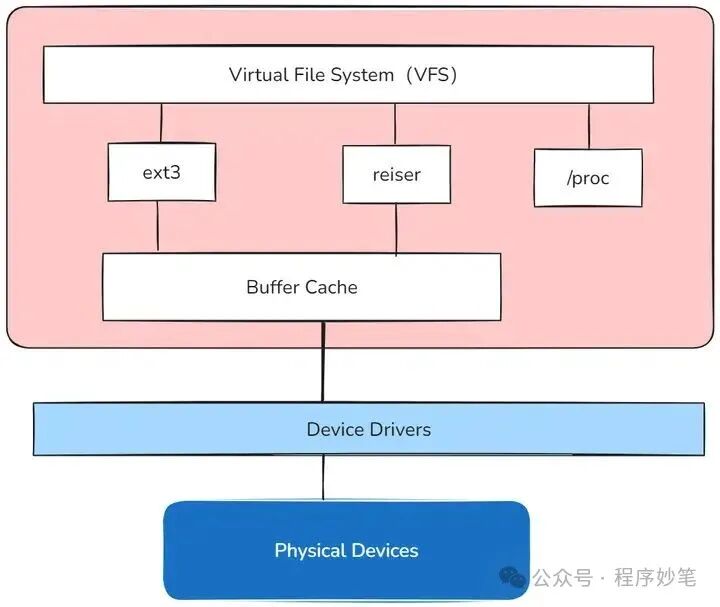
The implementation of VFS relies on several key data structures, including superblocks, inodes, and directory entries. The superblock is an extremely important data structure in VFS, describing the overall information of a file system. Each mounted file system has a corresponding VFS superblock, which is read into memory when the file system is mounted and remains in memory until the file system is unmounted. The superblock contains important information such as the type of file system, block size, number of free blocks, number of inodes, and mount points. Additionally, the superblock contains pointers to function pointers used to operate the inode and the superblock itself. For example, the superblock of the ext2 file system will contain pointers to the inode reading functions specific to ext2. Through these function pointers, VFS can call specific functions of the concrete file system to perform various operations.
Inodes are also an important component of VFS, with each file and directory in VFS represented by an inode. An inode stores metadata information about the file, such as permissions, owner, size, modification time, creation time, etc. At the same time, the inode also contains pointers to the data blocks of the file, allowing access to the data stored on the disk. Similar to the superblock, the inode also has a set of function pointers used for various operations on the inode, such as creating files, deleting files, reading file contents, etc. When an application operates on a file, VFS finds the corresponding operation function based on the inode of the file and calls these functions to complete the specific operation. It is important to note that the VFS inode is a different concept from the inode of the specific file system, but the information in the VFS inode is obtained and filled by calling the relevant routines of the specific file system from the underlying inode.
Directory entries (Dentry) are a data structure used by VFS to represent the directory structure, primarily used to establish the mapping relationship between file names and inodes. In the Linux directory tree, each directory consists of a series of directory entries, with each directory entry corresponding to a file or subdirectory. A directory entry contains the file name and a pointer to the corresponding inode. When we access a file in Linux via a path, VFS looks up the corresponding directory entries based on the directory names in the path to find the inode of the target file, allowing operations on the file. For example, when we want to access the file ” /home/user/Documents/file.txt,” VFS first finds the inode of the root directory ” /” and then looks up the directory entry for the ” home” directory in the root directory’s directory entries, and so on, until it finds the directory entry corresponding to the ” file.txt” file and uses that entry to find its corresponding inode.
Through these key data structures and a unified interface, VFS successfully hides the different implementation details of various hardware devices, allowing users and applications to operate different file systems in the same way, whether they are local hard drives, USB drives, or network file systems. It provides high flexibility and scalability for file management in Linux systems and is an indispensable part of the Linux kernel.
4. Network Interface: The Link Connecting the World
In today’s digital age, networks have become an indispensable part of people’s lives and work. In the Linux kernel, the network interface plays a crucial role as the important link connecting the system to the external network world. The network interface is responsible for managing data transmission between network devices and the network, serving as a key component for achieving network communication. It acts like a bridge, connecting various processes and applications within the computer on one end and the external network on the other, enabling data exchange and communication between the computer and other devices.
Functionally, the network interface is primarily responsible for sending and receiving data packets. When we enter a URL in a browser to access a webpage, the browser generates an HTTP request data packet, which is sent to the network via the network interface. After a series of routing and forwarding, it eventually reaches the target server. Upon receiving the data packet, the server processes the request and returns the corresponding HTTP response data packet, which is transmitted back to our computer through the network interface, where the browser receives and parses it, allowing us to see the webpage content. The network interface also manages the allocation and configuration of network addresses.
The network protocol is a set of rules, standards, or agreements established for data exchange in computer networks, defining the format, order, error handling, and other aspects of data transmission over the network. Common network protocols include TCP/IP and UDP protocols. The TCP/IP protocol is the most commonly used protocol stack on the Internet, comprising multiple layers of protocols, such as application layer protocols like HTTP, FTP, SMTP, transport layer protocols like TCP and UDP, network layer protocols like IP, and various protocols at the network interface layer. These protocols work together to ensure that data can be accurately and reliably transmitted between different computers and networks.
For example, when we use a browser to access a webpage, the browser communicates with the server using the HTTP protocol at the application layer. The HTTP protocol specifies the format of requests and responses, and the browser generates a request data packet according to this format, including the request method (such as GET, POST), URL, header information, etc. This request data packet is then passed to the transport layer, typically using the TCP protocol for transmission. The TCP protocol encapsulates the data packet, adding a TCP header that includes source port, destination port, sequence number, acknowledgment number, etc., to ensure reliable data transmission. Next, the data packet is passed to the network layer, using the IP protocol for addressing and routing, adding an IP header that includes source IP address, destination IP address, etc. Finally, the data packet is transmitted to the network interface layer and sent to the physical network through the network driver.
The network driver is the software module responsible for controlling network hardware devices, serving as the interface between the operating system and network hardware. Different types of network hardware devices, such as Ethernet cards and wireless cards, require corresponding network drivers to function. The main responsibilities of the network driver include initializing network devices, configuring device parameters, and sending and receiving data packets. When the operating system needs to send a data packet, it calls the send function of the network driver, passing the data packet to the network device for transmission; when the network device receives a data packet, it triggers an interrupt, and the receive function of the network driver is called to read the data packet from the network device and pass it to the operating system for processing.
The network interface has a wide range of applications in practice. In the server domain, the network interface is key to connecting servers to external networks, requiring high performance, reliability, and stability to ensure that servers can quickly and accurately handle a large number of network requests. For example, a server cluster for a large website may need to handle hundreds of millions of user requests daily, and the performance of the network interface directly affects the website’s response speed and user experience. In cloud computing environments, the network interface provides network connectivity for virtual machines and containers, enabling resource sharing and elastic scaling. Each virtual machine or container needs an independent network interface to communicate with other virtual machines, containers, and external networks. In IoT devices, the network interface allows various smart devices to connect to the network, enabling data transmission and remote control. For instance, smart home devices connect to the home network via the network interface, allowing users to remotely control these devices through a mobile app, achieving an intelligent living experience.
5. Inter-Process Communication: The “Language” of Multi-Process Collaboration
In a multi-process system environment, inter-process communication (IPC) serves as the “language” for communication and collaboration between processes, being the key mechanism for data exchange, information transfer, and collaborative work among multiple processes. In a computer system, multiple processes often run simultaneously, and these processes are not isolated; they often need to collaborate to complete complex tasks. For example, in a web server system, there are processes responsible for listening to network requests, processing requests, and logging. The listening process needs to pass the request information to the processing process for handling; after processing, the processing process may need to pass relevant log information to the logging process for recording. This requires inter-process communication to facilitate information exchange and collaboration between different processes.
Common inter-process communication mechanisms include pipes, message queues, shared memory, semaphores, and sockets. A pipe is a half-duplex communication method where data can only flow in one direction and can only be used between processes with a parent-child relationship. It is like a one-way water pipe, where water (data) can only flow from one end to the other. For example, in a Linux system, a pipe can be created using the pipe function, and after the parent process creates the pipe, it can create a child process using the fork function, allowing the child and parent processes to communicate through the pipe.
A message queue is a message-based communication mechanism where processes can send messages to a message queue, and other processes can read messages from the queue. Messages in the message queue have specific formats and types, allowing receiving processes to selectively receive messages based on message types. It is like a mailbox where different processes can place mail (messages) into the mailbox, and other processes can retrieve mail from the mailbox for processing. Shared memory, on the other hand, is a highly efficient communication method that allows multiple processes to share the same memory space, enabling direct read and write operations on shared memory for fast data exchange. This is akin to multiple processes sharing a blackboard, where they can freely read and write information, greatly improving communication efficiency.
However, since multiple processes may access shared memory simultaneously, data contention and inconsistency issues may arise, necessitating the use of synchronization mechanisms like semaphores to ensure data consistency. Semaphores are primarily used for synchronization and mutual exclusion between processes, controlling access to shared resources and preventing multiple processes from accessing shared resources simultaneously, which could lead to data errors. For example, when a process wants to access a shared resource, it must first acquire the semaphore; if the semaphore is available, it can access the resource; if not, it must wait until the semaphore is released.
Sockets are a more general inter-process communication mechanism that can be used not only for local inter-process communication but also for communication between processes on different hosts over a network, widely used in network programming. For instance, when we use a browser to access a webpage, it communicates with the web server via sockets to retrieve the webpage content.
Inter-process communication plays an important role in practical applications. In distributed systems, processes on different nodes need to collaborate through inter-process communication to achieve data sharing and task distribution. For example, in a distributed database system, database processes on different nodes need to communicate with each other to coordinate data storage, querying, and updating operations, ensuring the consistency and reliability of the entire database system. In multi-process applications, different module processes exchange data and information through inter-process communication to achieve integration and collaboration of functionalities. For example, a video editing software may include processes for video clipping, effects processing, and audio processing, and these processes need to communicate through inter-process communication to pass video, audio data, and processing instructions to collaboratively complete video editing tasks.
6. Dependencies Among Subsystems: A Cohesive Collaboration
The various subsystems of the Linux kernel do not exist in isolation; they have tight dependencies and collaborate closely to ensure the stable operation of the system. Like a symphony orchestra, each subsystem is a part of the orchestra, playing different melodies while coordinating to produce harmonious and beautiful music.
The process scheduling and memory management subsystems are closely linked and interdependent. In a multiprogramming environment, to run a program, a process must first be created, and the primary task of creating a process is to load the program and data into memory. This is akin to a performance where the process scheduler is responsible for arranging the order in which actors (processes) take the stage, while memory management provides the stage (memory space) for the actors. When a process is scheduled for execution, it requires memory space to store program code and data; memory management also relies on process scheduling because when memory is insufficient, memory management needs to use process scheduling to pause some processes and free their memory space for other processes that need memory more urgently.
The inter-process communication subsystem is also closely related to memory management. Inter-process communication relies on memory management to support shared memory communication mechanisms, which allow two processes to access a common memory area in addition to their private spaces. For example, in a database management system, multiple processes may need to access and modify data in the database simultaneously, which can be achieved through shared memory. Memory management is responsible for allocating and managing this shared memory area, ensuring that multiple processes can safely and efficiently access and operate on the data in shared memory. Inter-process communication, in turn, facilitates data exchange and collaboration between processes, allowing the database management system to function properly.
The virtual file system and network interface also have interdependent relationships. The virtual file system utilizes the network interface to support network file systems (NFS), allowing users to access files on remote servers as if they were accessing a local file system. At the same time, the virtual file system also utilizes memory management to support RAMDISK devices, simulating part of the memory as a disk to improve the read and write performance of the file system. For example, in a distributed storage system, clients access files stored on remote servers through the virtual file system, while the network interface is responsible for data transmission, and the virtual file system converts remote file access requests into calls to the network interface. In this process, memory management also plays an important role, providing the necessary memory resources for the virtual file system and network interface to ensure efficient data caching and processing.
Memory management and the virtual file system are also interdependent. Memory management utilizes the virtual file system to support swapping; when a memory mapping accessed by a process is swapped out, memory management requests the file system to write that memory page to the disk’s swap partition while suspending the currently running process. The swap process (swapd) is periodically scheduled by the scheduler, which is the only reason memory management depends on process scheduling. For example, when the system memory is insufficient, memory management may swap out some temporarily unused memory pages to the disk to free up memory space. These memory pages can then be read back from the disk’s swap partition through the virtual file system when needed, reloading them into memory. In this process, the process scheduler is responsible for controlling the timing of the swap process’s execution, ensuring system performance and stability.