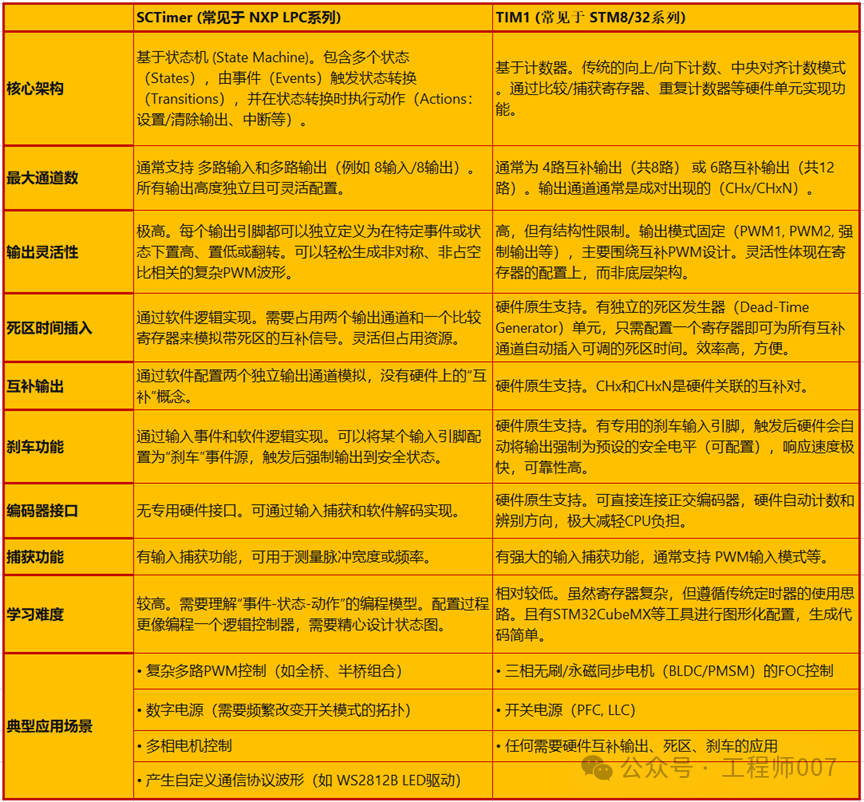
NXP Corporation’s SCTimer (State Configurable Timer) is highly powerful and can compete with TIM1 from the STM8 microcontroller. However, they differ in hardware design philosophy and application focus. The following is a comparison from multiple aspects.
First, it should be noted that both powerful timers are unique to their respective designs. Their main features are as follows:
SCTimer: The core is a highly flexible, programmable state machine+ timer. Its advantage lies in its state-driven operation, which can generate extremely complex and precise multi-channel timing waveforms, making it very suitable for multi-channel, complex sequence control, such as digital power supplies, multi-phase motor control, and LED lighting, etc.
TIM1: The core is a feature-rich advanced PWM timer. Its advantage is that it integrates a large number of dedicated hardware circuits for motor control and power conversion, such as complementary outputs, dead-time insertion, emergency braking, and encoder interfaces, making it ready to use and very suitable for traditional BLDC/PMSM motor drives and LLC resonant converters, etc.
◆ Choose SCTimer if:
1 When the application requires more than 4 independent PWM groups, and the timing relationships between them are very complex.
2 When there is a need to dynamically and frequently change the PWM phase, duty cycle, and mode, which is difficult to achieve with traditional timer modes.
3 If you want to use an MCU to implement part of the functionality of a “programmable logic device” (CPLD/FPGA), SCTimer is a better choice.
4 Key requirement: extreme flexibility.
◆ Choose TIM1 if:
1 When the application is a classic motor drive or switch-mode power supply.
2 When hardware complementary output, hardware dead-time insertion, and hardware braking functions are needed. These are standard features of TIM1, making it simple, reliable, and responsive to use.
3 If you want a simple development process, leveraging a mature ecosystem (such as STM32CubeMX and HAL library) to quickly set up projects.
4 Key requirement: powerful dedicated functions and high reliability.
A vivid analogy is as follows:
◆TIM1 is like a professional Swiss Army knife: it comes with various specialized tools (motor control tools) ready for developers to use, making it very handy and efficient, with a low learning curve.
◆SCTimer is like a box of advanced LEGO bricks: it provides a large number of basic components (events, states, actions), allowing developers to use their imagination to build any complex structure (complex timing) they desire, but it requires self-design and assembly, with a higher learning curve.
Both are extremely powerful timers, and there is no absolute superiority or inferiority; it only depends on which is more suitable for your specific application.