Welcome to follow the public account belowAbao1990, this public account focuses on autonomous driving and intelligent cockpits, providing you with a piece of automotive knowledge every day. We start with cars, but we are not limited to cars.

The commonly used hollow cup motors, frameless torque motors, and servo motors in humanoid robots are key to achieving high-precision movements. These motors are typically controlled by microcontroller unit (MCU) chips. Research shows that a humanoid robot usually requires 30-40 MCU chips to precisely control its joints, sensors, and actuators.
These MCUs are distributed throughout the robot, with each motor or a group of motors possibly having a dedicated MCU for local control, while a central processor is responsible for coordinating overall behavior. The selection of MCU chips is based on their real-time control capabilities, the number of I/O interfaces, and clock speed, making them particularly suitable for handling the high-speed data processing and low-latency response required for motor control.
We observed that at the 2025 Munich Shanghai Electronics Show, domestic and foreign manufacturers have released and laid out some new products targeting MCUs for humanoid robots. Today, we will sort and compare the MCU products from domestic and foreign manufacturers for more design reference in the industry.

1. Overseas MCU Manufacturers and Products
1.1. Comparison Analysis of Overseas Manufacturers
1.1.1. Motor Types and MCU Requirements
Hollow Cup Motors
Hollow cup motors are suitable for controlling the hands and small joints of humanoid robots due to their lightweight and high torque density. The MCU needs to respond quickly and efficiently control PWM.
Frameless Torque Motors
Used for the torso and major joints, providing high torque density and precise torque control, these motors require MCUs that support high current and complex control algorithms.
Servo Motors
Servo motors achieve high precision through closed-loop control and are widely used in robotic arms and legs. The MCU needs to support encoder interfaces and real-time feedback.
1.2. Overseas Manufacturers and Main Products
1.2.1. Texas Instruments (TI)
At the exhibition, Texas Instruments showcased the TMS32 C2000 series MCU, featuring a floating-point DSP core for real-time processing and an NPU AI accelerator, capable of real-time control and embedded AI analysis. Additionally, this series of MCUs includes built-in PWM generators, ADCs, and communication interfaces (such as CAN, SPI), suitable for high-precision motor control applications, such as servo motors and frameless torque motors.
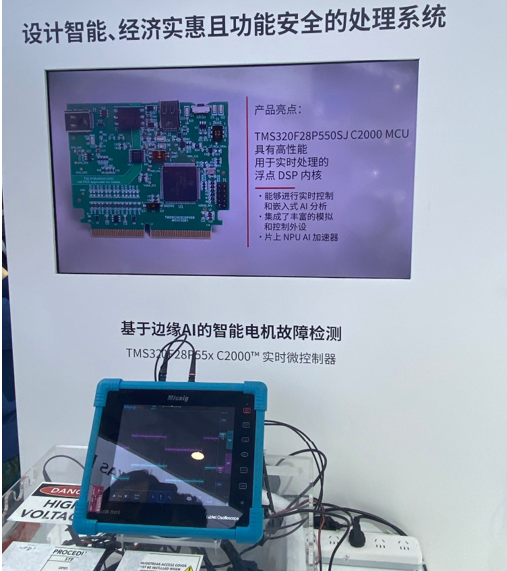
Source: Organized by the Institute of Unconventional Research
According to Texas Instruments (TI) official website, combined with the core requirements of humanoid robots for high-precision motion control, multi-sensor fusion, real-time performance, and reliability, the TMS320F28P659SH-Q1 offers superior overall performance and adaptability.
Representative Model: TMS320F28P659SH-Q1
This chip has a processing capability of 400 MIPS, based on the C28x+CLA core, supporting high-speed digital signal processing, meeting the real-time computing needs of complex motion control algorithms for humanoid robots (such as inverse kinematics calculation and trajectory planning). It also features a 16-bit ADC and high-resolution PWM, supporting high-precision sensor data acquisition (such as joint torque sensors and IMUs), combined with 150 ps precision HRPWM (high-resolution pulse width modulation), enabling precise motor drive (such as vector control of servo motors).
Multi-channel and Communication Capabilities
It has 40 ADC channels, supporting multi-sensor synchronous sampling (such as multi-joint current/voltage monitoring and environmental perception sensors), avoiding time delay errors caused by time-division sampling. It is also equipped with EtherCAT and CAN-FD interfaces, supporting industrial-grade real-time communication protocols, facilitating the construction of distributed control architectures (such as high-speed data exchange between the main controller and joint controllers), enhancing system coordination efficiency.
Compact Packaging and Cost Optimization
9mm×9mm small package: suitable for the compact joint space layout of humanoid robots, enhancing mechanical design flexibility.
Typical Application Scenarios
Main controller or joint controller: handling multi-joint coordinated motion control, sensor fusion (such as fusion of inertial measurement unit and force sensor data), supporting high-precision gait planning and dynamic balance algorithms.
1.2.2. STMicroelectronics
STMicroelectronics’ STM32 series, particularly the STM32G4 and STM32H7, offers a balance of performance and cost, featuring advanced motor control capabilities, widely used in servo motors and industrial robots.
Representative Model: STM32H750
This chip uses a Cortex-M7 core, with a main frequency of 480 MHz, supporting double-precision floating-point operations and DSP instruction sets, capable of running complex motion control algorithms (such as model predictive control MPC), with a control cycle as low as 1μs. It integrates an Art Accelerator and AI-assisted accelerator, supporting lightweight machine learning models (such as joint torque prediction), with AI inference computing power reaching 1 TOPS and energy efficiency of 8 TOPS/W.
Application Scenarios:Humanoid robot balance control, logistics AGV navigation.
1.2.3. Other Major Manufacturers and Products
Microchip’s dsPIC series MCUs are known for their digital signal processing capabilities, suitable for motors requiring high-precision control, such as hollow cup motors and servo motors.
Renesas’ RH850 series and RX series MCUs are suitable for industrial and robotic applications, featuring integrated motor control peripherals, suitable for high-load scenarios.
Infineon’s XMC series MCUs provide advanced motor control functions, commonly found in automotive and robotics fields, especially in applications requiring high current and fast response.
These manufacturers’ MCU chips are typically 32-bit architecture, with high clock speeds and rich I/O interfaces, meeting the real-time and complex task processing needs of humanoid robots.

Technology | Workplace | Industry | Events
In the electronics industry Authoritative Community
Over a thousand experts Collaborative Community
Welcome to join Unconventional Community
Scan to reply【Humanoid Robot】 to receive an exclusive report!
2. Domestic Major MCU Manufacturers and Products
In addition to some commonly used MCU product solutions from overseas manufacturers, domestic manufacturers such as Guomin Technology, GigaDevice, Biyiwai, and Jihai Semiconductor also showcased leading humanoid robot MCU products at this year’s Shanghai Electronics Show. We will conduct a detailed analysis.
2.1. Guomin Technology
At this exhibition, Guomin Technology released and showcased chips mainly aimed at humanoid robots: N32H76xEC and N32H78xEC, as well as the dexterous hand N32H473. According to Guomin Technology’s official website, the company has a total of 6 high-performance MCU series (N32H78EC, N32H78x, N32H76EC, N32H76x, N32H48x, N32H47x).
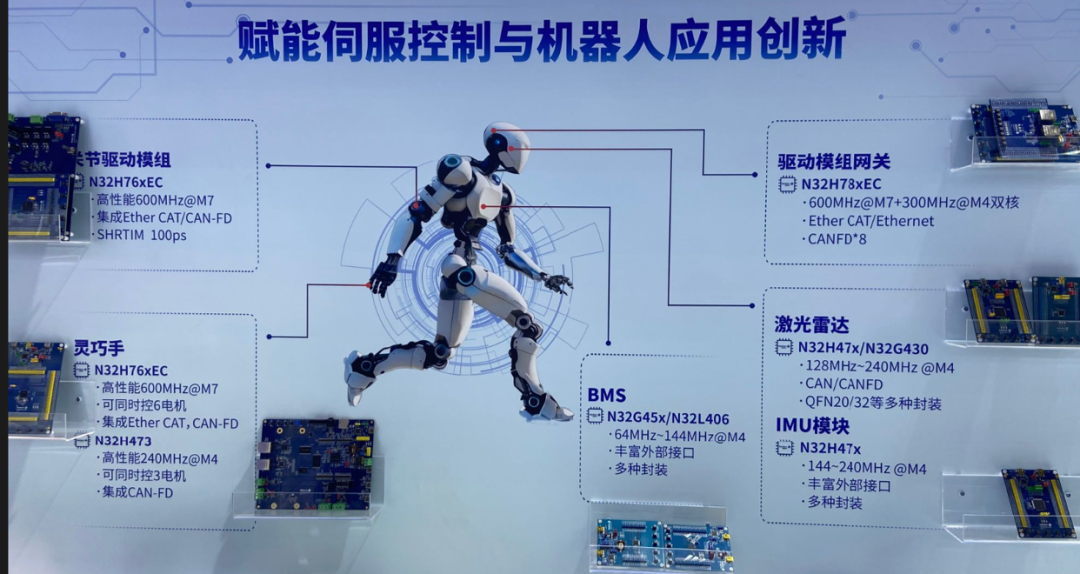
Source: Organized by the Institute of Unconventional Research
Main Representative Models:N32H78EC, using Cortex-M7 (600MHz main frequency) + Cortex-M4 (200MHz main frequency) dual-core heterogeneous, is the first mass-produced M7+M4 chip in China.
Core Advantages:This chip can achieve parallel processing of multiple tasks, with the M7 core processing AI algorithms (such as SLAM, path planning), and the M4 core focusing on real-time control (such as motor drive). It has a built-in EtherCAT slave controller, supporting multi-axis coordinated servo control (such as 22 degrees of freedom dexterous hand design). It is compatible with ARM development toolchains (Keil/IAR), reducing migration costs. Typical application scenarios: humanoid robot joint control, industrial robotic arm servo systems.
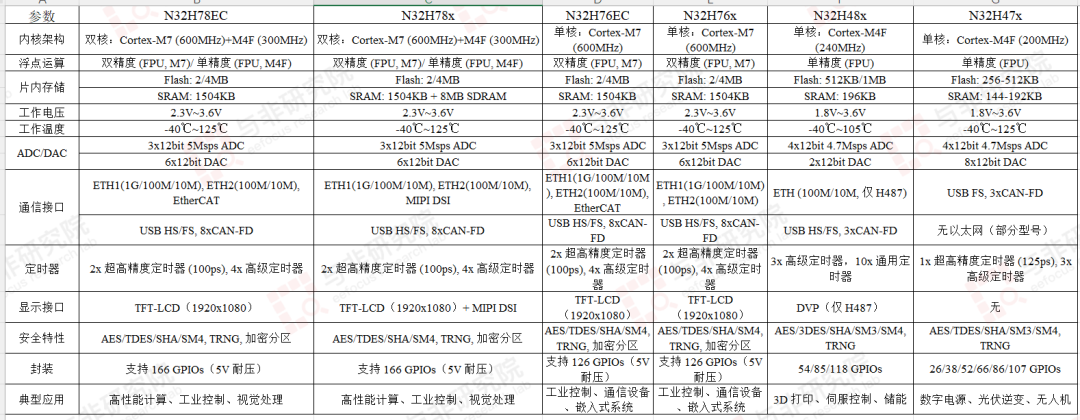
Source: Organized by the Institute of Unconventional Research
Main Product Differences
The high-performance dual-core option is N32H78x (with MIPI DSI)/N32H78EC (with EtherCAT). The single-core high-performance option is N32H76x (general)/N32H76EC (industrial communication). The cost-effective option is N32H48x (with Ethernet, suitable for IoT). The analog control option is N32H47x (multiple DAC/PGA, suitable for power/motor control).
2.2. GigaDevice
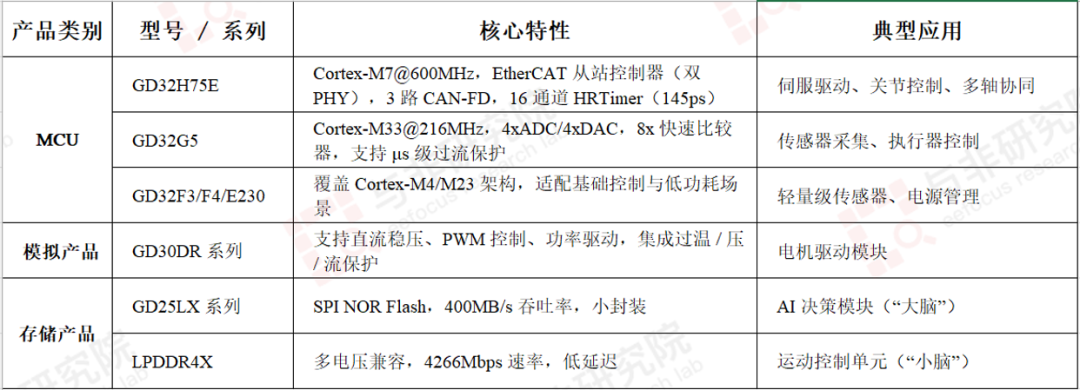
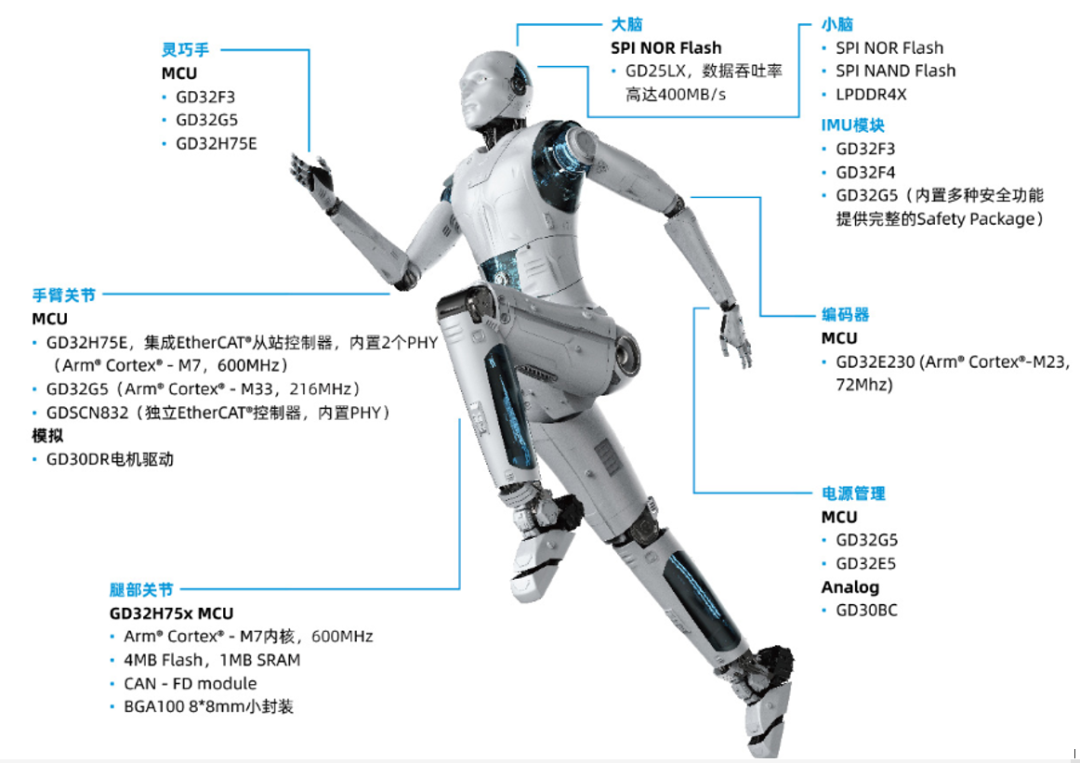
At this exhibition, we saw GigaDevice’s GD32 MCU product matrix built on Arm® Cortex® and RISC-V multi-core architecture, creating a complete solution from basic control to high-performance computing. This series of products provides full-stack support for humanoid robot systems with excellent energy efficiency and hard real-time response characteristics. It can achieve high-precision multi-joint motor drive, ensuring real-time processing of IMU/force/vision sensor fusion, and meeting the multi-modal sensing needs of robots through rich peripheral interfaces.
Source: GigaDevice official website
Main Products: GD32H75E Series
This chip series is designed as a high-performance solution for servo drive, robot joint control, and motion control. Core architecture: ARM® Cortex®-M7 core @600MHz. Network features: integrated EtherCAT controller and dual PHY, saving 30% PCB area. Computing acceleration: equipped with TMU/hardware DSP/FPU units, improving algorithm efficiency by 40%. Analog resources: high-precision ADC/DAC/Comparator combination. Interface configuration: 3 CAN-FD + 8 high-speed serial ports, supporting multi-axis coordinated control.
GD32G5 SeriesThis chip series is mainly an optimized solution for robot sensing and execution systems, with signal acquisition primarily from 4×12-bit ADC (5.3MSPS) + 4×12-bit DAC (15MSPS). Safety protection: 8x fast comparators achieve μs-level overcurrent protection. Motion control: 16-channel HRTimer (145ps) provides ultra-high precision PWM. Core performance: ARM® Cortex®-M33 core ensures real-time response.
Source: GigaDevice official website
Other Related Products
GigaDevice GD32 MCU can be paired with GD30DR series motor drive products, supporting DC conversion voltage regulation, LDO linear voltage regulators, PWM control, and power drive modules, providing multiple protections such as over-temperature, over-voltage, and over-current, specifically designed for robot joint motors, servo drives, etc., to build a complete motor control system.
GigaDevice GD25LX series SPI NOR Flash provides high-speed storage support for the “brain” of robots undertaking AI decision-making, while LPDDR4X products compatible with multiple voltages and 4266Mbps rates meet the low-latency needs of the “small brain” motion control unit, achieving precise command execution for robots.
2.3. Biyiwai
At the 2025 Munich Show, Biyiwai’s exhibits focused on the “MCU + motor drive + power management” integrated solution, characterized by high integration, high performance, and high reliability, applicable in various humanoid robot fields.
Core Product: KP88676X Chip
KP88676X is the world’s first fully integrated high-voltage BLDC motor dedicated chip, demonstrating its application in humanoid robot joint drives, showcasing the ability to achieve motor control and high-voltage drive with a single chip.
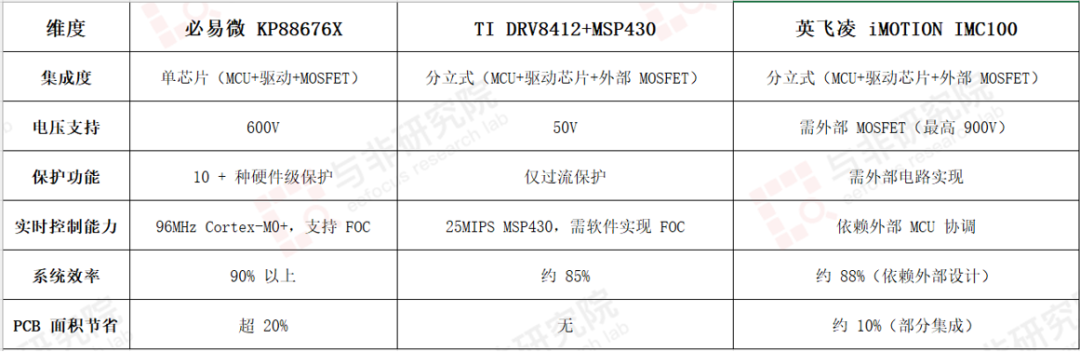
KP88676X integrates a high-performance ARM Cortex-M0+ MCU (96MHz main frequency), a high-voltage three-phase gate driver module (supporting 600V withstand voltage), and 6 600V MOSFETs into a single chip, forming a complete IPM (Intelligent Power Module).
In comparison, international manufacturers (such as TI’s DRV series, ST’s STM32F3 series) typically require a combination of MCU + independent driver chip + external MOSFET, resulting in a large number of peripheral components and PCB area. KP88676X reduces about 30% of peripheral components through integrated design, with PCB area reduced by over 20%, significantly lowering system costs and complexity, especially suitable for the lightweight needs of humanoid robots.
Source: Organized by the Institute of Unconventional Research
The Cortex-M0+ core has a main frequency of 96MHz, supporting complex algorithms such as FOC (Field Oriented Control) and PID regulation, with data processing efficiency nearly 4 times higher than TI’s MSP430 series (maximum 25 MIPS), meeting the dynamic response needs of humanoid robot joints.
Biyiwai’s KP88676X chip, with its fully integrated IPM architecture, 600V high-voltage adaptability, industrial-grade protection features, and high real-time control capabilities, forms a differentiated competitive advantage in humanoid robot joint drives and industrial motor control. Its core advantage lies in the single-chip design concept replacing multiple components, reducing system complexity and cost while enhancing reliability and energy efficiency, providing high-performance and cost-effective localized solutions for domestic humanoid robot manufacturers.
2.4. Jihai Semiconductor
Jihai Semiconductor’s booth showcased the theme “The time for domestic power is now, choose Jihai Industrial Core” and comprehensively displayed core technologies for humanoid robots.
Core Exhibits and Solution Demonstrations
G32R501 Real-time Control MCU is the world’s first dual-core real-time control chip, demonstrating its application in six-axis robotic arms, validating 0.1mm positioning accuracy and 5ms dynamic response through multi-axis synchronous control and real-time feedback, adapting to the complex motion coordination needs of humanoid robots.
Architecture and Computing Power
Based on the Arm Cortex-M52 dual-core architecture (250MHz main frequency), supporting homogeneous dual-core parallel processing, with real-time computing power equivalent to an 800MHz Cortex-M7, capable of simultaneously running multi-joint motion control algorithms (such as trajectory planning, force control PID) and real-time operating systems (RTOS), meeting the high dynamic response needs of humanoid robots.
It integrates Arm Helium™ technology and self-developed Zidian mathematical instruction extension units, supporting hardware acceleration for complex calculations such as trigonometric functions and Fourier transforms, with AI inference computing power increased by 3 times, capable of deploying lightweight machine learning models (such as joint torque prediction).
APM32M3514 Motor Control SoC combines a 600V dual N-channel gate driver GHD1620T, demonstrating a single-chip drive solution for robot joint modules, showcasing stability under extreme conditions such as high-speed start-stop and torque fluctuations.
It features a built-in Cortex-M0 + core (72MHz) and M0CP coprocessor, integrating a 200V 6N gate driver, 3.3V LDO, and 4 operational amplifiers, achieving MCU + drive + signal conditioning in a single chip, reducing peripheral components by 30% and PCB area by 20%, particularly suitable for the miniaturization needs of humanoid robot joint drives.
It supports both sensored and sensorless FOC vector control, six-step commutation algorithms, and can drive brushless DC motors (BLDC) and permanent magnet synchronous motors (PMSM), suitable for dexterous hands, wrist joints, and other small to medium-sized joint motors (3A drive current).
Jihai Semiconductor precisely matches the core needs of humanoid robots in multi-joint coordinated control, high dynamic response, and lightweight design through high-performance real-time control MCUs (G32R501), highly integrated motor control SoCs (APM32M3514), and full-stack solutions.
3. Conclusion
International manufacturers TI’s C2000 series and ST’s STM32 series continue to dominate the high-end market, relying on industrial-grade reliability and global ecosystems, and remain the mainstream solutions for most humanoid robots’ MCUs. Domestic manufacturers have approached international levels in core indicators such as computing power (e.g., Guomin Technology’s dual-core), integration (Biyiwai and Jihai Semiconductor), and communication protocols (GigaDevice EtherCAT), with some parameters (such as control cycle, AI acceleration) achieving a lead.
As humanoid robots enter large-scale production in 2025, the penetration rate of domestic MCUs in the humanoid robot field is expected to increase from 30% in 2025 to 50% in 2030, especially forming large-scale replacements in scenarios such as motor control and multi-axis coordination.
END
A group of like-minded friends gather in the Knowledge Sphere
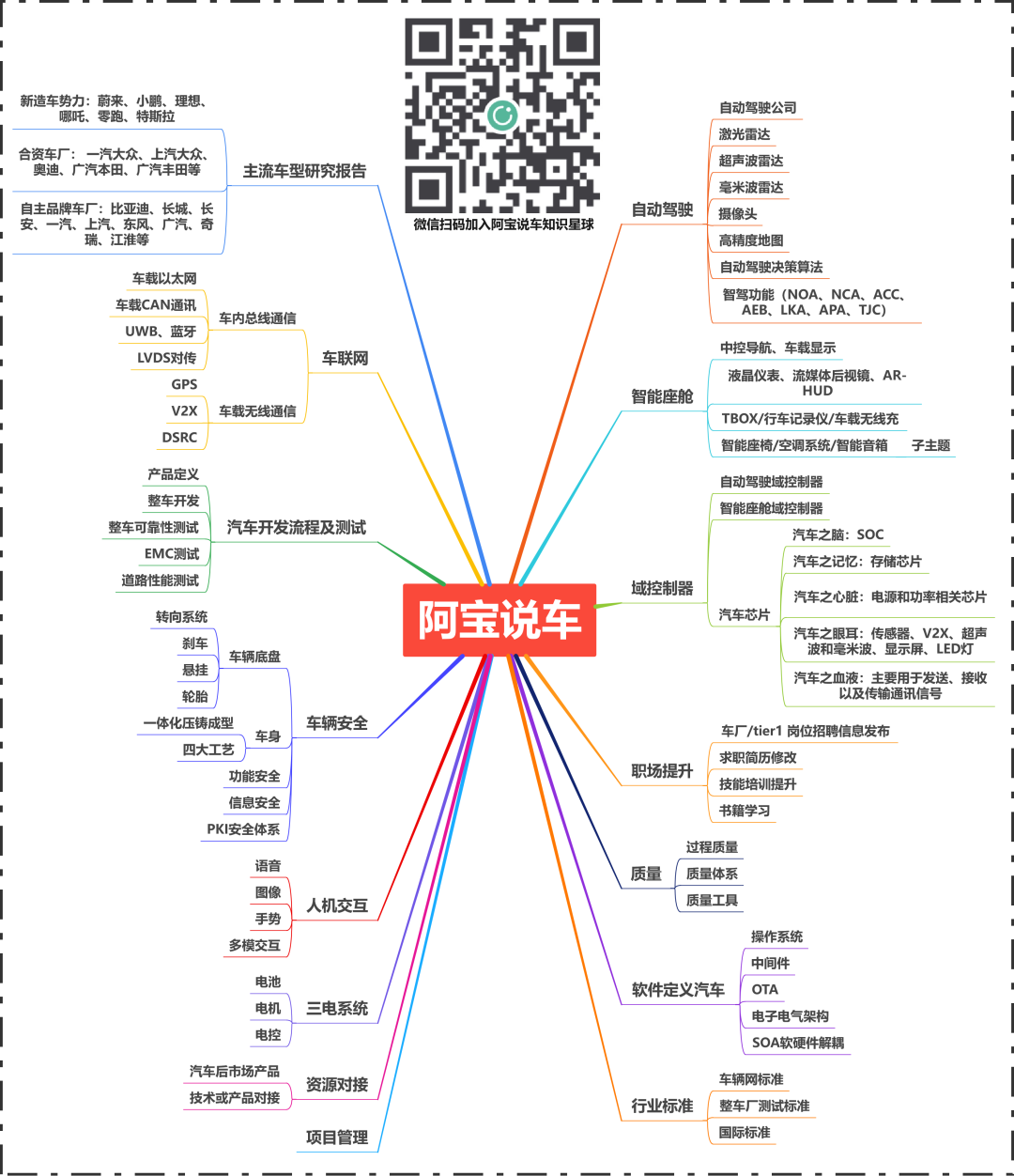
Join “Abao Talks Cars” Knowledge Sphere to obtain related learning materials for these modules (currently including research reports, online expert sharing, and offline closed-door meetings), covering 16 major sections, detailed list as follows: