The mobile processor is akin to the human brain; it is responsible for processing and computing all data within the phone, making it the most critical chip determining the phone’s performance. The speed of program execution, smoothness, photography, battery life, and network standards of a smartphone are all fundamentally determined by the mobile processor.
2016 was a significant year for mobile processors, with a large number of top-tier processors entering mass production for commercial use. Mid-range and even entry-level processors have also surpassed the basic performance thresholds required by average users. The leap in processor technology is a result of the accumulated technical prowess of chip manufacturers and the increasingly upgraded demands of consumers. So, how do the numerous mobile processors that became commercially available in 2016 rank in terms of overall performance? We have compiled a ranking based on multi-threading capabilities, single-threading capabilities, graphics processing capabilities, power consumption levels, as well as ISP and baseband capabilities, to assist consumers in choosing their smartphones.
Qualcomm Quad-Core MSM8996 (Snapdragon 820)
This is the most powerful mobile CPU of 2016, excelling in both computational and graphics processing capabilities, supporting all network standards. This processor’s performance is outstanding, whether running large 3D games or handling multiple applications, it stands at the industry’s highest level, and it also supports network processing and photography functions that few competitors can match.
Performance Index: 98 points
Multi-threading Capability: ★★★★★
Single-thread Performance: ★★★★★
Graphics Capability: ★★★★★
Power Consumption Control: ★★★☆☆
Qualcomm’s 2015 Snapdragon 810 faced controversy due to its power consumption and heating issues. The Snapdragon 820 chip adopts Qualcomm’s self-designed Kryo architecture with a 4-core design. This Kryo architecture is based on the ARMv8 instruction set, supports 64-bit operations, and can reach a maximum frequency of 3GHz. While there is still a gap in single-thread processing capability compared to Apple, the difference has significantly narrowed. Importantly, the Snapdragon 820 integrates the latest Adreno 530 GPU, supporting virtual display technology, showcasing its powerful processing performance. Additionally, the Snapdragon 820 will switch from TSMC’s 16nm process to Samsung’s 14nm process, effectively addressing heating issues. GeekBench scores: single-thread 2400, multi-thread 5500.
Samsung Octa-Core Exynos 8890
While the Qualcomm 820 is the strongest in performance, the Samsung 8890 is not far behind in overall performance. Although its graphics processing performance is slightly weaker than the 820, it has better power consumption control. The downside is that it does not support all network standards.
Performance Index: 95 points
Multi-threading Capability: ★★★★★
Single-thread Performance: ★★★★★
Graphics Capability: ★★★★☆
Power Consumption Control: ★★★★☆
The process has been upgraded from FinFET LPE to LPP, achieving lower leakage rates, and the core frequency can be further increased. Architecturally, the 8890 features 4 Mongoose cores and 4 A53 cores (a total of 8-core design), with the first 4 self-developed Mongoose cores reaching a frequency of 2.3GHz (overclockable to 2.5GHz) for performance enhancement, while the latter 4 A53 cores operate at 1.56GHz (overclockable to 2.2GHz) for power efficiency. The GPU is a Mali T880 with a 12-core design. GeekBench scores: single-thread 2200, multi-thread 6500.
HiSilicon Kirin 950
The HiSilicon Kirin 950 is a pride of domestic processors. Although its overall performance still lags slightly behind Qualcomm and Samsung, its excellent power consumption performance surpasses both. The downside is its weaker image processing capabilities. While current mainstream games do not require high configurations and run smoothly, the future remains uncertain.
Performance Index: 92 points
Multi-threading Capability: ★★★★☆
Single-thread Performance: ★★★★☆
Graphics Capability: ★★★☆☆
Power Consumption Control: ★★★★★
The Kirin 950 features four Cortex-A53 cores and four Cortex-A72 cores, with a maximum frequency of 2.3GHz. Its GPU is the ARM Mali T880, and it supports dual-channel LPDDR4 memory, UFS 2.0, and eMMC 5.1. Additionally, this processor is equipped with an i5 co-processor, providing a Tensilica Hi-Fi 4 independent audio DSP, and supports dual SIM LTE Cat 6, USB 3.0, Bluetooth 4.2, etc. Its single-core performance score is 1909, while the multi-thread score is 6096, surpassing the 810 processor and Exynos 7420.
Qualcomm Snapdragon Octa-Core MSM8976 (Snapdragon 652)
If the MSM8996 is the strongest CPU, then the MSM8976 is the most balanced processor. Although it belongs to the 6 series, it surpasses the previous flagship 810 in performance, while also excelling in power consumption control and supporting all network standards. Whether for gaming or high-definition movies, the MSM8976 performs at a flagship level.
Performance Index: 90 points
Multi-threading Capability: ★★★★☆
Single-thread Performance: ★★★★☆
Graphics Capability: ★★★★☆
Power Consumption Control: ★★★★☆
The Qualcomm Snapdragon MSM8976 is also positioned as a flagship series, with overall performance not to be underestimated. The MSM8976 uses a 28nm process, featuring a design of 4 A72 and 4 A53 cores. This processor shares many functions with the Qualcomm Snapdragon 820, including the Adreno 510 GPU and X8 LTE modem. In benchmark tests, the MSM8976 processor shows a performance gap not far from the previous flagship Snapdragon 810, but it does not suffer from the same severe power consumption and heating issues as the Snapdragon 810. Among mid-range processors, the MSM8976 is indeed impressive. GeekBench scores: single-thread 1450, multi-thread 5800.
MediaTek Helio MT6797 (Helio X20)
The X20 is MediaTek’s latest flagship processor, featuring a 10-core tri-cluster architecture, theoretically offering strong performance. However, it unfortunately suffers from the same heating issues seen in the Qualcomm 810, which has left its commercial prospects uncertain.
Performance Index: 88 points
Multi-threading Capability: ★★★★☆
Single-thread Performance: ★★★★★
Graphics Capability: ★★★☆☆
Power Consumption Control: ★★★☆☆
In early 2015, MediaTek launched the high-end Helio X10 chip to enter the high-end market, but due to strategic missteps, it had to use this chip in mid-range models from domestic manufacturers. As a product aimed at re-entering the high-end processor market, the Helio X20 MT6797 is the world’s first 10-core processor. The X20 is manufactured using TSMC’s 20nm HPM process, integrating two 2.5GHz Cortex-A72 cores, four 2.0GHz Cortex-A53 cores, and four 1.4GHz Cortex-A53 cores, while also incorporating a Mali-T880 MP4 700MHz GPU. However, its weak multi-thread performance raises concerns about the X20’s future. GeekBench scores: single-thread 1559, multi-thread 5201.
Qualcomm Snapdragon MSM8994 (Snapdragon 810)
The Snapdragon 810 is a somewhat awkward product; despite its powerful performance, it is plagued by severe heating issues, leading to throttling and an overall unsatisfactory experience.
Performance Index: 85 points
Multi-threading Capability: ★★★★☆
Single-thread Performance: ★★★★☆
Graphics Capability: ★★★★☆
Power Consumption Control: ★★☆☆☆
The Snapdragon 810 features four A57 and four A53 cores, forming an octa-core design interconnected via the CCI-400 bus, with frequencies of 1958MHz and 1555MHz, respectively, and a 2MB L2 cache. The GPU is the new generation Adreno 430, which offers a 30% performance improvement over the Adreno 420 in the Snapdragon 805, supporting OpenGL ES 3.1/AEP. Memory is dual-channel 32-bit LPDDR4-1555, with a bandwidth of 24.88GB/s. It also supports all network standards, performing well in signal quality. However, in terms of heating, it has been rated by the public as “the hottest mobile processor in history,” so despite its powerful performance, it can only be used at reduced frequencies, leading to significant waste, ultimately resulting in overall performance that is inferior to the subsequently released 652 processor.
Qualcomm Snapdragon MSM8992 (Snapdragon 808)
The Snapdragon 808 is a simplified version of the 810, offering better power consumption performance, but still showing significant gaps compared to current sensors.
Performance Index: 80 points
Multi-threading Capability: ★★★☆☆
Single-thread Performance: ★★★★☆
Graphics Capability: ★★★★☆
Power Consumption Control: ★★★☆☆
The Qualcomm Snapdragon 808 processor is a hexa-core processor, lacking two A57 cores compared to the octa-core Snapdragon 810. It is equipped with the Adreno 418 GPU, integrating the Qualcomm Snapdragon X10 LTE modem, supporting all network standards, and Cat 9, with a maximum speed of 450Mbps, which is considered high-end. It also supports VIVE dual-stream 802.11n/ac with MU-MIMO, encompassing many of Qualcomm’s top technologies. Although its performance is lower than the 810, the 808 manages to control heating to a certain extent, resulting in better overall performance.
MediaTek Helio MT6795 (Helio X10)
The X10 is an older generation processor, and its processing and graphics capabilities cannot compare with this year’s products. However, its overall performance is still decent, making it a good choice for entry-level smartphones. Nevertheless, it struggles with large games and high-definition videos.
Performance Index: 80 points
Multi-threading Capability: ★★★☆☆
Single-thread Performance: ★★★★☆
Graphics Capability: ★★★☆☆
Power Consumption Control: ★★★★☆
The MediaTek MT6795 is built on a 28nm process, featuring 8 Cortex-A53 cores, and the GPU is the Power VR G6200 from the MT6595, also supporting LPDDR3 memory. Its performance is slightly better than the Snapdragon 808, and it performs better in terms of heating control, but unfortunately, the X10’s signal performance is inferior to the 808, and it does not support all network standards, ultimately leading to a lower overall experience compared to the 808.
MediaTek Helio MT6755 (Helio P10)
The P10 is a simplified version of the X10 with all network support, but its performance is not strong, placing it at the entry-level, sufficient for daily use of common apps like WeChat and QQ, but gaming can be quite demanding.
Performance Index: 65 points
Multi-threading Capability: ★★★☆☆
Single-thread Performance: ★★☆☆☆
Graphics Capability: ★☆☆☆☆
Power Consumption Control: ★★★☆☆
The MediaTek Helio P10 features eight Cortex-A53 cores, with a maximum frequency of 2GHz. The biggest highlight of the Helio P10 chip is its excellent battery life, even outperforming the currently popular Helio X10, and it supports all network standards and LTE Cat6 technology. This processor is positioned as mid-range, and it is expected to be a significant tool for popularizing all-network support in low-end smartphones. However, the P10’s GPU is the Mali T860 MP2, which offers only average performance, often experiencing frame drops in certain games. GeekBench scores: single-thread 882, multi-thread 3371.
Qualcomm Snapdragon MSM8952 (Snapdragon 615)
The Snapdragon 615 is Qualcomm’s failed product, disappointing in both power consumption and performance, leading to its rapid clearance and discontinuation.
Performance Index: 65 points
Multi-threading Capability: ★★★☆☆
Single-thread Performance: ★★☆☆☆
Graphics Capability: ★★☆☆☆
Power Consumption Control: ★★☆☆☆
The Snapdragon 615 features an octa-core Cortex-A53 architecture, with the “big core” part having four cores with a maximum frequency of 1.7GHz, and the “small core” part having four cores with a maximum frequency of 1.2GHz, supporting LPDDR3-933MHz memory and eMMC 5.1 specifications. The GPU is still the Adreno 405, supporting a maximum resolution display of 1920×1200 and a 21-megapixel camera. Additionally, it supports Bluetooth 4.1, 802.11ac, and other standards. However, in terms of overall performance, it is truly disappointing, landing at the bottom of the rankings.
Through the above introduction, everyone should have a better understanding of these processors. In terms of overall performance, the Snapdragon MSM8996, Samsung Exynos 8890, Helio X20, and Snapdragon MSM8976 all exhibit high-end processor performance and impressive power consumption control, which is truly surprising. As for the entry-level Helio P10 and X10, due to their positioning, they will likely become more common in budget smartphones, offering high cost-performance ratios and meeting consumer needs in terms of processing performance and power consumption levels.
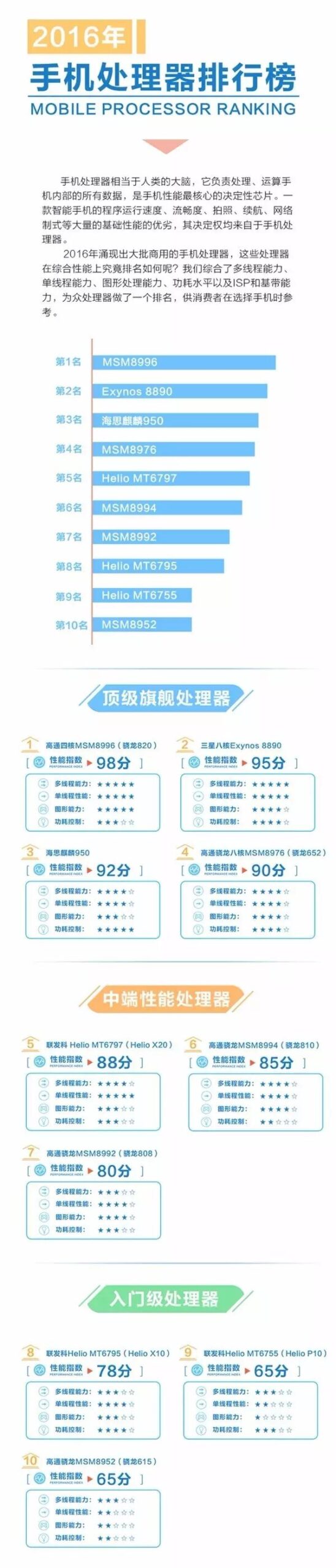
If you find this information insufficient, we have also prepared a performance ladder chart for mobile processors for your reference.
(This content is sourced from the internet; copyright belongs to the original author)