This article provides a comprehensive comparative analysis of AI agent development frameworks such as LangGraph, AutoGen, Dify, Coze, MetaGPT, and OpenAI Agents from various dimensions including core positioning, technical features, typical scenarios, cost models, and community support, to offer usage references.
1. Core Framework Comparison Matrix
|
Framework |
Core Positioning |
Technical Features |
Typical Scenarios |
Cost Model |
Community Support |
Official Website |
Project Address |
|---|---|---|---|---|---|---|---|
|
LangGraph |
General-purpose complex application development framework |
Modular toolchain (prompt engineering, memory management, chain structure), supports multiple LLMs (OpenAI/Hugging Face), LangGraph multi-agent orchestration |
Intelligent research assistant, contextual dialogue bot, complex task automation (code generation / data analysis) |
API call costs (OpenAI, etc.) + computational resource consumption |
Active global developer community, comprehensive documentation |
https://langchain-ai.github.io/langgraph/ |
https://github.com/langchain-ai/langgraph |
|
AutoGen |
Multi-agent collaboration system construction platform |
Asynchronous dialogue mechanism based on Actor model, dynamic task decomposition, code execution sandbox, deep integration with Microsoft ecosystem |
Enterprise-level workflow automation (financial risk control / medical diagnosis), cross-system collaboration (CRM + ERP + database) |
Computational resource costs (LLM calls) + cloud service fees (Azure optional) |
Official Microsoft support, active community contributions |
https://microsoft.github.io/autogen/ |
https://github.com/microsoft/autogen |
|
Dify |
Low-code enterprise-level agent platform |
Visual workflow design, RAG engine optimization, private deployment support, compatibility with domestic models (DeepSeek / Tongyi Qianwen) |
Enterprise knowledge base Q&A, customized customer service bots, cross-platform automation (WeChat / Feishu integration) |
Open source free + cloud service billed by usage (domestic cost advantage) |
Active open-source community, comprehensive Chinese documentation |
https://dify.ai/ |
https://github.com/langgenius/dify |
|
Coze |
Low-code rapid deployment platform |
Deep integration with Byte ecosystem (Douyin / Feishu), visual process design, supports multiple models (Doubao / GPT-4o) |
Simple chatbots, social media content management, automation for small and medium enterprises (customer service / marketing) |
Cloud service subscription (domestic version lower cost) + custom development fees |
ByteDance technical support, suitable for rapid domestic deployment |
https://coze.com/ |
https://github.com/coze-dev/coze-studio |
|
MetaGPT |
Multi-agent collaborative development framework |
Role-based dynamic task allocation (product manager / architect / engineer), supports multiple models, simulates human team collaboration |
Complex organizational modeling (e.g., full software development process), debate simulation, multi-role collaboration scenarios (e.g., supply chain collaboration) |
Open source free + model API call costs |
High community activity, supports multi-language model integration |
https://www.deepwisdom.ai/ |
https://github.com/FoundationAgents/MetaGPT |
|
OpenAI Agents |
Enterprise-level AI native application development framework |
Deep integration with GPT-4o/5 models, low-code workflow design, supports toolchain expansion (search / API calls), enterprise-level security (permission control / audit logs) |
Intelligent customer service (integrated with CRM), data analysis assistant (SQL + Power BI), knowledge management (permission-aware RAG system) |
Cloud service billed by usage (e.g., $12 / thousand queries), relatively high cost |
Official OpenAI technical support, comprehensive documentation |
https://openai.com/agents |
https://github.com/openai/openai-agents-python |
|
Google ADK |
Cloud-native multimodal agent development kit |
Deep integration with Gemini 2.0 multimodal model, Vertex AI managed service, visual debugging tools |
Enterprise-level multimodal interaction (video analysis / real-time translation), production-level deployment (high concurrency / elastic scaling) |
Cloud service billed by usage (e.g., $12 / thousand queries), relatively high cost |
Google technical support, suitable for existing GCP users |
https://github.com/google/adk-python |
Internal tools of Google Cloud Platform |
|
CrewAI |
Role-based multi-agent collaboration framework |
Role-based dynamic task allocation, simulates human team collaboration, supports custom agent behavior patterns |
Complex organizational modeling (project management / supply chain collaboration), collaborative simulation training (emergency response / educational scenarios) |
Open source free + enterprise custom service fees |
Moderate community activity, provides Python SDK |
https://www.crewai.com/ |
https://github.com/crewAIInc/crewAI |
|
Agno |
Multi-agent collaborative development framework |
Role-based dynamic task allocation, supports custom agent behavior patterns, simulates human team collaboration, supports multiple models (LLaMA/Flan-T5) |
Complex organizational modeling (project management / supply chain collaboration), collaborative simulation training (emergency response / educational scenarios) |
Open source free + model API call costs |
Moderate community activity, provides Python SDK |
https://www.agno.com/ |
https://github.com/agno-agi/agno |
2. Selection Recommendations
1. Complex Process Management:
LangGraph: Suitable for enterprise scenarios requiring state persistence, human intervention, and audit tracking (e.g., healthcare, finance).
Dify: Low-code threshold with enterprise-level security certification, suitable for rapid implementation of business processes and knowledge hubs.
2. Multi-agent Collaboration:
AutoGen:Distributed deployment and conversational programming, suitable for cross-department collaboration and distributed applications.
MetaGPT:Simulates team division of labor and SOP processes, suitable for software development and vertical task automation.
3. Rapid Prototyping:
Dify/Coze:Visual process building and plugin ecosystem, suitable for non-technical personnel to build lightweight AI tools.
OpenAI Agents:Minimal integration relying on OpenAI API, suitable for validating tool invocation scenarios.
4. Enterprise-level Compliance Requirements:
Dify:ISO 27001 certification and private deployment, meeting data security requirements in industries such as finance and healthcare.
OpenAI Agents:Five-layer security protection and compliance audit, suitable for decision-making scenarios involving sensitive data.
5. Cost-sensitive Projects:
LangGraph/AutoGen/MetaGPT:Open-source frameworks reduce initial investment, suitable for technical teams to develop independently.
Dify/Coze:Free version and pay-as-you-go model, suitable for enterprises to quickly build PoC prototypes with low-cost trial and error.
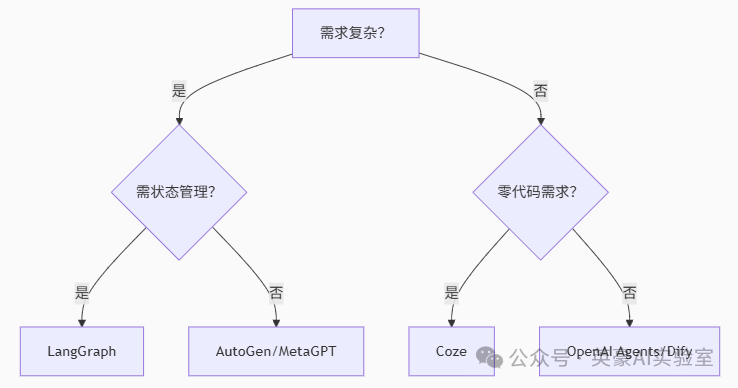
Conclusion
Technical Depth: LangGraph, AutoGen, and MetaGPT excel in complex logic and multi-agent collaboration, suitable for deep customization by technical teams.
Implementation Speed: Dify and Coze significantly shorten development cycles through low-code/no-code capabilities, suitable for business-driven projects.
Ecological Dependence: OpenAI Agents highly depend on OpenAI API, suitable for enterprises pursuing stability and security compliance; other frameworks offer more autonomous options.
Long-term Costs: Private deployment (Dify, LangGraph) is suitable for long-term business; SaaS subscriptions (Coze, OpenAI) are suitable for flexible expansion of short-term projects.
Enterprises should flexibly choose based on their technical reserves, business scenarios, and budget, and may adopt hybrid architectures (e.g., Dify + MetaGPT) to meet complex needs.
– End –
Previous Recommendations
Comprehensive Diagram of AI Large Model ApplicationsBuilding RAG Knowledge Base Based on DifyBuilding Text2SQL Application Based on DifyExploration of MCP Applications in the Data Field Building Enterprise Knowledge Base Based on DeepSeek + RAGFlowDevelopment Practice of MCP Based on DeepSeekDeepSeek Basics: Detailed Explanation of PPO, DPO, GRPO ConceptsDeepSeek Basics: Detailed Explanation of MoE ConceptsDeepSeek Basics: Detailed Explanation of Model Distillation Concepts and TechniquesDeepSeek Basics: Detailed Explanation of Model Pre-training Concepts and TechniquesDeepSeek Basics: Detailed Explanation of Model Fine-tuning Concepts and TechniquesLarge Model Basics: Detailed Explanation of Model Quantization Concepts and TechniquesDetailed Explanation of Context Engineering in Large ModelsBasic Concepts and Core Principles of MCP ExplainedUnderstanding the Core Technologies Behind DeepSeek in One ArticleDeepSeek Core Technology Diagram Revealed