
Introduction
Gastric cancer remains a significant public health challenge globally, ranking fifth in incidence and mortality among all cancer types. In recent years, targeted therapy and immunotherapy have greatly improved survival for patients with gastric cancer/gastroesophageal junction cancer (GC/GEJC). However, there are few meaningful therapeutic targets in the field of gastric cancer, and the benefits of first-line and second-line treatments for HER2-negative patients remain limited.
CLDN18.2 is one of the emerging targets in gastric cancer, and monoclonal antibody therapies targeting this antigen have been approved. Additionally, antibody-drug conjugates (ADCs) are considered a promising direction for development. On July 16, Professor Shen Lin’s team from Peking University Cancer Hospital published a study in Nature Medicine, exploring the application of the anti-CLDN18.2 ADC IBI343 in the treatment of metastatic GC/GEJC in the third-line and later settings. The following is a summary of the research by Yimaitong.
Research Background
CLDN18.2 is a promising therapeutic target in gastrointestinal tumors, especially gastric cancer, expressed in approximately 80% of gastric cancers. The monoclonal antibody Zolbetuximab targeting this antigen has been approved in Japan, the United States, and China. Furthermore, various emerging therapeutic strategies, including bispecific antibodies, CAR T therapy, and ADCs, are actively being explored. IBI343 is an ADC with a payload of 4, and in this study, the researchers explored the efficacy and safety of IBI343 monotherapy in a Phase I trial.
Research Methods
This Phase I trial is a single-arm, multicenter, open-label clinical study, enrolling patients with CLDN18.2-positive GC/GEJC who have failed at least two lines of prior treatment. From October 26, 2022, to June 30, 2024, a total of 211 patients were enrolled across 32 centers in China and Australia, all receiving IBI343 monotherapy. The primary endpoints of the study were safety, tolerability, and the recommended Phase II dose (RP2D), while secondary endpoints included preliminary efficacy, including the objective response rate (ORR) assessed by investigators, disease control rate (DCR), duration of response (DOR), progression-free survival (PFS), and overall survival (OS).
Research Results
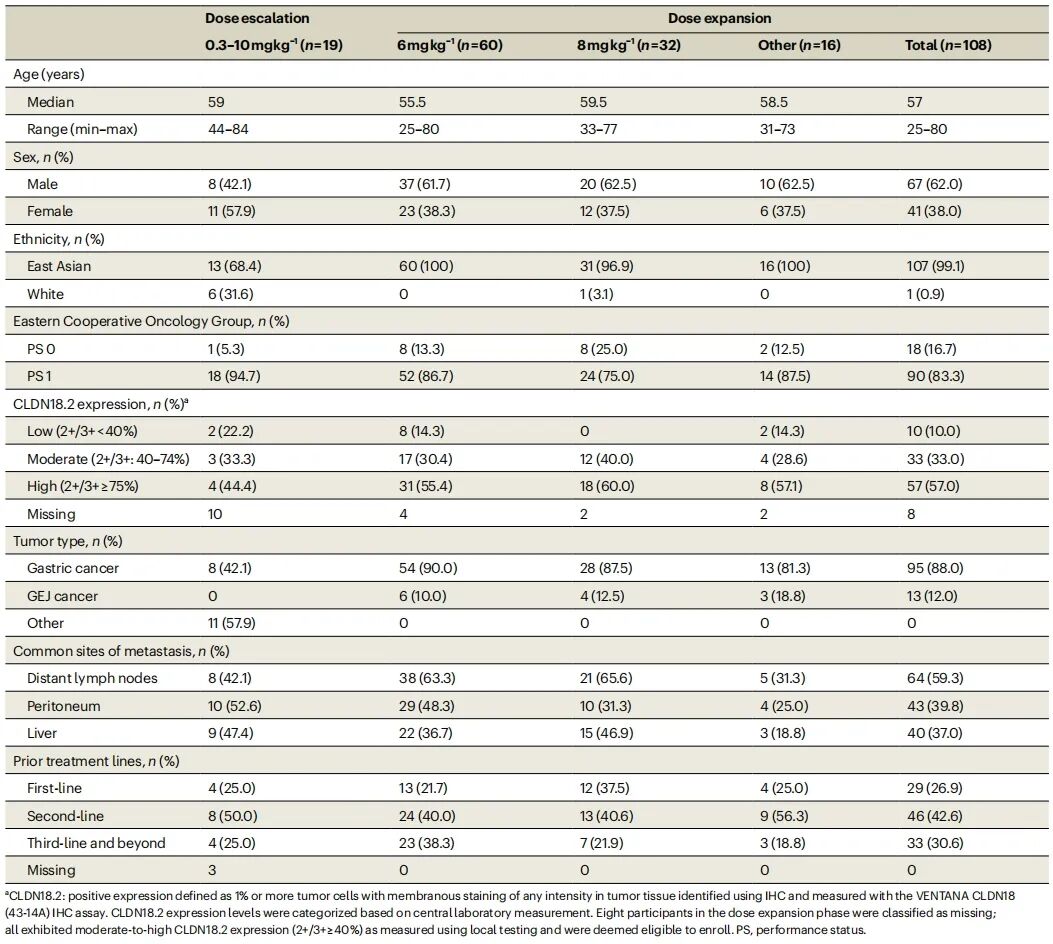
This analysis included 19 patients in the dose escalation phase and 108 patients in the dose expansion phase. In the dose escalation phase, the drug doses administered to patients included 0.3 mg/kg, 1 mg/kg, 3 mg/kg, 6 mg/kg, 8 mg/kg, and 10 mg/kg, every three weeks. In the dose expansion phase, patients received doses of 6 mg/kg (n=60), 8 mg/kg (n=32), and other doses (n=16). An assessment of CLDN18.2 expression in 100 of these patients showed that the proportions of high, medium, and low expressers were 57.0%, 33.0%, and 10.0%, respectively.
Table 1 Patient Baseline
Safety analysis showed that in the dose escalation phase, two patients in the 10 mg/kg dose group experienced dose-limiting toxicities (DLT), while no DLTs occurred in other dose groups. The maximum tolerated dose (MTD) of IBI343 was determined to be 8 mg/kg Q3W, and the RP2D was established at 6 mg/kg Q3W.
Among the 116 patients included in the safety analysis, the incidence of treatment-related adverse events (TRAE) of any grade was 92.2%, with ≥ grade 3 TRAE incidence at 52.6%. Seven patients experienced death, but all were considered unrelated to treatment.
Table 2 Safety Analysis
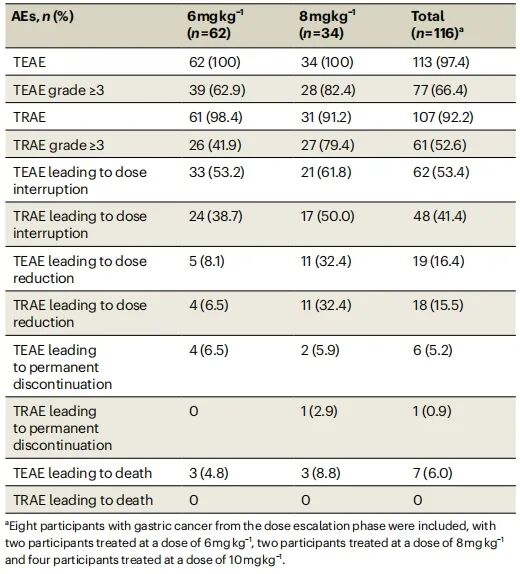
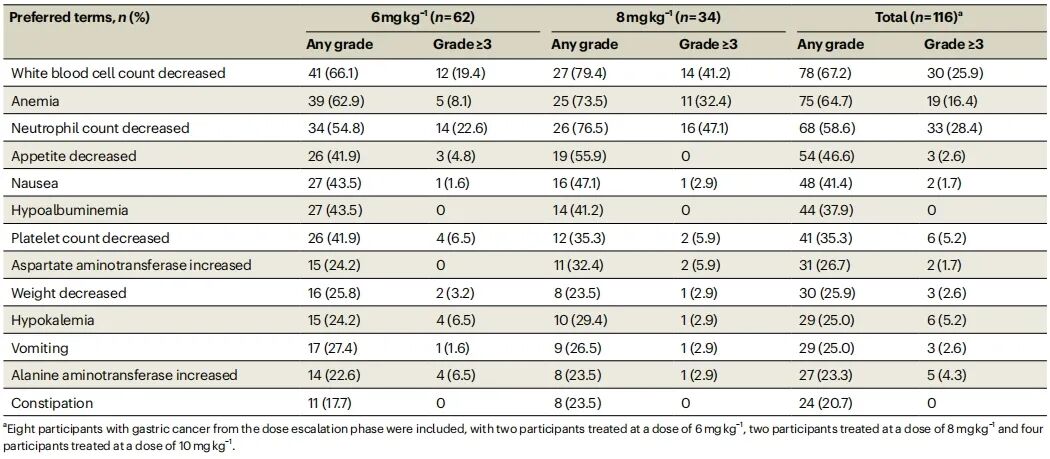
Table 3 Adverse Event Details
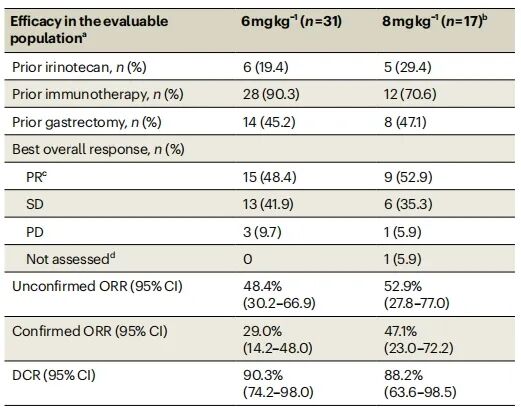
Efficacy analysis showed that for the 6 mg/kg dose group, the unconfirmed and confirmed ORR were 48.4% and 32.3%, respectively, with a DCR of 90.3% and a median DOR of 5.6 months. At a median follow-up time of 10.6 months, the median PFS was 5.5 months.
For the 17 patients with high CLDN18.2 expression in the 8 mg/kg dose group, the unconfirmed and confirmed ORR were 52.9% and 47.1%, respectively, with a DCR of 88.2% and a median DOR of 5.7 months. At a median follow-up time of 8.1 months, the median PFS was 6.8 months.
Table 4 Efficacy Analysis
 Research Conclusion
This study indicates that IBI343 monotherapy is well-tolerated and has controllable safety. For patients with high expression of CLDN18.2 in GC/GEJC, the efficacy of IBI343 in third-line and later treatment is promising. Based on the findings of this study, researchers are conducting a Phase III, multicenter, randomized, controlled study to evaluate the further application of IBI343 in combination with immunotherapy and other therapies.
References
Liu, J., Yang, J., Sun, Y. et al. CLDN18.2–targeting antibody–drug conjugate IBI343 in advanced gastric or gastroesophageal junction adenocarcinoma: a phase 1 trial. Nat Med (2025). https://doi.org/10.1038/s41591-025-03783-8
Written by: Babel
Typeset by: Babel
Executed by: Babel
Yimaitong is a professional online doctor platform, with the mission of “perceiving the pulse of world medicine and assisting clinical decision-making in China.” Yimaitong has a series of products including “Clinical Guidelines,” “Medication Reference,” “Medical Literature King,” “Medical Knowledge Source,” “e-Research Communication,” and “e-Medical Broadcasting,” which comprehensively meet the needs of medical professionals for clinical decision-making, acquiring new knowledge, and improving research efficiency.This platform aims to deliver more medical information to healthcare professionals. The content published on this platform should not be considered a substitute for professional medical guidance and should not be viewed as medical advice. The platform does not assume any responsibility for the use of such information for purposes other than understanding medical information. The platform does not endorse the descriptions and viewpoints of the published content. If there are copyright issues, please contact us, and we will address them promptly.