In the current era of deepening intelligence, industrial production places equal emphasis on quality and safety. As a key component ensuring production safety, industrial safety sensors not only need to meet high certification standards but also must monitor mechanical risks and personnel safety in real-time. Therefore, they often require independent deployment to form a reliable safety closed loop.
Currently, this field is mainly dominated by international companies such as Keyence, SICK, and Omron. Domestic sensors still lag behind in certification adaptation, standard participation, and application scenarios, facing significant barriers in expanding into overseas markets. Breakthroughs require a focus on three core areas: obtaining international compliance certifications to open up markets, actively participating in standard-setting to enhance influence, and building one-stop service capabilities for rapid implementation of solutions—this is not only key for domestic sensors to break the deadlock but also an important path for value reconstruction.
01
Periodic Adjustment in 2024
Expected to Return to Growth in 2025
According to the latest data report from MIR Rui Industrial, the market size of China’s industrial safety sensor market is expected to be over 3 billion RMB in 2024, a year-on-year decline of more than 5%.
Market Size and Forecast of China’s Industrial Safety Sensor Market from 2021 to 2027
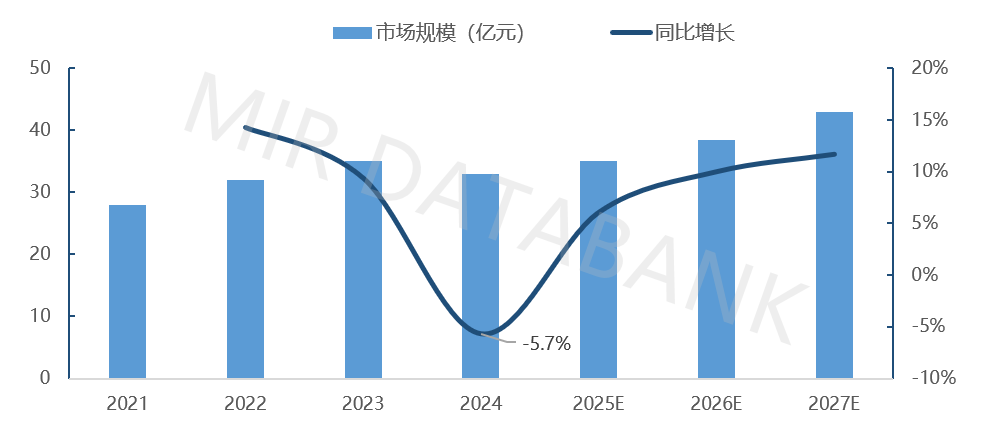
Data Source: MIR Rui Industrial Data Report. Industrial safety sensor products mainly include safety light curtains, safety door switches, 3D safety sensors, safety proximity switches, safety mats, safety encoders, safety laser scanners, etc., excluding instrumentation products. The market size includes product sales, safety services, integrated solutions, and other revenues.
The main reason for the market decline in 2024 is the periodic adjustment in downstream industries:the saturation of lithium battery production capacity and the entry into the destocking phase, while automotive manufacturers have reduced investments in automated production lines, both of which have suppressed the demand for safety sensors, and the market is gradually digesting the high base brought by the explosive expansion of photovoltaics and lithium batteries, returning to a normalized development track.
Looking ahead, the market is expected to recover in 2025:the automotive and metal processing demands are recovering, the safety standards in the 3C industry are improving, and the resumption of lithium battery production capacity expansion will jointly boost demand. Domestic automotive, lithium battery, and home appliance companies are accelerating overseas factory construction (with production line equipment still mainly sourced domestically), and the stringent certification requirements overseas will drive the demand for high-end safety sensors. From 2026 to 2027, the growth momentum will become more solid: the improvement of domestic manufacturing safety standards will drive the widespread adoption of safety sensors, and the intelligent upgrading of factories will generate demand for high-performance sensors, leading the market into a stable growth cycle.
02
Multidimensional Perspective on the Competitiveness of Industrial Safety Sensors:
The Key Value of Certification, Standards, and Services
Currently, the industrial safety sensor market faces significant challenges, as end users (such as automotive and semiconductor companies) find it difficult to clearly distinguish the actual technical gaps between domestic and international brands, as well as between domestic brands. The phenomenon of information asymmetry is prominent; at the same time, some domestic manufacturers are trapped in low-end price competition, lacking the key technologies and resource reserves needed to break into the mid-to-high-end market. This not only hinders the growth of the companies themselves but also restricts the upgrading pace of the entire industry, making it difficult for true technical strength to be fully recognized and incentivized by the market, further amplifying the urgent need for an objective evaluation system.
To address this, MIR Rui Industrial conducted a comprehensive strength assessment of Chinese industrial safety sensor manufacturers. The assessment system closely revolves around the core attributes of safety sensors: strong compliance, high reliability, and deep scene adaptation, and sets eight key dimensions based on the actual needs of the industry chain:certification and compliance, participation in standard-setting, market performance and customer base, solution capability, consulting and training service capability, expert team strength, product strength, and technical research and development capability. Through the quantitative assessment of these dimensions, the aim is to select enterprises that truly possess high-end market competitiveness, provide reliable procurement decision-making basis for end customers, and guide domestic manufacturers in clarifying their technical upgrade direction.
Among the many dimensions, certification and compliance, participation in standard-setting, and consulting and training service capabilities hold particularly important strategic significance.
Certification and Compliance as the “Pass” for Domestic Brands to Go Global
As domestic industries such as automotive, lithium battery, 3C, and home appliances accelerate overseas factory construction, their production line equipment is still mainly sourced domestically. International certifications such as CE, UL, and TÜV have become mandatory thresholds for equipment entering overseas markets. Strong certification capabilities are the foundation for domestic sensors to gain global market trust.
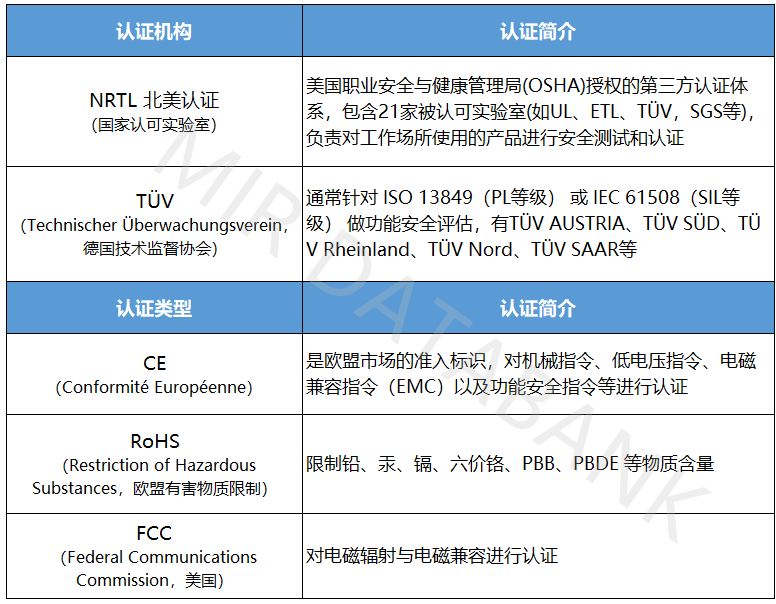
Information Source: MIR Rui Industrial Collection and Organization
Participation in Standard-Setting as the “Barometer” of Industry Influence
Actively participating in the formulation of national (such as GB/T 16855 mechanical safety) and even international IEC safety standards not only reflects the depth and foresight of the enterprise’s understanding of technical specifications but can also substantively influence the technological development path of the industry, avoiding low-level repeated investments by domestic manufacturers.
Consulting and Training Service Capability as the “Catalyst” for Scene Implementation
The effectiveness of industrial safety sensors highly depends on their deep integration with specific production line equipment and processes. A lack of professional risk assessment, solution design, and personnel training capabilities can easily lead to the problem of “parameters meeting standards but actual deployment failing.” Strong service capabilities are key to ensuring the effective implementation of safety solutions and enhancing customer stickiness.
Based on a multidimensional assessment and comprehensive consideration by MIR Rui Industrial, WONSOR ranks first among domestic industrial safety sensor manufacturers due to its comprehensive capability performance.WONSOR has not only built a comprehensive international certification system but also actively participated in national and international standard-setting, providing a full-stack service of “product + solution + safety consulting,” empowering customers to shift from passive compliance to proactive safety management. WONSOR is actively rewriting the market landscape dominated by international giants with its position as a “benchmark for domestic alternatives.” This result is not only a high recognition of WONSOR’s own strength but also sets a new benchmark for the entire industry.
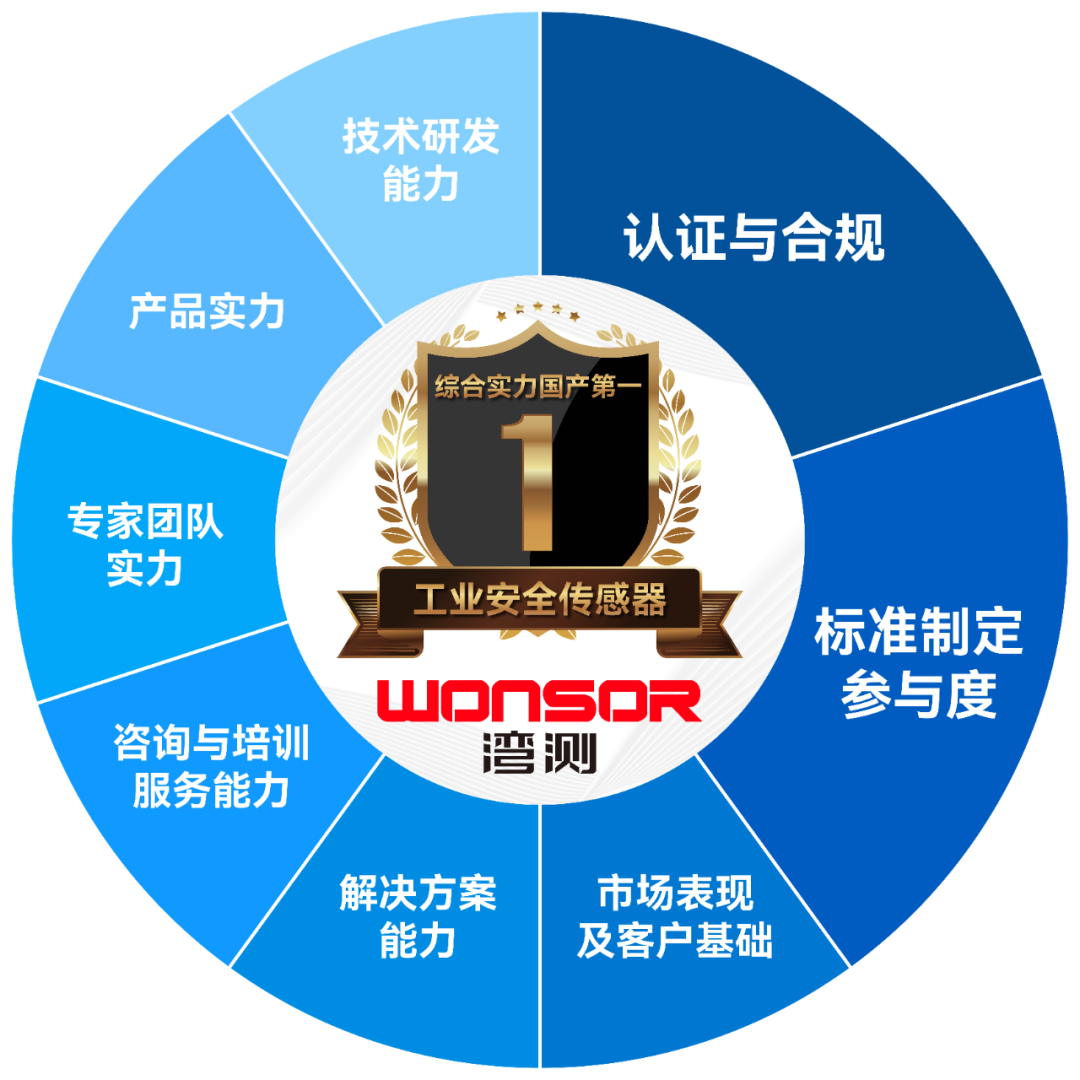
Information Source: MIR Rui Industrial
03
WONSOR’s Winning Strategy
WONSOR’s rise to the top of domestic industrial safety sensor manufacturers is no coincidence. Its core competitiveness is reflected in three key pillars:full-stack service capability, global compliance certification system, and industry standard influence, together forming its systematic advantage.
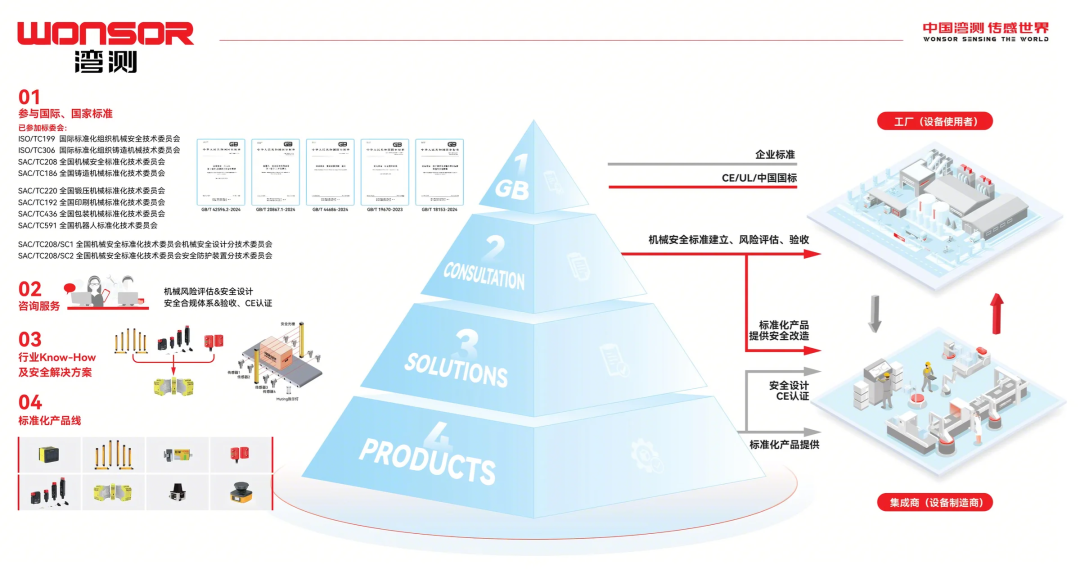
1) WONSOR is the only domestic brand providing “product + solution + safety consulting” in the industrial safety field
Full-stack service capability is WONSOR’s core advantage that distinguishes it from traditional manufacturers. Unlike the model of providing only single product replacements, WONSOR has pioneered and practiced a complete service system of “product + solution + safety consulting.”
-
At the product level, it covers a full range of industrial safety products including safety light curtains, safety door switches, and 3D safety sensors, meeting diverse scene protection needs.
-
At the solution level, WONSOR has launched the SCPCE safety solution, which can provide customers with full-process services from risk assessment, production line safety renovation design to certification support, as practiced in the equipment safety acceptance of Autoliv and the safety compliance renovation project of Bourns.
-
At the safety consulting and capability empowerment level, WONSOR has assembled a professional safety service expert team dedicated to providing customers with full lifecycle support covering international safety standard training, customized solution design, and final certification implementation, helping customers build their own safety capability system and promoting the shift from passive compliance to proactive safety management.
2) WONSOR has the most comprehensive international certification system among domestic brands
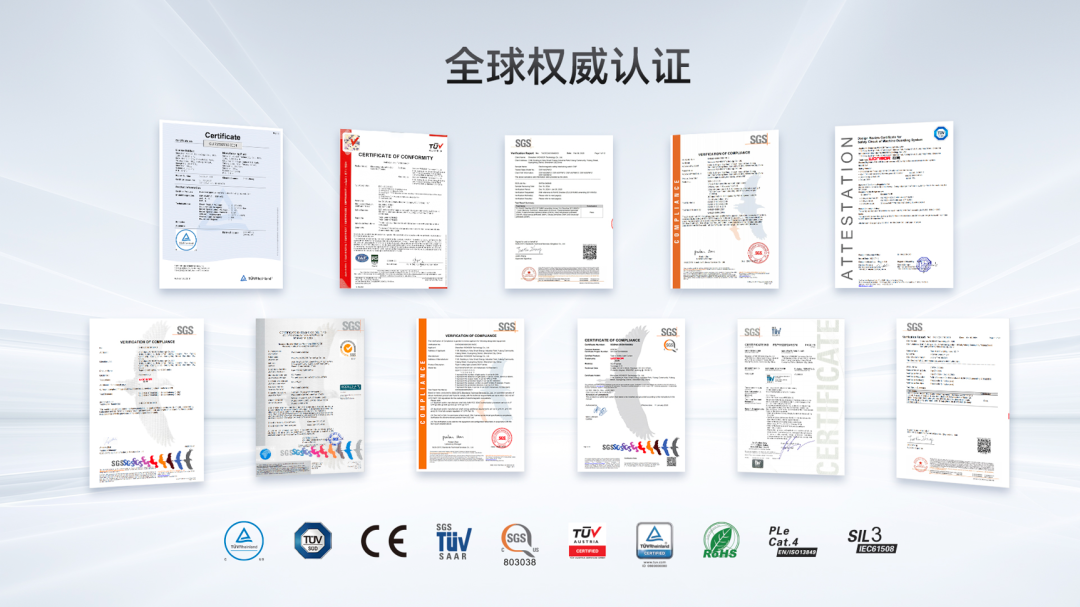
The global compliance certification system is the cornerstone for WONSOR to open up international markets and gain customer trust, and it is also an indispensable lifeline for industrial safety products. WONSOR has established the most comprehensive international certification matrix among domestic brands, with its safety light curtain products being the first domestic ones to pass the stringent UL safety standard certification in North America, while also holding TÜV, CE, SIL3, and other global mainstream certifications; its safety door switch products not only passed TÜV and CE certifications but also successfully obtained the highly demanding UL safety standard certification in North America, meeting the highest safety level standard of EN ISO 13849-1 (PL e)… These complete certification qualifications provide downstream equipment manufacturers with a “safety passport” to access global markets, significantly shortening the time for their equipment to enter international high-end markets (especially North America and Europe).
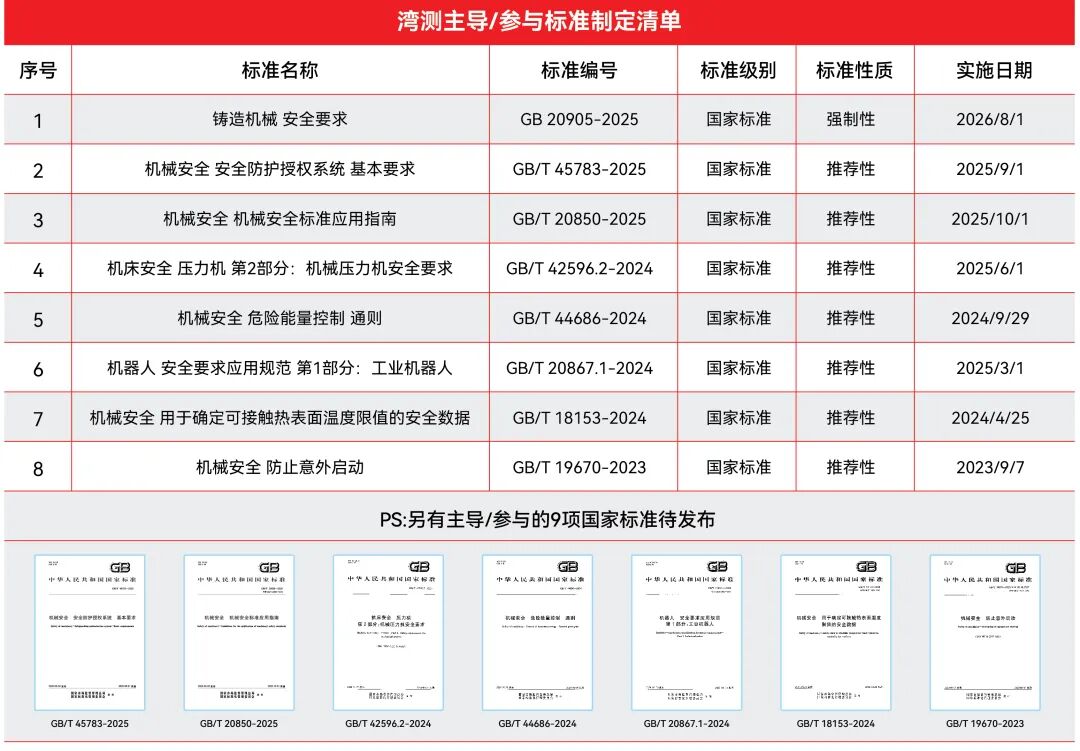
3) WONSOR leads/participates in the formulation of 17 national and international industrial safety-related standards
Industry standard influence highlights WONSOR’s technological foresight and industry impact. The company not only leads or deeply participates in the formulation of 17 national and international industrial safety-related standards (including GB/T 16855 mechanical safety standards and IEC international standards) but also represents China in the revision work of international standardization organizations (ISO/TC 199 mechanical safety, IEC/TC 44 electrical safety, etc.) as an ISO registered expert. By transforming its rich product development and application experience into industry technical specifications, WONSOR not only enhances its ability to predict technological development directions but also effectively promotes the overall technological level of the industry, guiding the development path of domestic technology and reducing low-level repeated R&D investments.
While continuously consolidating these three pillars, WONSOR is also actively laying out technology innovation and ecosystem building. The company insists on technological integration and innovation, such as launching the first domestic 3D safety sensor, which addresses the limitations of traditional two-dimensional detection. To enhance the overall safety awareness and application level of the industry, WONSOR has established the “WONSOR Academy” and formed strategic partnerships with authoritative organizations such as TÜV and the National Mechanical Safety Standardization Technical Committee to provide customers with professional safety standards and technical training courses. In addition, WONSOR has successfully implemented unique applications such as the PLd safety level person-goods separation solution in sub-sectors like automotive, new energy, and 3C electronics.
Final Thoughts
Breaking through the encirclement of foreign giants and leading the rise of domestic industrial safety sensors with the highest comprehensive strength, WONSOR’s growth trajectory reflects the enhancement of China’s high-end manufacturing industry’s independent innovation capabilities. Its core competitiveness of “full-stack service, global compliance, and standard leadership” not only provides domestic enterprises with safety guarantees that meet international standards and offer better cost performance but also becomes a “safety engine” to assist China’s high-end equipment in going global. In the context of accelerating industrial safety intelligence and globalization, WONSOR redefines the value of domestic sensors with systematic capabilities, providing new development paths for industrial upgrading.