For many tech enthusiasts, Apple’s autumn launch event is like a festival, and the aftermath of this event continues to dominate discussions. Besides the polarizing camera design, another major highlight is the Apple A13 processor.
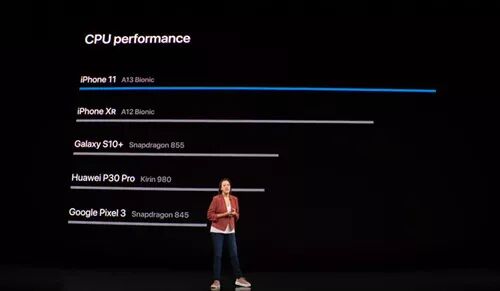
During the event, Apple unusually compared its device with the Huawei P30 Pro, but the focus was on how the previous generation A12 chip “crushed” the Huawei P30 Pro, leading to some humorous reactions online.
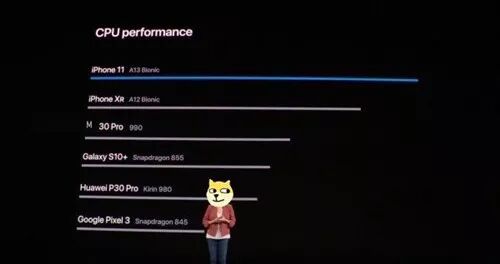
However, the reality is not so straightforward, as Huawei’s latest Kirin 990 chip has yet to be featured in a new device, and Apple can only compare with an “old device,” making the comparison somewhat unsatisfactory for both sides. Today, I will take you through the differences between the Apple A13 and the Kirin 990, aiming for a fair showdown.
What is Kirin 990?
First, let’s take a look at the Kirin 990, which comes in both 4G and 5G versions. The main difference lies in the integration of the 5G communication modem, with the 5G version supporting both standalone and non-standalone networking, leading the way globally. This is the biggest distinction between the two versions. Below are some details about the Kirin 990 (5G) for readers to consider (please skip to the next section if not interested):
In terms of manufacturing process, it uses a 7nm+ EUV process, with a board area 36% smaller than other industry solutions. It is the world’s first mobile terminal chip with over 10 billion transistors, reaching 10.3 billion transistors, an increase of 4.4 billion compared to the previous Kirin 980. For the CPU, the Kirin 990 5G features 2 large cores (based on Cortex-A76) + 2 medium cores (based on Cortex-A76) + 4 small cores (Cortex-A55), achieving 10% higher single-core performance and 9% higher multi-core performance compared to mainstream flagship chips. On the GPU side, the Kirin 990 5G is equipped with a 16-core Mali-G76 GPU, offering 6% higher graphics processing performance and 20% better energy efficiency compared to mainstream flagship chips. For the NPU, the Kirin 990 5G adopts Huawei’s self-developed Da Vinci architecture NPU, featuring a dual large core + micro core computing architecture, which can improve energy efficiency by up to 24 times in facial recognition applications.
Of course, one should not take all this information at face value; just like reading an article or listening to someone speak, it is essential to consider what is said and what is not said. Evaluating a chip should not rely solely on official promotional materials. I believe that assessing a mobile chip’s strengths and weaknesses generally involves four aspects: 1. Communication: For a mobile phone, the ability to make calls and access mobile networks anytime and anywhere is a primary factor; 2. CPU and GPU performance: Performance is the primary productivity factor, and this is non-negotiable; 3. Architecture: The chip architecture is the main factor determining the balance between mobile energy consumption and performance; 4. NPU: With the development of artificial intelligence, AI is no longer just a cloud-based issue; similar to how GPUs replaced some CPU functions in image processing, NPUs are set to become the next benchmark, which is why I include it here.
First, Communication: In terms of 5G communication, Huawei is undoubtedly leading the way, having both base stations and modems. The Kirin 990 features the Balong 5G modem, which is the world’s first, but there are two issues: first, global 5G commercialization is still immature; as a leading 5G country, China has only a few pilot cities, with only 26 cities being tested by the three major operators, and these cities are shared among the operators. Before buying a phone, one must confirm which operator is piloting in their city; for most second and third-tier cities, 5G is unnecessary. Secondly, due to the incomplete construction of 5G base stations, 5G phones experience significant heating issues. In previous tests, I found that when downloading over a 5G network, the phone’s temperature increased dramatically, making it noticeably hot to the touch, and the battery life of 5G phones can drop to 60%-70% of normal. Therefore, from these two aspects, 5G is currently not a great choice.
Second, Architecture: Many people overlook the importance of architecture, but it is crucial as it determines the balance between performance and power consumption in a mobile phone. Portability is essential; a phone that requires a power bank to carry around is a complete failure for consumers. This was also the main reason why Jobs abandoned the x86 architecture in favor of ARM architecture; while x86 offers strong performance, its high power consumption is unaffordable for many mobile manufacturers. The Kirin 990, like its predecessor, uses the Cortex-A76 architecture, while the A77 has already been released. Huawei stated that they did not use the A77 architecture because of its high power consumption, preferring to provide consumers with a phone that has better battery life rather than focusing solely on increasing speed at the expense of battery life. On the other hand, I believe that the Kirin 990, due to its integration of the 5G modem, will significantly increase power consumption, and combined with the high power consumption of the A77, it would be disastrous for Huawei phones, forcing them to choose the lower power consumption A76 architecture.
Third, Performance: In terms of performance, the Kirin 990 has slightly adjusted the previous Kirin 980’s design of 4 large cores and 4 small cores, adopting a design of 2 large cores (based on Cortex-A76) + 2 medium cores (based on Cortex-A76) + 4 small cores (Cortex-A55). The large core frequency is 2.86GHz, which is higher than the previous generation’s 2.6GHz, while the medium core is 2.38GHz, lower than the previous generation, and the small core frequency is 1.95GHz, higher than the previous generation’s 1.8GHz. Therefore, I speculate that the performance improvement of the 990 generation is not significant. According to data released at Huawei’s event, compared to the Qualcomm Snapdragon 855, single-core performance is improved by 10%, and multi-core performance is improved by 9%, with detailed tests to follow.
Fourth, NPU: The Kirin 970 was the world’s first mobile processor to feature an NPU, initially equipped with the Cambricon 1H intelligent processor, debuting in the Huawei Mate 20, and it delivered impressive performance in image and text processing. Two generations later, in the Kirin 990, Huawei switched to its self-developed Da Vinci architecture, and AI has always been a strong point for Huawei, with the Kirin 990 achieving a score of 476% on the AI Benchmark, showcasing its powerful AI capabilities.
AI Performance Enhancement is a Trend for Both
Many people believe that AI capabilities are a server-side issue and have no relation to terminals, but we all remember the impressive performance of the Huawei Mate 20 series. The Huawei Mate 20 Pro used the Kirin 970, which was the world’s first mobile chip with an NPU, and while this may seem unfair to Apple, it should be noted that Apple has had related AI capabilities for a long time, just under the name of the Neural Engine. Returning to the impressive performance of the Kirin series NPU, it first shines in imaging; since the 970, Huawei’s flagship phones have been able to achieve AI portrait color retention, real-time portrait recognition, and other features, allowing Huawei users to enjoy these black technologies.

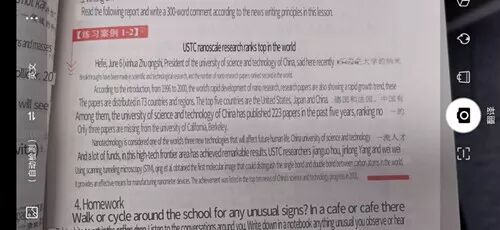
Additionally, in portrait recognition, features like intelligent night scene enhancement, low-light photography, and skin smoothing are all powered by the NPU. In text recognition, Huawei phones equipped with an NPU can instantly translate text into foreign languages while maintaining a similar font to the original text. Below is an example of a Chinese text translated using the Huawei P30 Pro.
Now, let’s talk about Apple. Since the A11, Apple has included a hardware component dedicated to machine learning in its A-series chips called the “Neural Engine,” which is essentially a processor package encapsulated together. This computing package, more technically referred to as SoC (System-on-a-Chip), includes many specialized functional units, such as the GPU we are most familiar with. The number of independent units in this package has been increasing, including ISP (Image Signal Processor), Modem (communication module), DSP (Digital Signal Processor), etc. Different data inputs are processed by different specialized computing modules, resulting in better performance and higher energy efficiency.
To some extent, Apple’s “Neural Engine” and Huawei’s NPU serve similar functions, but initially, Huawei’s use of the Cambricon NPU attracted more attention, while Apple has kept its components more proprietary and less publicized. The functions of the “Neural Engine” and NPU are roughly similar, significantly enhancing capabilities in imaging; Huawei’s NPU is more prominent in camera functions, while Apple’s is more focused on facial recognition. To date, Apple’s facial recognition feature is the most user-friendly, which is a testament to this. For instance, the “Face ID” feature on the iPhone X projects over 30,000 invisible infrared dots, then transmits the resulting infrared image and dot pattern to the neural network to create a mathematical model of the face, sending this data to a secure enclave to verify if the data matches. If a person’s appearance changes over time, it can adjust accordingly.
From the impressive performances of these two giants, it is clear that AI is becoming a significant trend for future smartphones and is gradually becoming an indispensable part of smart devices.
Additionally, it is worth noting that the area of a single GPU core in the A12 has decreased by 37% compared to the A11, indicating that the new 7nm process allows the A12 to shrink in size while adding an additional GPU core. The area of the neural network unit has increased by 3.16 times, resulting in a performance surge, making the A13 a powerful upgrade over the A12.
The Great Showdown Between Apple and Huawei
Now we arrive at the most critical part of this article: who comes out on top, the Apple A13 or the Kirin 990? Apple, which has always focused on user experience, has for the first time revealed benchmark scores during the event and compared them with competitors. Does this mean that the smartphone industry is entering the benchmark era, or has the traditionally proud Apple finally resorted to “benchmarking due to lack of innovation”?
During this event, Apple compared its performance with competitors, and the comparison chart shows that the iPhone 11 with the A13 chip significantly outperforms the Huawei P30 Pro with the Kirin 980. But how does it stack up against the Kirin 990?
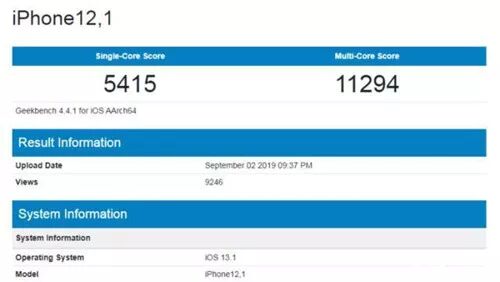
On the well-known CPU benchmarking site Geekbench, the iPhone 11’s benchmark scores have leaked, showing a single-core score of 5415 and a multi-core score of 11294, providing important reference for my comparison.
At the Kirin 990 launch event, the data presented was benchmarked against the Qualcomm Snapdragon 855: Compared to the Snapdragon 855, the Kirin 990 boasts 10% higher single-core performance, 9% higher multi-core performance, and 6% higher graphics processing performance. I found the scores on the authoritative benchmarking site Geekbenchmark: The Samsung S10+ has a single-core score of 4461 and a multi-core score of 10003, and based on Huawei’s announced performance improvements, the Kirin 990’s scores can be estimated as follows: Single-core 4907, multi-core 10901. By this rough comparison, the Kirin 990 falls short of the Apple A13, but the gap is not enormous.
From the above deductions, we can conclude:
1. The Apple A13 chip outperforms the Kirin 990;
2. The performance gap between the Apple A13 and Kirin 990 is not vast; the reality is not as the internet suggests, “Apple has performance, Huawei has the modem”; in terms of performance, the two are not significantly apart;
3. The Kirin 990’s use of the A76 architecture has limited impact on performance, and with the transition to a 5nm process, the next generation of Kirin chips has significant room for improvement.
It should be noted that the above comparisons do not possess rigorous scientific validity; there is a certain margin of error in the benchmarking conversions, and we can only arrive at a rough conclusion. Additionally, the same chip may perform differently across different devices, and a more accurate comparison will have to wait until the Huawei Mate 30 Pro is released.
— 【 THE END 】—
Check out our previous exciting articles:

| For just 10 yuan, I became a millionaire in my friend circle…

| The iPhone 11 series lacks 5G and innovation; Cook’s response is truly frustrating…